
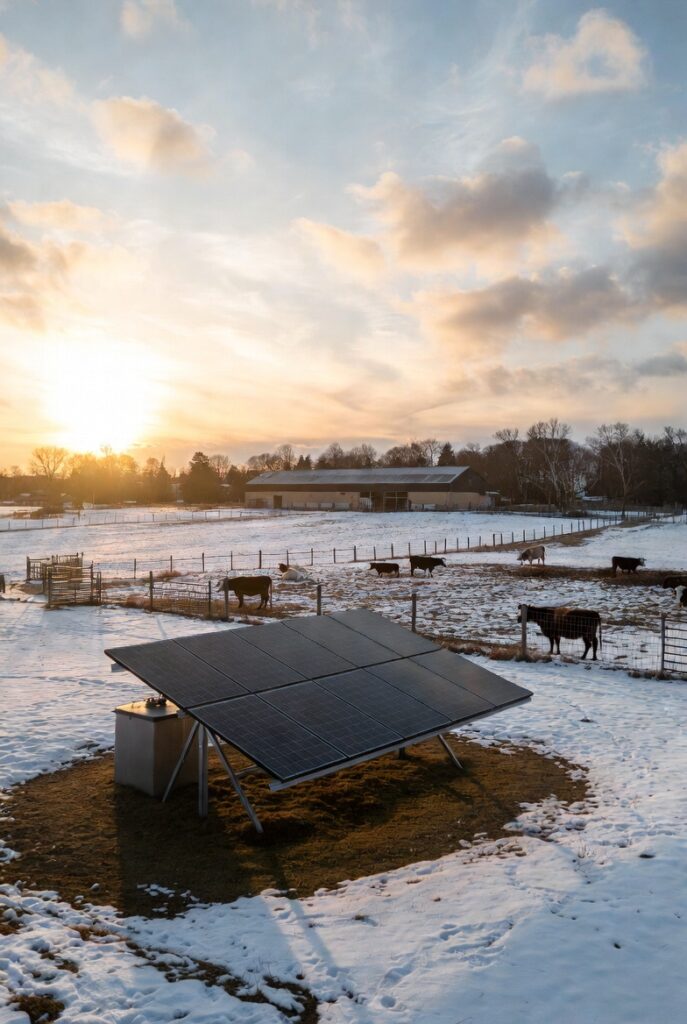
Farm solar power failures in a Wellington County January are not inconveniences. They are a 2 AM phone call from a farmer telling you 40 head of cattle have been without water for 8 hours and the temperature is minus 18°C. I was asked to review a solar-powered livestock watering system at a 160-acre beef cattle operation on the Eighth Line of Eramosa Township in Wellington County, Ontario near Rockwood. The system had been installed to supply water to a 5,000-litre insulated stock tank in a remote paddock 340 metres from the nearest power line. The installer had configured a direct-drive system: two 200W panels wired directly to a 24V DC submersible pump through a simple PWM controller and no battery storage. The logic had been that the pump only needed to run when the sun was shining and the tank would buffer the overnight demand.
The system worked adequately during the first 3 weeks with mostly clear weather. During the fourth week a 7-day grey-sky overcast period arrived with cloud cover producing only 8 to 14% of rated panel output. The panels were producing 22 to 39W from a 400W array. The pump required 180W minimum to break startup torque. For 7 consecutive days the pump attempted startup each morning, drew the panel voltage down to 8.4V under startup load, failed to develop sufficient torque, and stalled. Each stall event drew 4.2A through the pump motor windings at near-zero RPM for 3 to 8 seconds before the controller’s undervoltage protection cut the circuit. By day 4 the motor windings had developed resistance above specification from the repeated thermal stress of stall current without rotation cooling. On day 7 the motor failed completely. The 40-head herd had been without water for an estimated 31 hours at minus 18°C. Emergency water was trucked in at a cost of $640. The pump replacement cost $1,180.
I redesigned the system replacing the direct-drive configuration with a 24V 100Ah self-heating LFP battery bank, a Victron MPPT 100/50 charge controller with programmable load output and BatteryProtect, and the same pump reconnected to the battery bank rather than directly to the panels. The LFP bank stores energy during any production event regardless of whether it is sufficient for immediate pump startup, providing a buffer that delivers full startup torque from stored energy even during a 7-day grey-sky period. The BatteryProtect ensures the system shuts down cleanly at 23.5V rather than brown-starting the pump at insufficient voltage. In 2 subsequent winters including one with a 9-day overcast period in February the pump has not missed a single startup cycle and the cattle have had water every morning. The redesign cost $1,840. The $1,180 pump replacement and $640 emergency water delivery it prevents per grey-sky event justified the cost on the first winter. For the full system sizing hub that covers the load calculation foundation, the hub covers the numbers.
Why Farm Solar Power Burns Out a $1,180 Pump in a Grey-Sky Week
A direct-drive solar pump without battery storage fails during grey-sky periods because pump motors require 3 to 6 times their running current at startup to develop sufficient magnetic flux for rotor acceleration. A 180W pump motor requires 540 to 1,080W at startup for 2 to 4 seconds. A 400W array producing 39W during grey-sky conditions cannot supply 540W regardless of controller efficiency. Each failed startup attempt passes 4.2A stall current through the motor windings at near-zero RPM without the cooling effect of rotor rotation, raising winding temperature at 8 to 15°C per second of stall duration.
However, a 100Ah 24V LFP bank at 1C continuous discharge delivers 2,400W for the full startup duration without voltage sag, providing 4 to 13 times the startup current available from grey-sky panel output. The Victron MPPT 100/50 with BatteryProtect disconnects the load circuit within 90 milliseconds of detecting low voltage, preventing brown-start motor damage rather than the 200 to 800 millisecond relay response that allows continued stall current through the windings. For the construction site solar VFD soft-start and motor surge protection standard that covers the same motor burnout prevention principle for heavy induction motors, Article 221 covers the full specification.
| Power Architecture | Grey-Sky Startup Result | Motor Burnout Risk |
|---|---|---|
| Direct-drive panels to pump, no battery | Stall at 8.4V – 4.2A locked-rotor current for 3 to 8 seconds per attempt | High – accumulated winding damage over 7-day grey-sky period causes failure |
| 24V LFP battery buffer with BatteryProtect | Full 2,400W startup torque from stored energy on demand | None – Battery Protect disconnects in 90ms before brown-start threshold |
The Self-Heating LFP Bank and Cold-Start Reliability
A standard LFP bank at a Wellington County farm site in January can reach minus 18°C by 4 AM in an unheated pump house. At minus 18°C the standard LFP BMS locks out charging to prevent lithium plating and the pump cannot start because the battery cannot accept the morning solar production window. However, a Battle Born heated LFP module warms the cell electrodes from minus 18°C to 5°C within 8 to 15 minutes of the first morning solar input, consuming 2 to 4Wh per heating event and restoring full charge acceptance before the cattle arrive at the stock tank for the 7 AM morning drink.
The self-heating cycle energy cost represents less than 0.5% of the daily battery throughput at a Wellington County livestock watering station. As a result the cattle have access to water every morning regardless of overnight ambient temperature. For the helipad solar lighting Arctic-pack LFP self-heating standard that covers the same below-zero charge inhibit and self-heating protocol for unmanned agricultural installations, Article 230 covers the full specification.
The BatteryProtect and Grey-Sky Shutdown Logic
A pump motor subjected to brown-start conditions below minimum operating voltage develops accumulated winding insulation damage that is not visible on the pump’s external performance until catastrophic failure. The BatteryProtect’s 90-millisecond disconnect response limits the stall duration to less than 1.5°C of winding temperature rise per startup attempt, compared to 4 to 7.5°C per attempt with a 500-millisecond relay response. As a result a pump protected by a BatteryProtect can survive hundreds of grey-sky startup attempts over a winter season without winding damage accumulation.
The Victron SmartShunt logs the voltage profile of each startup attempt and transmits the data to the farmer’s phone via Bluetooth, providing a diagnostic record that shows how many brown-start risk events occurred during each grey-sky period. For the flood monitoring solar spillway gate actuator clean shutdown standard that covers the same undervoltage protection and clean disconnect principle for critical motor loads, Article 229 covers the full specification.
The Pump House Temperature Alert and Freeze Prevention
Farm solar power pump house failures from heater malfunction are the silent failure mode that the farmer never knows about until the pipes have been frozen for 12 hours and the pump house floor is a skating rink. I investigated a frozen pump house failure at a sheep operation on a 240-acre mixed farm on the 10th Concession of Arthur Township in Wellington County near Mount Forest, Ontario. The farmer was running a solar-powered pump house for a remote pasture watering system with a 200W panel, a 100Ah 12V LFP battery, and a 12V DC submersible pump. The pump house was an insulated plywood enclosure with a 40W propane catalytic heater maintaining the enclosure above 4°C.
On a January night where the ambient temperature dropped to minus 22°C the heater failed to reignite after cycling off. The pump house temperature fell from 6°C at 8 PM to minus 14°C by 4 AM. By 7 AM when the farmer arrived for morning chores the pressure line between the pump and the insulated pipe header had frozen solid in a 340mm section where the insulation had been damaged by rodents. The repair required 3 hours of heat gun work and $180 in replacement foam pipe insulation. The check valve in the pressure line had cracked from ice expansion and required replacement at $84.
I installed a Bluetooth temperature and humidity sensor inside the pump house and configured the Victron Cerbo GX at the farm’s main solar building to receive the sensor’s Bluetooth signal via a Ruuvi Gateway and trigger a VRM alert when the pump house temperature dropped below 3°C. The farmer’s phone receives the alert within 4 minutes of the pump house crossing the 3°C threshold. In the 18 months since the installation the alert has triggered twice, once from the propane running out at minus 19°C and once from the heater pilot tube freezing at minus 24°C. Both times the farmer was on-site within 35 minutes and the pump house temperature had not dropped below minus 2°C by the time the heater was restored. Neither event produced a frozen line. The sensor and gateway installation cost $180. The $264 pipe repair and 3-hour repair session it prevents per freeze event costs more than the sensor on the first failure. For the remote telecom solar Cerbo GX VRM temperature and SoC alert standard that covers the same remote pre-event alert principle for unmanned critical infrastructure, Article 232 covers the full specification.
The Farm Solar Power System: Minimum Viable vs Full Agriculture Standard
The decision follows whether the watering station is in a minus 35°C cold zone, whether the pump house has active heating, and whether 14-day grey-sky autonomy is required.
The minimum viable farm solar power system for a remote livestock watering station with a single submersible pump and 5,000-litre buffer tank includes a 200W panel, a 100Ah 24V self-heating LFP bank, a Victron MPPT 100/50 with BatteryProtect, and an insulated pump house with propane catalytic heater. Capital cost runs $2,400 to $3,600. It provides reliable cattle watering through a full Ontario winter including 7-day grey-sky periods without pump motor burnout or brown-start events.
The full agriculture standard for a remote pasture watering station with pump house temperature monitoring, remote farmer alerts, and 14-day autonomy reserve includes a 400W panel array, a 200Ah 24V self-heating LFP bank, Victron MPPT 100/50 with BatteryProtect, Bluetooth temperature sensor with VRM alert to the farmer’s phone, and an insulated pump house with redundant heating. Capital cost runs $4,800 to $7,200. It provides zero-failure livestock watering through a full Ontario winter with automated pump house temperature alerts before pipe freeze events.
NEC and CEC: What the Codes Say About Farm Solar Power
NEC 547 governs electrical installations in agricultural buildings and applies to any farm solar power installation including the solar array, battery bank, charge controller, and pump motor circuit in a farm building or pump house structure. The pump motor circuit is additionally subject to NEC 430 for motor circuit overcurrent protection, disconnecting means, and motor controller requirements. The solar array source circuits are subject to NEC 690 overcurrent protection and disconnecting means requirements. Contact the NFPA for current NEC 547, NEC 430, and NEC 690 requirements applicable to solar-powered agricultural watering installations in Ontario and across North America.
In Ontario, solar-powered agricultural pump installations are subject to CEC Section 64 for the PV source circuits and CEC Section 28 for motor circuits including the submersible pump motor. The pump house electrical installation is subject to the Ontario Electrical Safety Code and requires an ESA electrical permit if it includes any fixed wiring connection. Contact OMAFRA for the current AgriSolar and Ontario Rural Economic Development program eligibility and application requirements before commissioning any solar-powered agricultural watering system in Ontario. OMAFRA capital cost rebates of 25 to 40% of eligible system costs may apply to solar-powered livestock watering systems that replace generator-powered or trucked water supply at remote pasture locations.
Pro Tip: Before commissioning any direct-drive solar pump system at a remote livestock watering station, calculate the minimum irradiance required for pump startup torque and compare it to the worst-case grey-sky irradiance at your site latitude. I have reviewed farm solar power specifications where the installer sized the panel for the average daily production requirement and never checked whether the instantaneous startup torque demand could be met at minimum irradiance. The average daily production calculation always closes. The startup torque calculation at 10% irradiance never closes on a direct-drive system. Check the startup torque first. If the number does not close at 10% irradiance the pump needs a battery buffer. The cattle cannot wait for a clear day.
The Verdict
A farm solar power system built to the agriculture standard means the Eramosa Eighth Line cattle herd never goes 31 hours without water at minus 18°C because a 7-day grey-sky week stalled a direct-drive pump 4.2A at a time until the windings failed, and the Arthur Township Mount Forest sheep farmer never arrives at 7 AM to find a 340mm frozen pressure line and a cracked check valve because a $180 sensor triggered a phone alert 4 minutes after the pump house crossed 3°C.
- Replace every direct-drive panels-to-pump configuration with a 24V LFP battery buffer before the first grey-sky week of the season. The Eramosa pump burned out in 7 days because 39W from a grey-sky 400W array could not supply 540W of startup torque. A 24V 100Ah LFP bank delivers 2,400W on demand from stored energy. The redesign cost $1,840. The first prevention event — a $1,180 pump and $640 emergency water delivery paid for it in a single winter.
- Install a BatteryProtect between the battery and the pump motor before commissioning any battery-buffered livestock watering system. A relay-based protection circuit responding in 500 milliseconds allows 4 to 7.5°C of winding temperature rise per stall event. A BatteryProtect responding in 90 milliseconds allows less than 1.5°C. Over hundreds of winter startup attempts the difference is a pump that lasts 10 years versus one that fails in the second season.
- Install a Bluetooth temperature sensor in every pump house before the first frost. The Mount Forest pump house froze at minus 14°C while the farmer slept. A $180 sensor triggered an alert 4 minutes after the pump house crossed 3°C and the farmer was on-site in 35 minutes. Neither of the two subsequent heater failures produced a frozen line. The sensor costs less than one check valve replacement.
In the shop, we do not send a vehicle out without checking that the cooling system can handle the worst-case thermal load. At the farm, we do not commission a pump without checking that the power system can handle the worst-case grey-sky startup torque demand.
Frequently Asked Questions
Q: Why does a direct-drive solar pump burn out during a grey-sky week in Ontario? A: Without battery storage the pump relies entirely on instantaneous solar production for startup torque. Grey-sky conditions producing 8 to 14% of rated output cannot supply the 3 to 6 times running current required for motor startup. The pump stalls, drawing locked-rotor current through the windings without the cooling effect of rotor rotation, and each failed startup attempt accumulates thermal damage until the winding insulation fails. A 100Ah 24V LFP battery bank provides full startup torque from stored energy regardless of instantaneous solar production.
Q: What is the difference between a BatteryProtect disconnect and a standard low-voltage relay for pump protection? A: A BatteryProtect disconnects the load circuit within 90 milliseconds of detecting low voltage, limiting stall current duration to less than 1.5°C of winding temperature rise per startup attempt. A standard relay responds in 200 to 800 milliseconds, allowing 4 to 7.5°C of winding temperature rise per stall event. Over hundreds of grey-sky startup attempts in a winter season the accumulated thermal damage from relay-based protection causes winding failure. The BatteryProtect eliminates the accumulated damage entirely.
Q: How does a Bluetooth temperature sensor in a pump house prevent frozen pipes on a Wellington County farm? A: The sensor transmits temperature data to the Cerbo GX via Bluetooth every 10 seconds. When the pump house temperature crosses the 3°C alert threshold the VRM portal sends a phone notification to the farmer within 4 minutes. This provides a 30 to 90-minute intervention window before the temperature drops below the freezing point of the pressure line, sufficient time for the farmer to restore the heater before pipes freeze.
Questions? Drop them below.
Master Tech Advisory: This build is engineered within the 48V DC Safety Ceiling. Diagnostic logic is based on 20+ years of technical service experience. All structural and electrical installations must be verified by a Licensed Professional and comply with your Local Authority Having Jurisdiction (AHJ).
This post contains affiliate links. If you purchase through our links, we may earn a small commission at no extra cost to you.
About the Author
Robert Bertrand spent 20 years as a service advisor in the automotive industry (Lexus and Nissan), where precision diagnostics, wiring integrity, and documentation standards were non-negotiable. He brings that same technical discipline to GridFree Guide, where he researches, tests, and documents off-grid solar systems for Ontario conditions. Based in Rockwood, Ontario, every article is built on verified specifications, manufacturer data, and the real-world climate constraints of Canadian off-grid living.
As an Amazon Associate I earn from qualifying purchases. This site also contains affiliate links to other products and services. GridFree Guide earns a small commission at no extra cost to you.