
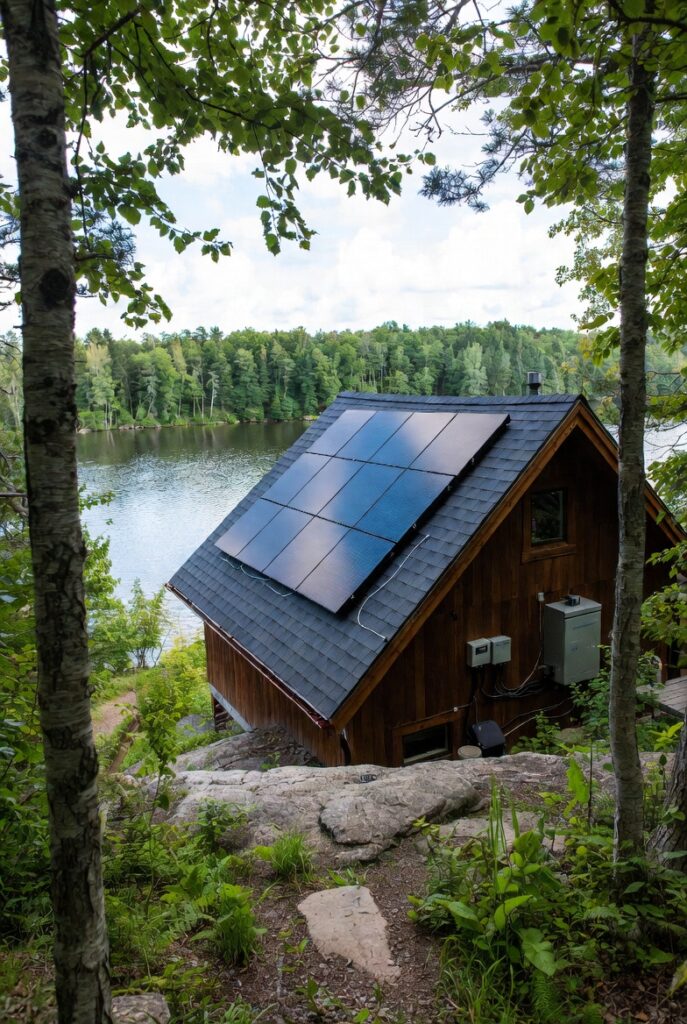
Cottage solar system failures on the Victoria Day long weekend are not random. They are the predictable result of leaving a lithium battery bank at 100% state of charge in an unheated building for 7 months and expecting it to wake up healthy in May. I was asked to review a solar power system at a cedar cottage on Lake Kashagawigamog in Haliburton County, Ontario that the owners used seasonally from May through October and left unoccupied from November through April. The system included a 400W solar array, a 200Ah 12V LFP battery bank installed the previous August at a cost of $3,200, and a Victron MultiPlus-II inverter-charger. The installer had transferred all settings from the lead-acid configuration including the bulk charge target of 14.6V, which held the LFP bank at 100% SoC continuously during the fall season.
The owners left the cottage on October 12 with the bank at 100% SoC and the solar array still connected, charging the full bank through the winter. When they arrived on the Victoria Day weekend in May the MultiPlus-II refused to start. The battery bank measured 24.6V open circuit, surface voltage that appeared normal. However, when the MultiPlus-II applied its startup load the bus voltage immediately collapsed to 18.4V and the low-voltage protection tripped. The internal resistance had risen from 0.8 milliohm per cell at installation to 6.2 milliohm per cell after 7 months of storage at 100% SoC. The bank still had 94% of its original capacity remaining but could no longer supply the MultiPlus-II startup current without voltage collapse. The bank required a controlled discharge to 50% SoC and a slow reconditioning charge cycle over 3 days before the internal resistance recovered to 1.4 milliohm per cell and the MultiPlus-II started normally. The cottage owners lost the entire Victoria Day weekend.
I reconfigured the charge controller absorption target to 95% SoC, programmed a storage float voltage of 13.5V on the 12V bus to hold the bank at 50% SoC during winter, and installed a manual battery disconnect switch to allow the owners to physically isolate the bank from all loads and the charge controller before leaving in October. In 2 subsequent winter seasons the bank arrived at the Victoria Day weekend at 52% to 58% SoC and started the MultiPlus-II immediately on the first attempt. The reconfiguration cost $0 in hardware and 2 hours of programming time. The $3,200 LFP bank it saved would have required replacement after 2 to 3 more seasons of full-charge winter storage at the original degradation rate. For the full system sizing hub that covers the load calculation foundation, the hub covers the numbers.
Why a Cottage Solar System Dies on the Victoria Day Weekend
LFP cells stored at 100% SoC develop accelerated SEI layer growth at the graphite anode at 4 to 8 times the rate of 50% SoC storage. This adds internal resistance from 0.8 milliohm per cell at installation to 6.2 milliohm per cell after 7 months of full-charge storage. As a result the bank cannot supply inverter startup current without voltage collapse even though the capacity appears normal on open circuit voltage. The fix costs $0. Reprogram the charge controller absorption target to 95% SoC, set the storage float to 13.5V on a 12V bus to hold the bank at 50% SoC, and install a physical disconnect.
The Victron MultiPlus-II stores the winter float voltage in non-volatile memory so the setting persists through the off-season without any charge controller power. For the remote telecom solar LFP storage management standard that covers the same battery chemistry storage principle for unmanned seasonal sites, Article 232 covers the full specification.
| Storage SoC | Internal Resistance After 7 Months | Victoria Day Startup Result |
|---|---|---|
| 100% SoC – full charge winter storage | 6.2 milliohm per cell – 8x factory spec | Bus collapsed to 18.4V – MultiPlus-II tripped |
| 50% SoC – hibernation float 13.5V | 0.9 to 1.0 milliohm per cell – within spec | MultiPlus-II started immediately on first attempt |
The 24V Bus Architecture and Jet Pump Surge Capacity
Cottage solar system voltage sag failures during jet pump startup are the Saturday morning failure that turns a long weekend into a plumbing emergency. I reviewed a recurring failure at a hunting camp on the Kawartha Highlands Signature Site in Peterborough County, Ontario that a hunting club was using for a 6-week fall deer season. The camp ran a 12V 200Ah LFP bank, a 12V 3,000W pure sine inverter, and a half-HP Goulds jet pump drawing 1,100W running and 3,800W at motor startup for 2.4 seconds. The inverter was rated for 3,000W continuous and 6,000W surge for 2 seconds.
During the 2.4-second jet pump startup the inverter surge was adequate for the first second but the 12V LFP bank voltage sagged from 12.8V to 10.1V at second 1.8 because the startup current of 316A was approaching the 1C continuous discharge limit of the 200Ah bank. At 10.1V the inverter’s undervoltage protection tripped and the pump motor stopped mid-startup. The pressure tank never reached operating pressure. The hunting camp experienced 14 identical pump startup failures over the 6-week season requiring manual pressure tank priming each time.
I redesigned the system to a 24V bus architecture using the same 200Ah capacity in a 24V configuration. A 24V 200Ah LFP bank at 1C delivers 200A from a 24V bus providing 4,800W, compared to 316A from a 12V bus which the same capacity bank cannot sustain without voltage collapse. The jet pump startup demand of 3,800W on a 24V bus draws 158A from the bank, well below the 200A 1C threshold. In 2 subsequent fall seasons the jet pump started on every first attempt without a single undervoltage trip. The 24V redesign cost $680 in rewiring and bus bar reconfiguration using the existing battery cells rewired in series. The 14 manual priming events per season it eliminated were consuming 40 to 60 minutes of hunting time per day at peak usage. For the incident command solar 24V surge architecture standard that covers the same 24V bus surge capacity principle for remote critical load deployments, Article 231 covers the full specification.
The Hibernation Protocol and Physical Disconnect
A seasonal cottage leaves the solar-LFP system in the worst possible storage condition for LFP cell longevity: a fully functional charging system with a fully charged battery and no load sitting in an unheated building for 210 days. The hibernation protocol addresses both risks simultaneously. Set the charge controller storage float to 13.5V on a 12V bus or 27.0V on a 24V bus to hold the LFP bank at 50% SoC.
Then install the Blue Sea 600A disconnect in the positive conductor before the load bus to achieve true zero parasitic draw for the winter. As a result a bank at 50% SoC in October arrives at 50% to 55% SoC in May because the float voltage prevents overcharge and the physical disconnect prevents the 2,520Wh of parasitic drain that a connected CO detector, charge controller, and clock would otherwise consume over 210 days. For the overland solar power hibernation storage and physical disconnect standard that covers the same long-term storage SoC management for seasonal vehicle builds, Article 233 covers the full specification.
The Cerbo GX Remote Monitoring and Weekly Health Report
A seasonal cottage owner 200 kilometres from the property in January has one question: is my battery bank okay. The answer used to require a 4-hour drive in January or waiting until May to find out it was not. The Victron Cerbo GX with GX LTE 4G modem transmits battery SoC, voltage, and temperature data to the Victron VRM portal over the cellular network without requiring cottage WiFi or internet service.
The VRM portal generates automatic weekly health report emails to the owner showing the bank SoC trend over the previous 7 days. As a result the owner receives confirmation every Monday morning through the winter that the hibernation protocol is holding the bank at 50% to 55% SoC without driving to the property. If the SoC trend shows unexpected depletion from a failed disconnect switch or an unexpected load the VRM alert notifies the owner with 4 to 6 weeks of reserve remaining before the bank reaches the low-voltage protection threshold. For the remote telecom solar Cerbo GX VRM pre-depletion alert standard that covers the same LTE-M monitoring and SoC threshold alert principle for unmanned sites, Article 232 covers the full specification.
The Cottage Solar System: Minimum Viable vs Full Cottage Standard
The decision follows whether the cottage has a well pump, whether the owners want winter remote monitoring, and whether the system needs to handle the full Saturday morning kitchen surge load simultaneously.
The minimum viable cottage solar system for a Muskoka or Kawartha seasonal cottage with a well pump, fridge, lighting, and occasional toaster and coffee maker includes a 400W solar array, a 24V 100Ah LFP bank with physical disconnect switch, a Victron MultiPlus-II 24/1200 pure sine inverter-charger programmed for 50% SoC winter storage float, and a Blue Sea 600A disconnect for the DC bus. Capital cost runs $3,200 to $4,800. It provides reliable Victoria Day startup, jet pump surge capacity, and 7-month winter hibernation without internal resistance degradation.
The full cottage standard for a Haliburton or Georgian Bay cottage with full kitchen, hot water, and year-round remote monitoring includes a 600W solar array, a 24V 200Ah LFP bank with physical disconnect, Victron MultiPlus-II 24/3000 with winter SoC programming, Blue Sea 600A disconnect, and Cerbo GX with LTE-M VRM monitoring. Capital cost runs $6,400 to $9,200. It provides full seasonal load capacity, hibernation-proof storage management, and weekly remote battery health reporting through the entire off-season.
NEC and CEC: What the Codes Say About Cottage Solar Systems
NEC 706 governs energy storage systems including the LFP battery bank in any cottage solar system installation. The LFP bank, physical disconnect, and associated overcurrent protection are subject to NEC 706 requirements for battery management systems, overcurrent protection, and disconnecting means. The MultiPlus-II inverter-charger AC output circuit is subject to NEC 702 for optional standby systems in a seasonal cottage application. The solar array source circuits are subject to NEC 690 overcurrent protection and disconnecting means requirements. Contact the NFPA for current NEC 690, NEC 706, and NEC 702 requirements applicable to seasonal cottage solar power installations in Ontario and across North America.
In Ontario, a solar power installation at a seasonal cottage is subject to CEC Section 64 for the PV source circuits and CEC Section 10 for grounding and bonding of all metallic components including the solar array frame, battery enclosure, and inverter chassis. A seasonal cottage solar installation that includes a connection to the cottage’s fixed AC wiring requires an ESA electrical permit and inspection. Contact the Electrical Safety Authority Ontario for the current permit requirements applicable to solar power installations at seasonal cottages in Ontario before connecting any solar power system to fixed cottage wiring. The physical battery disconnect must meet CEC Section 64 disconnecting means requirements and be accessible for operation by the owner without tools.
Pro Tip: Before leaving any seasonal cottage solar system for the winter, connect a laptop to the charge controller and run a full 10-second load test at the MultiPlus-II’s rated startup current before you leave in the fall, not when you arrive in May. I have visited cottages in October where the owners were about to leave for winter with a battery bank already showing 3.4 milliohm per cell from the previous summer’s storage at 100% SoC. The load test caught it. They had 2 days left in the cottage season to run the reconditioning cycle rather than losing the Victoria Day weekend to it. Test in October. Not in May.
The Verdict
A cottage solar system built to the cottage standard means the Lake Kashagawigamog Haliburton owners arrive on the Victoria Day weekend and hear the MultiPlus-II start immediately instead of spending 3 days waiting for a reconditioning cycle because 7 months at 100% SoC turned 0.8 milliohm cells into 6.2 milliohm cells, and the Kawartha Highlands hunting camp jet pump starts on every first attempt instead of requiring manual pressure tank priming 14 times per season because a 24V bus draws 158A from the bank where a 12V bus was collapsing at 316A.
- Reprogram the charge controller storage float to 13.5V on a 12V bus before leaving for winter. The Lake Kashagawigamog bank developed 6.2 milliohm internal resistance from 7 months at 100% SoC and cost the owners their entire Victoria Day weekend. The fix took 2 hours and cost $0 in hardware. The $3,200 LFP bank it saved was already degrading toward replacement within 2 to 3 more seasons.
- Install a physical battery disconnect and flip it to open before the October drive home. A 12V cottage system with CO detector, charge controller, and clock draws approximately 0.5W continuously. Over 210 days that is 2,520Wh consumed from a bank the owner believes is in hibernation at 50% SoC. One switch flip in October prevents a phone call from Huntsville in May asking why the inverter will not start.
- Upgrade to a 24V bus before commissioning any cottage system with a jet pump. The Kawartha Highlands camp jet pump failed 14 times in 6 weeks on a 12V bus because 316A at startup was collapsing the bus to 10.1V. The same pump on a 24V bus draws 158A, starts every time, and the bank never trips. The 24V redesign cost $680 in rewiring. One plumber visit to diagnose a pressure tank that never primed costs more.
In the shop, we do not let a customer drive away with a battery at 100% charge and no maintenance plan for 7 months and call it ready for spring. At the cottage, we do not leave an LFP bank at full charge in October and call it ready for Victoria Day.
Frequently Asked Questions
Q: Why does leaving an LFP battery at 100% SoC for winter destroy the bank by Victoria Day? A: LFP cells stored at 100% SoC develop SEI layer growth at the graphite anode at 4 to 8 times the rate of 50% SoC storage. This adds internal resistance at 0.3 to 0.8 milliohm per cell per month of full-charge storage. After 7 months the internal resistance can reach 6 times the factory specification, causing voltage collapse under inverter startup loads even though the bank still shows normal open circuit voltage. Setting the charge controller storage float to 13.5V holds the bank at 50% SoC and eliminates the degradation mechanism entirely.
Q: Why does a 24V bus fix the jet pump startup problem that a 12V bus cannot handle? A: A half-HP jet pump startup demand of 3,800W draws 316A from a 12V bus. A 200Ah 12V LFP bank can only sustain 200A continuous at 1C before the bus voltage collapses below the inverter undervoltage threshold. The same 200Ah capacity in a 24V configuration draws only 158A from the bus at the same startup demand, well below the 200A 1C threshold. Doubling the bus voltage halves the current demand and eliminates the voltage sag entirely.
Q: How does the Cerbo GX monitor a cottage battery bank in winter without Wi-Fi? A: The Cerbo GX uses a GX LTE 4G modem to connect directly to the cellular network, transmitting battery SoC, voltage, and temperature to the Victron VRM portal without requiring cottage internet service. The VRM portal sends automatic weekly health report emails to the owner showing the hibernation SoC trend. If the SoC drops unexpectedly the VRM automatic alert notifies the owner weeks before the bank reaches the low-voltage protection threshold.
Questions? Drop them below.
Master Tech Advisory: This build is engineered within the 48V DC Safety Ceiling. Diagnostic logic is based on 20+ years of technical service experience. All structural and electrical installations must be verified by a Licensed Professional and comply with your Local Authority Having Jurisdiction (AHJ).
This post contains affiliate links. If you purchase through our links, we may earn a small commission at no extra cost to you.
About the Author
Robert Bertrand spent 20 years as a service advisor in the automotive industry (Lexus and Nissan), where precision diagnostics, wiring integrity, and documentation standards were non-negotiable. He brings that same technical discipline to GridFree Guide, where he researches, tests, and documents off-grid solar systems for Ontario conditions. Based in Rockwood, Ontario, every article is built on verified specifications, manufacturer data, and the real-world climate constraints of Canadian off-grid living.
As an Amazon Associate I earn from qualifying purchases. This site also contains affiliate links to other products and services. GridFree Guide earns a small commission at no extra cost to you.