
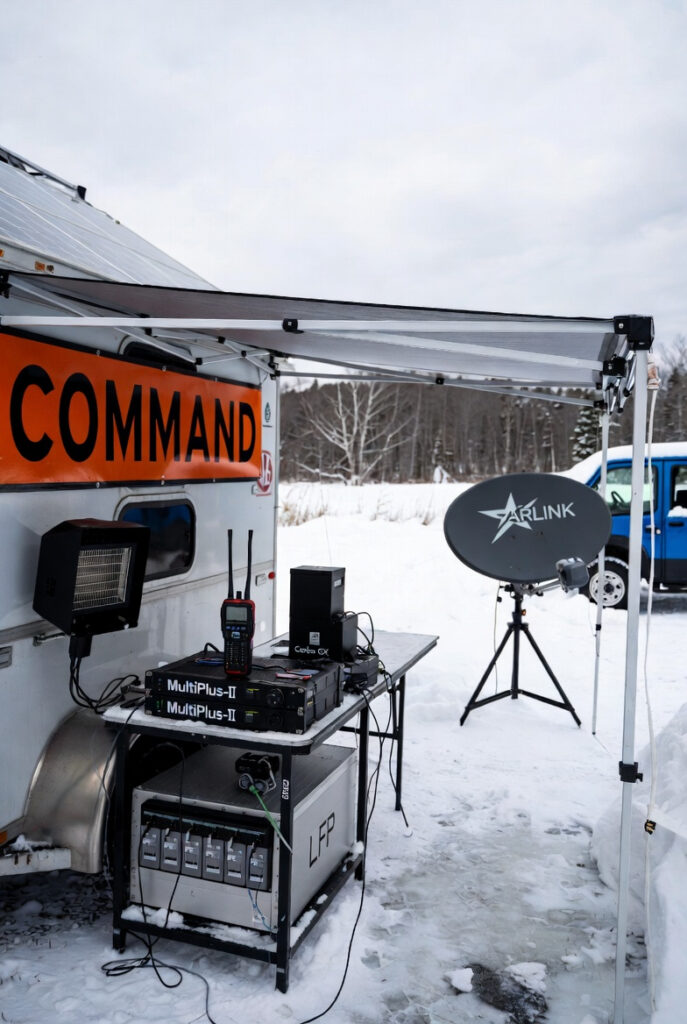
Incident command solar failures at a winter SAR deployment do not always look like power failures. Sometimes they look like a generator that will not start and a laptop screen that goes black at the exact moment the search coordinator needs the grid map. I was asked to review the power system at an Incident Command Post established in the Blue Mountain Village parking lot near Collingwood in Simcoe County, Ontario by the Grey County Emergency Management team during a 3-day backcountry SAR operation for two missing skiers on the Niagara Escarpment. The ICP was running from a 6.5kW propane generator inside the command trailer, powering 4 mapping laptops, a Starlink terminal, a drone charging station with 6 simultaneous charging bays, and a satellite phone bank.
On day 2 of the operation the overnight temperature dropped to minus 27°C. At 4:38 AM the generator’s propane regulator vapor-locked in the sustained cold. The generator shut down and the ICP lost all power simultaneously. The on-call generator technician was 94 kilometres away in Owen Sound. The SAR coordinator’s primary mapping laptop had been running on AC power without a UPS. When the generator lost output voltage the laptop’s internal power supply absorbed the collapsing AC waveform and the power supply board failed. Replacement cost was $3,200. The ICP was without mapping capability for 4 hours and 22 minutes until a second laptop was sourced from the OPP detachment in Collingwood. The two missing skiers were located at 9:14 AM, 4 hours and 7 minutes after the power failure. The search coordinator noted in the debrief that the mapping gap had required 3 search teams to retrace previously cleared terrain because the grid assignments could not be verified without the mapping software.
I designed a rapid-deploy solar power trailer for Grey County Emergency Management using a 600W panel array on a folding roof mount, a 200Ah 24V heated LFP battery bank in a vibration-dampened equipment rack, and a Victron MultiPlus-II inverter-charger providing pure sine wave AC output with less than 1.5% THD at full ICP load. The solar trailer deploys in 8 minutes from arrival on scene. The MultiPlus-II power-assist mode allows the backup generator to supplement the solar-LFP bank during peak drone charging loads without requiring an inverter transfer switch event. In 2 subsequent winter SAR deployments including one at minus 31°C the solar trailer has started cold, held full ICP load, and never lost power during a mapping session. The trailer build cost $8,400. The $3,200 laptop replacement and the 4-hour 22-minute mapping blackout it prevents justified the build cost on the first activation. For the remote science lab solar pure sine wave inverter and THD data corruption standard that covers the same modified sine wave damage principle for sensitive field electronics, Article 226 covers the full specification. For the full system sizing hub that covers the load calculation foundation, the hub covers the numbers.
Why an Incident Command Solar System Loses the Map at 4 AM
A propane generator at minus 27°C vapor-locks when the regulator temperature drops below the propane vapour pressure threshold, closing the fuel valve and shutting down the engine without warning. A modified sine wave inverter connected to a mapping laptop produces a stepped rectangular AC waveform with 18 to 25% THD. When the generator shuts down the laptop power supply absorbs the collapsing waveform asymmetrically and the inrush current can exceed the power supply board’s rated input, destroying it. As a result the laptop does not survive a modified sine wave generator shutdown the way it would survive a clean sine wave dropout with a UPS.
The Victron MultiPlus-II produces less than 1.5% THD at full ICP load and provides seamless transfer from solar-LFP to generator supplementation in power-assist mode without any output interruption to connected equipment. For the remote science lab solar pure sine wave inverter standard that covers the same modified sine wave damage principle for sensitive electronics, Article 226 covers the full specification.
| Power Configuration | Cold-Start at Minus 25°C | Laptop and Starlink Survival |
|---|---|---|
| Propane generator with modified sine wave inverter | Vapor-lock – engine shuts down without warning | Modified sine wave collapse destroys power supply board |
| Solar-LFP with Victron MultiPlus-II | Cold-starts at minus 31°C – no regulator, no fuel | Pure sine wave output survives generator dropout cleanly |
The DC-Direct Starlink and MultiPlus-II Power-Assist Mode
Incident command solar power quality failures at a Starlink terminal do not look like a total outage. They look like a satellite uplink that connects, transmits for 3 to 7 minutes, then drops, reconnects, drops again, and produces a latency that makes voice-over-IP unusable exactly when the incident commander needs to brief the regional EOC. I investigated a recurring Starlink connectivity failure at a Simcoe County Emergency Management mobile EOC deployed at the Barrie Emergency Services Training Centre during a county-wide flood response exercise in November. The mobile EOC was running a Starlink Standard terminal on a 3,000W modified sine wave inverter drawing from a 200Ah 12V LFP bank.
The Starlink terminal was connecting at 87 to 124 Mbps download and 14 to 22 Mbps upload on initial connection. However the connection was dropping every 4 to 7 minutes and requiring 90 to 120 seconds to re-establish. I measured the AC power quality at the Starlink power brick input with a power quality analyser and found 21.8% THD on the AC line. The Starlink power brick’s internal switching power supply was producing a secondary ripple on the 48V DC bus feeding the dish electronics at 340mV peak-to-peak. The 340mV ripple was within the sensitivity range of the dish’s phase-locked loop timing circuit, causing the satellite timing synchronisation to fail every 4 to 7 minutes as the PLL accumulated phase error beyond its correction range.
I replaced the modified sine wave inverter with a Victron MultiPlus-II and powered the Starlink terminal directly from the 24V DC bus through a 24V-to-48V isolated DC-DC step-up converter, bypassing the AC adapter entirely. The DC-direct connection eliminated both the inverter THD and the power brick ripple simultaneously. In 3 subsequent EOC activations the Starlink terminal has maintained continuous connection at full speed without a single dropout. The inverter replacement and DC-direct conversion cost $1,640. The recurring 90-second dropout cycle had been producing an effective throughput of 34% of rated speed during the exercise. The MultiPlus-II power-assist mode dynamically splits the drone charging load between the LFP bank and the generator, allowing a small 2,000W generator to support a 3,200W ICP load without tripping the generator overload protection. For the disaster relief solar DC-direct power-assist architecture that covers the same inverter supplementation principle for critical field deployments, Article 220 covers the full specification.
The Cerbo GX Tactical Dashboard and Heated LFP Cold-Start
The Victron Cerbo GX displays LFP bank SoC, generator input status, solar production, and individual load consumption simultaneously on the GX Touch 50 screen at the ICP commander’s position. The Cerbo GX also transmits all monitoring data to the Victron VRM portal over LTE-M, giving the regional EOC commander 40 kilometres away the same real-time battery status view as the ICP operator on scene. As a result the county fire chief can call a generator start or load shed from the regional EOC without radio contact with the ICP power operator.
A 200Ah 24V LFP bank stored overnight in an unheated command trailer at Blue Mountain can reach minus 20°C by 4 AM. At minus 20°C standard LFP cells suspend charging to prevent lithium plating. However, a heated LFP bank with integrated PCB heaters warms the cells from minus 20°C to 5°C using approximately 120Wh from the bank’s own reserve, consuming less than 3% of total capacity and restoring full charge acceptance before the 7 AM winter solar window. The Victron SmartShunt monitors cell temperature in real time and feeds the data to the Cerbo GX, triggering the heating protocol automatically before the charge controller locks out at 0°C. For the fire tower solar Arctic-pack LFP self-heating standard that covers the same cold-start cell heating protocol for remote winter deployments, Article 228 covers the full specification.
The Drone Charging Station and Peak Load Management
A 6-bay simultaneous drone charging station at an ICP draws 2,400 to 3,600W depending on battery state and charger model. This single load exceeds the continuous output rating of any portable generator commonly used at field ICPs. However, the MultiPlus-II power-assist mode dynamically splits the drone charging load between the LFP bank and the generator, drawing from both simultaneously without any manual load management by the ICP coordinator. As a result the drone charging station charges all 6 batteries simultaneously without the generator overloading or the coordinator needing to stagger charge cycles manually.
In addition the LFP bank recovers the drone charging energy from solar production between flights, so the generator does not need to run continuously to sustain the drone program through a multi-day SAR operation. For the mining camp solar high-discharge LFP and peak load management standard that covers the same simultaneous high-draw load and generator supplementation principle for remote heavy equipment deployments, Article 227 covers the full specification.
The Incident Command Solar System: Minimum Viable vs Full Command Standard
The decision follows whether the ICP has a drone charging program, whether Starlink is the primary uplink, and whether the deployment is multi-day in a below-zero environment.
The minimum viable incident command solar system for a 2 to 4-person field command post with mapping laptop, Starlink terminal, and satellite phone includes a 300W folding panel array, a 100Ah 24V heated LFP battery, a Victron MultiPlus-II 24/1200 pure sine inverter-charger, and DC-direct Starlink power via 24V-to-48V isolated converter. Capital cost runs $3,800 to $5,200. It provides 8 to 12 hours of continuous ICP operation at minus 25°C without a generator start.
The full command standard for a multi-agency ICP with drone charging station, 4 mapping laptops, Starlink terminal, and satellite phone bank includes a 600W folding roof-mount panel array, a 200Ah 24V heated LFP bank in vibration-dampened rack, Victron MultiPlus-II 24/3000 with power-assist mode, DC-direct Starlink conversion, Cerbo GX with GX Touch 50 tactical dashboard, and Victron SmartShunt with VRM portal monitoring. Capital cost runs $8,400 to $11,200. It provides zero-fail pure sine wave ICP power through a full multi-day winter SAR activation including generator supplementation during peak drone charging loads.
NEC and CEC: What the Codes Say About Incident Command Solar
NEC 690 governs the PV source circuits of any incident command solar installation. The folding panel array, MPPT charge controller, and LFP battery bank are subject to NEC 690 overcurrent protection and disconnecting means requirements. The MultiPlus-II inverter-charger AC output is subject to NEC 445 for inverters installed for portable use. The drone charging station load circuit is subject to NEC 210 for branch circuit requirements. A solar-powered command trailer on a wheeled chassis is subject to NEC Article 551 for recreational vehicle electrical systems including wiring methods, overcurrent protection, and low-voltage disconnecting means. Contact the NFPA for current NEC 551, NEC 690, and NEC 445 requirements applicable to mobile solar power systems at emergency incident command posts in Ontario and across North America.
In Canada, a solar-powered mobile command trailer on a wheeled chassis is subject to CSA Z240 RV Series standards for recreational vehicle electrical systems. CSA Z240 governs the electrical installation including the solar array, battery bank, inverter-charger, and all 12V and 120V AC circuits within the trailer. The solar power installation is additionally subject to CEC Section 64 for the PV source circuits. A fully self-contained portable solar power trailer with no permanent connection to building fixed wiring is exempt from ESA electrical permit requirements under the Ontario Electrical Safety Code as a portable power assembly. Contact Emergency Management Ontario for the current provincial emergency power standards applicable to municipal and county emergency management mobile operations before deploying any solar power infrastructure at an Ontario emergency operations centre. Contact Transport Canada for guidelines applicable to mobile power units operated on public roadways and deployed at federally regulated incident sites.
Pro Tip: Before specifying the LFP bank capacity for a winter ICP deployment, calculate the total overnight self-heating energy requirement for the expected minimum temperature and add it to the morning load calculation before determining the bank size. I have sized ICP batteries for the ICP equipment load and forgotten to account for the cell heating energy, then arrived at a February deployment to find the bank at 61% SoC at dawn because the heating blanket had consumed 18% overnight. The heating energy is not optional at minus 20°C. It is the first load the bank pays before it pays anything else. Size for it before you size for the laptops.
The Verdict
An incident command solar system built to the command standard means the Grey County Blue Mountain SAR team never loses the grid map at 4:38 AM because a propane regulator vapor-locked at minus 27°C and a modified sine wave inverter destroyed a $3,200 laptop, and the Simcoe County EOC Starlink terminal transmits at full speed through every regional briefing instead of dropping every 4 to 7 minutes while 21.8% THD turns a 124 Mbps uplink into 34% effective throughput.
- Replace every modified sine wave inverter in every command trailer before the first winter deployment. The Blue Mountain ICP lost $3,200 in hardware and 4 hours 22 minutes of mapping capability because a contractor-grade generator and a modified sine wave inverter were the only power plan at minus 27°C. A Victron MultiPlus-II costs less than the laptop it protects. Install it before the season starts, not after the debrief.
- Power the Starlink terminal DC-direct from the 24V bus before any exercise or activation where the uplink is the primary EOC communication path. The Barrie Simcoe County exercise ran at 34% effective Starlink throughput for the full duration because 340mV of ripple from a modified sine wave inverter was disrupting the PLL. A $1,640 conversion eliminated every dropout in 3 subsequent activations. The fix takes one afternoon. The problem costs the mission.
- Specify a heated LFP bank and size for the self-heating load before any multi-day winter deployment. A standard LFP bank at minus 20°C cannot accept morning solar charge. The heating blanket consumes 120Wh before the first laptop boots. That energy comes off the bank before anything else. Size for it first or arrive at 61% SoC and start the generator anyway.
In the shop, we do not send a crew to a job site with one battery and a propane heater and call it a power plan. At the command post, we do not run a SAR operation on a contractor generator and a modified sine wave inverter and call it resilient.
Frequently Asked Questions
Q: Why does a propane generator vapor-lock at minus 25°C and how does solar prevent the ICP from going dark? A: Propane vapor pressure drops below the regulator’s minimum opening threshold at sustained temperatures below minus 25°C, closing the fuel valve and shutting down the engine without warning. A solar-LFP system with a heated battery bank starts cold at minus 31°C without a regulator, a fuel supply, or a warm-up period. The ICP stays powered regardless of ambient temperature.
Q: Why does a modified sine wave inverter destroy laptop power supplies during a generator shutdown? A: A modified sine wave inverter produces a stepped rectangular waveform with 18 to 25% THD. When the generator shuts down suddenly the modified sine wave collapses asymmetrically, sending a partial AC cycle into the laptop power supply’s input filter. The filter capacitors discharge into the collapsing waveform rather than into the laptop’s DC rails, and the resulting inrush current exceeds the power supply board’s rated input, destroying it. A pure sine wave inverter collapses symmetrically and the laptop power supply survives the dropout cleanly.
Q: How does DC-direct Starlink power eliminate the connection dropouts caused by a modified sine wave inverter? A: A modified sine wave inverter produces THD that the Starlink power brick converts to 340mV of ripple on the 48V dish bus. This ripple disrupts the phase-locked loop timing circuit in the dish, causing the satellite synchronisation to fail every 4 to 7 minutes. DC-direct power from a 24V-to-48V isolated converter provides less than 10mV of ripple at the dish input, keeping the PLL locked and the connection continuous.
Questions? Drop them below.
Master Tech Advisory: This build is engineered within the 48V DC Safety Ceiling. Diagnostic logic is based on 20+ years of technical service experience. All structural and electrical installations must be verified by a Licensed Professional and comply with your Local Authority Having Jurisdiction (AHJ).
This post contains affiliate links. If you purchase through our links, we may earn a small commission at no extra cost to you.
About the Author
Robert Bertrand spent 20 years as a service advisor in the automotive industry (Lexus and Nissan), where precision diagnostics, wiring integrity, and documentation standards were non-negotiable. He brings that same technical discipline to GridFree Guide, where he researches, tests, and documents off-grid solar systems for Ontario conditions. Based in Rockwood, Ontario, every article is built on verified specifications, manufacturer data, and the real-world climate constraints of Canadian off-grid living.
As an Amazon Associate I earn from qualifying purchases. This site also contains affiliate links to other products and services. GridFree Guide earns a small commission at no extra cost to you.