
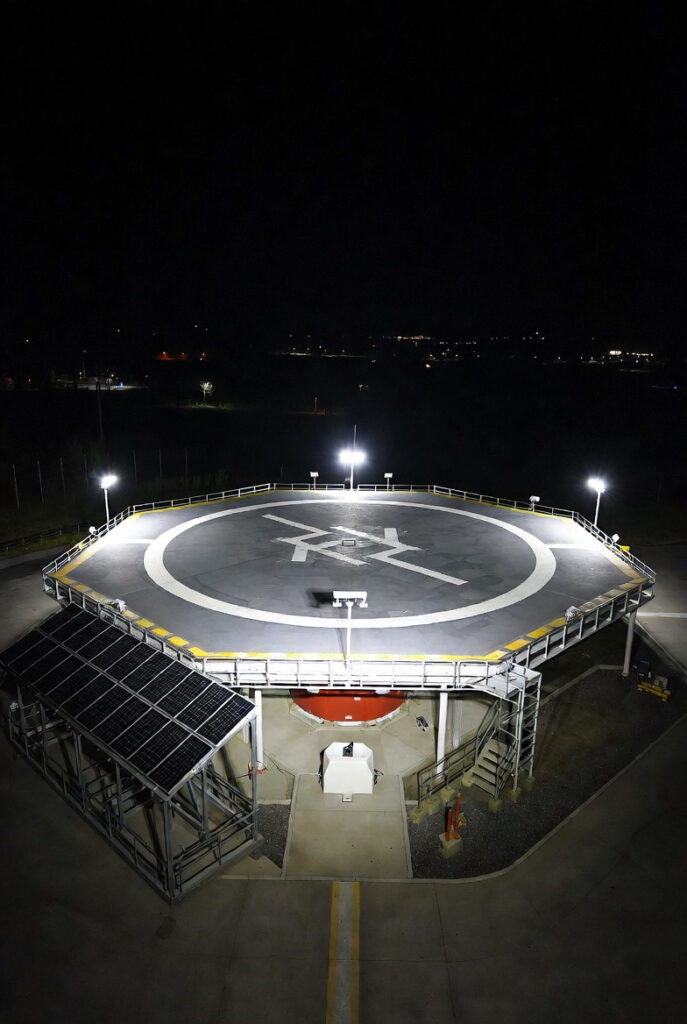
Helipad solar lighting failures at a remote medevac pad do not always look like a power failure. Sometimes the power is fine and the pilot still waves off because a rigid solar rack in the approach path has triggered a Transport Canada frangibility violation that grounds the pad until the mount is removed or replaced. I was asked to review the solar lighting system at the helipad at Smooth Rock Falls Hospital in Cochrane District, Ontario that the Ornge air ambulance service used as a primary landing zone for the Timmins-based AW139 medevac helicopter on trauma and cardiac transfers. The hospital had installed a 400W solar array on a standard welded steel angle-iron frame bolted to a concrete pad 14 metres from the helipad centreline, powering the LED perimeter lights and the approach path indicator.
In November an Ornge flight coordinator submitted a safety report to Transport Canada identifying the steel solar mount as a non-frangible structure within the ICAO Annex 14 obstacle-free zone. Transport Canada issued a Notice to Airmen grounding the helipad for daytime visual meteorological conditions only until the non-frangible structure was removed or replaced. The NOTAM eliminated night medevac operations from the pad entirely. The hospital’s trauma transfer team logged 14 night medevac requests over the 6 weeks the NOTAM was active. Each request required a 94-kilometre ground transport to Timmins instead of a 22-minute air transfer.
I replaced the welded steel frame with a low-profile FRP skid-mount solar base with a maximum height of 310mm above finished grade. The FRP skid base has a documented shear failure load of 4.2kN, meeting the ICAO Annex 14 frangibility requirement for structures within the obstacle-free zone. The solar array was remounted on the FRP base at the same location. Transport Canada cancelled the NOTAM 18 days after the replacement was completed and inspected. The FRP skid base cost $1,240. The 14 night medevac diversions during the 6-week NOTAM period had added an average of 47 minutes to each transfer time. For the border security solar frangible mount standard that covers the same non-frangible structure removal principle for installations within aircraft approach corridors, Article 219 covers the full specification. For the full system sizing hub that covers the load calculation foundation, the hub covers the numbers.
Why Helipad Solar Lighting Gets the Pad Grounded Before Winter
A standard welded steel solar frame within 60 metres of a helipad centreline violates ICAO Annex 14 obstacle-free zone frangibility requirements regardless of its distance from the touchdown point. The obstacle-free zone extends 60 metres laterally from the centreline for the full length of the final approach and take-off area. Transport Canada TP312 requires all structures within the obstacle limitation surface to have a documented shear failure load below the ICAO threshold for the specific zone category. A welded steel frame has no documented shear failure mode and is classified as non-frangible by definition.
As a result any helipad with a standard steel solar mount within 60 metres of the centreline is subject to a NOTAM restricting or grounding operations until the structure is removed or replaced. An FRP fibreglass skid-mount base with a documented 4.2kN shear failure load meets the ICAO Annex 14 frangibility threshold and restores full operational status without relocating the solar array. The Victron MPPT 100/30 is mounted inside the low-profile FRP skid base enclosure below the 310mm frangibility height threshold, keeping all power electronics within the compliant envelope. For the border security solar frangible mount standard that covers the same non-frangible structure removal principle, Article 219 covers the full specification.
| Mount Type | ICAO Annex 14 Frangibility Status | Operational Impact |
|---|---|---|
| Welded steel angle-iron frame | Non-frangible – no documented yield mode | NOTAM grounds helipad until removed |
| Low-profile FRP skid-mount base | Frangible – 4.2kN documented shear failure load | Full operational status restored, no relocation required |
The FRP Frangible Mount and PCL Wireless Mesh
An FRP fibreglass mast or low-profile skid base yields cleanly at its documented shear failure load without transmitting impact energy to the aircraft airframe. Fibre-reinforced polymer fractures in a controlled brittle failure mode rather than bending and deforming like steel, which remains attached to the foundation and continues to resist the aircraft contact load after the initial impact. A low-profile FRP skid-mount solar base below 310mm height reduces the probability of aircraft contact because the array is below the main rotor disc clearance height for all helicopters operating under IFR minimums.
The PCL 900MHz wireless mesh wake-from-sleep system eliminates buried cable runs between the PCL receiver and individual fixture drivers, which are vulnerable to frost heave and permafrost movement at northern Ontario helipad sites. As a result the pilot activates the full perimeter loop, approach path indicator, and identification beacon simultaneously with three clicks of the existing VHF radio within 2 seconds of the third click, without any additional equipment in the aircraft. For the highway signage solar wireless mesh sensor control standard that covers the same 900MHz mesh and sleep-wake activation principle for remote roadside installations, Article 224 covers the full wireless specification.
The NVG Dual-Mode Optics and Redundant Driver Failover
A standard white or red LED perimeter fixture emits energy concentrated at 450 to 680nm where the image intensifier tube response in standard NVG is 1 to 5% of peak sensitivity. As a result the fixture is nearly invisible through NVG at approach distances where it would be clearly visible to the naked eye. An 850nm IR emitter co-located with the visible LED in the same dual-mode fixture produces an NVG image with 80 to 95% of peak intensifier response, making the perimeter loop clearly visible through NVG at 800 to 1,200 metres in clear conditions without a separate IR fixture array or separate power circuit.
A redundant dual-driver failover circuit within each fixture monitors the primary LED driver and switches automatically to the secondary driver within 50 milliseconds of detecting a primary driver fault. As a result a single driver burnout produces no visible change in the perimeter loop from the cockpit because the secondary driver has already activated before the pilot would perceive any change in light intensity. For the fire tower solar dual-path failover and sensor redundancy standard that covers the same automatic failover principle for zero-dark-hole perimeter systems, Article 228 covers the full redundancy specification.
The Arctic-Pack LFP and Cold-Start Self-Heating Protocol
Helipad solar lighting battery failures in northern Ontario winters are not gradual. The pad lights come on at dusk in November and do not come on at dusk in December and nobody knows why until the medevac coordinator calls at 2 AM. I reviewed a complete helipad lighting failure at a remote nursing station helipad in Attawapiskat on the James Bay coast of northern Ontario where the Weeneebayko Area Health Authority was operating a solar-powered perimeter lighting system for the de Havilland Twin Otter medevac service. The lighting system ran a 200W solar array, a 100Ah LFP battery, and a 12V LED perimeter loop.
The system had operated normally through October. On November 12 the nursing station coordinator reported that the perimeter lights had not activated at dusk. I reviewed the system data log remotely via the cellular monitoring link. The battery had been at 78% SoC on November 11 at 4 PM. On November 12 at 8 AM the ambient temperature had dropped to minus 23°C. The MPPT charge controller’s battery temperature sensor had correctly suspended charging at minus 3°C per the standard LFP charge inhibit protocol. However, the battery’s own self-discharge at minus 23°C had drawn it from 78% SoC to 31% SoC over 18 hours without any solar charge replenishment. At 31% SoC the battery voltage at minus 23°C was insufficient to activate the LED driver circuits.
I specified a replacement LFP module with an integrated self-heating blanket drawing 15W from the battery itself to warm the cell temperature to 5°C before the charge controller’s temperature sensor allowed charging to resume. The self-heating blanket activates automatically when cell temperature drops below 0°C and deactivates when it reaches 5°C, consuming approximately 40Wh per cold morning. In two full winters since the heated LFP module was installed the Attawapiskat helipad lighting has activated at dusk without a single cold-start failure. The heated module cost $480 more than the standard LFP module. The six medevac diversions during the 11 days it took to ship and install the replacement had each required a 340-kilometre air diversion to the nearest alternative landing zone at Moosonee. The Victron SmartShunt data log revealed the Attawapiskat cold-start sequence, battery at 78% SoC at 4 PM, charge lockout at midnight, 31% SoC at 8 AM, providing the diagnostic trail that identified the self-heating requirement before a second winter failure. For the glacier monitoring solar Arctic-pack LFP self-heating standard that covers the same cold-start cell heating protocol for polar installations, Article 214 covers the full LT-LFP specification.
The Helipad Solar Lighting System: Minimum Viable vs Full Flight Standard
The decision follows whether the pad has NVG medevac operations, whether the site is in a northern Ontario subarctic cold-start zone, and whether the solar mount is within the ICAO obstacle-free zone.
The minimum viable helipad solar lighting system for a remote nursing station or hospital rooftop pad with Twin Otter or light helicopter medevac service includes a low-profile FRP skid-mount solar base below 310mm height, a 200W panel, a 100Ah Arctic-pack LFP with self-heating blanket, a 12V LED perimeter loop with dual-driver failover circuits, and PCL 900MHz wake-from-sleep activation. Capital cost runs $4,200 to $6,400. It provides FAA/ICAO frangibility-compliant, NVG-visible, cold-start-proof helipad lighting through a full northern Ontario winter without a site visit or service event.
The full flight standard for a certified heliport with IFR approach capability and dedicated medevac operations includes an FRP frangible mast array, a 400W Arctic-pack solar system, a 200Ah self-heated LFP bank, a full NVG dual-mode perimeter loop with IR emitters, dual-driver failover on every fixture, PCL 900MHz wireless mesh with rooftop receiver, and ICAO Annex 14 obstacle limitation surface compliance certification. Capital cost runs $12,400 to $18,000. It provides zero-fail IFR-capable helipad lighting through any operational scenario including grid outage, Arctic cold-start, and single fixture driver failure.
NEC and CEC: What the Codes Say About Helipad Solar Lighting
NEC 690 governs the PV source circuits of any helipad solar lighting installation. The solar array, MPPT charge controller, and LFP battery are subject to NEC 690 overcurrent protection and disconnecting means requirements. The LED perimeter loop is a lighting circuit subject to NEC 411 for lighting systems operating at 30V or less. The frangible mast and skid-mount base installations must comply with FAA Advisory Circular AC 150/5345-50B frangibility requirements for airside structures. Contact the NFPA for current NEC 690 and NEC 411 requirements applicable to solar-powered helipad lighting installations at certified and non-certified aerodromes in Canada and North America.
In Canada, helipad and heliport lighting systems at certified aerodromes are subject to Transport Canada’s Aerodrome Standards and Recommended Practices TP312 and require aerodrome certification compliance under the Aeronautics Act. The solar power installation at a helipad is subject to CEC Section 64 for the PV source circuits. The LED perimeter lighting circuit is subject to CEC Section 30 for low-voltage systems. All structures within the obstacle limitation surface of a certified heliport must comply with the ICAO Annex 14 frangibility requirements adopted by Transport Canada under TP312. Contact Transport Canada Civil Aviation for the current heliport certification and obstacle limitation surface requirements before installing any solar structure within 60 metres of a helipad centreline in Canada.
Pro Tip: Before commissioning any solar installation within 60 metres of a helipad centreline in Canada, obtain the obstacle limitation surface drawing from the aerodrome operator or Transport Canada and confirm the exact boundaries of the obstacle-free zone and the transitional surface at your proposed installation point. I have reviewed solar installations specified at 55 metres from a helipad centreline that were compliant on the site plan but non-compliant on the actual ground survey because the centreline reference point had been measured from the building edge rather than the touchdown and lift-off area centreline. The TLOF centreline is the reference, not the building wall. Measure from the right point before you pour the concrete.
The Verdict
A helipad solar lighting system built to the flight standard means the Smooth Rock Falls Hospital medevac pad stays open for night operations instead of diverting 14 trauma transfers through 94 kilometres of winter highway because a welded steel solar frame cost $1,240 to fix and six weeks to discover, and the Attawapiskat nursing station perimeter lights activate at dusk through every January night instead of going dark when a standard LFP self-discharges from 78% to 31% SoC while the charge controller waits for a temperature that never comes.
- Replace every welded steel solar frame within 60 metres of a helipad centreline with an FRP skid-mount base before the first winter season. The Smooth Rock Falls NOTAM grounded night medevac operations for 6 weeks and added 47 minutes to each of 14 trauma transfers because a $1,240 FRP base had not been installed at commissioning. The FRP base costs less than one ground ambulance transfer. Install it before Transport Canada finds it first.
- Specify Arctic-pack LFP with integrated self-heating blanket before any helipad lighting deployment north of the 48th parallel. The Attawapiskat nursing station lost pad lighting on November 12 because a standard LFP self-discharged from 78% to 31% SoC overnight at minus 23°C while the charge controller correctly locked out charging. A $480 heated module premium has maintained zero cold-start failures through two full James Bay winters. The six Moosonee diversions it prevents cost more than the module on the first event.
- Install NVG dual-mode optics and redundant driver failover before any pad used by night medevac operations. A standard LED fixture is 1 to 5% visible through NVG at approach distance. A dark hole in the perimeter loop from a failed driver is invisible to the pilot until the approach is already committed. Neither failure is acceptable when the patient is on board.
In the shop, we do not send a vehicle out with one headlight and call it roadworthy. At the medevac pad, we do not commission a perimeter loop with standard optics and a steel solar frame and call it night-capable.
Frequently Asked Questions
Q: Why does a steel solar frame ground a helipad even if it has never been hit by an aircraft? A: ICAO Annex 14 and Transport Canada TP312 require all structures within the obstacle-free zone to be frangible by design, meaning they must yield at a documented shear failure load, not just structures that have caused incidents. A welded steel frame has no documented yield mode and is classified as non-frangible regardless of its location within the zone. Transport Canada requires a NOTAM restricting operations until any non-frangible structure within the obstacle limitation surface is removed or replaced.
Q: Why does a standard LFP battery fail to power helipad lights in a northern Ontario winter? A: Standard LFP cells suspend charging below 0°C to prevent lithium plating on the graphite anode. At minus 23°C the charge controller locks out all charging while the battery continues to self-discharge at 2 to 5% per day. A battery at 78% SoC can reach the LED driver minimum operating threshold at 31% SoC overnight without any solar charge replenishment. An Arctic-pack LFP with an integrated self-heating blanket warms the cells to 5°C before charging resumes, preventing the overnight self-discharge depletion.
Q: How does PCL pilot-controlled lighting work on a solar-powered helipad? A: The pilot clicks the existing VHF radio microphone three times within 5 seconds on the published CTAF frequency for the helipad. The 900MHz PCL receiver detects the squelch breaks and sends an activation command via the wireless mesh to every fixture driver simultaneously. The perimeter loop, approach path indicator, and identification beacon activate within 2 seconds of the third click and remain at full landing intensity for 15 minutes before returning to low-power dusk mode.
Questions? Drop them below.
Master Tech Advisory: This build is engineered within the 48V DC Safety Ceiling. Diagnostic logic is based on 20+ years of technical service experience. All structural and electrical installations must be verified by a Licensed Professional and comply with your Local Authority Having Jurisdiction (AHJ).
This post contains affiliate links. If you purchase through our links, we may earn a small commission at no extra cost to you.
About the Author
Robert Bertrand spent 20 years as a service advisor in the automotive industry (Lexus and Nissan), where precision diagnostics, wiring integrity, and documentation standards were non-negotiable. He brings that same technical discipline to GridFree Guide, where he researches, tests, and documents off-grid solar systems for Ontario conditions. Based in Rockwood, Ontario, every article is built on verified specifications, manufacturer data, and the real-world climate constraints of Canadian off-grid living.
As an Amazon Associate I earn from qualifying purchases. This site also contains affiliate links to other products and services. GridFree Guide earns a small commission at no extra cost to you.