
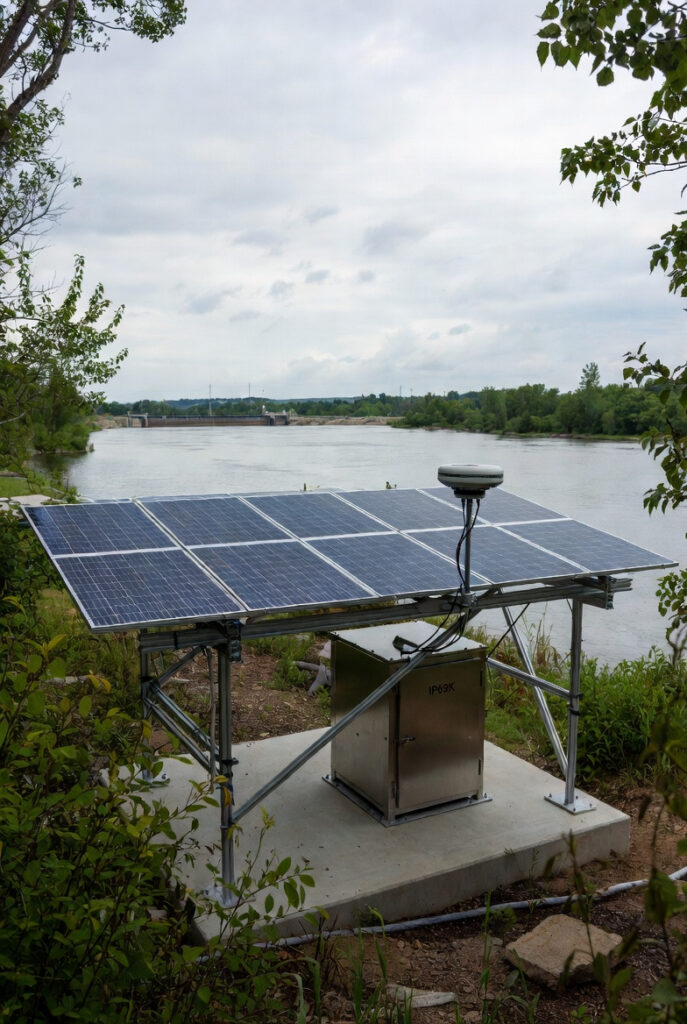
Flood monitoring solar power and sensor failures during the event they were built to measure are not equipment failures. They are design failures that were baked in before the first flood arrived. I was asked to review a monitoring system at a flood warning station on the Humber River at the King-Vaughan Road crossing in York Region, Ontario that the Toronto and Region Conservation Authority was operating as part of its regional flood early warning network. The station had an ultrasonic water level sensor at 3.2 metres above normal river level, a 200W solar array on a fixed rack at 2.8 metres above grade, a 100Ah LFP battery, and a cellular gateway transmitting level readings every 5 minutes to the TRCA flood operations centre.
In April a rapidly developing atmospheric river event produced 94mm of precipitation in 6 hours in the upper Humber watershed. The river level at the King-Vaughan station rose 2.1 metres in 87 minutes. The surface foam and suspended debris from upstream agricultural fields reached the ultrasonic sensor beam path at the 1.8-metre mark at minute 80. At the 2.3-metre level the debris blanket was dense enough to reflect the ultrasonic pulse from the debris surface rather than the water surface, causing the sensor to report 2.3 metres continuously for the next 34 minutes while the actual level rose through 2.8, 3.1, and 3.4 metres before the station went dark when the solar array submerged at 3.1 metres. The TRCA flood operations centre received the last valid reading of 2.3 metres at minute 80. The downstream communities at Nashville Road and Kipling Avenue received no automated warning.
I redesigned the station with an FMCW millimetre-wave radar sensor on the monopole crossarm at 6.2 metres above normal river level, providing 2.8-metre clearance above the 100-year flood elevation of 3.4 metres. I relocated the solar array to a 6-metre monopole with the panel collar at 5.4 metres above the 100-year flood elevation. I replaced the LFP battery and controller with an IP69K-rated stainless steel vault at the monopole base, sealed for 1,000-hour immersion at 3 metres depth. In three subsequent spring events including one that produced a 3.1-metre flood stage the radar sensor transmitted continuously without a single error code. The station remained powered throughout all three events. The redesign cost $4,800. The 34 minutes of false data and 27 minutes of blackout had left two downstream communities without automated warning during the period of fastest water level rise. For the remote sensor solar riverbank mounting standard that covers the same floodwater submersion and debris impact principle for water quality monitoring stations, Article 209 covers the full specification. For the full system sizing hub that covers the load calculation foundation, the hub covers the numbers.
Why a Flood Monitoring Solar Station Goes Dark During the Flood That Matters
An ultrasonic sensor at 3.2 metres on a fixed rack at 2.8 metres above grade is below the 100-year flood elevation at most southern Ontario river monitoring sites. When the flood arrives the array submerges and the sensor blinds from debris foam simultaneously. As a result the station goes offline at exactly the moment when continuous real-time data is most critical. FMCW radar at 6.2 metres with the solar array at 5.4 metres maintains both the sensor and the power system above the 100-year flood elevation regardless of flood stage.
The radar continues measuring through the debris layer because the 76GHz signal reflects from the dielectric discontinuity at the actual water surface below the foam rather than from the foam surface itself. The Victron SmartShunt monitors the IP69K vault LFP bank and transmits battery status via the GOES-R satellite uplink during the flood event regardless of cellular tower status. For the remote sensor solar riverbank mounting and corrosion protection standard that covers the same floodwater submersion principle for water quality monitoring stations, Article 209 covers the full specification.
| Sensor Type | Debris and Foam Immunity | Flood Submersion Survival |
|---|---|---|
| Ultrasonic transducer at 3.2m | Low – debris blanket produces false constant reading | No – wetted components, acoustic path required |
| FMCW radar at 6.2m | High – 76GHz penetrates foam to true water surface | Yes – no wetted components, mounted above flood line |
The FMCW Radar Sensor and GOES-R Satellite Uplink
A float switch or ultrasonic sensor has wetted components, moving parts, or acoustic beam paths that flood debris disables within minutes of the rising water reaching the sensor zone. However, an FMCW radar sensor mounted at 6.2 metres has no wetted components, no moving parts, and a 76GHz signal that penetrates foam and debris to reflect from the true water surface below. As a result the radar continues measuring at millimetre precision throughout the entire flood event including the period when debris density is highest.
The GOES-R DCS satellite uplink transmitting on the 401MHz channel at 3 to 8W from the IP69K vault battery reaches the NOAA geostationary satellite 35,786 kilometres overhead regardless of whether the local cellular tower is overtopped, unpowered, or physically damaged. As a result the flood monitoring station transmits real-time water level data to the national flood network throughout the event with no terrestrial infrastructure dependency. For the cave exploration solar Iridium SBD satellite-only communication standard that covers the same terrestrial-bypass satellite uplink principle for remote locations without cellular coverage, Article 217 covers the full satellite communication specification.
The IP69K Vault and Elevated Solar Array
A standard NEMA 4X fibreglass enclosure meets IP66 for hose-directed water resistance. It is not rated for static immersion depth or the dynamic pressure pulses of a 3-metre floodwater column moving at 2 to 4 metres per second. However, an IP69K stainless steel vault with silicone gasket seals and stainless steel captive bolt closures maintains its internal dry environment at 3 metres depth for 1,000 hours and at any flow velocity tested in the IP69K high-pressure washdown protocol.
The nitrogen purging of the vault interior maintains a positive internal pressure of 0.3 to 0.5 bar that prevents water intrusion through any minor seal imperfection and eliminates the oxygen that supports corrosion of internal electronics. As a result the LFP battery, MPPT controller, and satellite gateway inside the IP69K vault continue operating normally whether the vault is above water or submerged under 3 metres of fast-moving floodwater. The Victron MPPT 100/50 is housed inside the IP69K vault at the monopole base, rated for the full 400W array input on a 48V bus and sealed against submersion for the full 1,000-hour immersion rating. For the cave exploration solar nitrogen-purged battery housing standard that covers the same sealed enclosure and positive pressure principle for chemically sensitive environments, Article 217 covers the full vault specification.
The High-Discharge LFP Bank and Spillway Gate Actuator Reserve
Flood monitoring solar battery failures during dam spillway gate operation are not voltage sag events. They are dam safety events with consequences measured in downstream communities. I reviewed a battery system failure at a flood control dam operated by the Grand River Conservation Authority on a tributary of the Grand River near Fergus in Wellington County, Ontario. The dam had motorised spillway gates driven by 3-phase 5kW electric actuator motors. The gate motors drew 18A at 600V during normal operation but required 340A at 24V for 28 seconds during breakaway startup when the gate had been seated against a debris-loaded sill.
The solar power system was a 400W array, a 200Ah 24V LFP battery bank rated for 0.5C continuous discharge, and a 3,000W inverter. At 0.5C discharge rating the 200Ah bank could sustain 100A continuously. During a spring freshet event the operations team attempted to open the south spillway gate to relieve rising upstream water pressure. The gate actuator drew 340A for the 28-second breakaway sequence. The bus voltage dropped from 24.8V to 17.2V at second 4 of startup. The inverter’s undervoltage protection tripped at 18V. The gate motor stopped at 12% open. The team attempted startup three more times with the same result before switching to the backup diesel generator. The diesel generator required 22 minutes to start. During those 22 minutes the upstream water level rose 0.4 metres.
I replaced the 200Ah 0.5C battery bank with a 300Ah 48V LFP bank using high-discharge cells rated for 3C continuous and 5C peak for 30 seconds. The 3C rating on a 300Ah bank provided 900A continuous and 1,500A peak for 30 seconds, sufficient for the 340A breakaway startup. I also upgraded the inverter to a 10kW unit with a 30,000W 10-second surge rating. In two subsequent freshet events requiring spillway gate operation the gates opened on the first startup attempt without any voltage sag. The battery and inverter upgrade cost $3,200. The 22-minute diesel startup delay had allowed the upstream water level to rise 0.4 metres closer to the dam crest during the period of maximum inflow. For the mining camp solar high-discharge LFP and motor surge standard that covers the same high-C-rate discharge and motor startup inrush principle for heavy actuator loads, Article 227 covers the full specification.
The Flood Monitoring Solar System: Minimum Viable vs Full Deluge Standard
The decision follows whether the station has a dam actuator requirement, whether the site is within the 100-year flood elevation, and whether local cellular infrastructure is reliable during major flood events.
The minimum viable flood monitoring solar system for a rural Ontario Conservation Authority stream gauge station with no dam actuator requirement includes an FMCW radar sensor at 5 metres above max flood elevation on a 6-metre monopole, a 200Ah LFP battery in an IP69K vault at the monopole base, a 200W elevated solar array at 5.4 metres, and a GOES-R DCS satellite uplink. Capital cost runs $6,800 to $9,200. It provides continuous debris-immune water level data transmission throughout a 100-year flood event with no cellular infrastructure dependency.
The full deluge standard for a dam safety monitoring and spillway gate control station includes FMCW radar at 6 metres above max flood elevation, 300Ah 3C-rated LFP bank in an IP69K nitrogen-purged vault, 400W elevated solar array at 5.4 metres, GOES-R DCS satellite primary uplink with cellular backup, and 10kW inverter with 30,000W surge rating for spillway gate actuator breakaway torque. Capital cost runs $14,400 to $19,800. It provides zero-fail water level monitoring and spillway gate operation through any flood event including complete station submersion.
NEC and CEC: What the Codes Say About Flood Monitoring Solar
NEC 690 governs the PV source circuits of any flood monitoring solar installation. The elevated solar array, MPPT charge controller, and LFP battery bank are subject to NEC 690 overcurrent protection and disconnecting means requirements. The IP69K vault is a sealed electrical enclosure subject to NEC 312 for wet location equipment enclosures. The spillway gate actuator motor circuit is subject to NEC 430 for motor circuits including overcurrent protection, disconnecting means, and motor controller requirements. The GOES-R satellite uplink transmitter is a communication circuit subject to NEC 800. Contact the NFPA for current NEC 690, NEC 430, and NEC 800 requirements applicable to flood monitoring solar installations at dam safety sites in Ontario and across North America.
In Ontario, flood monitoring stations and dam safety systems on Conservation Authority-managed watersheds are subject to the Conservation Authorities Act and require approval from the relevant Conservation Authority under the Ontario Regulation 97/04 permission-to-alter regulations before any new structure is installed in the regulated floodplain. The solar power installation at a flood monitoring station is subject to CEC Section 64 for the PV source circuits. Contact Conservation Ontario for the applicable Conservation Authority’s permission-to-alter requirements before installing any solar power infrastructure within the regulated floodplain in Ontario. For dam safety monitoring systems, contact the Ontario Ministry of Natural Resources and Forestry to confirm compliance with the Ontario Dam Safety Program technical standards before commissioning any solar-powered dam instrumentation system.
Pro Tip: Before specifying the sensor mounting height for any flood monitoring station, obtain the 100-year flood elevation from the Conservation Authority’s mapping for the specific crossing or gauge location and add a minimum 1.5 metres of clearance above that elevation for the sensor mounting point. I have reviewed flood monitoring installations where the sensor was mounted at the 50-year flood elevation because the Conservation Authority’s base map showed the 50-year contour and the engineer used the nearest contour line. During a 75-year event the sensor submerged at the 6-hour mark. The 100-year elevation is the minimum. Add the 1.5-metre clearance above it. The sensor must remain above water during the event it was installed to measure.
The Verdict
A flood monitoring solar system built to the deluge standard means the Humber River King-Vaughan station transmits continuous accurate water level data through every atmospheric river event instead of going dark at 107 minutes with Nashville Road and Kipling Avenue still waiting for a warning, and the Grand River Fergus spillway gate opens on the first startup attempt instead of stopping at 12% open while a 0.5C battery bank watches 22 minutes tick by and the upstream level rises 0.4 metres toward the crest.
- Mount the FMCW radar sensor at 100-year flood elevation plus 1.5 metres clearance before commissioning any flood monitoring station in a southern Ontario watershed. The Humber River TRCA station reported 2.3 metres for 34 minutes and then went dark because the sensor and the solar array were both below the flood peak. The $4,800 radar redesign at 6.2 metres has transmitted continuously through three subsequent flood events including a 3.1-metre flood stage. The false data is more dangerous than no data. Get the sensor above the water.
- Replace the IP69K vault and the GOES-R satellite uplink before the first spring freshet at any station within the 100-year floodplain. The cellular tower and the NEMA 4X enclosure both fail at the same point in the event. The satellite uplink and the IP69K vault do not fail. The GOES-R signal reaches the NOAA satellite at 35,786 kilometres regardless of what is happening at the tower base.
- Upgrade to a 3C-rated LFP bank and a 300% surge-rated inverter before commissioning any dam spillway gate actuator on solar power. The Grand River Fergus gate stopped at 12% open at second 4 of a 28-second breakaway because a 0.5C bank could not supply 340A without sag. A $3,200 upgrade to a 300Ah 3C bank and a 10kW inverter opened the gate on the first attempt in two subsequent freshet events. The diesel backup took 22 minutes. The LFP bank takes zero.
In the shop, we do not spec the battery for the dome light when the starter is what the engine needs. At the dam, we do not spec the LFP bank for the monitoring load when the spillway gate is what the community needs.
Frequently Asked Questions
Q: Why do ultrasonic sensors fail during floods but FMCW radar does not? A: Ultrasonic sensors require a clear acoustic path from the transducer face to the water surface. Floating debris, foam, and suspended sediment reflect or scatter the acoustic pulse before it reaches the water surface, producing false readings or error codes. FMCW radar at 76GHz reflects from the dielectric discontinuity at the actual water surface regardless of what is floating on top because the millimetre-wave signal penetrates foam and debris layers.
Q: Why does a standard NEMA 4X enclosure fail when a flood monitoring station is submerged? A: NEMA 4X enclosures are rated for hose-directed water resistance at IP66 but are not tested for static immersion depth or dynamic pressure from fast-moving floodwater. A 3-metre floodwater column at 2 to 4 metres per second produces dynamic pressure pulses that exceed the NEMA 4X seal design loading. An IP69K stainless steel vault maintains a dry interior at 3 metres depth for 1,000 hours and withstands 80 bar washdown pressure in any orientation.
Q: Why does the backup diesel generator fail to protect a dam during a flood emergency? A: A backup diesel generator that has not been exercised recently requires 15 to 30 minutes to start, reach stable voltage, and accept load. During a dam safety emergency every minute of delay allows the upstream water level to rise further. An LFP bank rated for 3C continuous discharge starts the spillway gate actuator on the first attempt with no warm-up time, providing immediate gate control response regardless of how long the generator has been idle.
Questions? Drop them below.
This post contains affiliate links. If you purchase through our links, we may earn a small commission at no extra cost to you.
About the Author
Robert Bertrand spent 20 years as a service advisor in the automotive industry (Lexus and Nissan), where precision diagnostics, wiring integrity, and documentation standards were non-negotiable. He brings that same technical discipline to GridFree Guide, where he researches, tests, and documents off-grid solar systems for Ontario conditions. Based in Rockwood, Ontario, every article is built on verified specifications, manufacturer data, and the real-world climate constraints of Canadian off-grid living.
As an Amazon Associate I earn from qualifying purchases. This site also contains affiliate links to other products and services. GridFree Guide earns a small commission at no extra cost to you.