
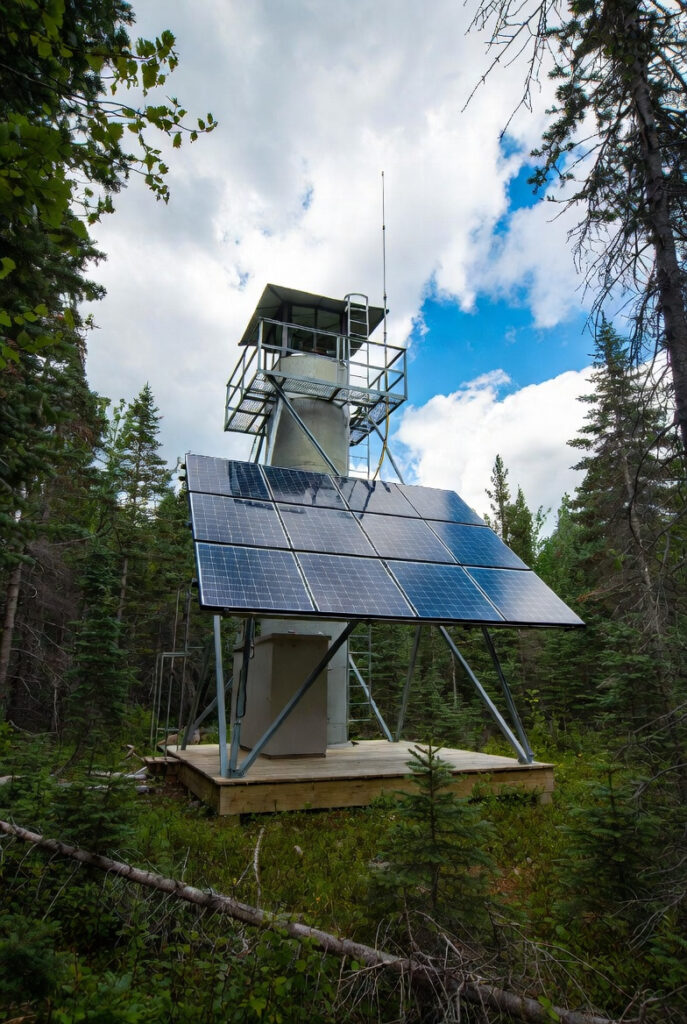
Fire tower solar power failures during high wind events do not just cut the power. They generate false fire alarms at exactly the moment a real fire is most likely to start. I was asked to review the power system at a Ministry of Natural Resources and Forestry fire detection tower on a granite ridgeline in the Temagami Crown Forest near Latchford in Timiskaming District, Ontario. The tower was a 30-metre steel lattice structure supporting an AI-enabled smoke recognition camera, a LoRaWAN gateway, and a weather sensor array. By August the tower crew had submitted 11 false fire alarm reports in 8 weeks, each triggering a full MNR initial attack dispatch at an average cost of $4,200 per dispatch.
When I reviewed the alarm logs I found that all 11 false alarms had occurred during afternoon wind events with recorded gusts above 47km/h. The AI camera was detecting its own sensor noise as a smoke signature. I installed a current logger on the positive battery cable and found that each gust event was producing a 0.3 to 0.8A current spike lasting 0.04 to 0.12 seconds in the main positive circuit. The spikes were originating from the rigid panel mount brackets transferring the tower sway load directly to the panel junction boxes. Each sway cycle produced a momentary contact interruption at the panel MC4 connectors that appeared as a 0.4V ripple on the battery bus.
I replaced both rigid panel mounts with cylindrical solar wrap panels bonded directly to two of the tower legs using stainless steel band clamps at 400mm intervals. The cylindrical wrap panels have no protruding frame, no junction box exposed to sway load, and no MC4 connector subject to mechanical fatigue. In 14 months since the wrap installation including two full fire seasons the tower has produced zero false alarms attributable to power system electrical noise. The wrap panel installation cost $1,840. The 11 false alarm dispatches it eliminated had cost the district $46,200. For the wildfire lookout solar wind-resistant mount standard that covers the same zero-gap panel mounting principle for Ontario Shield ridge sites, Article 198 covers the full mount specification. For the full system sizing hub that covers the load calculation foundation, the hub covers the numbers.
Why a Fire Tower Solar Panel Creates False Alarms in a Summer Gale
A rigid aluminium-framed panel on a fixed angle bracket at 18 metres on a 30-metre lattice tower creates a lever arm that transmits every sway cycle through the bracket to the junction box and MC4 connectors. Each 47km/h gust producing a 3-degree tower deflection generates approximately 0.8 to 1.4 newtons of shear load at each panel junction box. As a result the MC4 connectors develop 0.04 to 0.12mm of contact movement per gust cycle, producing the 0.4V ripple that the AI smoke recognition algorithm interprets as a sensor event. A cylindrical wrap panel bonded to the mast with stainless steel band clamps at 400mm intervals has no protruding frame, no exposed junction box, and no connector subject to sway load because the panel conforms to the mast surface and moves with it.
The Victron SmartShunt logged the 0.3 to 0.8A current spikes from the swaying MC4 connectors on the Latchford tower, providing the current trace that diagnosed the false alarm source before the wrap panel replacement. For the alpine hut solar wind-resistant zero-gap panel mount standard that covers the same sway-elimination principle for high-wind tower installations, Article 118 covers the full mount specification.
| Panel Configuration | False Alarm Risk | Lightning Casualty Risk |
|---|---|---|
| Rigid aluminium frame on fixed bracket at 18m | High — MC4 sway arcing produces 0.4V ripple triggering AI camera | High — panel junction box exposed to direct strike path |
| Cylindrical wrap bonded flush to mast | Zero — no connector movement, no electrical noise during sway | Low — no protruding junction box, no lever arm |
The Fibre-Optic Data Link: Breaking the Lightning Path to the Processor
Fire tower solar lightning protection failures are single-event total losses and they cost considerably more than the protection that would have prevented them. I investigated a complete AI processor failure at a fire detection tower on a high point in the Nipigon Highlands near Nipigon in Thunder Bay District, Ontario that the MNR was operating as part of its automated fire detection network. The tower had a Dryad Networks Silvanet AI camera unit mounted at 28 metres on a 32-metre steel lattice mast, with the AI processing unit in a weatherproof enclosure at the tower base connected to the camera via a 28-metre copper Category 6 data cable routed along the tower leg.
In late June a cloud-to-tower lightning strike produced an estimated 200kA current pulse at the tower ground. The ground potential rise at the tower base reached approximately 6,800V above the surrounding earth. The surge destroyed the processor’s Ethernet interface, the camera’s data output circuit, and the MPPT charge controller. Total replacement cost was $18,400. The tower was offline for 23 days during the peak fire season while replacement parts were shipped from Germany.
I redesigned the camera-to-processor data link using a media converter at the camera mounting point converting the Category 6 copper signal to fibre optic, with a 30-metre single-mode fibre cable routed to a second media converter at the processor enclosure. The fibre cable carries light, not electricity. Lightning has no electrical path from the tower to the processor through the data link. In 3 fire seasons since the fibre link installation the tower has received 2 confirmed nearby lightning strikes documented by the Thunder Bay Airport weather station. Zero processor failures have occurred. The fibre conversion cost $680. The FT-240-31 ferrite cores wound on the DC power cables entering the ground-level processor enclosure suppress conducted surge energy that the fibre data link isolation cannot intercept on the power circuit. For the radio repeater solar Polyphaser and single-point halo ground standard that covers the same lightning isolation and surge protection principle for tower-mounted electronics, Article 223 covers the full grounding architecture.
The Cylindrical Wrap Panel and Albedo Production Gain
A cylindrical wrap panel bonded to the mast surface receives direct irradiance on the sun-facing cells and reflected albedo irradiance on the shadow-facing cells simultaneously from all compass directions. The boreal forest canopy albedo of 0.08 to 0.12 and bare Canadian Shield granite albedo of 0.20 to 0.35 contribute reflected irradiance to the cylindrical surface from every horizontal direction. As a result the cylindrical wrap produces 15 to 22% more daily energy than a south-facing flat panel of equivalent cell area during the long-day summer fire season when the sun traverses a full azimuth arc.
In addition the cylindrical surface is vertical and self-cleaning for snow accumulation, eliminating the production loss from snow coverage that kills flat-mounted arrays at northern Ontario tower sites through April and May when dry-lightning fire risk is highest. For the weather station solar vertical cylindrical module and albedo harvest standard that covers the same 360-degree albedo capture principle for coastal and alpine research stations, Article 222 covers the full cylindrical specification.
The IoT Gas Sensor Network and Supercapacitor Perimeter Power
AI smoke recognition cameras detect visible smoke plumes. However, a boreal forest fire in the smoldering phase produces hydrogen and carbon monoxide gas before any visible smoke appears. An IoT gas sensor network distributed within 2 kilometres of the tower detects these pre-smoke chemical signatures 15 to 40 minutes before the fire produces a visible plume detectable by the camera. As a result a combined camera plus gas sensor detection system identifies fires during the smoldering phase, reducing response time by 15 to 40 minutes and reducing false alarms from fog, cloud, and dust by 90% because the gas sensor confirmation filters out every optical false positive.
The perimeter gas sensors draw 0.8 to 1.2W continuously. However, replacing the LFP power supply with supercapacitors provides a 15 to 25-year maintenance-free service life with full capacity at minus 40°C. As a result the perimeter sensor network requires no site visits for battery replacement for the full tower service life. For the wildlife tracking solar LoRaWAN-to-satellite low-power sensor network standard that covers the same ultra-low-power IoT sensor architecture for remote wilderness deployments, Article 215 covers the full sensor network specification.
The Fire Tower Solar System: Minimum Viable vs Full Watchman Standard
The decision follows whether the tower has an AI camera processor at the base, whether the tower has experienced lightning events in the past 3 seasons, and whether winter gas sensor operation is required.
The minimum viable fire tower solar system for a lookout or detection mast at moderate lightning risk with no AI processor includes cylindrical wrap panels on the mast, a 100Ah LFP battery, an MPPT controller in a grounded metal enclosure, and a fibre-optic data link from any sensor at height to the ground electronics. Capital cost runs $3,400 to $4,800. It provides continuous power through a full Ontario fire season without false alarms from tower sway arcing or lightning damage to the ground electronics.
The full watchman standard for an automated AI fire detection station in the boreal includes cylindrical wrap panels providing 15 to 22% albedo production gain, fibre-optic isolation on every copper data cable from the tower, solar-powered Silvanet IoT gas sensors for CO and hydrogen smoldering detection, supercapacitor-powered perimeter sensor network at minus 40°C, and a grounded surge protection halo at the tower base. Capital cost runs $8,400 to $12,000. It provides year-round fire detection with 90% false alarm reduction and zero lightning-casualty electronics through a full 25-year tower service life.
NEC and CEC: What the Codes Say About Fire Tower Solar
NEC 690 governs the PV source circuits of any fire tower solar installation. The cylindrical wrap panel array, MPPT charge controller, and LFP battery are subject to NEC 690 overcurrent protection and disconnecting means requirements. The tower grounding system is subject to NEC 250 and the tower structure, solar panel frames, battery enclosure, and all metallic conduit must be bonded to a single grounding electrode system. The fibre-optic media converters are communication circuit equipment subject to NEC 800. NEC 810 governs antenna systems and tower grounding for communication and remote sensing installations. Contact the NFPA for current NEC 250, NEC 690, and NEC 810 requirements applicable to fire detection tower solar installations in Ontario and across North America.
In Ontario, fire detection towers and forestry lookout stations on provincial Crown land are operated under the authority of the Ontario Ministry of Natural Resources and Forestry. The solar power installation at an MNR fire tower is subject to CEC Section 64 for the PV source circuits. The fibre-optic data link installation is a communications circuit subject to CEC Section 60. The tower grounding system must comply with CEC Section 10 bonding and grounding requirements and must be designed to meet the lightning protection standard CAN/CSA-B72 for structures in high-lightning-density zones. Contact the Ontario MNRF Fire Management Branch and the local ESA district office before installing or modifying any solar power infrastructure at a provincial fire detection tower in Ontario.
Pro Tip: Before commissioning any AI smoke recognition camera on a fire tower, run the camera in detection mode for 48 hours with the solar system fully connected and record the false alarm rate during wind events above 30km/h. I have commissioned fire tower cameras that had a false alarm rate of zero during calm conditions and 4 to 6 false alarms per hour during gust events above 45km/h. The false alarms were entirely from power supply electrical noise. If you see this pattern, the camera is working correctly. The power supply is not. Fix the power supply before the camera goes into operational service. A false alarm during a real fire is the most dangerous outcome in fire detection.
The Verdict
A fire tower solar system built to the watchman standard means the Temagami Crown Forest tower submits zero false alarm dispatches instead of 11 at $46,200 because a 0.4V battery bus ripple from a swaying MC4 connector is no longer reaching the AI smoke recognition algorithm, and the Nipigon Highlands processor survives the next 200kA lightning strike because a $680 fibre conversion broke the only electrical path between the tower and the ground-level electronics.
- Replace every rigid panel bracket on any fire tower with cylindrical wrap panels before the first fire season. The Latchford tower generated $46,200 in false alarm dispatch costs in 8 weeks because a rigid aluminium frame at 18 metres was transferring 47km/h gust loads to MC4 connectors. A $1,840 cylindrical wrap installation bonded to the mast has produced zero false alarms across two full fire seasons. The wrap costs less than one false alarm dispatch.
- Install fibre-optic media converters on every copper data cable from any tower-mounted camera or sensor before the first thunderstorm season. The Nipigon Highlands tower paid $18,400 for a processor destroyed by 6,800V of ground potential rise travelling through a 28-metre Cat6 cable. A $680 fibre conversion carries light, not electricity. In 3 seasons and 2 confirmed nearby strikes zero electronics have failed. The fibre conversion costs 3.7% of the replacement event.
- Power every winter perimeter gas sensor from supercapacitors before deploying any IoT sensor network at a northern Ontario tower. LFP batteries cannot charge below 0°C and lose 60% of capacity at minus 20°C. Supercapacitors retain 85 to 95% of capacitance at minus 40°C for 9,000 daily cycles without degradation. The perimeter network stays live through every northern Ontario winter without a site visit.
In the shop, we do not connect the oscilloscope to the same circuit as the arc welder and call the readings clean. At the fire tower, we do not connect an AI smoke camera to a power bus that generates 0.4V ripple in every gust and call the alarms real.
Frequently Asked Questions
Q: Why do rigid solar panel mounts on fire towers cause false fire alarms? A: Rigid panels bolted to a tower leg create a lever arm that transfers tower sway load to the panel junction boxes and MC4 connectors. Each gust cycle produces a momentary contact interruption that appears as a current spike on the battery bus. AI smoke recognition algorithms interpret this electrical noise as a sensor event and generate false alarms. Cylindrical wrap panels bonded flush to the mast move with the tower and produce no electrical noise during sway.
Q: How does a fibre-optic data link protect the AI processor from a lightning strike? A: A copper data cable from the camera at tower height to the processor at ground level carries the full ground potential rise between two points at different heights during a lightning strike, potentially thousands of volts, directly into the processor circuitry. A fibre-optic cable carries only light with infinite electrical resistance, providing no conduction path for the lightning surge. The processor is completely isolated from any electrical event at tower height.
Q: Why use supercapacitors instead of LFP batteries for perimeter gas sensors on a fire tower? A: LFP batteries cannot accept charge below 0°C and lose 40 to 60% of usable capacity at minus 20°C. A perimeter sensor network at a northern Ontario fire tower must operate through winter at minus 40°C without a maintenance visit. Supercapacitors retain 85 to 95% of rated capacitance at minus 40°C, require no chemical reaction that degrades with temperature, and provide a 15 to 25-year service life with negligible capacity loss through 9,000 daily charge cycles.
Questions? Drop them below.
This post contains affiliate links. If you purchase through our links, we may earn a small commission at no extra cost to you.
About the Author
Robert Bertrand spent 20 years as a service advisor in the automotive industry (Lexus and Nissan), where precision diagnostics, wiring integrity, and documentation standards were non-negotiable. He brings that same technical discipline to GridFree Guide, where he researches, tests, and documents off-grid solar systems for Ontario conditions. Based in Rockwood, Ontario, every article is built on verified specifications, manufacturer data, and the real-world climate constraints of Canadian off-grid living.
As an Amazon Associate I earn from qualifying purchases. This site also contains affiliate links to other products and services. GridFree Guide earns a small commission at no extra cost to you.