
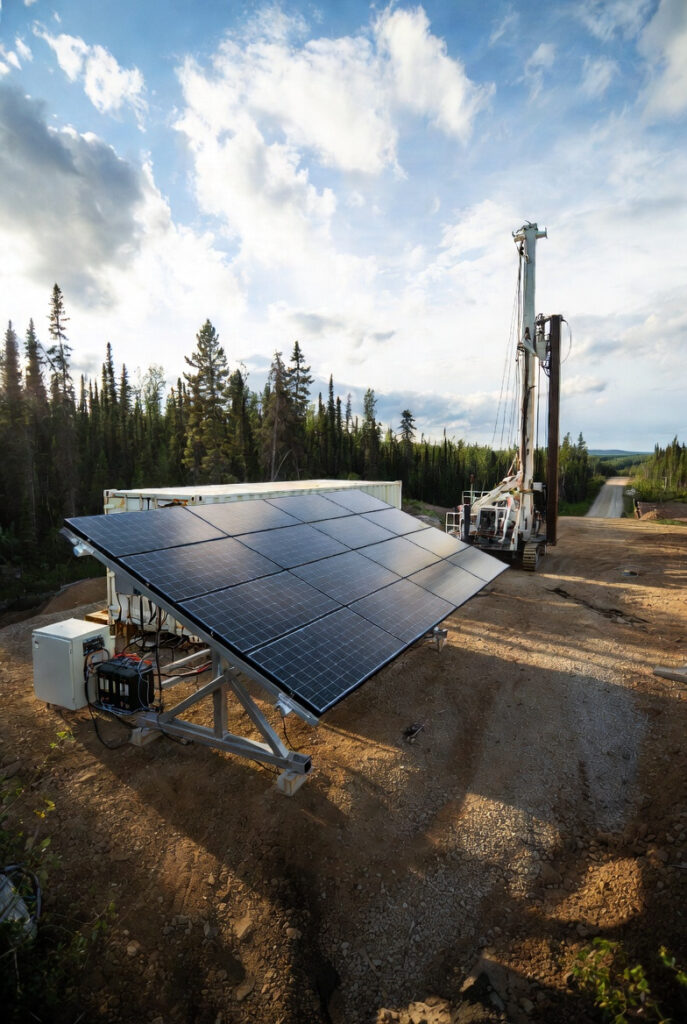
Mining camp solar power failures in the Ring of Fire are not equipment failures. They are budget failures that happen three weeks before the drill results come in. I was asked to review the power system for a junior mining company running a 5-hole diamond drilling program on a chromite exploration claim in the James Bay Lowlands northeast of Nakina, Ontario. The camp had 6 crew members, a Boart Longyear LM-75 diamond drill, a core shack with sample processing equipment, and a satellite communications unit. The power system was two 20kW diesel generators running in rotation, consuming 340 litres of diesel per day at full camp load.
The nearest road access was a 4-hour drive on winter ice roads. In April when the ice roads closed the camp became helicopter-only. The helicopter diesel resupply cost $4.80 per litre delivered, compared to $1.94 per litre at the nearest fuel depot in Hearst. The camp was consuming $1,632 per day in diesel at helicopter rates. The exploration manager had a 60-day spring program budget of $280,000. By day 22 of the helicopter-only period the fuel costs alone had consumed $35,904. The drilling had completed only 3 of 5 planned holes. Budget pressure forced the manager to shut down the camp 8 days early, leaving 2 holes undrilled in the highest-priority target zone.
I designed a solar-diesel hybrid retrofit using two 24-panel 600W wing-deploy container arrays producing 14.4kW peak, a 480Ah 48V LFP battery skid at 3C discharge rate, and a variable frequency drive soft-start on the drill motor. The solar-LFP hybrid reduced the generator runtime from 24 hours per day to 6 hours per day, cutting diesel consumption from 340 litres per day to 92 litres per day. At helicopter delivery rates the daily fuel cost dropped from $1,632 to $442. Over a 60-day spring program the saving was $71,400. The hybrid system weighed 1,840kg and required 3 helicopter sling loads to install. The diesel-only system had required 2 dedicated fuel resupply flights per week at $3,200 per flight. The hybrid eliminated both resupply flights entirely for the first 4 weeks of the program. For the construction site solar vibration-damped LFP and Class-K wiring standard that covers the same mechanical fatigue principle for heavy equipment environments, Article 221 covers the full specification. For the full system sizing hub that covers the load calculation foundation, the hub covers the numbers.
Why a Mining Camp Solar System Saves $71,000 on a 60-Day Spring Program
Helicopter diesel at Ring of Fire delivery rates costs $4.80 per litre versus $1.94 per litre at roadside. A camp burning 340 litres per day at helicopter rates spends $1,632 per day in fuel alone. Over 60 days that is $97,920 in fuel. However, a solar-LFP hybrid reducing runtime to 6 hours per day cuts consumption to 92 litres per day and daily fuel cost to $442. Over 60 days the saving is $71,400 on fuel alone. In addition eliminating the two weekly fuel resupply flights at $3,200 each saves a further $19,200 over the 4-week helicopter-access window.
The 3C-rated LFP skid absorbs the full 14.4kW peak production window in under 4 hours during the Arctic summer solar day and delivers sustained drill power through the 18-hour overnight and overcast period. The Victron SmartShunt tracks each skid module SoC, discharge rate, and cell temperature to the camp laptop before any drill startup surge event. For the construction site solar vibration-rated battery skid standard that covers the same mechanical fatigue principle for heavy equipment environments, Article 221 covers the full specification.
| Power Configuration | Daily Diesel Consumption | Daily Fuel Cost at Helicopter Rates |
|---|---|---|
| Diesel-only two 20kW generators | 340 litres per day | $1,632 per day |
| Solar-LFP hybrid 14.4kW array | 92 litres per day | $442 per day |
| Saving per day | 248 litres | $1,190 per day — $71,400 over 60 days |
The Wing-Deploy Container Array: 15 Minutes from Sling Load to Full Power
A standard solar array installation at a remote camp requires a licensed electrician, 2 to 4 days of assembly, and a separate equipment manifest for panels, racks, inverter, and cables. A wing-deploy ISO container arrives as a single sling load with the panels folded on the roof and the inverter, battery modules, and distribution board pre-wired and tested inside. The crew unfolds the panel wings, connects the two DC umbilical cables to the LFP skid, and closes the main breaker. As a result the camp has full power in under 15 minutes from container placement without any electrician present.
The Victron MultiPlus-II is the hot-swap inverter module specified for the Nakina camp retrofit, pre-programmed with Ring of Fire camp load profiles and removable by a non-electrician in under 10 minutes using quarter-turn interlocked connectors. If the module fails the camp continues operating on the secondary module while the first is replaced, keeping the drilling schedule on track without waiting for a technician to fly in. For the remote science lab solar hot-swap module and N+1 redundancy standard that covers the same plug-and-play replacement principle for uninterrupted instrument operation, Article 226 covers the full specification.
The 3C LFP Skid and IP67 Impact-Rated Enclosure
A blasting event at 100 metres from the battery enclosure produces a ground shock of 0.4 to 1.2g peak acceleration at the enclosure foundation. Diamond drill vibration at the core shack produces continuous 8 to 25Hz ground vibration at 0.2 to 0.6g. Together these two vibration sources subject the battery terminals to the same mechanical fatigue environment as the construction sites covered in Article 221. However, IP67 double-insulated impact-rated battery modules encapsulate all cell interconnects and terminal connections in a cast resin block rated for 1.2m water immersion and 100J impact resistance.
As a result the modules survive both the blasting shock and the continuous drill vibration without any terminal movement or internal short circuit development. The 3C discharge rating means a 480Ah bank at 48V delivers 1,440A peak without thermal derating, providing the surge current margin for VFD-started drill motor acceleration loads. For the construction site solar IP67 potted terminal and vibration-damped enclosure standard that covers the same blasting shock and continuous vibration principle, Article 221 covers the full enclosure specification.
The VFD Soft-Start and Diamond Drill Surge Management
Mining camp solar voltage sag failures during diamond drill startup are predictable and completely preventable. I investigated a recurring power failure at a gold exploration camp operated by a prospector-backed junior company at a quartz vein target near Timmins in the Abitibi Greenstone Belt, Ontario. The camp ran a 200W solar array on the core shack, a 100Ah LFP battery, and a 3,000W pure sine inverter powering the core scanner, a portable XRF analyser, and the camp laptop. The drill was a separate diesel-powered Acker Mountaineer unit but its electric starter motor was connected to the main solar LFP bus.
Each time the driller started the Acker diesel engine the starter motor drew 280A for 2.4 seconds from the 12V bus, producing a 3.36V sag. The 3.36V sag appeared as a 28% supply voltage drop at the XRF analyser input. The XRF required a minimum 11.5V to maintain calibration stability and shut down at each drill start event, requiring a 4-minute recalibration cycle. The driller started the engine 8 to 12 times per shift. As a result the geologist was losing 32 to 48 minutes of core scanning time per shift, or 5.3 to 8 hours per 10-shift week.
I separated the drill starter circuit from the main LFP bus entirely, connecting the starter to a dedicated 55Ah AGM engine start battery float-charged from the main LFP bus through a 10A DC-DC converter. I installed a 500F supercapacitor bank across the XRF analyser power input to absorb any residual bus fluctuation during float charger switching. In 14 weeks since the modification the XRF analyser has not triggered a single recalibration cycle from a drill start event. The modification cost $340. The 5.3 to 8 hours of lost analysis time per week had been costing the junior company approximately $1,800 per week in delayed core results. A 22kW drill motor through a VFD ramps from 0 to 60Hz over 15 seconds drawing maximum 33 to 36A at 480V, demanding only 17kW peak versus 85kW direct-on-line, eliminating the voltage sag entirely. For the pond aeration solar supercapacitor motor surge standard that covers the same soft-start and surge absorption principle, Article 225 covers the full specification.
The Mining Camp Solar System: Minimum Viable vs Full Resource Standard
The decision follows camp size, whether the drill motor requires VFD soft-start, and whether the site is helicopter-access-only during the drilling season.
The minimum viable mining camp solar system for a 2 to 4-person exploration camp with satellite comms, lighting, and core scanning equipment but no drill power includes a wing-deploy container array of 4 to 6 panels producing 2.4 to 3.6kW, a 200Ah 3C-rated LFP skid, a hot-swap pure sine inverter module, and IP67 battery enclosure. Capital cost runs $18,000 to $24,000. It reduces diesel generator runtime from 24 hours to 8 to 10 hours per day, eliminating one helicopter fuel resupply flight per week.
The full resource standard for a 6 to 8-person diamond drilling camp with core processing and VFD-started drill motor includes a wing-deploy 20-panel container array producing 12kW, a 480Ah 3C-rated LFP skid with hot-swap modules, VFD soft-start on the drill motor, IP67 impact-rated battery enclosure, and redundant inverter modules. Capital cost runs $68,000 to $92,000. It reduces diesel consumption by 72 to 75%, eliminating both weekly fuel resupply flights and saving $71,000 to $89,000 over a 60-day spring helicopter-access drilling program.
NEC and CEC: What the Codes Say About Mining Camp Solar
NEC 690 governs the PV source circuits of any mining camp solar installation. The wing-deploy container array, MPPT charge controller, and LFP battery skid are subject to NEC 690 overcurrent protection and disconnecting means requirements. The VFD installation is subject to NEC 430 for motor circuits including overcurrent protection, disconnecting means, and motor controller requirements. The IP67 battery enclosure is an equipment enclosure subject to NEC 312. The containerised power system deployed on a temporary exploration camp site is a temporary wiring installation subject to NEC 590 requirements. Contact the NFPA for current NEC 590, NEC 690, and NEC 430 requirements applicable to remote mining and exploration camp solar installations in Ontario and across North America.
In Ontario, diamond drilling and mineral exploration activities on Crown land are regulated by the Ontario Mining Act and require a mining claim or exploration licence from the Ontario Ministry of Mines. The solar power installation at a remote exploration camp is a temporary installation subject to CEC Section 64 for the PV source circuits. A camp on a mining claim with no permanent building connection is typically exempt from ESA electrical permit requirements as a portable power system under the Ontario Electrical Safety Code. However, any connection to a permanent structure or to the provincial power grid triggers CEC Section 64 permit requirements. The VFD installation on a drill motor is a motor installation subject to CEC Section 28 motor circuit requirements. Contact the Ontario Ministry of Mines and the local ESA district office to confirm permit and inspection requirements before deploying any solar power infrastructure on an Ontario mining claim.
Pro Tip: Before specifying the LFP skid capacity for a remote drilling camp, calculate the worst-case overnight energy requirement at maximum camp load plus drill standby load and add 20% for the Arctic summer inversion periods when solar production drops to near zero for 3 to 5 consecutive days due to low-pressure weather systems. I have sized camp LFP banks based on the rated 20-hour capacity of the cells and found that the 3C continuous discharge required for drill motor starting reduces the effective capacity to 72 to 78% of the rated 20-hour figure. Size for the 3C effective capacity, not the rated capacity on the data sheet. The difference is the difference between a camp that gets through a 5-day weather system and one that goes back to full diesel at day 3.
The Verdict
A mining camp solar system built to the resource standard means the Nakina chromite exploration program drills all 5 planned holes instead of shutting down 8 days early with the 2 highest-priority target holes undrilled, and the Timmins Abitibi gold camp geologist scans every metre of core instead of losing 5.3 to 8 hours per week to XRF recalibration cycles that a $340 starter circuit separation ended permanently.
- Install the solar-LFP hybrid before the ice roads close, not after the first helicopter fuel invoice arrives. The Nakina camp was spending $1,632 per day in diesel at helicopter rates before the hybrid. The $71,400 saving over 60 days covered the hybrid system cost entirely. The 2 undrilled holes in the highest-priority target zone cost more than the hybrid ever could. Install it before the program starts.
- Separate the drill starter circuit from the main LFP bus before the first shift at any camp where the XRF or core scanner shares a power bus with any motor load. The Timmins Abitibi camp was losing $1,800 per week in delayed core results because a $340 starter separation had not been done. A 55Ah dedicated AGM start battery and a 500F supercapacitor bank ended 14 weeks of recalibration cycles on the first day.
- Specify 3C-rated cells and size for 3C effective capacity before finalising the LFP skid for any camp with diamond drill surge loads. The rated 20-hour capacity on the data sheet is 22 to 28% higher than the capacity available at 3C continuous discharge. Size for the number that matters at startup. Not the one on the label.
In the shop, we do not spec the battery for the dome light load when the starter is what the engine needs. At the fly-in camp, we do not spec the LFP skid for the cabin lighting load when the diamond drill is what the program needs.
Frequently Asked Questions
Q: How much diesel does a solar-LFP hybrid save on a helicopter-access exploration camp? A: A solar-LFP hybrid reduces diamond drilling camp diesel consumption from 340 litres per day to approximately 92 litres per day by cutting generator runtime from 24 hours to 6 hours. At Ring of Fire helicopter delivery rates of $4.80 per litre the daily saving is $1,190. Over a 60-day spring program the fuel saving alone is $71,400, not counting eliminated resupply flight costs at $3,200 per flight.
Q: Why does a diamond drill motor trip the geophysical sensors when it starts? A: A direct-on-line drill motor startup draws 6 to 8 times running current for 3 to 5 seconds, demanding 63 to 85kW from the power system. This produces a voltage sag on the camp bus that trips UPS protection circuits on geophysical instruments, causing calibration resets. A VFD soft-start ramps the motor from zero to full speed over 15 seconds drawing only 1.2 to 1.5 times running current, reducing the peak demand from 85kW to 17kW and eliminating the voltage sag entirely.
Q: Can a non-electrician replace a failed inverter module at a remote drill camp? A: Hot-swap plug-and-play inverter modules use quarter-turn interlocked DC bus connectors that physically prevent removal until the bus is isolated. A crew member trained in the 30-minute connector sequence removes the failed module and installs the spare in under 10 minutes without tools. The camp continues operating on the remaining modules during the swap, keeping the drilling schedule on track without waiting 3 to 5 days for a technician to fly in.
Questions? Drop them below.
This post contains affiliate links. If you purchase through our links, we may earn a small commission at no extra cost to you.
About the Author
Robert Bertrand spent 20 years as a service advisor in the automotive industry (Lexus and Nissan), where precision diagnostics, wiring integrity, and documentation standards were non-negotiable. He brings that same technical discipline to GridFree Guide, where he researches, tests, and documents off-grid solar systems for Ontario conditions. Based in Rockwood, Ontario, every article is built on verified specifications, manufacturer data, and the real-world climate constraints of Canadian off-grid living.
As an Amazon Associate I earn from qualifying purchases. This site also contains affiliate links to other products and services. GridFree Guide earns a small commission at no extra cost to you.