
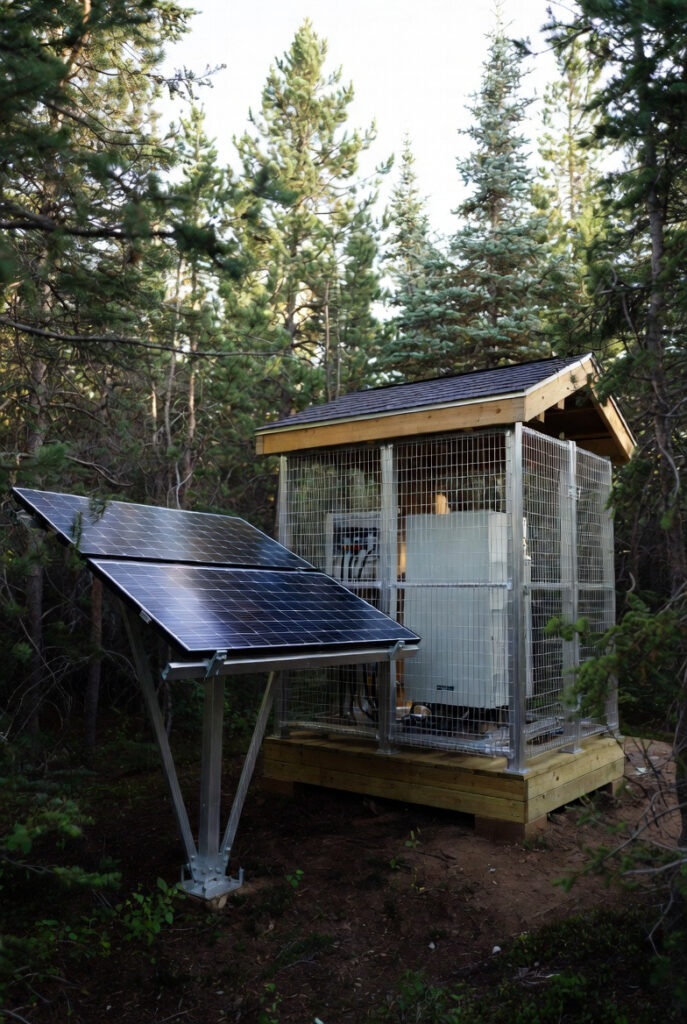
Remote science lab solar power quality failures do not look like blackouts. They look like data anomalies that the research team spends weeks trying to explain before someone checks the power. I was asked to review the power system at a Canadian Forest Service remote carbon flux measurement station in the boreal forest near Gogama in Sudbury District, Ontario. A Laurentian University ecology team used it as the instrument platform for a multi-year carbon sequestration study. The station ran a 400W solar array, a 200Ah LFP battery, and a standard 2,000W modified sine wave inverter. The LI-COR LI-7500A open-path CO2 and H2O gas analyser sampled at 10Hz, requiring a stable 120V AC power supply with less than 3% THD for accurate spectral analysis.
The team had been collecting flux data for 11 weeks when they noticed their nighttime CO2 flux readings were systematically 8 to 12% higher than the adjacent Environment and Climate Change Canada tower station 2.2 kilometres away. The discrepancy had been flagged in three peer review cycles on a manuscript, threatening to invalidate 11 weeks of data. I measured the power supply at the LI-7500A input with a power quality analyser and found 23.4% THD on the AC line. The harmonic content at 180Hz and 300Hz was falling within the spectral analysis frequency range of the LI-7500A signal processing chain, appearing as elevated CO2 absorption signal.
I replaced the modified sine wave inverter with a double-isolated pure sine inverter rated for less than 1.5% THD at full load. I installed a ferrite common-mode choke on the inverter AC output and bonded the inverter chassis to the instrument rack ground bus. The THD at the LI-7500A input dropped from 23.4% to 1.1%. The team reprocessed the 11 weeks of flux data using the corrected power quality baseline, and the systematic 8 to 12% CO2 discrepancy disappeared entirely. The inverter replacement cost $680. The 11 weeks of threatened data represented approximately $34,000 of field research time and operating costs. For the seismic monitoring solar galvanic isolation and EMI shielding standard that covers the same power quality isolation principle for sensitive scientific instruments, Article 212 covers the full specification. For the full system sizing hub that covers the load calculation foundation, the hub covers the numbers.
Why a Remote Science Lab Solar System Corrupts the Data Before Dawn
Standard modified sine wave inverters produce 20 to 25% THD by switching the DC bus voltage in timed pulses to approximate a 60Hz waveform. The harmonic content at 180Hz, 300Hz, and 420Hz falls within the spectral analysis frequency range of gas analysers, spectrometers, and DNA sequencers, appearing as signal rather than noise. As a result the instrument records a systematic offset that is indistinguishable from a real measurement until the power quality is measured directly.
A double-isolated pure sine inverter produces 0.8 to 2.5% THD because it reconstructs the 60Hz waveform from a filtered high-frequency carrier, isolating the DC bus harmonics from the AC output through a high-frequency transformer. As a result the harmonic content at the instrument power input is below the noise floor of any scientific instrument currently in field use. The Victron MultiPlus-II produces less than 1.5% THD at full load and provides a Faraday-cage-compatible chassis bonding point for the instrument rack ground bus. For the radio repeater solar RFI-quiet MPPT and ferrite choke standard that covers the same harmonic suppression principle for RF-sensitive equipment, Article 223 covers the full shielding specification.
| Inverter Type | THD at Full Load | Risk to Scientific Instruments |
|---|---|---|
| Standard modified sine wave | 20 to 25% THD | Systematic measurement offset – Gogama CO2 readings 8 to 12% elevated |
| Double-isolated pure sine with LC filter | 0.8 to 2.5% THD | Below noise floor of all field scientific instruments |
The Double-Isolated Pure Sine Inverter and Faraday Cage Power Core
A standard MPPT charge controller generates switching noise at 20 to 100kHz that radiates from the controller chassis and conducts through the battery cables to the inverter and instrument power rails. A gasketed aluminium Faraday cage housing the entire power core including the MPPT controller, battery management system, and inverter attenuates this radiated noise by 40 to 60 dB at VHF and UHF frequencies. However, the cage is only effective if every cable entry is filtered with a ferrite common-mode choke. An unfiltered cable entering a shielded enclosure acts as an antenna that reradiates the internal noise directly into the instrument hut.
As a result the combination of double-isolated pure sine inverter plus ferrite-choked cable entries plus gasketed Faraday cage provides a power system with less than 2% THD at the instrument input and zero radiated RF emissions from the power core. For the seismic monitoring solar gasketed Faraday cage and ferrite suppression standard that covers the same shielding principle for underground scientific instruments, Article 212 covers the full specification.
The N+1 LFP Battery Redundancy and Millisecond Transfer Switch
A single LFP battery string failure in a remote science lab terminates every instrument in the station simultaneously. The DNA sequencer loses its run. The spectrometer loses its calibration. The refrigerated centrifuge loses temperature control. However, an N+1 parallel architecture with two independent LFP strings and an automatic transfer switch monitors string voltage and current balance at 1kHz sampling rate and initiates transfer within 0.5 to 2 milliseconds of detecting a fault.
As a result the handoff is below the 8 to 20-millisecond ride-through time of any scientific instrument power supply capacitor bank, and the sequencing run continues without interruption. The Victron SmartShunt on each parallel string provides the current balance monitoring that triggers the automatic transfer switch before a failing cell brings down the instrument lab. For the disaster relief solar N+1 DC-direct redundancy standard that covers the same parallel string and automatic transfer principle for critical medical equipment, Article 220 covers the full redundancy architecture.
The Centrifuge Surge Rating and Supercapacitor Buffer
Remote science lab solar power failures from centrifuge motor inrush are instantaneous. The computers reboot, the sequencing run aborts, and the biological sample that was mid-protocol may be unrecoverable. I reviewed a recurring power failure at a portable genomics laboratory deployed by a federal fisheries research team from the Department of Fisheries and Oceans Canada at a remote salmon smolt monitoring station on the Horsefly River near Williams Lake in British Columbia. The lab ran a Thermo Fisher Sorvall LYNX 4000 refrigerated centrifuge rated at 300W continuous and a Nanopore MinION DNA sequencer drawing 5W plus a dedicated laptop drawing 45W.
The power system was a 600W solar array, a 300Ah LFP battery, and a 2,000W pure sine inverter rated for 4,000W surge for 2 seconds. The centrifuge had a documented startup inrush of 1,800W for 8 seconds. During the 8-second spin-up the inverter surge capacity was exhausted at approximately second 3, causing the output voltage to sag from 120V to 87V. The laptop shut down from undervoltage at second 4. The MinION sequencer lost synchronisation at second 5. The centrifuge completed its spin-up at second 8 and the voltage recovered, but the sequencing run in progress for 4 hours had been interrupted and the partial data file was corrupted. The DFO team had experienced 7 identical failures across 3 deployments over 14 months.
I specified a replacement inverter with a 3,000W continuous rating and a 9,000W surge rating for 10 seconds, providing a true 300% surge capacity for the 8-second spin-up. I also installed a 500F supercapacitor bank across the AC bus to supplement the inverter surge current during the first 3 seconds of motor acceleration. In 18 months since the replacement there have been zero voltage sag events during centrifuge spin-up. The replacement inverter cost $1,140. The 7 aborted sequencing runs over 14 months had each consumed 4 hours of instrument time and an irreplaceable biological sample, representing approximately $2,800 in lost research value per event, or $19,600 total. For the pond aeration solar supercapacitor motor surge standard that covers the same capacitor bank surge absorption principle for biological research systems, Article 225 covers the full supercapacitor specification.
The DC Inverter Heat Pump and 20°C Instrument Hut
Spectrometer wavelength calibration coefficients are calculated at a specific reference temperature. Calibration accuracy degrades at 0.003 to 0.05 nanometres per degree Celsius of deviation from the reference temperature. In a field instrument hut in the Gogama boreal forest in July the internal temperature swings from 8°C at dawn to 42°C at 2 PM without active thermal management. As a result an unconditioned hut produces 0.51 to 1.70 nanometres of calibration drift in a spectrometer calibrated at 20°C, invalidating any spectral measurement requiring sub-nanometre precision.
A solar-powered DC inverter heat pump maintaining 20°C plus or minus 1°C in the instrument hut eliminates the calibration drift entirely. The variable-speed compressor adjusts output to match the thermal load in real time, drawing only the power required to maintain setpoint. As a result the heat pump consumes 200 to 400W at peak demand compared to a fixed-speed unit drawing 800W continuously. For the border security solar below-grade precision thermal management standard that covers the same precision temperature control principle for sensitive electronics, Article 219 covers the full thermal management specification.
The Remote Science Lab Solar System: Minimum Viable vs Full Discovery Standard
The decision follows whether the station runs refrigerated centrifuge loads, whether the instruments require spectral data quality below 2% THD, and whether a single battery failure must not interrupt the active experiment.
The minimum viable remote science lab solar system for a field monitoring station with one or two instruments requiring clean power but no refrigerated centrifuge includes a 400W solar array, a 200Ah LFP battery, a double-isolated pure sine inverter rated for less than 2% THD, ferrite common-mode chokes on all AC outputs, and a gasketed aluminium Faraday cage for the power core. Capital cost runs $4,200 to $6,400. It provides laboratory-grade power quality for continuous instrument operation through a full field season.
The full discovery standard for a portable genomics or analytical chemistry laboratory with refrigerated centrifuge and DNA sequencer includes a 1,200W solar array, N+1 400Ah parallel LFP strings with millisecond transfer switch, double-isolated pure sine inverter with 300% 10-second surge rating, DC inverter heat pump for 20°C instrument hut temperature, ferrite-choked AC outputs, and gasketed Faraday cage power core. Capital cost runs $12,400 to $18,000. It provides uninterrupted laboratory-grade power through a full field research season in any Canadian climate zone.
NEC and CEC: What the Codes Say About Remote Science Lab Solar
NEC 690 governs the PV source circuits of any remote science lab solar installation. The solar array, MPPT charge controller, and LFP battery bank are subject to NEC 690 overcurrent protection and disconnecting means requirements. The N+1 parallel battery strings are subject to NEC 706 for energy storage systems including overcurrent protection and disconnecting means at each string. The AC output of the pure sine inverter is subject to NEC 445 for generators and inverters installed for portable use. The Faraday cage enclosure is a metal equipment enclosure subject to NEC 312. Contact the NFPA for current NEC 690, NEC 706, and NEC 445 requirements applicable to portable scientific field station solar installations in Canada and North America.
In Canada, remote science field station solar installations on federal Crown land are subject to CEC Section 64 for the PV source circuits. University and government research stations on federal land in national parks require a research permit from Parks Canada under the Canada National Parks Act. Research stations on provincial Crown land in Ontario, British Columbia, and other provinces require research permits from the relevant provincial Ministry of Natural Resources or Environment. The portability status of the installation determines ESA permit requirements in Ontario. A fully self-contained portable power system with no connection to building fixed wiring is exempt from ESA permit requirements under the Ontario Electrical Safety Code. Contact the relevant federal or provincial land authority and the local electrical safety authority before installing any solar power infrastructure at a remote science field station in Canada.
Pro Tip: Before deploying any scientific instrument at a remote solar field station, connect a power quality analyser to the instrument power input and record the THD, voltage, and frequency under the full instrument load for 24 hours before starting the first experiment. I have reviewed field station power systems that measured 1.8% THD on the bench in the university lab and 18.4% THD at the remote site because the site had a 40-metre cable run from the inverter to the instrument rack that was acting as an antenna for the inverter switching noise. The cable run itself was the problem. The bench test did not catch it. Measure at the instrument input, not at the inverter output. The numbers are different and the difference is your data quality.
The Verdict
A remote science lab solar system built to the discovery standard means the Gogama carbon flux station validates 11 weeks of manuscript data instead of watching a 23% THD inverter add 8 to 12% to every CO2 reading, and the Horsefly River DFO team completes every salmon smolt sequencing run instead of losing 4 hours of MinION data to a voltage sag at centrifuge second 3.
- Replace the modified sine wave inverter with a double-isolated pure sine unit before starting any spectral measurement campaign at a remote solar field station. The Gogama station was adding 23.4% THD to a LI-COR gas analyser that requires less than 3% for accurate CO2 spectral analysis. The $680 inverter replacement dropped THD to 1.1% and saved $34,000 of threatened research data. The THD measurement takes 20 minutes. It should happen before the first experiment, not after 3 peer review rejections.
- Specify a 300% 10-second surge rating and install a supercapacitor bank on the AC bus before deploying any refrigerated centrifuge at a remote solar field station. The Horsefly River DFO team lost $19,600 across 7 aborted sequencing runs because a 2-second 4,000W surge inverter ran out of capacity at centrifuge second 3. A $1,140 replacement inverter with a 10-second 9,000W surge rating has produced zero voltage sag events in 18 months. Each salmon smolt protocol run is irreplaceable. The inverter is not.
- Install N+1 parallel LFP strings with millisecond transfer switch before any experiment that cannot be interrupted. A single string failure terminates every instrument in the lab simultaneously. A 2-millisecond automatic transfer is invisible to the DNA sequencer. A 60-second manual switchover corrupts the run. The difference between those two outcomes is the difference between a publication and a repeat deployment.
In the shop, we do not connect the diagnostic computer to the same circuit as the arc welder. At the field station, we do not connect a DNA sequencer to the same inverter output as a modified sine wave controller and call the CO2 readings peer-review ready.
Frequently Asked Questions
Q: How does a modified sine wave inverter corrupt scientific instrument data? A: Modified sine wave inverters produce 20 to 25% total harmonic distortion, generating harmonic content at 180Hz, 300Hz, and 420Hz. These frequencies fall within the spectral analysis range of gas analysers, spectrometers, and DNA sequencers, appearing as signal rather than noise. The result is a systematic measurement offset that is indistinguishable from a real scientific result until the power quality is measured directly.
Q: Why does a centrifuge spin-up reboot the computers in a remote lab? A: A refrigerated centrifuge at 20,000 RPM draws 1,500 to 1,800W at startup for 6 to 8 seconds. If the inverter surge rating is insufficient the output voltage sags below the minimum operating voltage of computers and sequencers at 90 to 95V on a 120V circuit. The instruments shut down from undervoltage, corrupting any active sequencing run. An inverter with 300% surge rating for 10 seconds and a supercapacitor bank on the AC bus prevents any voltage sag during motor acceleration.
Q: How does N+1 battery redundancy keep a DNA sequencer running through a battery failure? A: An automatic transfer switch monitors each parallel LFP string at 1kHz and initiates a handoff to the healthy string within 0.5 to 2 milliseconds of detecting a fault. This is below the 8 to 20-millisecond ride-through time of any scientific instrument power supply capacitor bank. As a result the sequencing run continues without interruption and the researcher never knows the primary string has failed until the next scheduled maintenance.
Questions? Drop them below.
This post contains affiliate links. If you purchase through our links, we may earn a small commission at no extra cost to you.
About the Author
Robert Bertrand spent 20 years as a service advisor in the automotive industry (Lexus and Nissan), where precision diagnostics, wiring integrity, and documentation standards were non-negotiable. He brings that same technical discipline to GridFree Guide, where he researches, tests, and documents off-grid solar systems for Ontario conditions. Based in Rockwood, Ontario, every article is built on verified specifications, manufacturer data, and the real-world climate constraints of Canadian off-grid living.
As an Amazon Associate I earn from qualifying purchases. This site also contains affiliate links to other products and services. GridFree Guide earns a small commission at no extra cost to you.