
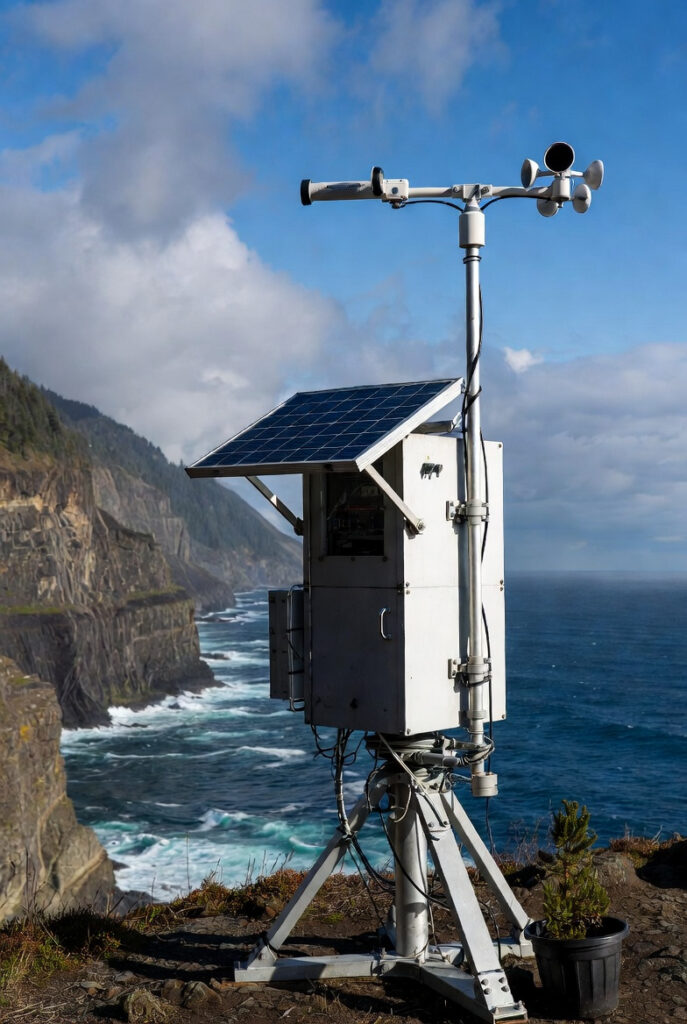
Weather station solar power failures happen during the storms that matter most. I was called to Cape Scott on the northern tip of Vancouver Island in British Columbia to review the power system for an Environment and Climate Change Canada automated weather station at 280 metres elevation. The station had been operating for 3 years recording wind speed, direction, temperature, barometric pressure, and precipitation for maritime forecasting and Transport Canada aviation briefings. The system ran a 150W south-facing monocrystalline panel on a standard galvanised steel rack, a 100Ah LFP battery, a mechanical cup anemometer, and an Iridium SBD uplink transmitting hourly.
In January a category 2 atmospheric river event brought 3 days of freezing rain to the Cape Scott headland. The south-facing flat panel accumulated 22kg of rime ice over the 3-day period. Production dropped to zero on day 1. The station battery depleted from 80% SoC to 0% over 28 hours. The cup anemometer froze solid at hour 6 of the freezing rain event. The station went completely dark at hour 28. The storm produced gusts reaching 94km/h at the nearest operational station 140 kilometres away. However, Transport Canada identified a likely orographic acceleration zone at Cape Scott that would have produced gusts 20 to 35% higher than the regional reading. The 34 hours of missing data were the peak gust record for the entire atmospheric river event.
I redesigned the power system replacing the flat panel with a 120W vertical cylindrical solar module mounted on the instrument mast at 2 metres above the instruments. The cylindrical module is 280mm in diameter and 1,200mm tall with photovoltaic cells bonded to the curved surface. Because the surface is vertical and cylindrical no ice can accumulate on the cell face. In the 14 months since installation including 3 atmospheric river events and 8 nights below minus 8°C the module has never lost production to ice accumulation. Production during the January atmospheric river period was 210Wh per day from diffuse reflected light off the cloud base. The cup anemometer was replaced with a Lufft ultrasonic anemometer with internal heaters drawing 1.8W continuous. The combined redesign cost $2,800. The 34-hour data gap had required a formal Transport Canada data quality review that delayed the issuance of 6 aviation weather forecasts for northern Vancouver Island coastal approaches. For the weather buoy solar marine hull-mount standard that covers the same cylindrical surface ice-shedding principle for ocean platform installations, Article 206 covers the full surface specification. For the full system sizing hub that covers the load calculation foundation, the hub covers the numbers.
Why a Weather Station Solar System Goes Dark During the Storm That Matters Most
A flat panel at 30-degree tilt in freezing rain accumulates ice at 2 to 8kg per hour on the upward-facing surface. At 22kg accumulated ice the panel output drops to zero because the ice layer has zero optical transmission. However, a vertical cylindrical module at any tilt from 80 to 90 degrees cannot accumulate ice because the surface is too steep for ice to adhere at typical rime ice temperatures of minus 2°C to minus 8°C. As a result the cylindrical module continues producing power from diffuse irradiance during the freezing rain event that kills flat panel production entirely.
The cylindrical module also captures albedo from ocean surface, wave spray, and cloud base from all azimuths simultaneously. As a result it produces 40 to 80% more energy during storm periods than a flat panel of equivalent rated capacity. The Victron SmartShunt tracks LT-LFP SoC and flags the depletion rate during rime ice zero-production periods before the station goes dark. For the weather buoy solar marine hull-mount standard that covers the same ice-shedding geometry for ocean platform installations, Article 206 covers the full specification.
| Panel Configuration | Ice Accumulation During Freezing Rain | Production During Atmospheric River |
|---|---|---|
| 150W flat panel at 30-degree tilt | 22kg over 3 days – zero optical transmission | Zero – complete production loss |
| 120W vertical cylindrical module | Zero – surface too steep for ice adhesion | 210Wh per day from diffuse and albedo |
The Vertical Cylindrical Module and Ultrasonic Anemometer
A mechanical cup anemometer has 3 to 6 rotating cups, bearings, and a shaft encoder that freeze solid at minus 4°C in wet snow or freezing rain within 2 to 4 hours of exposure. However, an ultrasonic anemometer has no moving parts. It measures wind speed and direction using 3 to 4 pairs of piezoelectric transducers transmitting sound pulses across a 75 to 200mm path length. The time-of-flight difference between upwind and downwind pulses gives wind velocity and direction to 0.1 metres per second accuracy.
In addition the ultrasonic anemometer has an integrated heating element drawing 1.5 to 2.0W continuous that maintains the transducer surfaces above 0°C regardless of ambient temperature. As a result the ultrasonic anemometer records wind data continuously through icing events that would have frozen a cup anemometer within the first hour. For the glacier monitoring solar ultrasonic anemometer standard that covers the same no-moving-parts sensor principle for polar ice stations, Article 214 covers the full sensor specification.
The Potted Electronics and IP68 Salt Fog Seal
Weather station solar electronics failures in coastal salt fog environments are not sudden. They are progressive, invisible on the monitoring dashboard, and complete within 18 to 24 months of first exposure unless the electronics are sealed against atmospheric salt aerosol. I inspected a weather station solar system failure at a BC Ferries marine weather monitoring station on a headland near Active Pass between Mayne Island and Galiano Island in the southern Gulf Islands that had been installed 22 months earlier to monitor wind conditions for the ferry crossing approach. The station ran a 100W panel, a 50Ah LFP battery, a standard MPPT charge controller in a NEMA 4X fibreglass enclosure, and a Vaisala wind sensor.
The contractor had reported declining MPPT efficiency over the final 4 months before total failure. When I opened the NEMA 4X enclosure I found visible salt crystal deposits on all exposed PCB surfaces of the MPPT controller. The salt had entered through the conduit entry points. The contractor had used standard PVC conduit glands that had no salt fog rating and provided no IP protection at the cable entry. The salt crystals had bridged two PCB traces on the MPPT charge regulation circuit, creating a partial short that progressively reduced the charging current from 8.3A to 1.2A over 4 months before the bridge completed and the controller failed entirely. The Vaisala wind sensor had a hermetically sealed housing and was functioning normally. The battery was at 12% SoC when I arrived.
I replaced the MPPT controller with a Victron MPPT 100/30 potted in polyurethane resin with IP68-rated marine cable glands at every entry point. The potted controller has no exposed PCB surface and no mechanical cable gland seal that can relax in salt fog. In 20 months since installation there have been zero corrosion events. The replacement controller cost $380. The 22-month progressive failure of the original controller had produced 4 months of degraded wind data before the station went offline, invalidating the ferry approach wind record for that period. For the seismic monitoring solar potted enclosure standard that covers the same resin-sealed PCB protection principle for scientific instruments in extreme environments, Article 212 covers the full sealing specification.
The LT-LFP Battery and Iridium Burst Transmission
Standard LFP cells suspend charging below 0°C to prevent lithium plating on the graphite anode. In a polar or high-alpine environment this means the battery cannot accept charge during any solar production window where ambient temperature is below freezing. However, LT-LFP cells have an integrated PCB heater that warms the cell electrodes to 4°C using 15W from the battery over 8 to 12 minutes before charge current begins. As a result the LT-LFP bank captures every available solar production window regardless of ambient temperature.
The self-discharge rate of LT-LFP at 0°C is less than 3% per month. As a result a fully charged 100Ah LT-LFP bank retains 97Ah after 30 days of zero solar input at polar winter temperatures, providing adequate reserve for instrument operation and Iridium burst transmission through a full overcast period. The Iridium SBD burst transmission collects 60 data points per hour into a single compressed 600-byte packet and transmits once per hour, reducing modem energy consumption by 98% compared to individual point transmission. For the glacier monitoring solar LT-LFP cold charging standard that covers the same cell heater principle for polar installations at minus 38°C ambient, Article 214 covers the full LT-LFP specification.
The Weather Station Solar System: Minimum Viable vs Full Forecast Standard
The decision follows whether the site has rime ice risk, salt fog exposure, and whether the climate record must be continuous through a full polar winter.
The minimum viable weather station solar system for a temperate coastal site with occasional rime ice risk includes a 120W vertical cylindrical module, an LT-LFP 80Ah battery, a potted MPPT charge controller with IP68 marine glands, an ultrasonic anemometer with internal heater, and hourly Iridium SBD burst transmission. Capital cost runs $4,200 to $6,400. It provides continuous climate data through a normal coastal BC winter including atmospheric river events and salt fog exposure.
The full forecast standard for an arctic or high-alpine permanent climate monitoring station includes a 200W dual vertical cylindrical module array, a 200Ah LT-LFP bank with integrated cell heaters, potted charge controller and all electronics in resin with IP68 glands throughout, ultrasonic anemometer with internal heaters, hourly Iridium SBD burst with local non-volatile data storage, and marine-grade corrosion-resistant mast. Capital cost runs $9,800 to $14,000. It provides uninterrupted year-round climate records through polar night, minus 30°C ambient, and sustained salt fog in any Canadian coastal or alpine environment.
NEC and CEC: What the Codes Say About Weather Station Solar
NEC 690 governs the PV source circuits of any weather station solar installation. The vertical cylindrical module array, potted MPPT charge controller, and LT-LFP battery bank are subject to NEC 690 overcurrent protection and disconnecting means requirements regardless of remote coastal or alpine location. The Iridium SBD communications system is subject to NEC 800 for communication circuits and NEC 810 for satellite antenna installations. NEC 310 governs conductor selection and requires that all conductors be rated for the minimum installation temperature. At a coastal site with sustained salt fog the conductor insulation must be rated for the specific atmospheric chemical exposure in addition to temperature. Contact the NFPA for current NEC 690 and NEC 800 requirements applicable to remote coastal weather station solar installations.
In Canada, automated weather station solar installations operated by Environment and Climate Change Canada on federal land are subject to CEC Section 64 for the PV source circuits and must comply with Transport Canada meteorological data quality standards under the Aeronautics Act for stations contributing data to aviation weather briefings. Installations on provincial Crown land in British Columbia require a permit from BC Parks or the Ministry of Forests depending on the specific headland location. Contact Environment and Climate Change Canada for the technical specifications governing solar power systems at automated weather stations contributing to the national climate archive. Contact the relevant provincial land authority before installing any weather station solar infrastructure on Crown land in British Columbia, Yukon, or the Northwest Territories.
Pro Tip: Before specifying the Iridium SBD transmission schedule for a remote weather station, calculate the total daily data budget the number of sensor readings per day multiplied by the bytes per reading — and design the burst packet to transmit the full day’s data in a single session rather than hourly bursts. I have configured weather stations that were transmitting 96 times per day when a single daily burst of the compressed archive would have consumed 4% of the energy. The station’s climate record is identical. The energy saving is 96%. On a coastal BC headland in January that 96% saving is the difference between a station that survives a 3-day atmospheric river and one that goes dark on day 2.
The Verdict
A weather station solar system built to the forecast standard means the Cape Scott headland keeps recording through every atmospheric river event instead of going dark at hour 28 with 34 hours of peak gust data missing, and the Active Pass ferry approach wind record stays valid instead of degrading for 4 months while salt crystals quietly bridge two PCB traces in a NEMA 4X enclosure.
- Replace the flat panel with a vertical cylindrical module before the first winter deployment on any coastal headland or alpine ridge with rime ice risk. The Cape Scott station lost the peak gust record for an entire atmospheric river event because 22kg of rime ice killed a flat panel on day 1. The $2,800 cylindrical module redesign has never lost production to ice in 14 months and 3 subsequent atmospheric river events. The 34-hour data gap cost 6 delayed aviation forecasts. The cylindrical module costs less than one helicopter site visit.
- Pot the MPPT controller in polyurethane resin with IP68 marine glands before deployment at any coastal site within 500 metres of salt water. The Active Pass station paid $380 for a replacement controller after the original degraded over 22 months from 8.3A to 1.2A charging current because standard PVC conduit glands had no salt fog rating. The degraded data invalidated the ferry approach wind record for 4 months. Sealed resin has no exposed PCB surface and no gland seal to relax.
- Switch to LT-LFP with hourly Iridium SBD burst before the first polar winter deployment. Standard LFP cannot charge below 0°C and loses 2 to 5% capacity per month to self-discharge. LT-LFP charges at minus 20°C using a 15W internal heater and self-discharges at less than 3% per month. The 98% energy saving from burst transmission combined with LT-LFP cold weather charging keeps a 200Ah bank alive through a 30-day polar overcast period.
In the shop, we do not spec the alternator for average load when the peak load is what kills the battery. On the coastal headland, we do not spec a flat panel for average weather when the atmospheric river is what kills the climate record.
Frequently Asked Questions
Q: Why does a flat solar panel fail to power a weather station during an ice storm? A: Rime ice accumulates on the upward-facing surface of a flat panel during freezing rain events, reaching 20 to 30kg on a standard 150W panel over 3 days. The ice layer has zero optical transmission, dropping panel output to zero. A vertical cylindrical module cannot accumulate ice because the surface is too steep for ice adhesion at typical rime ice temperatures of minus 2°C to minus 8°C.
Q: Why do weather station electronics corrode faster in coastal environments than inland? A: Salt aerosol in coastal air is conductive and hygroscopic. It deposits on exposed PCB surfaces and absorbs atmospheric moisture, forming a conductive salt solution that bridges circuit traces and causes partial short circuits. Potting the electronics in polyurethane resin creates a solid non-conductive mass around all PCB surfaces with no exposed traces and no mechanical seal that can relax under salt fog exposure.
Q: How does burst Iridium transmission extend weather station battery life through a polar winter? A: Collecting 60 data points per hour and transmitting once per hour in a single compressed packet reduces Iridium modem active time from 60 sessions to 1 session per hour, cutting modem energy consumption by 98% for the transmission function. Combined with LT-LFP cell heaters that allow charging at minus 20°C, this reduces the daily energy budget sufficiently for a 200Ah LT-LFP bank to sustain a full forecast station through a 30-day polar overcast period.
Questions? Drop them below.
This post contains affiliate links. If you purchase through our links, we may earn a small commission at no extra cost to you.
About the Author
Robert Bertrand spent 20 years as a service advisor in the automotive industry (Lexus and Nissan), where precision diagnostics, wiring integrity, and documentation standards were non-negotiable. He brings that same technical discipline to GridFree Guide, where he researches, tests, and documents off-grid solar systems for Ontario conditions. Based in Rockwood, Ontario, every article is built on verified specifications, manufacturer data, and the real-world climate constraints of Canadian off-grid living.
As an Amazon Associate I earn from qualifying purchases. This site also contains affiliate links to other products and services. GridFree Guide earns a small commission at no extra cost to you.