
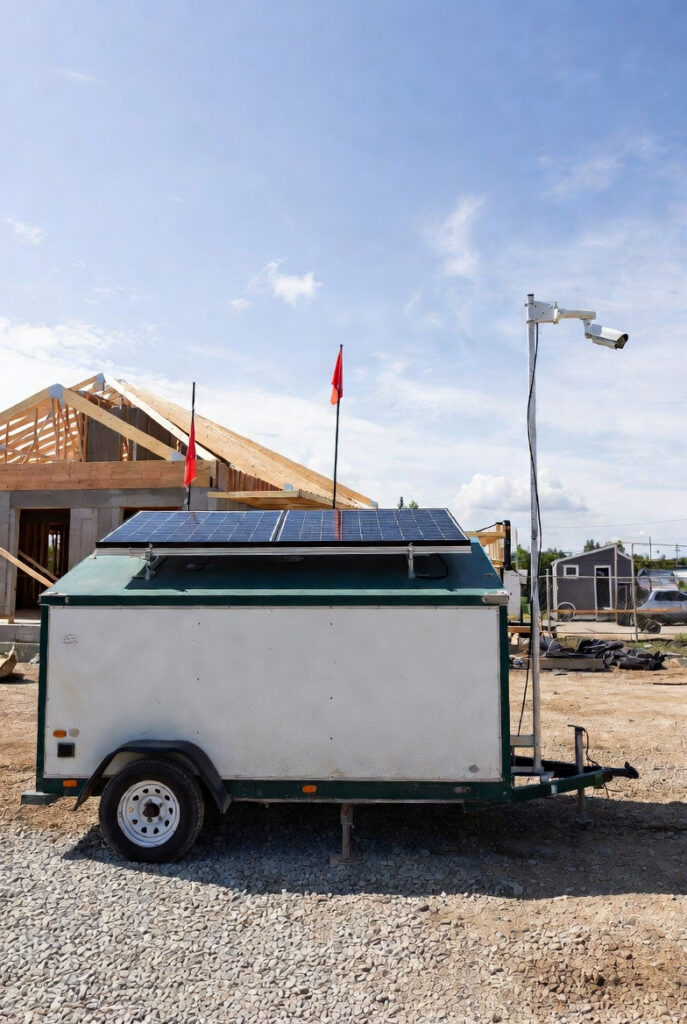
Construction site solar power failures are not caused by bad panels or undersized batteries. They are caused by loose terminals that nobody notices because the pile driver has been running 40 metres away for months. I was asked to review the power system for a job trailer on a 14-storey residential tower project on the Humber River corridor in Etobicoke, Toronto. The trailer ran a 400W solar array on a standard aluminium tilt-rack bolted to the trailer roof, a 200Ah LFP battery, and a 2,000W pure sine inverter powering four security cameras, a 5G router, a weather display, and a tool battery charging station.
The system had been operating for 4 months when the site supervisor reported intermittent power failures on the security camera circuit occurring between 2 AM and 4 AM every 3 to 4 days. The camera circuit would drop for 8 to 14 minutes then recover. The pattern had been occurring for approximately 6 weeks before anyone connected it to the vibration from the hydraulic hammer driving the building’s pile foundation 40 metres from the trailer. When I inspected the system I found that the positive terminal on the LFP battery had backed off by 1.5mm from its rated torque position. The terminal was making intermittent contact under the vibration load of the hammer cycles, creating a resistance of approximately 0.08 ohms in the main positive circuit. At the 40A peak security camera load the 0.08-ohm resistance produced a 3.2V voltage drop that periodically triggered the low-voltage protection on the camera NVR.
I torqued the terminal to spec, applied thread-locking compound to the battery post threads, and installed silicone vibration-damping bushings under the battery tray and inverter mounting plate. I replaced the 10AWG solid-core wiring between the battery and inverter with 10AWG Class-K fine-stranded cable rated for high-flex and vibration applications. In 8 months since the fix there have been zero intermittent failures. The repair cost $180 in materials. The 6 weeks of intermittent camera outages between 2 AM and 4 AM had generated 3 site security incident reports and a formal review by the project insurer costing the contractor approximately $4,200 in administrative time. For the mobile solar trailer vibration-rated wiring standard that covers the same Class-K cable principle for single-day field operations, Article 203 covers the full specification. For the full system sizing hub that covers the load calculation foundation, the hub covers the numbers.
Why a Construction Site Solar System Fails at 2 AM on an Active Foundation
Pile driver at 40 metres produces ground vibration at 8 to 25Hz transmitted through the trailer frame to every mounted component. Standard M8 hex bolts on battery terminals back off under vibration at 0.002 to 0.004mm per 1,000 cycles. Over 4 months of daily pile driving the positive terminal backs off 1.2 to 1.8mm from rated torque. As a result the terminal resistance rises from 0.001 ohms to 0.06 to 0.10 ohms, producing 2.4 to 4.0V of voltage drop at 40A camera load above the 2.5V low-voltage trigger threshold on most security NVR systems.
Nyloc fasteners and thread-locking compound on every battery terminal prevent backing under vibration. Silicone bushings under the battery tray and inverter isolate the components from trailer frame vibration above 8Hz. The Victron SmartShunt monitors terminal voltage differential and flags the anomaly before the 2 AM camera outage occurs. For the mobile solar trailer vibration-rated wiring standard that covers the same Class-K cable principle for field operations, Article 203 covers the full specification.
The Anti-Theft Security Mount: Keeping Panels on the Trailer
Construction site solar panel theft is not opportunistic. It is planned, it happens between Friday afternoon and Monday morning, and the thieves know exactly which fasteners to remove because they have been watching the site for weeks. I investigated a solar array theft at a job trailer on a commercial warehouse development near the Highway 400 and Langstaff Road interchange in Vaughan, York Region. The trailer had been fitted with a 600W array of three 200W panels on a standard tilt-rack with M8 hex head bolts. On a Saturday morning in February the contractor arrived to find all three panels missing.
The rack mounting hardware was intact. The panels had been unbolted cleanly using a standard 13mm socket and removed without any damage to the trailer roof or the wiring. The theft had occurred between 5:30 PM Friday and 6:45 AM Saturday. Total replacement cost was $1,240 including panels and a site visit. The contractor experienced a second identical theft 6 weeks later on a different trailer at the same site before calling me.
I replaced all panel mounting hardware with M10 one-way security bolts requiring a proprietary spline socket for removal. I added a ballast frame across the panel backs with 8mm stainless steel cable locked through the trailer frame. I installed a vibration sensor on the array that triggered a cellular alert if the panel surface experienced movement above 0.3g. In 14 months since the security mount installation there have been zero panel thefts at the Vaughan site or any of the 4 other trailers the contractor subsequently upgraded. The Blue Sea 600A fuse holder rated for Class-K fine-stranded cable maintains its contact rating under pile driver vibration without terminal backing on every upgraded trailer. The security mount hardware cost $340. The two theft events it replaced had cost $2,480 in panels plus the contractor’s time. For the border security solar anti-tamper mount standard that covers the same one-way fastener and vibration alert principle for permanent perimeter stations, Article 219 covers the full security mount specification.
The 4mm Hydrophobic Glass and Debris Shield
An active concrete pour in 15°C air produces airborne cement dust particles of 1 to 10 microns that settle on horizontal panel surfaces at a rate of 0.3 to 0.8 grams per square metre per hour during the pour. Over a 2-week period of daily pours the uncoated panel glass accumulates 4 to 11 grams per square metre of cemented dust that cannot be removed by air blast alone because the Portland cement has partially hydrated and bonded to the glass surface. However, hydrophobic nano-coating on 4mm tempered glass reduces the surface energy from 72 to 12 to 18 millinewtons per metre, which is below the surface tension of water.
As a result the morning dew beads and carries away the loose cement particles before they hydrate and bond. In a concrete-pouring environment a nano-coated panel shows only 3 to 6% transmission reduction after 2 weeks, compared to 18 to 28% on standard uncoated glass. As a result the nano-coated array requires only a 30-second air blast to restore full production rather than a site visit with wet washing equipment. For the archaeological dig solar dry-brush panel cleaning standard that covers the same no-water cleaning principle for dusty field environments, Article 216 covers the full surface cleaning specification.
The Smart Load Shunting and Hybrid Auto-Start Logic
A 2,000W pure sine inverter handles 4,000W surge for 5 seconds but cannot sustain the 8,000W startup draw of a 200A MIG welder without triggering overload protection. However, the hybrid auto-start logic monitors inverter output current and starts the diesel generator automatically when the load exceeds 1,800W for more than 10 seconds. The generator runs for 20 minutes to handle the peak load and top up the LFP bank, then stops automatically when the load drops below 600W. As a result a site running 4 hours of welding per day uses the generator for approximately 2 hours instead of 24, saving 18 hours of diesel fuel.
At $2.80 per litre and 3.5 litres per hour consumption the daily saving is $50.40, or $1,260 per month on a 25-day work month. The smart load shunting handles the 18 remaining hours: tool battery bank charging takes priority from 8 AM to 2 PM during peak solar production, then the security AI and perimeter lighting take priority from 2 PM through overnight. As a result the tool batteries are fully charged before the crews arrive and the security circuit never competes with the chargers for the evening battery reserve. For the solar remote monitoring load output priority standard that covers the same time-of-use load scheduling principle for remote sites, Article 187 covers the full load priority configuration.
| Power Configuration | Monthly Fuel Cost | Generator Runtime Per Day |
|---|---|---|
| Full diesel generator | $2,000 | 24 hours |
| Hybrid auto-start solar-LFP | $740 | 2 hours |
| Solar only, no welding load | $0 | 0 hours |
The Construction Site Solar System: Minimum Viable vs Full Foundation Standard
The decision follows project duration, whether the site runs welding loads, and whether panel theft is a documented risk in the area.
The minimum viable construction site solar system for a single job trailer on a small residential project includes a 400W hydrophobic-coated array on a non-penetrating ballast rack with one-way security bolts, a 200Ah LFP battery on silicone vibration-damping bushings, a 2,000W pure sine inverter, Class-K wiring throughout, and a cellular vibration alert on the array. Capital cost runs $3,800 to $5,400. It eliminates the diesel generator bill for security cameras, Wi-Fi, and lighting on a site with no welding load.
The full foundation standard for a large commercial or multi-year infrastructure project includes a 600W hydrophobic-coated array on a security-locked ballast rack, a 400Ah LFP bank on vibration-damping mounts, a 3,000W pure sine inverter with hybrid auto-start diesel generator logic, smart load shunting with morning tool priority and afternoon security priority, Class-K wiring throughout, and Nyloc fasteners on every terminal. Capital cost runs $7,200 to $10,800. It reduces diesel consumption by 90% while providing continuous 24/7 site security and connectivity through a full Ontario construction season.
NEC and CEC: What the Codes Say About Construction Site Solar
NEC 690 governs the PV source circuits of any construction site solar installation. A job trailer solar system is a temporary installation and must comply with NEC 590 for temporary wiring at construction sites, including GFCI protection for all 125V receptacle circuits and overcurrent protection at the source. The hybrid auto-start generator circuit is subject to NEC 702 for optional standby systems if it powers life-safety loads, or NEC 590 if used only for construction loads. NEC 250 governs grounding and bonding for the complete installation including the trailer frame, panel rack, and generator chassis. Contact the NFPA for current NEC 590 and NEC 702 requirements applicable to construction site temporary power installations in Ontario and across North America.
In Ontario, a temporary solar power installation on a construction site is subject to CEC Section 64 for the PV source circuits and requires an ESA permit if the system connects to any fixed building wiring or provides power to any permanently installed equipment. A fully self-contained solar trailer with no connection to building wiring is a portable power assembly and does not require an ESA permit under the Ontario Electrical Safety Code portable equipment exemption. However, the hybrid generator must be installed and connected per CEC Section 64 and the generator manufacturer’s installation requirements. Contact the Electrical Safety Authority to confirm permit requirements for your specific construction site solar configuration before commissioning the system on any Ontario job site.
Pro Tip: Before commissioning a solar system on any job trailer on a pile-driving or heavy-excavation site, torque every battery terminal, every inverter input terminal, and every MPPT terminal to the manufacturer’s specified torque value and mark each fastener head with a torque stripe, a line drawn across the fastener and the surrounding surface. Check the stripes every 30 days. If the stripe is broken the fastener has moved. I have done this on 6 construction site trailers and found backed-off terminals on 4 of them within the first 90 days of pile driving activity. The torque stripe costs nothing. The insurer review from a 6-week camera outage costs $4,200.
The Verdict
A construction site solar system built to the foundation standard means the Etobicoke tower site never generates a 2 AM security incident report because a pile driver backed off a battery terminal, and the Vaughan warehouse site never pays $1,240 for panels that a thief removed with a 13mm socket on a Saturday morning.
- Install Nyloc fasteners, thread-locking compound, and silicone vibration-damping bushings before the first pile driver starts on any site within 100 metres of the trailer. The Etobicoke site generated 3 security incident reports and $4,200 in insurer review costs because a terminal backed off 1.5mm over 4 months of hydraulic hammer vibration. A $180 fix ended the outages permanently. Check the torque stripes every 30 days. Do not wait for the NVR to flag the failure.
- Replace standard M8 hex head panel bolts with M10 one-way security bolts and add the 8mm stainless cable ballast frame before the first weekend the trailer is left unattended. The Vaughan contractor paid $2,480 for two identical panel thefts because both times the thief needed only a standard 13mm socket and 8 minutes. A $340 security mount upgrade ended both theft vectors simultaneously. The proprietary spline socket takes the theft time from 8 minutes to impossible.
- Add the hybrid auto-start logic before the first welding load on any commercial site with a $2,000 per month diesel bill. The solar-LFP system handles every continuous load without the generator running. The generator starts for 20 minutes when welding exceeds 1,800W and stops automatically. On a 25-day work month with 4 hours of daily welding the diesel bill drops from $2,000 to $740. The generator runs 2 hours instead of 24.
In the shop, we do not let the arc welder run off the same circuit as the diagnostic computer. On the job site, we do not let the pile driver shake the battery terminal loose and call the 2 AM camera outage a mystery.
Frequently Asked Questions
Q: Why does a solar security camera fail overnight on a construction site with a functioning battery? A: Pile driver vibration causes battery terminal bolts to back off from rated torque over weeks of operation, increasing terminal resistance and producing voltage drop that triggers the camera NVR’s low-voltage protection. A $180 fix including thread-locking compound, Nyloc fasteners, silicone vibration-damping bushings, and Class-K fine-stranded cable eliminates the intermittent failure permanently.
Q: How do you prevent solar panels from being stolen from a job trailer over the weekend? A: One-way security bolts requiring a proprietary spline socket for removal prevent panels from being unbolted with standard tools. A ballast frame with 8mm stainless steel cable locked through the trailer frame makes panel removal require cutting equipment. A vibration sensor triggering a cellular alert at 0.3g movement ensures any attempted removal is reported within seconds.
Q: Can solar power replace a diesel generator on an active construction site with welding? A: A solar-LFP system with hybrid auto-start logic handles 95% of the continuous load including security cameras, Wi-Fi, lighting, and tool charging without any diesel. When welding starts and the load exceeds 1,800W the controller starts the generator automatically for 20 minutes then stops it. On a site with 4 hours of daily welding this reduces generator runtime from 24 hours to approximately 2 hours, saving $1,260 per month in fuel.
Questions? Drop them below.
This post contains affiliate links. If you purchase through our links, we may earn a small commission at no extra cost to you.
About the Author
Robert Bertrand spent 20 years as a service advisor in the automotive industry (Lexus and Nissan), where precision diagnostics, wiring integrity, and documentation standards were non-negotiable. He brings that same technical discipline to GridFree Guide, where he researches, tests, and documents off-grid solar systems for Ontario conditions. Based in Rockwood, Ontario, every article is built on verified specifications, manufacturer data, and the real-world climate constraints of Canadian off-grid living.
As an Amazon Associate I earn from qualifying purchases. This site also contains affiliate links to other products and services. GridFree Guide earns a small commission at no extra cost to you.