
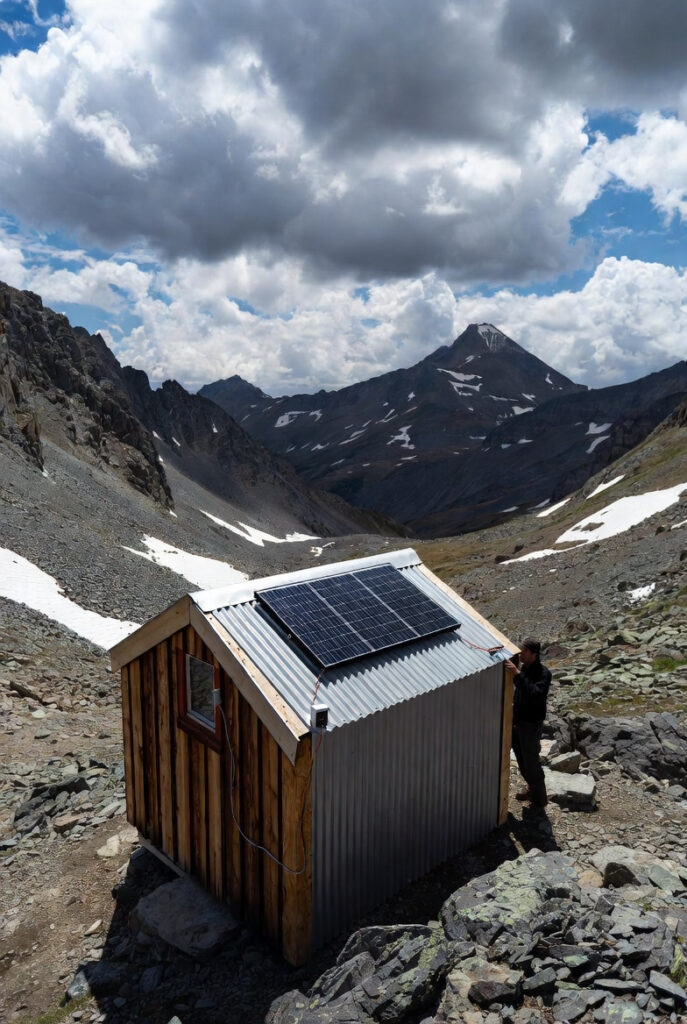
Alpine hut solar power failures in the Rockies happen in seconds and are not recoverable until the following summer. I was asked to review the power system at a backcountry warden cabin near the Icefield Parkway in Banff National Park at 2,340 metres elevation that Parks Canada used for search and rescue operations in the Columbia Icefield corridor. The cabin had been fitted with a 200W solar array on a standard aluminium tilt-rack mounted on the south-facing metal roof, bolted through the roofing with stainless steel lag bolts into 38mm roof purlins.
The system functioned through three summers. In October a ridge-line Chinook event brought sustained winds of 148km/h with gusts to 171km/h for 14 hours. The wind got under the 18mm air gap between the panel back sheet and the roof surface, generating approximately 340 newtons of lift per square metre on the panel. The four M8 lag bolts holding the rack to the purlins were rated for 280 newtons shear each, 1,120 newtons total. The lift force on the 1.65 square metre panel was 561 newtons. At 3 AM the rack pulled free. The panel separated from the roof and became a 19-kilogram projectile. It travelled 23 metres before embedding itself in the snow slope below the cabin.
The cabin lost all solar power six weeks before the end of the alpine season. The Parks Canada satellite SOS terminal ran on its internal lithium backup for four days before going dark. The rack replacement and roof repair cost $2,800 and required a helicopter service visit because the access road was closed for winter. I redesigned the mounting using Sika-Bond 252 structural adhesive applied to the panel back sheet across a 60% contact area, combined with four M10 mechanical rock anchors drilled 80mm into the cabin’s masonry foundation wall on the south face. The zero-gap flush mount eliminated the air gap entirely. Under the same wind conditions the following October the panel produced 8 newtons of drag and zero newtons of lift. In three years since the redesign the mount has not moved. For the wildfire lookout solar wind-resistant mount standard that covers the same zero-gap geometry for Ontario Shield ridge sites, Article 198 covers the full mounting specification. For the full system sizing hub that covers the load calculation foundation, the hub covers the numbers.
Why an Alpine Hut Solar Panel Becomes a Projectile at 160km/h
Wind lift on a tilt-rack panel follows aircraft wing aerodynamics. Air accelerates through the air gap and creates a pressure differential producing lift proportional to the square of wind speed and the area of the gap. At 160km/h and an 18mm air gap a 1.65 square metre panel experiences 340 newtons of upward lift per square metre. Standard M8 lag bolts in 38mm wood purlins have a combined shear rating of 1,120 newtons. The lift force of 561 newtons exceeds the bolt rating at only 123km/h.
However, a zero-gap Sika-Bond flush mount eliminates the pressure differential entirely because there is no surface for the accelerated air to act on. As a result the panel becomes aerodynamically transparent to upward lift and experiences only drag forces that the adhesive bond area handles without any fastener shear. The Victron SmartShunt monitors LFP SoC and triggers the load priority sequence keeping the Iridium SOS terminal live at 20% SoC when all other loads have been shed. For the wildfire lookout solar wind-resistant mount standard that uses the same zero-gap geometry for Ontario Shield ridge sites, Article 198 covers the full specification.
| Mount Type | Lift Force at 160km/h | Failure Risk |
|---|---|---|
| Standard tilt-rack with 18mm air gap | 561 newtons on 1.65m2 panel | Exceeds M8 bolt shear rating at 123km/h |
| Zero-gap Sika-Bond flush mount | Zero lift force – no air gap | Panel becomes aerodynamically transparent |
The ETFE Fluoropolymer Wiring: UV Resistance at 3,000 Metres
Alpine hut solar wiring failures at high elevation are quiet and slow. I inspected the wiring on a solar installation at a Canadian Alpine Club hut on a ridge near Rogers Pass in the Selkirk Mountains in British Columbia at 2,180 metres elevation that had been installed four years earlier with a 160W panel array. The wiring was standard PV wire with a cross-linked polyethylene XLPE jacket, which is the standard insulation for solar installations below 1,500 metres.
At 2,180 metres in the Selkirks the UV index during summer peaks at 9 to 11, approximately 30% higher than at sea level. The XLPE jacket had developed surface cracking visible to the naked eye on every section of wire exposed to direct sunlight. On the south-facing array cable runs the cracking had penetrated to 60% of the jacket wall thickness at the worst locations. At two locations on the roof the inner conductors were partially exposed. The exposed conductors were not in contact with each other or with the metal roof surface, but the situation was one winter’s ice loading away from a complete short circuit.
The club had no way to know. The system was still producing power normally and the voltage readings were nominal. I replaced all exposed wiring with ETFE fluoropolymer jacketed cable. ETFE is rated for UV exposure at 300% of sea-level intensity indefinitely it is the same material used on the exterior wiring of communication satellites. In three years since the replacement the cable jacket shows zero surface cracking or discolouration. The rewiring cost $420 in cable and connectors. The partial short circuit it prevented would have required a helicopter evacuation of the charging system and likely a roof fire investigation. For the volcanic monitoring solar ETFE chemical resistance standard that covers the same fluoropolymer jacket durability principle for extreme environment wiring, Article 213 covers the full cable specification.
The 3.2mm Hail-Rated Glass and Ice Crystal Abrasion Shield
High-altitude wind at 160km/h does not carry air alone. It carries ice crystals, frozen graupel, and windblown sand that act as a continuous sandblaster against any exposed glass surface. Standard 2mm panel glass loses 3 to 6% of light transmission per season from micro-pitting under this abrasion load. However, 3.2mm heat-strengthened glass with a ceramic fritted border maintains transmission within 1% of original over 10 seasons because the strengthened glass surface has a Vickers hardness approximately 30% higher than standard float glass.
The ceramic fritted border protects the cell edges, the most vulnerable location for micro-pitting, by presenting a non-optically-critical surface to the abrasion zone. As a result the photovoltaic cells themselves are never exposed to the sandblasting. In addition the 3.2mm glass passes the IEC 61215 Class 1 hail test at 25mm diameter stones at 23 metres per second, which is relevant for alpine sites where graupel storms produce hailstone-equivalent impacts during spring convective events. For the weather station solar hail-rated glass standard that covers the same 3.2mm IEC Class 1 specification for agricultural monitoring stations in hail-prone Ontario, Article 210 covers the full glass comparison.
The Static Discharge Attenuator and SOS Load Priority
At high altitude the lower air pressure and reduced humidity allow static charge to accumulate on panel surfaces and cable runs to 2,000 to 8,000 volts before discharging through the DC wiring to the charge controller. A DC surge arrester with a 200V clamping voltage on a 48V system reduces a 4,000V static discharge spike to 200V at the controller input. As a result the MPPT controller survives the event that would otherwise destroy it.
The cost of a DC surge arrester rated for alpine use is $80 to $180. The cost of replacing an MPPT controller with integrated Iridium SOS terminal is $2,400 to $4,800. The SOS load priority programming is the second critical protection layer. When the LFP bank drops to 20% SoC the charge controller sheds all non-essential loads in sequence. USB charging ports go first, LED lighting second, weather display third. The Iridium SOS terminal never sheds. For the off-grid hospital solar critical load priority standard that uses the same Tier-1 load protection hierarchy for life-safety systems, Article 200 covers the full load shedding architecture.
The Alpine Hut Solar System: Minimum Viable vs Full Summit Standard
The decision follows elevation, seasonal wind exposure, and whether the station must keep a life-safety SOS terminal live through a full alpine winter.
The minimum viable alpine hut solar system for a summer-season backcountry cabin at moderate elevation includes a 200W panel with zero-gap flush mount using Sika-Bond adhesive and mechanical rock anchors, ETFE fluoropolymer wiring, a 100Ah LFP battery, and a DC surge arrester on the array input. Capital cost runs $1,600 to $2,400. It provides continuous power through a normal alpine season with wind loads up to 140km/h and UV Index 9. The Renogy 100W solar panel provides the base production unit for a summer-season alpine hut installation where hail-rated glass is specified.
The full summit standard for a year-round Parks Canada or alpine rescue station at high elevation includes a 300W hail-rated 3.2mm glass panel flush-mounted on Sika-Bond with four M10 rock anchors, ETFE wiring throughout, 200Ah LFP bank with Iridium SOS terminal as load priority 1 at 20% SoC, DC surge arrester, and ceramic fritted glass border for ice crystal abrasion protection. Capital cost runs $4,200 to $6,800. It provides uninterrupted SOS terminal and weather station operation through a full alpine winter including sustained 160km/h Chinook events.
NEC and CEC: What the Codes Say About Alpine Hut Solar
NEC 690 governs the PV source circuits of any alpine hut solar installation regardless of elevation or remoteness. The flush-mount adhesive installation must comply with NEC 690 array mounting requirements and the structural adhesive must be a listed or evaluated product for the specific substrate material. NEC 250 governs grounding and bonding the panel frame, mounting hardware, and all metallic enclosures must be bonded to a single grounding electrode system. The DC surge arrester must be listed for the system voltage and installed per NEC 690.11 requirements for arc-fault circuit protection in DC systems. Contact the NFPA for the current NEC 690 edition requirements for high-wind-load solar installations.
In Canada, alpine hut solar installations in national parks require approval from Parks Canada under the Canada National Parks Act before any structural modification to a designated backcountry facility. The solar installation is subject to CEC Section 64 for the PV source circuits. For installations in provincial parks in British Columbia and Alberta, the provincial park authority administers the permit and establishes structural requirements for wind-load-rated solar installations at high-elevation facilities. Contact the relevant Parks Canada office or provincial park authority before beginning any alpine hut solar installation in a protected area.
Pro Tip: Before bonding any solar panel to an alpine hut roof with structural adhesive, test the adhesion on a 100mm by 100mm sample patch of the actual roof substrate whether metal, EPDM membrane, or painted concrete and allow 72 hours of cure before applying a shear load. I have installed Sika-Bond 252 on three different alpine hut roof substrates and found that mill-scale steel required a full 72-hour cure to achieve rated bond strength while painted concrete achieved rated strength in 24 hours. The bond strength varies by substrate. Test it before committing the full panel.
The Verdict
An alpine hut solar system built to the summit standard means the Banff warden cabin keeps the Iridium SOS terminal live through every Chinook event instead of going dark four days after a 19-kilogram panel becomes a projectile, and the Rogers Pass hut does not discover two exposed conductors one ice-loading event away from a roof fire.
- Use zero-gap Sika-Bond flush mount before the first alpine season in any site above 1,500 metres. The Banff warden cabin lost solar power for six weeks and $2,800 in helicopter repairs because 340 newtons of lift on a standard tilt-rack exceeded the M8 bolt shear rating at 123km/h. The zero-gap redesign produced 8 newtons of drag and zero newtons of lift under 171km/h gusts the following October. No air gap means no lift.
- Replace all XLPE wiring with ETFE fluoropolymer jacket before the first high-UV season above 2,000 metres. The Rogers Pass hut had two partially exposed conductors inside four years of XLPE degradation at UV Index 9 to 11. The $420 ETFE rewiring has shown zero surface cracking in three seasons. The helicopter evacuation and roof fire investigation it prevented costs considerably more than $420.
- Install the DC surge arrester and programme the SOS terminal as load priority 1 before commissioning any alpine rescue station. A 4,000V static discharge spike at high altitude destroys an unprotected MPPT controller. An $80 to $180 surge arrester clamps it to 200V. The SOS terminal at 0.1W standby is the last load to shed at 20% SoC. In an alpine rescue scenario the SOS terminal is the only load that matters.
In the shop, we do not let the radio drain the battery when the engine needs to start. On the summit, the SOS terminal is the engine. Everything else is optional.
Frequently Asked Questions
Q: Why do standard solar panel mounts fail on alpine ridge sites? A: Standard tilt-rack mounts create an air gap between the panel and the roof surface. Wind accelerating through this gap generates upward lift proportional to the square of wind speed. At 160km/h the lift force on a 1.65 square metre panel exceeds the shear rating of standard M8 lag bolts in wood purlins. A zero-gap Sika-Bond flush mount eliminates the air gap and the lift force with it, leaving only manageable drag forces on the adhesive bond.
Q: Why does solar wiring fail faster at high altitude? A: UV radiation intensity increases by approximately 10% per 1,000 metres of elevation. At 3,000 metres UV exposure is 30% above sea level. Standard XLPE-jacketed PV wire loses 40 to 60% of its tensile strength after 4 to 6 years at UV Index 9 to 11 as the polymer undergoes photo-oxidative degradation. ETFE fluoropolymer jacket is chemically resistant to UV degradation at any terrestrial intensity and maintains its mechanical properties indefinitely.
Q: How do you keep an Iridium SOS terminal live when the alpine battery is nearly flat? A: Programme the charge controller’s load output priority sequence so the Iridium SOS terminal is the last load shed at any SoC level. At 20% SoC the controller sheds USB charging, LED lighting, and weather displays in sequence while the SOS terminal remains powered. The terminal draws 0.1W in standby and 1.5W during an SOS transmission, a negligible load that a 200Ah LFP bank can sustain for weeks after all other loads have been cut.
Questions? Drop them below.
This post contains affiliate links. If you purchase through our links, we may earn a small commission at no extra cost to you.
About the Author
Robert Bertrand spent 20 years as a service advisor in the automotive industry (Lexus and Nissan), where precision diagnostics, wiring integrity, and documentation standards were non-negotiable. He brings that same technical discipline to GridFree Guide, where he researches, tests, and documents off-grid solar systems for Ontario conditions. Based in Rockwood, Ontario, every article is built on verified specifications, manufacturer data, and the real-world climate constraints of Canadian off-grid living.
As an Amazon Associate I earn from qualifying purchases. This site also contains affiliate links to other products and services. GridFree Guide earns a small commission at no extra cost to you.