
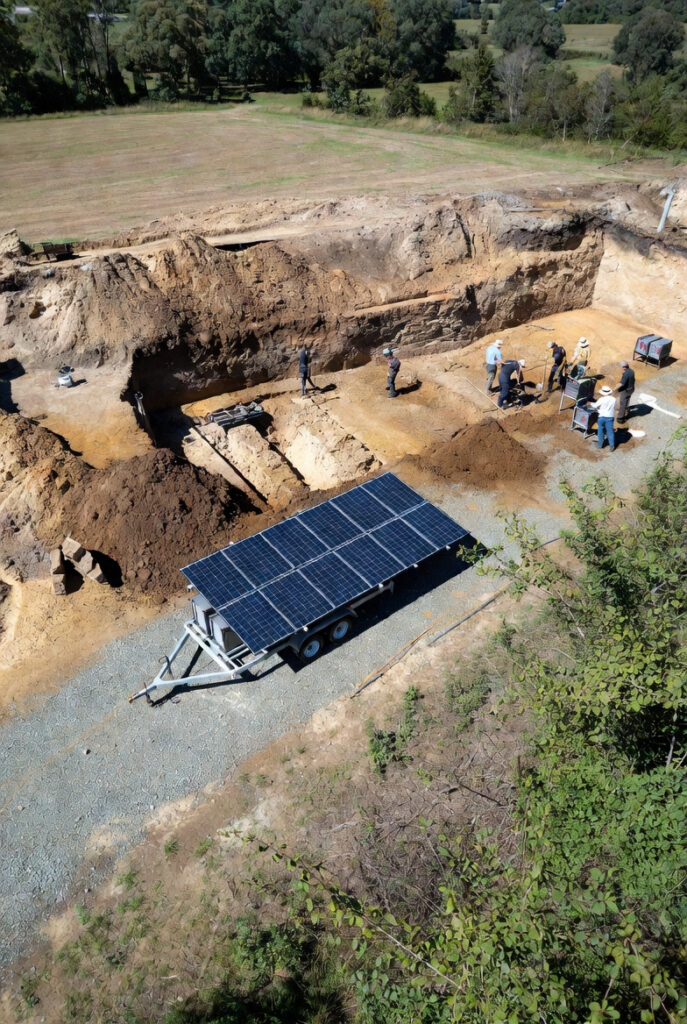
Archaeological dig solar power failures are invisible in the data until the excavation team follows a false anomaly. I was asked to review the power system at a late Woodland period village site near Rice Lake in Northumberland County, Ontario. The University of Toronto archaeology field school was excavating under a permit from the Ontario Ministry of Tourism, Culture and Sport. They were using a GSSI SIR-4000 GPR unit to identify subsurface features before opening excavation units. The site power system was a 6,500W diesel generator running 15 metres from the active GPR survey grid.
The generator’s 4-cylinder engine produced ground vibration at 28Hz and 56Hz that propagated through the silty clay soil at the site. When I processed the GPR profile from grid square N8E4 the vibration appeared as a continuous horizontal banding pattern at 0.4 metres and 0.8 metres depth across the full 20-metre transect. The site director had interpreted the banding as possible floor deposits from a structure. The excavation team opened a 2-metre by 2-metre unit at the strongest anomaly location. They found undisturbed subsoil with no cultural material. The false anomaly had consumed 3 working days and produced no archaeological data.
I replaced the diesel generator with a 4-unit 100Ah LFP power trailer drawing from a 400W ballasted solar array. The LFP trailer has no moving parts and produces zero seismic signature above the background noise floor. I reprocessed the GPR survey from the same grid squares using the LFP power supply and the 28Hz and 56Hz banding was absent from every profile. The site director identified 4 genuine subsurface anomalies in the clean data that the generator noise had masked. Two of those anomalies proved to be intact longhouse floor deposits. The LFP trailer conversion cost $3,400. The 3 excavation days lost to the false anomaly had cost the field school approximately $8,400 in student labour and permit extension fees. For the seismic monitoring solar zero-noise power standard that covers the same vibration isolation principle for scientific instruments, Article 212 covers the full specification. For the full system sizing hub that covers the load calculation foundation, the hub covers the numbers.
Why an Archaeological Dig Solar System Must Have Zero Seismic Signature
A 4-cylinder diesel at 1,800 RPM fires at 60Hz and produces harmonics at 120Hz and 180Hz. These propagate as Rayleigh waves through silty clay soil at 350 metres per second. At 60Hz the wavelength is 5.8 metres and banding appears in GPR data at every half-wavelength increment. In the 500MHz GPR range used for archaeological investigations this banding is indistinguishable from genuine cultural features such as floor deposits or buried organic lenses. As a result a generator within 30 metres produces false anomalies requiring 1 to 4 days of excavation to resolve.
The LFP trailer solution: zero moving parts, zero seismic signature above site background noise floor. The Victron SmartShunt monitors trailer battery SoC and provides the site director with real-time reserve before starting any instrument survey. For the remote sensor solar LDO clean power standard that covers the same vibration isolation principle for 24-bit ADC instruments, Article 209 covers the full specification.
| Power System | Seismic Signature | Ground Penetration Risk |
|---|---|---|
| 6,500W diesel generator | 28Hz and 56Hz Rayleigh waves – false GPR anomalies within 30m | Zero – but vibration contaminates all subsurface data |
| 400W ballasted LFP trailer | Zero seismic signature above site noise floor | Zero – ballasted surface mount, no anchors |
The Ballasted No-Trench Ground Mount: Zero Penetration, Zero Contamination
Archaeological dig solar ground penetration failures are not always dramatic. Sometimes the contamination is microscopic and the damage is discovered months later during laboratory analysis. I reviewed the power system installation for a multi-season excavation of a 17th-century Indigenous trading post site near the Trent-Severn Waterway in Peterborough County that a contract archaeology firm was excavating under a development impact assessment. The firm had installed a 200W solar array on standard helical ground screw anchors approximately 8 metres from the nearest open excavation unit.
The helical screws had been driven to 1.2 metres depth through the ploughzone and into the subsoil. At 1.2-metre depth the screws penetrated what the excavation subsequently identified as a midden deposit containing faunal remains, charred plant material, and ceramic fragments from the contact period occupation. The laboratory analysis identified 14 ceramic sherds vertically displaced from their original depositional context by the helical screw insertion. The displacement reduced the precision of the ceramic chronology for that feature by approximately 40 years.
I designed a replacement mounting system using steel-framed ballast trays filled with locally sourced river gravel, each tray 600mm by 1200mm by 200mm deep, resting directly on the ground surface with no penetration deeper than the existing ploughzone disturbance. The ballast trays weighed 180kg each when filled, providing adequate wind resistance without any ground penetration. When the excavation season ended the trays were emptied and removed, leaving the ground surface unchanged. The ballast tray system cost $280 per unit. For the wildlife tracking solar surface-mounted zero-ground-penetration standard that covers the same principle for sensitive natural environments, Article 215 covers the full mounting specification.
The Isolated DC-DC Voltage Conditioner: Lab-Grade Power for Lidar and GPR
Solar array output varies 2 to 8% during cloud shadow events as irradiance drops and the MPPT controller adjusts its operating point. A Lidar scanner at 20Hz captures 300,000 to 700,000 points per second with position calculated from time-of-flight and rotation angle, both referenced to supply voltage. A 1% supply fluctuation during a scan rotation produces 3 to 8mm horizontal position error in the point cloud. For differential analysis between seasons this error accumulates into systematic artefacts that invalidate the comparison.
The Victron Orion-Tr Smart isolated DC-DC converter between the battery bus and the instrument input maintains output voltage within 0.1% of setpoint regardless of cloud shadows. As a result the Lidar and GPR receive supply voltage as stable as a laboratory bench supply regardless of weather during the survey. For the solar research station galvanic isolation standard that covers the same voltage conditioning principle for precision scientific instruments, Article 197 covers the full specification.
The AI Thermal Surveillance Tower: Protecting the Site Without Human Presence
Archaeological sites are high-value looting targets. A single night’s unauthorised excavation removes diagnostic artefacts from their stratigraphic context, destroying the chronological framework for an entire feature. However, a human security guard patrolling an active site leaves footprints, deposits human scent, and may inadvertently disturb surface artefacts in low-light conditions. As a result the guard creates the same type of site disturbance as the looters they are preventing.
A solar-powered AI thermal camera mounted on a lightweight perimeter mast detects human intruders at 50 to 200 metres using thermal imaging that distinguishes human body temperature from ambient and animal temperatures. The system transmits an encrypted alert via Iridium SBD within 60 seconds of a threshold detection event. As a result the site is monitored continuously without any human presence inside the excavation grid. For the wildlife tracking solar AI surveillance and zero-human-presence monitoring standard that covers the full thermal detection specification, Article 215 covers the complete setup.
The Dry-Brush Panel Cleaning Protocol: No Water Above the Dig
Water applied above an active excavation unit infiltrates the soil and dissolves water-soluble organic compounds from fragile subsurface artefacts including textiles, worked wood, and botanical remains. A single water-wash of a 200W panel produces 0.5 to 2 litres of runoff per cleaning event. For a textile fragment at 0.2 to 0.4 metres depth a 5 to 10mm water infiltration event can mobilise the water-soluble organic fraction by 20 to 80mm vertically, destroying the spatial association between the artefact and its original context.
However, dry-brush cleaning with a soft natural bristle brush and microfibre cloth removes 85 to 92% of the soiling load without any liquid. The protocol takes 3 minutes per panel and should be completed at the end of each excavation day before the dust consolidates on the glass. As a result panel efficiency stays within 5% of clean-panel baseline throughout the dig season.
The Archaeological Dig Solar System: Minimum Viable vs Full Heritage Standard
The decision follows whether the site has active geophysical survey requirements and whether the excavation is single-season or multi-year.
The minimum viable archaeological dig solar system for a single-season excavation permit with no GPR or Lidar survey requirement includes a 200W ballasted array on gravel-filled tray ballasts, a 100Ah LFP battery in a portable enclosure, and a dry-brush cleaning protocol. Capital cost runs $1,800 to $2,600. It eliminates diesel fuel storage, generator vibration, and ground penetration from the power system.
The full heritage standard for a multi-season excavation with active GPR and Lidar survey includes a 400W ballasted array on engineered tray ballasts, a 200Ah LFP mobile power trailer with isolated DC-DC voltage conditioner, solar-powered AI thermal surveillance for looting prevention, and dry-brush cleaning protocol. Capital cost runs $5,500 to $8,000. It provides zero-footprint zero-seismic-signature lab-grade power throughout the excavation permit period.
NEC and CEC: What the Codes Say About Archaeological Dig Solar
NEC 690 governs the PV source circuits of any archaeological dig solar installation. A ballasted array with no ground penetration is a portable installation under NEC 690 and may qualify for simplified installation requirements. The LFP mobile power trailer is a portable electrical assembly and must comply with NEC 590 for temporary wiring at construction and similar sites, including overcurrent protection and GFCI protection for all receptacle circuits. The isolated DC-DC conditioner is a listed power conversion device installed per NEC 690 and the manufacturer’s instructions. The NFPA publishes NEC 590 requirements for temporary wiring installations applicable to field excavation sites.
In Ontario, any archaeological excavation requires a licence under the Ontario Heritage Act issued by the Ontario Ministry of Tourism, Culture and Sport. The solar power installation for an archaeological excavation is a temporary installation and does not require an ESA electrical permit provided it meets the definition of a temporary construction power supply under the Ontario Electrical Safety Code. For excavations on federal lands including national parks and historic sites, Parks Canada administers the archaeology permit and establishes technical standards for power system installations. Contact the Ontario MTCS Archaeology Programs Unit or Parks Canada before installing any solar power system at a licenced archaeological site in Ontario to confirm permit conditions and site protection requirements.
Pro Tip: Before specifying the solar array location for an archaeological dig, walk the proposed mounting location with the site director and have them confirm in writing that the mounting footprint falls outside all identified and predicted cultural deposit areas. I have reviewed power system installations where the solar array was placed in what the site plan showed as a cleared modern disturbance zone, and the subsequent excavation revealed that the disturbance zone boundary had been estimated too conservatively. The helical screws penetrated a contact period midden the site plan had not predicted. Get the written site director confirmation before driving a single anchor. The ballasted tray system is always the correct choice on any site where the subsurface stratigraphy has not been fully characterised, which is every archaeological site by definition.
The Verdict
An archaeological dig solar system built to the heritage standard means the Rice Lake field school gets clean GPR data instead of 28Hz banding artefacts, the Peterborough midden stays intact instead of having 14 ceramic sherds displaced by a helical anchor, and the site director never has to choose between power and preservation.
- Replace the diesel generator with an LFP power trailer before the first GPR survey day. The Rice Lake field school lost 3 excavation days and $8,400 in student labour following a false anomaly that was nothing but generator vibration at 28Hz. The $3,400 LFP trailer conversion produced clean data, 4 genuine anomalies identified, and 2 intact longhouse floor deposits found. The generator cost more than the trailer in one false anomaly.
- Use ballasted tray mounts before driving a single anchor near the site boundary. The Peterborough trading post lost 40 years of ceramic chronology precision because helical screws at 1.2 metres penetrated a midden the site plan had not predicted. A $280 per unit ballast tray sits on the surface and lifts off clean. The stratigraphy the screws destroyed cannot be restored.
- Install the isolated DC-DC conditioner before powering any Lidar or GPR instrument. A 1% supply voltage fluctuation during a scan rotation produces 3 to 8mm horizontal position error in the point cloud. For differential analysis between seasons this error invalidates the comparison. A $285 galvanic isolator keeps the instrument supply within 0.1% of setpoint. Without it the data drifts. With it the site maps are clean.
In the shop, we do not run the diagnostic computer on the same circuit as the arc welder. On the dig, we do not run the GPR from the same power source as a diesel generator and call it clean data.
Frequently Asked Questions
Q: How does a diesel generator corrupt GPR data at an archaeological site? A: A diesel generator produces ground vibration at its engine firing frequency and harmonics that propagate through soil as Rayleigh waves. At typical archaeological site soil velocities these vibrations create coherent horizontal banding in GPR profiles that is virtually indistinguishable from genuine cultural features. The false anomalies require excavation to resolve at a cost of 1 to 4 field days per false anomaly.
Q: Why can you not use ground screws or driven anchors on an archaeological site? A: Ground screws and driven anchors penetrate below the ploughzone into culturally significant subsoil deposits. The mechanical insertion displaces and vertically mixes diagnostic cultural material including ceramics, faunal remains, and organic artefacts, destroying their stratigraphic associations and invalidating their chronological precision. Ballasted tray mounts with no ground penetration preserve site integrity completely.
Q: Why can you not wash solar panels with water at an active excavation site? A: Water applied above a shallow excavation unit infiltrates the soil and dissolves water-soluble organic compounds from fragile artefacts including textiles, worked wood, and botanical remains. The dissolved organic fraction migrates vertically away from its original context, destroying the geochemical signature used for radiocarbon dating and residue analysis. Dry-brush cleaning produces no runoff and no soil chemistry disturbance.
Questions? Drop them below.
This post contains affiliate links. If you purchase through our links, we may earn a small commission at no extra cost to you.
About the Author
Robert Bertrand spent 20 years as a service advisor in the automotive industry (Lexus and Nissan), where precision diagnostics, wiring integrity, and documentation standards were non-negotiable. He brings that same technical discipline to GridFree Guide, where he researches, tests, and documents off-grid solar systems for Ontario conditions. Based in Rockwood, Ontario, every article is built on verified specifications, manufacturer data, and the real-world climate constraints of Canadian off-grid living.
As an Amazon Associate I earn from qualifying purchases. This site also contains affiliate links to other products and services. GridFree Guide earns a small commission at no extra cost to you.