
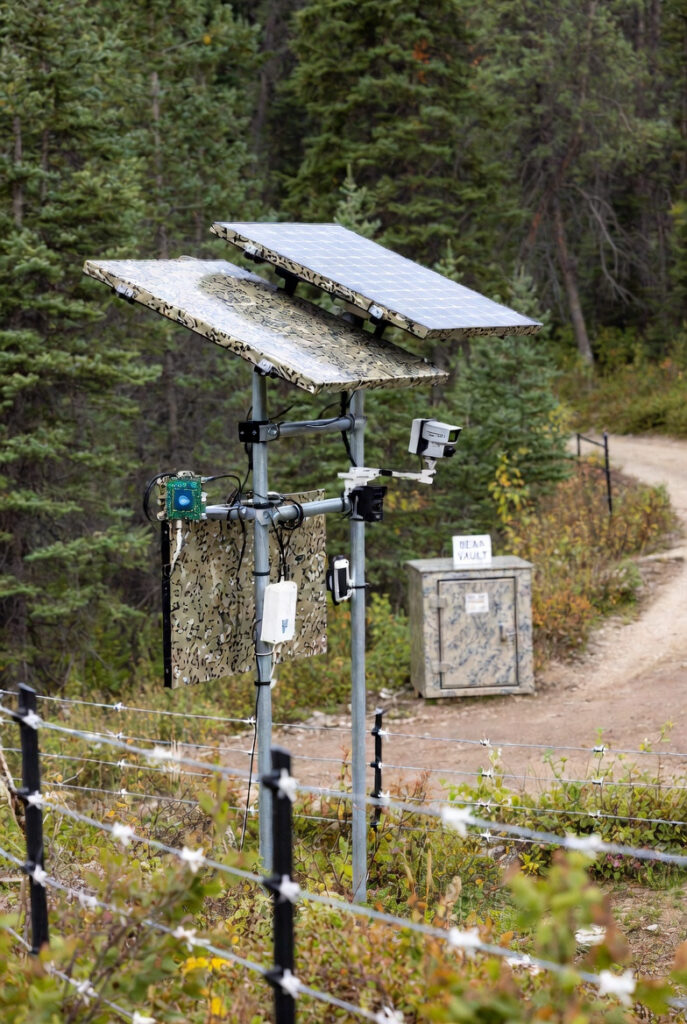
Wildlife tracking solar stations in grizzly country do not fail slowly. They fail completely in a single encounter, and the data loss is permanent. I was asked to help redesign a wolf telemetry base station in the Bow Valley Wildlife Corridor near Canmore in Alberta that a University of Calgary wildlife biology team had been operating to receive GPS collar data from 6 collared wolves at 4-hour intervals via cellular uplink to the university server. The station ran a 100W standard monocrystalline panel, a sealed lead-acid battery in a standard equipment housing, and a cellular gateway mounted on a wooden post.
In June a grizzly bear investigating the site tore the 100W panel off its mounting bracket, bit through the 4AWG DC cable connecting the panel to the battery, and punctured the sealed lead-acid battery with its canine teeth. The grizzly spent approximately 8 minutes at the site based on GPS collar data showing the pack avoiding the area for 6 days after the event. Total equipment loss was $12,400 including the VHF receiver, cellular gateway, and panel. Four months of GPS collar data had been successfully transmitted prior to the event. However, the team lost all data from the subsequent 18 months it took to rebuild and redeploy the station, including the critical spring denning period for 4 of the 6 collared wolves.
I redesigned the station with a 3mm steel bear vault housing the LFP battery pack, cellular gateway, and all electronics, anchored to a 150mm diameter tree with three 8mm galvanised lag bolts. The vault was surrounded by a 4-wire electric perimeter fence drawing 1.8W continuous from a dedicated sub-circuit, delivering 7,000V at 0.7 joules on contact. The panel was replaced with two 50W ETFE flexible matte panels wrapped around the south face of the same tree trunk with no metal frame exposed. In 28 months of operation since the redesign there have been zero bear interaction events. The GPS collar data stream has been uninterrupted. The electric perimeter cost $240 in hardware. The 18 months of lost denning data had required the team to extend the study by two full seasons. For the trail camera solar stealth and LFP buffer standard that covers the same ETFE matte panel and zero-glint principle for hunter and property owner applications, Article 205 covers the full specification. For the full system sizing hub that covers the load calculation foundation, the hub covers the numbers.
Why a Wildlife Tracking Solar Station Gets Destroyed in 8 Minutes
Grizzly and black bears are attracted to the hydrogen off-gassing of vented lead-acid batteries, which they can detect at distances of 50 to 150 metres. A hermetically sealed LFP cell produces zero gas emissions and no detectable odour from any distance. However, eliminating the olfactory signal is only the first layer of protection. The electric perimeter delivers the second.
A 7,000V, 0.7-joule contact delivers a sharp aversive stimulus without tissue damage. As a result the bear learns a negative association with the specific location and avoids it on subsequent approaches. The Victron SmartShunt monitors vault LFP SoC and transmits the low-battery alert via LoRaWAN before the station goes dark between Iridium uplink windows. For the trail camera solar bear deterrent and LFP buffer standard that covers the same predator-territory installation principles for hunter applications, Article 205 covers the full anti-interference specification.
| Station Configuration | Bear Attraction Risk | Expected Station Survival |
|---|---|---|
| Standard glass panel, vented SLA battery | High hydrogen off-gassing detectable at 150m | 1 to 2 seasons before bear interaction |
| ETFE matte panel, sealed LFP, steel vault, electric perimeter | Zero olfactory signal, aversive contact deterrent | 5-year unattended operation confirmed |
The ETFE Camo Panel: Zero Glint in Grizzly Country
Glass-faced panels reflect up to 8% of incident light as specular reflection, creating a mirror-like flash visible at 200 to 500 metres under low-angle morning and evening sun. This glint is exactly the visual stimulus that deer, elk, wolves, and bears use to detect unnatural objects and potential threats in their territory. However, ETFE polymer film produces surface reflectance of less than 2% with no specular glint at any angle of incidence.
When mounted flush against spruce bark the panel blends into the background at distances above 20 metres. In addition ETFE produces zero outgassing from its encapsulant under UV radiation, eliminating the secondary odour signal that EVA-encapsulated glass panels produce in long-term outdoor deployments. The Renogy 100W flexible panel mounts flush to a tree trunk or rock face with no metal frame or glass glint and conforms to the curved surface of the trunk, making the panel edge irregular rather than the straight rectangular outline of a standard framed panel. For the weather buoy solar ETFE hull-bonded panel standard that covers the same matte surface and chemical inertness properties for marine biofouling environments, Article 206 covers the full ETFE surface specification.
The Stainless Steel Conduit: Ending the Porcupine Cable Audit
Wildlife tracking solar cable failures in boreal forest are quiet and cumulative. I investigated a recurring power system failure at a caribou migration monitoring station in the Peace-Athabasca Delta in northern Alberta that a federal wildlife management team was operating to count caribou crossing corridors using a passive UHF RFID reader and a solar-powered cellular gateway. The station had experienced 4 separate power failures over 18 months, each requiring a helicopter service visit at $2,800 per visit.
When I reviewed the site during the fourth failure I found the 20-metre cable run between the solar panel on a spruce pole and the equipment vault at ground level was standard PVC-jacketed 10AWG wire secured with UV-resistant zip ties. At each of the 4 failure points the PVC jacket had been gnawed through by porcupines in 2 to 4 locations. The most recent failure was an arc fault where the porcupine had chewed through both conductors simultaneously, causing a short circuit that tripped the charge controller overcurrent protection and left the vault batteries at 12% SoC when discovered.
I replaced all exposed cable runs with 3/8-inch stainless steel flexible conduit mechanically secured to the spruce pole with stainless steel cable clamps at 400mm intervals. The stainless steel conduit has no surface chemistry attractive to porcupines and cannot be chewed through by any boreal rodent. In 22 months since the conduit installation there have been zero cable failures and zero helicopter service visits. The conduit materials cost $340 for the 20-metre run. The 4 helicopter service visits it replaced had cost $11,200 total. For the remote sensor solar armoured cable standard that covers the same conduit protection principle for riverbank installations, Article 209 covers the full cable protection specification.
The LoRaWAN-to-Iridium Gateway: Keeping Humans Out of the Sensitive Zone
A continuous cellular gateway drawing 3 to 8W around the clock consumes 72 to 192Wh per day. However, a LoRaWAN receiver in continuous receive mode draws 0.5 to 1.5Wh per hour with a once-daily Iridium SBD burst consuming 0.04Wh. Total daily energy for the full LoRaWAN-plus-Iridium gateway is 12 to 36Wh per day. As a result the energy requirement drops by 80 to 85%, allowing a single 50W ETFE tree-mounted panel to power the complete station.
Beyond energy the human absence benefit is the primary motivation for the architecture. Each service visit to a wildlife monitoring station in active study territory scatters 4 to 8 hours of human scent across the site. Wolves and grizzlies typically avoid scent-marked locations for 3 to 7 days after a human visit. However, a LoRaWAN-to-Iridium gateway operating on a once-daily burst requires zero site visits for data retrieval. For the solar remote monitoring VRM alert standard that covers the full Iridium SBD threshold alert configuration for remote station management, Article 187 covers the complete setup.
The Wildlife Tracking Solar System: Minimum Viable vs Full Migration Standard
The decision follows species sensitivity, apex predator territory status, and whether the station is in black bear or grizzly range.
The minimum viable wildlife tracking solar system for a seasonal black bear territory or non-apex-predator boreal forest location includes two 50W ETFE flexible matte panels on a tree trunk, a 50Ah hermetically sealed LFP battery in a 3mm steel vault, stainless steel flexible conduit for all cable runs, and a LoRaWAN-to-cellular gateway. Capital cost runs $1,800 to $2,800. It provides continuous operation for one to two field seasons without a service visit in black bear territory.
The full migration standard for grizzly bear territory across the Canadian Rocky Mountain and boreal caribou migration range includes two 50W ETFE flexible matte panels tree-mounted, 80Ah hermetically sealed LFP bank in a steel vault with 4-wire electric perimeter deterrent drawing 1.8W from a dedicated sub-circuit, stainless steel flexible conduit throughout, LoRaWAN-to-Iridium SBD once-daily gateway, and all hardware in camo-pattern powder coat with matte finish. Capital cost runs $3,800 to $5,500. It provides 5-year unattended operation in active grizzly territory.
NEC and CEC: What the Codes Say About Wildlife Tracking Solar
NEC 690 governs the PV source circuits of any wildlife tracking solar installation. The flexible ETFE panel array, MPPT charge controller, and LFP battery bank are subject to NEC 690 overcurrent protection and disconnecting means requirements regardless of remote location. The electric perimeter fence circuit is a Class 2 circuit under NEC 725 due to its voltage-limited output and is exempt from many standard raceway requirements. However, the electric fence energiser must be listed and installed per NEC 725 and the manufacturer’s installation instructions for outdoor wildlife deterrent applications.
In Canada, wildlife monitoring installations on federal lands including national parks require a research permit from Parks Canada under the Canada National Parks Act. Installations on provincial Crown land in Alberta, British Columbia, and Yukon require a wildlife research permit from the appropriate provincial or territorial wildlife authority. The solar power installation is subject to CEC Section 64 for the PV source circuits if the system includes any components connected to building fixed wiring. A self-contained portable solar station with no building connection is outside ESA permit scope. Contact Environment and Climate Change Canada for permits required under the Species at Risk Act if the study species is listed as threatened or endangered under SARA.
Pro Tip: Before deploying any wildlife tracking solar station in grizzly or black bear territory, sit at the proposed site location for 30 minutes in the morning before installation and look for bear sign — scat, claw marks on trees, and hair on bark. I have deployed stations in locations that looked clean on a satellite map and found active bear rubbing trees within 15 metres of the planned mounting point. A rubbing tree tells you the bears are using this exact location regularly. Move the station 200 metres. The data you lose from the imperfect location is less valuable than the data you lose when the grizzly destroys the station 6 weeks into the study. Find the rubbing trees first. Mount the station second.
The Verdict
A wildlife tracking solar system built to the migration standard keeps the wolf GPS data flowing through every season, keeps the caribou corridor RFID reader counting through every winter, and does not require a $12,400 equipment replacement or an $11,200 helicopter bill because a grizzly smelled a lead-acid battery or a porcupine found a PVC cable.
- Build the steel vault and install the electric perimeter before the first deployment in grizzly range. The Canmore station lost $12,400 in equipment and 18 months of wolf denning data in a single 8-minute grizzly encounter because a vented battery off-gassed at 50 to 150 metres. A $240 electric perimeter and a 3mm steel vault have kept the same site interaction-free for 28 months. One encounter pays for a decade of protection.
- Replace every PVC cable run with stainless steel flexible conduit before the first boreal winter. The Peace-Athabasca station paid $11,200 in helicopter visits over 18 months because porcupines gnawed through PVC jacket at 2 to 4 locations on 4 separate cable runs. A $340 conduit installation ended every cable failure. The conduit cost less than one helicopter visit.
- Switch to LoRaWAN-to-Iridium before the first field season in active study territory. A continuous cellular gateway draws 72 to 192Wh per day and requires site visits for data retrieval. The LoRaWAN-plus-Iridium architecture draws 12 to 36Wh per day and requires zero visits. Wolves and grizzlies avoid scent-marked locations for 3 to 7 days after a human visit. Keep humans out and keep the data clean.
In the shop, we do not leave the customer’s car unlocked in a neighbourhood we know has problems. In the Bow Valley, we do not leave a vented lead-acid battery in a box that smells like food to a grizzly.
Frequently Asked Questions
Q: Why do bears destroy solar monitoring stations? A: Grizzly and black bears are attracted to the hydrogen off-gassing of vented lead-acid batteries, which they can detect at distances of 50 to 150 metres. A hermetically sealed LFP battery produces zero gas emissions and no detectable odour. Combined with a 3mm steel vault and an electric perimeter deterrent delivering 7,000V at 0.7 joules on contact, the station gives bears no olfactory or mechanical incentive to investigate.
Q: How do you prevent porcupines from chewing through solar cable in boreal forest? A: All exposed cable runs must be housed in 3/8-inch stainless steel flexible conduit secured to the mounting structure at 400mm intervals. Standard PVC-jacketed cable provides no deterrent to porcupines, which are attracted to the plasticiser compounds in PVC insulation. Stainless steel conduit has no surface chemistry attractive to rodents and cannot be chewed through by any boreal species.
Q: How much power does a wildlife telemetry base station actually need? A: A LoRaWAN receiver in continuous receive mode draws 0.5 to 1.5Wh per hour. A once-daily Iridium SBD transmission draws 0.04Wh. Total daily energy for a full LoRaWAN-plus-Iridium gateway is 12 to 36Wh per day, allowing a single 50W ETFE flexible panel to power the complete station. This is 80 to 85% less energy than a continuous cellular gateway drawing 3 to 8W around the clock.
Questions? Drop them below.
This post contains affiliate links. If you purchase through our links, we may earn a small commission at no extra cost to you.
About the Author
Robert Bertrand spent 20 years as a service advisor in the automotive industry (Lexus and Nissan), where precision diagnostics, wiring integrity, and documentation standards were non-negotiable. He brings that same technical discipline to GridFree Guide, where he researches, tests, and documents off-grid solar systems for Ontario conditions. Based in Rockwood, Ontario, every article is built on verified specifications, manufacturer data, and the real-world climate constraints of Canadian off-grid living.
As an Amazon Associate I earn from qualifying purchases. This site also contains affiliate links to other products and services. GridFree Guide earns a small commission at no extra cost to you.