
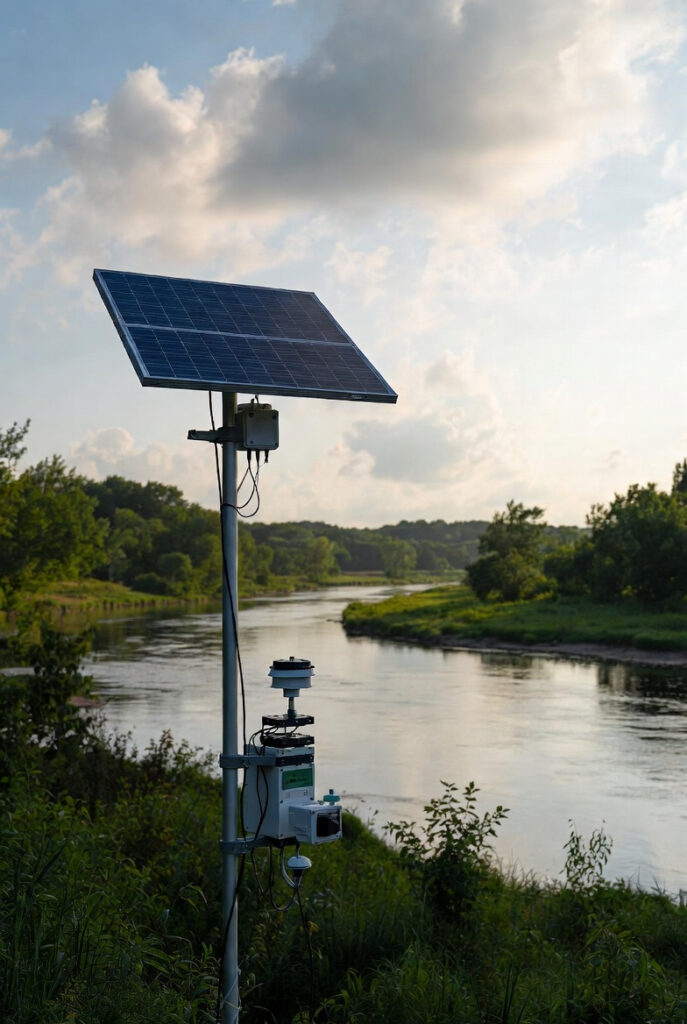
Remote sensor solar power systems fail field researchers in a way that is almost impossible to diagnose without a spectrum analyser. I was asked to review a persistent data quality problem at a water quality monitoring station on the Grand River near Elora in Wellington County. The station used a Campbell Scientific CR1000 datalogger connected to a YSI EXO2 multiparameter sonde measuring pH, specific conductance, dissolved oxygen, and turbidity at 15-minute intervals. The solar system included a 40W panel, a 20Ah LFP battery, and a standard PWM charge controller. The researcher had noticed that the pH readings showed a systematic oscillation of plus or minus 0.04 pH units with a period of approximately 8 to 12 minutes. She had replaced the pH sensor twice and recalibrated three times. The oscillation persisted.
When I connected a power quality analyser to the 12V DC bus feeding the CR1000 and EXO2 the cause was immediately visible. The PWM charge controller was switching at 6.8kHz, producing a 180mV peak-to-peak ripple on the DC bus. The EXO2’s pH analogue input circuit referenced the DC bus as its ground. When the DC bus voltage oscillated the pH reading oscillated with it. The 0.04 pH unit jitter was not a geochemical signal. It was the charge controller switching frequency modulated onto the DC bus and appearing as a pH reading through the shared ground reference.
I replaced the PWM controller with an MPPT controller and installed a linear drop-out regulator between the battery and the EXO2 power input. The LDO reduced the DC bus ripple from 180mV to less than 3mV at the sensor input. The pH oscillation disappeared completely. The researcher had 14 months of data with the 0.04 pH jitter throughout. The correction pass required reprocessing every 15-minute reading against a model of the switching frequency. The LDO regulator cost $24. The 14 months of data correction cost approximately 80 hours of graduate student time. For the solar research station sovereign data bank isolation architecture that uses the same galvanic isolation principle to prevent ground loop noise in scientific instruments, Article 197 covers the full isolation standard. For the full system sizing hub that covers the load calculation foundation, the hub covers the numbers.
Why a Remote Sensor Solar System Corrupts Your Data at the Source
PWM charge controllers switch at frequencies like 6.8kHz, producing 180mV peak-to-peak ripple on the DC bus. For a 24-bit ADC with a full-scale range of 2.5V, 50mV ripple represents 2% of full scale, approximately 330,000 counts of noise on a 16.7 million count scale. However, an LDO regulator output noise is 10 to 50 microvolts RMS, 1,000 times lower. As a result replacing the PWM controller with an MPPT and adding an LDO drops the sensor noise floor by a factor of 1,000 for $24 in parts.
The FT-240-31 ferrite cores wound 3 to 5 turns on the DC output cable between the controller and sensor supply attenuate conducted emissions above 1MHz by 40 to 60dB before the LDO input. As a result the sensor receives clean DC regardless of charge controller switching frequency. The Victron SmartShunt monitors battery voltage and triggers the data quality flag at 11.5V before sensor drift begins. For the remote radio station solar Type-31 ferrite choke standard that covers the same suppression principle for audio equipment, Article 202 covers the full ferrite installation specification.
| Power Supply Type | DC Bus Ripple | ADC Impact |
|---|---|---|
| PWM charge controller direct | 50 to 180mV | Measurable jitter on 16-bit and 24-bit sensors |
| MPPT with LDO regulator | Less than 3mV | Below sensor noise floor |
The LDO Regulator and Ferrite Choke: Clean Power for a 24-Bit ADC
The LDO working principle is straightforward. A linear transistor biased in its linear region never switches. Output noise is thermal noise only, typically 10 to 50 microvolts RMS. However, the LDO dissipates the voltage difference as heat. A 12V to 5V LDO at 100mA dissipates 700mW. For sensor currents below 200mA this heat is manageable without a heatsink in any reasonable field ambient temperature.
The ferrite choke complements the LDO by suppressing conducted emissions from the MPPT controller above 1MHz before they reach the LDO input. As a result even a high-frequency MPPT controller’s residual switching noise is attenuated before it reaches the sensor power supply. The combination of ferrite choke plus LDO reduces the sensor power supply noise from 180mV to below 3mV in a single pass. For the weather buoy solar Iridium SBD event-triggered telemetry standard that covers the same modem power management principle for remote scientific platforms, Article 206 covers the full threshold configuration.
The Supercapacitor Buffer: Preventing Satellite Modem Inrush Sag
The Iridium SBD modem draws 1.5A surge for 800 milliseconds during satellite acquisition. An aged 20Ah LFP battery with 200 milliohm internal resistance produces a 300mV terminal voltage sag during this surge. However, a 10 to 47 Farad supercapacitor in parallel with the battery provides the 1.5A from a source with less than 5 milliohm ESR, limiting the sag to less than 8mV.
The voltage step artifact appears as a step change in the sensor supply voltage at every satellite transmission. For a dissolved oxygen sensor this produces an apparent DO spike or drop of 0.1 to 0.3mg/L at each transmission timestamp. As a result the data has a periodic artifact exactly correlated with the Iridium transmission schedule, invisible to the researcher unless they cross-reference data timestamps against the satellite log. For the solar weather station battery monitoring standard that uses the same Victron Smart Battery Sense wireless threshold alert for remote agricultural sensor stations, Article 199 covers the full sensor architecture.
The Motor Isolation Circuit: Flyback Diode and Dedicated Power Branch
Remote sensor solar inductive kickback failures are violent and instantaneous. I investigated a recurring logger freeze at an automated water quality sampling station on the Nottawasaga River near Angus in Simcoe County. The station used a Teledyne ISCO 3700 sampler connected to the same 12V DC power rail as the CR1000 datalogger and cellular uplink modem. Each time the ISCO sampler triggered its 12V peristaltic pump motor the logger froze and rebooted.
The pump motor drew 3.8A running current. However, when the motor shut off after each 45-second sample collection the collapsing magnetic field in the motor windings generated a voltage spike of 68V on the 12V DC bus for approximately 2 milliseconds. At 68V the CR1000’s internal power supply protection clamped and reset the processor. The logger had been recording data gaps every 4 hours for 7 months. The researcher had attributed the gaps to cellular connectivity failures.
I installed a 1N5408 flyback diode across the motor terminals and moved the sampler motor to a dedicated 12V power branch with its own 10A fuse and 100uF electrolytic capacitor across the supply terminals. The flyback diode clamped the motor kickback from 68V to 13.4V. The capacitor absorbed the residual transient. The CR1000 has not rebooted during a sample collection in the 11 months since. The diode and capacitor together cost $3.40 in parts. Seven months of 4-hour data gaps required manual gap-filling and partial dataset invalidation. For the fish hatchery solar dedicated DC circuit standard that uses the same dedicated power branch isolation principle for critical loads, Article 207 covers the full circuit separation architecture.
The Battery Voltage Data Flag: Protecting Research Data Quality
When the 12V supply drops to 11.5V the internal 5V regulator output drops to 4.8V and the bandgap voltage reference begins to drift at approximately 0.02% per 100mV of supply reduction. For a dissolved oxygen sensor this produces a systematic DO reading decrease of 0.03 to 0.05mg/L per hour at voltages below 11.5V. This drift is indistinguishable from genuine deoxygenation in the water column.
The data flagging protocol: configure the CR1000 to record the battery terminal voltage alongside every sensor reading. Set a data quality flag when voltage drops below 11.5V. As a result the researcher can identify and quarantine every reading collected during a low-voltage event before the data enters the analysis pipeline. For a multi-year dataset this flagging protocol prevents a single low-battery event from invalidating months of otherwise clean data. For the solar remote monitoring standard that covers the full VRM alert configuration for remote station management, Article 187 covers the threshold alert setup.
The Remote Sensor Solar System: Minimum Viable vs Full Precision Standard
The decision follows sensor resolution and whether the station is running a short-term screening survey or a multi-year funded research program.
The minimum viable remote sensor solar system for a basic water quality logger at a sheltered riverbank location includes a 40W panel, a 20Ah LFP battery, an MPPT charge controller with FT-240-31 ferrite choke on the DC output, an LDO regulator for the sensor power supply, and a battery voltage data flag at 11.5V. Capital cost runs $280 to $450. It eliminates PWM switching noise from the sensor power chain and flags low-voltage data for quality control.
The full precision standard for a research-grade multi-parameter monitoring station on a funded environmental program includes an 80W panel with shielded cable glands on all enclosure penetrations, 40Ah LFP battery with supercapacitor buffer for satellite modem inrush, LDO regulator bank for each sensor type, flyback diode and dedicated power branch for any motor loads, battery voltage data flag at 11.5V, and Victron SmartShunt SoC telemetry with low-voltage alert to the researcher’s phone. Capital cost runs $900 to $1,600. It provides laboratory-grade power quality for unattended operation through a full Ontario field season.
NEC and CEC: What the Codes Say About Remote Sensor Solar
NEC 690 governs the PV source circuits of any remote sensor solar installation regardless of array size. A 40W or 80W field research array is subject to the same NEC 690 overcurrent protection and disconnecting means requirements as a residential installation. The low-voltage sensor circuits powered through the LDO regulator are Class 2 circuits under NEC 725 due to their voltage and current levels. NEC 725 Class 2 circuits require appropriate wiring methods but are exempt from many raceway and installation requirements. The motor control circuit for the water sampler pump is subject to NEC 430 for motor branch circuit protection, requiring a motor branch circuit protective device rated for the motor’s full-load current.
In Ontario, a remote sensor solar installation on Crown land or conservation authority property is subject to CEC Section 64 for the PV source circuits if the system includes components connected to building fixed wiring. A self-contained portable solar logger unit with no connection to building wiring is outside the scope of ESA permit requirements as a low-voltage DC portable system. Research stations operated by universities or conservation authorities under approved environmental monitoring programs may qualify for simplified installation procedures under Environment and Climate Change Canada monitoring network standards. Contact the Ontario Ministry of the Environment, Conservation and Parks for permit requirements for permanently installed monitoring equipment in provincially significant wetlands or sensitive aquatic environments.
Pro Tip: Before deploying any precision sensor station, power the complete system on the bench with the solar array connected and actively charging, and measure the AC ripple on the DC bus at the sensor power input with a multimeter set to AC millivolts. Do this test with the battery at 50% SoC and the charge controller in bulk charge mode — that is when switching noise is highest. I have bench-tested systems that looked clean at full battery and showed 140mV of ripple as soon as the controller entered bulk charge. The sensor sees the bulk charge ripple, not the float ripple. Test at bulk. Fix at bulk. Deploy after.
The Verdict
A remote sensor solar system built to the precision standard means the pH readings on the Grand River reflect the river, the DO readings on the Nottawasaga reflect the water, and the researcher does not spend 80 hours correcting data that a $24 regulator would have kept clean.
- Replace the PWM controller and add an LDO regulator before the first field deployment. The Elora station had 14 months of pH jitter because a 180mV PWM ripple was appearing as a geochemical signal through the shared ground reference. An MPPT controller and a $24 LDO dropped the ripple to 3mV and eliminated the jitter entirely. The graduate student time it saved was worth considerably more than $24.
- Add the flyback diode before connecting any motor load to the sensor power rail. The Angus station had 4-hour data gaps every 7 months because a peristaltic pump generated a 68V kickback spike that reset the CR1000 on every sample collection. A $3.40 diode and capacitor ended it. The dataset invalidation it prevented took weeks to recover.
- Flag every data point collected below 11.5V before it enters the analysis pipeline. Sensor bandgap references drift when the supply drops below 11.5V. The drift looks like real environmental data. A single line of CR1000 code that records battery voltage alongside every reading and flags the low-voltage points is the cheapest quality control step in environmental monitoring.
In the shop, we calibrate the torque wrench before we use it. In the field, we clean the power supply before we trust the data.
Frequently Asked Questions
Q: How do I know if my solar charge controller is corrupting my sensor data? A: Connect a multimeter set to AC millivolts across the DC power supply terminals feeding your sensors while the charge controller is actively charging. A reading above 20mV AC indicates switching noise on the DC bus. More than 50mV AC will cause measurable jitter in most precision environmental sensors.
Q: What is the simplest fix for PWM noise in a solar field sensor station? A: Replace the PWM charge controller with an MPPT controller and add a linear drop-out regulator between the battery and the sensor power supply. The LDO costs $15 to $35 and reduces DC bus ripple from 50 to 180mV to less than 3mV at the sensor input. This is the minimum fix for any precision measurement application.
Q: Why does my data logger freeze when the water sampler pump triggers? A: The pump motor generates an inductive voltage kickback spike when it shuts off, often reaching 5 to 10 times the supply voltage for 1 to 3 milliseconds. A $2 flyback diode across the motor terminals clamps this spike to one diode drop above supply voltage. Without the diode the spike resets the logger processor on every sample collection.
Questions? Drop them below.
This post contains affiliate links. If you purchase through our links, we may earn a small commission at no extra cost to you.
About the Author
Robert Bertrand spent 20 years as a service advisor in the automotive industry (Lexus and Nissan), where precision diagnostics, wiring integrity, and documentation standards were non-negotiable. He brings that same technical discipline to GridFree Guide, where he researches, tests, and documents off-grid solar systems for Ontario conditions. Based in Rockwood, Ontario, every article is built on verified specifications, manufacturer data, and the real-world climate constraints of Canadian off-grid living.
As an Amazon Associate I earn from qualifying purchases. This site also contains affiliate links to other products and services. GridFree Guide earns a small commission at no extra cost to you.