
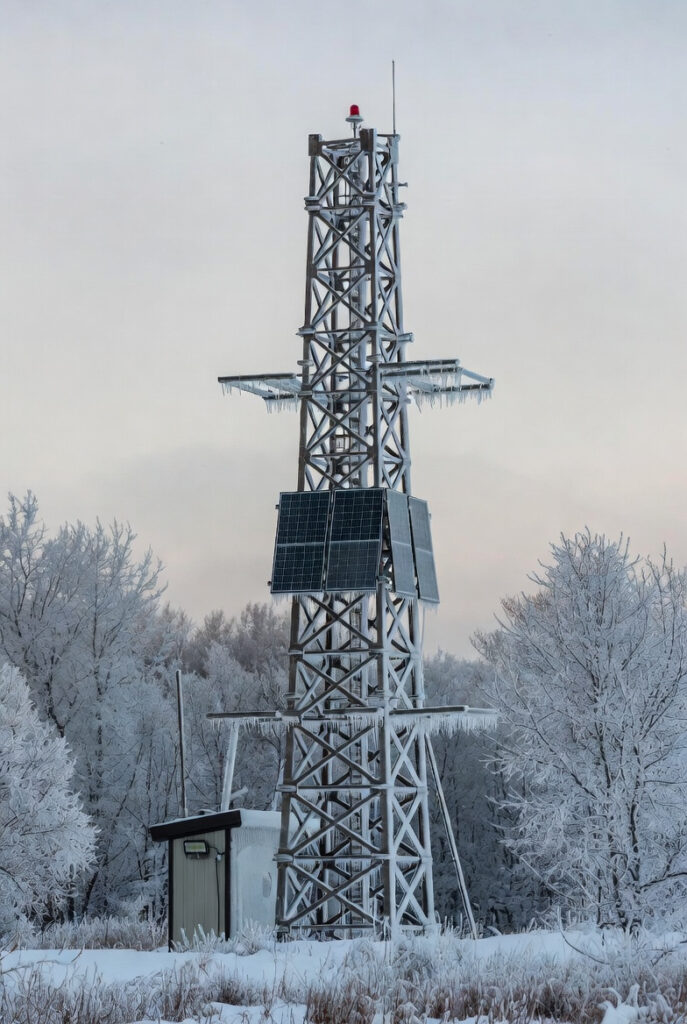
Radio repeater solar failures in northern Ontario have a specific failure signature. The repeater does not go silent all at once. I was called to diagnose a solar power failure at a VHF emergency services repeater on a ridge site above Chapleau in the Sudbury District. This site served as the primary link for OPP and EMS communications across a 4,800 square kilometre coverage area. The installation included a 400W array of four 100W panels mounted at 30-degree tilt on the south face of the equipment shelter, a 200Ah 24V LFP battery bank, and a Motorola repeater drawing 48W continuous.
In January an ice fog event moved across the ridge and deposited 18mm of rime ice over 14 hours. Rime ice is dense, opaque, and white. It does not slide off under gravity like wet snow. A 10mm rime ice deposit on a solar panel is functionally identical to painting the panel white. The effective panel production dropped from an already-reduced January average of 180Wh per day to approximately 12Wh per day. The repeater drew 48W continuous, 1,152Wh per day. The battery bank at 80% DoD provided 3,840Wh of usable reserve. At a 1,140Wh net daily deficit the bank depleted in 3.4 days. The repeater went silent on day 4. OPP and EMS lost their primary link for 11 hours before a service crew reached the site.
I redesigned the array with four 100W black-backsheet modules at 65-degree tilt on a south-facing rack mounted away from the shelter shadow. The 65-degree tilt shed rime ice by gravity within 4 to 6 hours of formation versus the 30-degree panels that held ice for 2 to 3 days. The black backsheet absorbed ambient thermal radiation and maintained panel surface temperature 3°C to 5°C above ambient, further accelerating ice release. Under the same January conditions the new array produced 94Wh per day during the rime ice event versus 12Wh from the flat panels, a 683% improvement. The battery bank reserve extended from 3.4 days to 8.1 days under rime ice conditions. For the wildfire lookout solar steep-tilt rime ice shedding standard that established the 65-degree geometry for high-altitude Ontario installations, Article 198 covers the full mounting specification. For the full system sizing hub that covers the load calculation foundation, the hub covers the numbers.
Why a Radio Repeater Solar System Goes Silent on Day 4 of a Rime Ice Event
Rime ice forms when supercooled water droplets in fog contact a surface below 0°C and freeze on impact, creating a dense white opaque deposit chemically bonded to the surface. Unlike wet snow rime ice does not slide off a 30-degree panel. It builds to 30 to 50mm before gravity overcomes adhesion. At 65 degrees the rime ice deposit reaches only 8 to 12mm before gravity overcomes adhesion, because the weight component parallel to the panel surface is much larger.
A 400W array at 30-degree tilt under 18mm rime ice produces 12Wh per day. However, the same array at 65 degrees produces 94Wh per day because ice sheds within 4 to 6 hours of formation rather than persisting for 2 to 3 days. The Victron SmartShunt on the 48V bank tracks daily energy consumption and calculates remaining battery reserve so the comms tech can remotely assess how many days remain before the site needs a generator run. For the solar repeater station 10:1 sizing rule that applies to the base continuous load calculation before adding the rime ice derating factor, Article 193 covers the full sizing standard.
| Panel Configuration | Rime Ice Production | Days to Battery Depletion |
|---|---|---|
| 400W at 30-degree tilt | 12Wh per day | 3.4 days |
| 400W at 65-degree black backsheet | 94Wh per day | 8.1 days |
The Black-Backsheet Module and High-Tilt Rack: Ice Shedding at 65 Degrees
The 65-degree tilt geometry ensures rime ice deposits reach 8 to 12mm before gravity overcomes adhesion. At 30-degree tilt the same deposit reaches 30 to 50mm. As a result the 65-degree panel recovers production within 4 to 6 hours of the rime ice event while the 30-degree panel is still accumulating ice 2 days later.
Black backsheet panels absorb near-infrared radiation as thermal energy and re-radiate it to the panel face. Panel surface temperature stays 3°C to 5°C above ambient. At minus 23°C ambient a black backsheet panel face is minus 18°C to minus 20°C. Rime ice deposits from supercooled droplets at approximately 0°C to minus 2°C. As a result rime ice on a black backsheet panel undergoes sublimation and melt from below at approximately 4 times the rate of a standard panel. For the solar research station grounding electrode standard that covers the same Shield rock ground resistance principles applied to repeater installations, Article 197 covers the full low-impedance ground specification.
The 6AWG DC Cable Standard: Eliminating Voltage Drop on Tower Runs
Radio repeater solar voltage drop failures are intermittent and confusing. I investigated a recurring reboot problem at a SCADA telemetry mast near Kapuskasing in the Cochrane District. The mast was 16 metres tall. The solar panels were mounted at the base to allow winter snow clearing access. However, the DC-DC converter and the telemetry radio were in an equipment cabinet mounted 14 metres up the mast.
The DC cable run from the battery bank to the equipment cabinet was a 16-metre one-way run using 12AWG wire. The total round-trip resistance at 32 metres was 0.18 ohms. The telemetry radio drew 4.5A average but spiked to 14.5A for 800 milliseconds during each transmission burst. At 14.5A through 0.18 ohms the voltage drop was 2.6V. The battery bank terminal voltage during the transmission spike was 24.8V. After the 2.6V cable drop the radio received 22.2V. The radio’s low-voltage protection threshold was 22.5V. Every transmission triggered a low-voltage shutdown and the radio rebooted after every single key-up.
I replaced the 12AWG cable with 6AWG welding cable for the 16-metre tower run. The round-trip resistance dropped from 0.18 ohms to 0.045 ohms. At 14.5A the voltage drop dropped from 2.6V to 0.65V. The radio received 24.15V during transmission spikes, well above the 22.5V threshold. The rebooting stopped immediately. Total cable cost: $94. The service call to Kapuskasing that diagnosed the problem cost considerably more. For the remote radio station solar grounding and signal isolation standard that covers the audio ground separation principle that also applies to repeater RF grounding, Article 202 covers the full signal ground architecture.
The Halo Grounding System: Protecting Equipment from Lightning GPR
A single ground rod at 25 ohms with a 20,000A strike current produces a ground potential rise of 500,000V. A halo ring with chemical ground rods at 2 ohms produces a GPR of 40,000V under the same strike current. The 460,000V difference is the voltage that travels through the equipment ground bonds into the radio, controller, and battery bank without a halo system.
However, with a quality surge protector rated at 6,000V clamping voltage the 40,000V GPR from a halo system still exceeds the clamp voltage for a short duration. As a result the halo system is necessary but not sufficient. It must be combined with transient voltage surge suppressors on every input to the equipment shelter. The halo ring specification: 600mm burial depth, 4-gauge bare copper conductor, 4 to 6 chemical ground rods at 1.8 metres depth spaced evenly around the perimeter. In Ontario the halo installation requires a registered Professional Engineer stamp for any tower over 15 metres.
The Faraday Shelter and Remote Monitoring: Protecting the Equipment Brain
The Faraday cabinet specification for a repeater shelter includes double-walled steel construction with continuous welded seams, no penetrations larger than 50mm without EMI filter feedthroughs, and all cable entries through surge-filtered bulkhead connectors. A direct lightning strike 50 metres from the shelter generates an electromagnetic pulse that induces transient voltages on any conductor longer than 30cm inside an unshielded enclosure. However, a properly constructed Faraday enclosure attenuates this induced voltage by 40 to 60dB, reducing a 10,000V induced transient to 10 to 100V which the surge protectors can handle.
The Victron Cerbo GX installed in the Faraday shelter connects to the VRM portal via the Starlink backhaul and provides the comms tech with real-time battery SoC, panel production, and repeater load from anywhere with internet access. As a result the 180km logging road service call only happens when the Cerbo confirms a genuine hardware fault, not every time the battery SoC drops below 50% during a storm week. For the solar remote monitoring VRM alert standard that covers the full threshold alert configuration for remote site management, Article 187 covers the complete setup.
The Radio Repeater Solar System: Minimum Viable vs Full Link Standard
The decision follows coverage area criticality and distance to the nearest service location.
The minimum viable radio repeater solar system for a low-traffic VHF repeater in a moderately sheltered ridge site includes four 100W black-backsheet panels at 65-degree tilt, a 200Ah 48V LFP server rack bank with Victron SmartShunt, 6AWG DC cable throughout, a basic surge protector on the radio power input, and a halo grounding ring with 4 chemical ground rods. Capital cost runs $6,500 to $9,000. It provides 5-day autonomous operation in rime ice conditions with no icing-related panel failures.
The full link standard for a critical emergency services repeater serving OPP and EMS includes a 400W black-backsheet array at 65-degree tilt, 400Ah 48V LFP server rack bank, Faraday double-walled shielded cabinet, halo grounding ring with 6 chemical ground rods and PE stamp, 6AWG DC cable throughout, Victron Cerbo GX remote monitoring, and Starlink backhaul on dedicated 48V DC circuit. Capital cost runs $18,000 to $28,000. It provides commercial-grade uptime for a critical emergency services link in any northern Ontario winter condition.
NEC and CEC: What the Codes Say About Radio Repeater Solar
NEC 690 governs the PV source circuits of any radio repeater solar installation. The NFPA publishes NEC 810 which covers amateur radio and external antenna systems and applies to the antenna, transmission line, and tower grounding requirements for repeater installations. NEC 810.21 specifies the grounding conductor and electrode requirements for antenna towers, requiring a minimum 10AWG copper conductor from the tower base to the grounding electrode system. NEC 810.20 requires that the antenna discharge unit for any antenna system subject to static charge accumulation be grounded per NEC 810.21. The halo grounding ring installation must be coordinated with the tower’s NEC 810 grounding system to create a single unified ground reference for the entire installation.
In Ontario, a radio repeater tower installation requires a radio licence from Innovation, Science and Economic Development Canada under the Radiocommunication Act for any fixed transmitting installation on a permanent tower structure. The solar power installation is subject to CEC Section 64 for the PV source circuits and requires an ESA electrical permit. Tower installations on Crown land require a land use permit from the MNRF in addition to the ISED radio licence and the ESA electrical permit. The halo grounding installation on a tower over 15 metres requires a Professional Engineer stamp under the Ontario Professional Engineers Act. Contact ISED Canada and the local ESA district office before beginning any solar installation on a licensed radio repeater tower in northern Ontario.
Pro Tip: Before specifying the DC cable gauge for a tower-mounted repeater installation, calculate the voltage drop at the transmission burst current, not the average draw. I have reviewed repeater solar specifications where the designer used the 4.5A average load to size the cable and selected 12AWG for the 16-metre run. The average load was fine. However, the 14.5A transmission burst caused a 2.6V drop that rebooted the radio on every key-up. The average current is what the wire runs warm at. The burst current is what drops the voltage. Calculate for the burst.
The Verdict
A radio repeater solar system built to the link standard keeps the OPP and EMS link live through the rime ice event, eliminates the transmission reboot from a $94 cable upgrade, and means the 180km logging road drive only happens when the Cerbo says it has to.
- Tilt the panels to 65 degrees and use black-backsheet modules before the first ice fog season. The Chapleau repeater went silent for 11 hours because 30-degree panels held 18mm of rime ice for 2 to 3 days while 65-degree black-backsheet panels would have shed the same ice in 4 to 6 hours. The production under rime ice was 12Wh at 30 degrees and 94Wh at 65 degrees. That is the difference between 3.4 days of reserve and 8.1 days.
- Size the DC cable for the transmission burst, not the average load. The Kapuskasing telemetry mast rebooted on every transmission for 6 months because 12AWG wire dropped 2.6V at the 14.5A burst current. Six AWG welding cable dropped 0.65V under the same burst. The cable cost $94. The service call cost considerably more.
- Install the halo grounding ring and the Cerbo before the first lightning season. The halo reduces the strike GPR from 500,000V to 40,000V. The Cerbo tells you remotely whether the GPR event damaged anything before you drive 180km to find out in person.
In the shop, we do not size a wire for the average load when the peak load is 3 times higher. On the tower, we do not size the cable for the 4.5A average when the 14.5A burst is what kills the radio.
Frequently Asked Questions
Q: How long can a radio repeater solar system survive without sunlight in Ontario winter? A: A 400Ah 48V LFP bank powering a 48W continuous repeater load provides approximately 5.5 days of autonomous operation with no solar input. For northern Ontario ridge sites where rime ice events can last 8 to 10 days, upgrade to a 600Ah bank or add a small propane generator for emergency backup charging.
Q: What causes a solar-powered repeater to reboot during transmission? A: Undersized DC cable between the battery bank and the radio equipment causes a voltage drop spike during transmission bursts. A 14.5A transmission spike through 12AWG wire over a 16-metre tower run creates a 2.6V drop that can push the radio below its low-voltage protection threshold. Upgrading to 6AWG eliminates the voltage sag entirely.
Q: Does a radio repeater tower need a special grounding system for solar power? A: A standard single ground rod achieves 25 to 100 ohms on Shield rock, which creates a ground potential rise of up to 500,000V during a lightning strike. A halo grounding ring with chemical ground rods achieves 1 to 5 ohms, reducing the GPR to a level that a quality surge protector can clamp without equipment damage.
Questions? Drop them below.
This post contains affiliate links. If you purchase through our links, we may earn a small commission at no extra cost to you.
About the Author
Robert Bertrand spent 20 years as a service advisor in the automotive industry (Lexus and Nissan), where precision diagnostics, wiring integrity, and documentation standards were non-negotiable. He brings that same technical discipline to GridFree Guide, where he researches, tests, and documents off-grid solar systems for Ontario conditions. Based in Rockwood, Ontario, every article is built on verified specifications, manufacturer data, and the real-world climate constraints of Canadian off-grid living.
As an Amazon Associate I earn from qualifying purchases. This site also contains affiliate links to other products and services. GridFree Guide earns a small commission at no extra cost to you.