
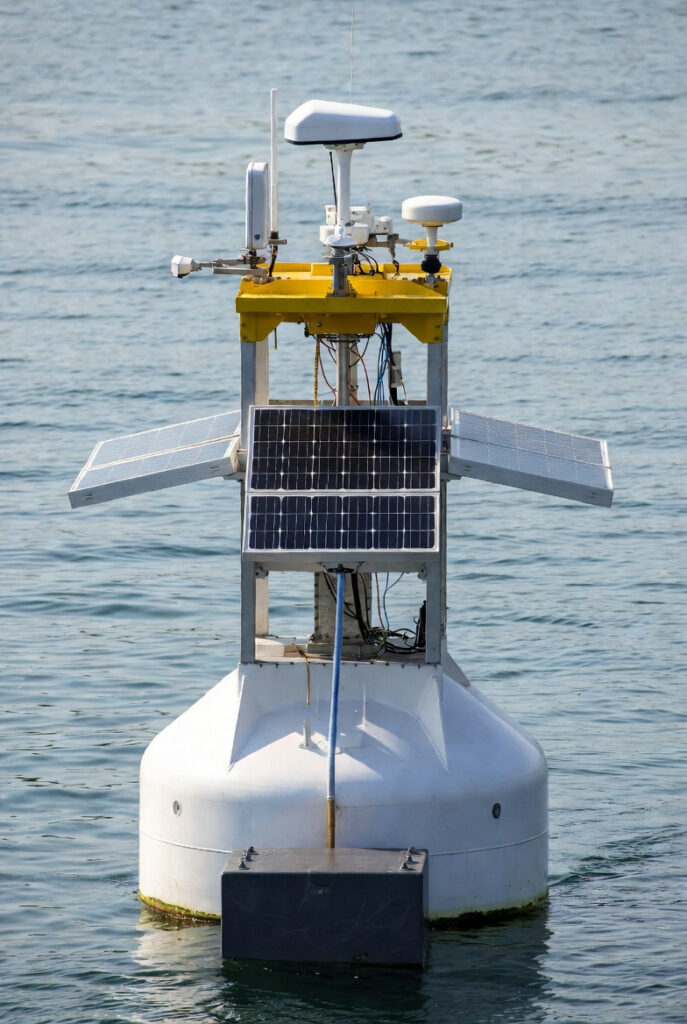
Weather buoy solar failures on the Great Lakes do not happen because the equipment is wrong. They happen because the energy budget was calculated for dry land. I was brought in to review the power system specification for a Lake Huron nearshore monitoring buoy deployed by a freshwater research group out of Owen Sound. The buoy carried a YSI EXO2 multiparameter sonde, a Gill Instruments ultrasonic anemometer, a Campbell Scientific CR1000 datalogger, and an Iridium SBD satellite modem.
The power system was a single 50W rigid monocrystalline panel mounted horizontally on the buoy superstructure and a 100Ah LFP battery bank. The system had been designed using standard solar calculations that assumed a fixed south-facing panel at 15-degree tilt in calm water. However, on Lake Huron in October the buoy was experiencing 1.5 to 2-metre significant wave height with 7 to 9-second period. At that sea state the buoy was pitching plus or minus 25 degrees from horizontal every 8 seconds. I modelled the actual panel production using 72-hour wave data from the Environment Canada buoy at the same location. The single horizontal panel spent 41% of each day at angles greater than 45 degrees from the solar disc. The effective daily production was 47Wh rather than the 200Wh the designer had assumed. The battery bank depleted to satellite modem cutoff within 4 days of any storm event above 1.5 metres. The research group lost the buoy’s satellite uplink during three separate October storm events, each for 18 to 36 hours.
I redesigned the power system with four 20W flexible ETFE panels mounted at 90 degrees to each other around the buoy superstructure, providing 360-degree coverage. At any pitch angle at least one panel was within 45 degrees of the solar disc. The effective daily production under the same wave conditions rose from 47Wh to 164Wh. The battery bank survived every storm event that season including a 4-metre wave height event in November that the single-panel system would have depleted in under 24 hours. For the solar weather station land-based standard that uses the same CR1000 datalogger platform in fixed terrestrial installations, Article 199 covers the full station architecture. For the full system sizing hub that covers the load calculation foundation, the hub covers the numbers.
Why a Weather Buoy Solar System Produces Half Its Rated Output in Heavy Seas
The cosine law applied to a pitching buoy: at 45 degrees from the solar disc the cosine is 0.71, a 29% production loss. At 60 degrees the cosine is 0.50, a 50% loss. At 90 degrees production is zero. A single horizontal panel in 1.5 to 2-metre seas spends 41% of the day above 45 degrees angle. As a result effective production is less than half the land-based calculation.
The 360-degree perimeter solution ensures that at any pitch angle at least one panel is within 45 degrees of the solar disc. Combined perimeter production under the same wave conditions is 164Wh per day versus 47Wh for the single horizontal panel. The Victron SmartShunt installed on the subsurface battery pod tracks real-time SoC and transmits the value via the Iridium uplink so the research team knows battery status without a site visit. For the solar research station sovereign data bank architecture that uses the same isolated monitoring principle for remote scientific platforms, Article 197 covers the full isolation standard.
| Panel Configuration | Production in Heavy Seas | Production in Calm |
|---|---|---|
| Single 50W horizontal panel | 47Wh per day | 200Wh per day |
| Four 20W ETFE perimeter panels | 164Wh per day | 180Wh per day |
The ETFE Panel and Hull Integration: Marine-Grade Corrosion Resistance
Weather buoy solar systems fail on the Great Lakes in a second way that marine engineers sometimes miss in freshwater applications. I inspected a monitoring buoy on Georgian Bay near Tobermory that had been reporting degraded solar production since its third season of deployment. The buoy’s original panel system was a pair of 30W aluminium-framed monocrystalline panels mounted on a stainless steel rail assembly above the buoy deck.
Georgian Bay is freshwater but the wave spray in a northwesterly blow carries fine mineral particulates and organic matter that deposit on aluminium surfaces and initiate crevice corrosion at the anodised frame edges. When I removed the panels for inspection in the fourth season I found crevice corrosion at every corner joint and every mounting hole. The corrosion had wicked into the panel laminate at 4 of 8 corner joints, creating conductive pathways that were shorting partial cell strings under wet conditions. The panels were producing 31% of rated output under wet conditions and 78% under dry conditions. Total production loss over the season was estimated at 58%.
I replaced both panels with ETFE-encapsulated frameless panels bonded directly to the buoy superstructure with marine-grade adhesive. The ETFE surface is chemically inert, has no aluminium frame to corrode, and bonds to the buoy hull as a single unit. Three seasons later the panels are producing 96% of rated output. The crevice corrosion failure has not recurred. For the modular housing solar flexible ETFE panel bonding standard that uses the same adhesive hull-integration principle for lightweight roof installation, Article 201 covers the full bonding specification.
The Subsurface Battery Pod: 4°C Thermal Stability Under Winter Ice
Water reaches maximum density at exactly 4°C. Below 4°C fresh water becomes less dense, rises to the surface, and freezes there. As a result the water at 5 metres depth in any Great Lakes location stays at approximately 4°C regardless of surface ice conditions. An LFP battery pack in a sealed subsurface pod at 5-metre depth therefore operates at 4°C throughout the Ontario winter.
However, a surface-mounted battery pack on the same buoy experiences minus 15°C to minus 25°C air temperatures. At 4°C the LFP pack retains 85 to 90% of rated capacity and accepts charge current at 50 to 70% of rated rate. At minus 15°C the same pack retains only 40 to 50% of capacity and cannot accept charge current without lithium plating risk. The difference between 4°C and minus 15°C is the difference between a functioning winter buoy and a dead one.
The Victron Smart Battery Sense wireless temperature sensor mounted inside the subsurface pod confirms the 4°C thermal stability assumption throughout winter operations, alerting the research team if pod temperature drops unexpectedly due to thermocline disruption during storm mixing events. For the battery bank winterization standard that covers surface-mounted LFP cold temperature management on land-based systems, Article 190 covers the full deep freeze protocol.
The Event-Triggered Iridium Uplink: 60% Energy Saving for Continuous Telemetry
A fixed-interval Iridium SBD transmission schedule of 24 messages per day at 1.5W per 60-second window draws 36Wh per day. However, an event-triggered configuration with 4 daily summary transmissions plus threshold alerts draws only 8 to 12Wh per day. The 24 to 28Wh daily saving equals the production of one 20W ETFE panel during a typical overcast Great Lakes day.
The event configuration transmits immediately on significant wave height above 1.5 metres, water temperature below 4°C, battery SoC below 30%, or any sensor reading outside the defined research envelope. Calm period data goes out in a 6-hour summary packet. As a result the data most valuable for storm research is transmitted in real time while routine monitoring data is batched. The Iridium SBD message format carries 340 bytes per transmission, sufficient for the complete sensor suite readings, battery SoC, GPS position, and event flag in a single message. For the off-grid hospital solar satellite alarm standard that uses the same Iridium SBD threshold alert protocol for critical facility monitoring, Article 200 covers the full alert configuration.
The Bird Deterrent and Biofouling Prevention Standard
A single herring gull can reduce weather buoy solar output by 40 to 60% in a single afternoon. The gull lands on the panel surface, deposits droppings on the ETFE coating, and the solid calcium-rich deposit creates a shading event equivalent to a physical obstruction. However, bird deterrent spikes mounted at 150mm intervals along the top edge of the panel array prevent landing entirely.
The spike material must be marine-grade 316 stainless steel or HDPE plastic. Aluminium spikes corrode within one season in freshwater spray environments. In addition the ETFE panel surface benefits from a quarterly wash with dilute citric acid solution to remove mineral deposits from spray evaporation. As a result production stays within 5% of rated output between annual maintenance visits. For the construction site panel cleaning protocol that uses the same weekly wash standard for solid surface deposits, Article 203 covers the surface deposit removal process.
The Weather Buoy Solar System: Minimum Viable vs Full Marine Standard
The decision follows deployment duration, water body, and winter ice exposure.
The minimum viable weather buoy solar system for a nearshore research buoy on Lake Huron or Georgian Bay includes four 20W flexible ETFE panels in 360-degree perimeter configuration, a 100Ah LFP battery bank in a sealed subsurface pod, an event-triggered Iridium SBD modem, and bird deterrent spikes on all panel surfaces. Capital cost runs $3,200 to $5,500. It provides continuous telemetry through normal Great Lakes conditions including 2-metre wave events and Ontario winters above the thermocline.
The full marine standard for a year-round offshore monitoring station on Lake Superior or Lake Ontario includes eight 20W ETFE perimeter panels hull-bonded with marine adhesive, 200Ah LFP subsurface pod with Victron Smart Battery Sense temperature monitoring and Victron SmartShunt SoC telemetry, event-triggered Iridium SBD with 6-hour summary and real-time threshold alert configuration, bird deterrent spikes, and quarterly citric acid wash maintenance protocol. Capital cost runs $8,500 to $14,000. It provides commercial-grade uptime for a year-round offshore monitoring station in any sea condition below Transport Canada Category 3.
NEC and CEC: What the Codes Say About Weather Buoy Solar
NEC 690 governs the PV source circuits of any weather buoy solar installation. The flexible ETFE panels, wiring, charge controller, and battery bank are subject to NEC 690 overcurrent protection and disconnecting means requirements regardless of the marine environment. NEC Article 553 covers floating buildings and applies by analogy to permanently moored buoy installations with electrical systems. NEC 553.10 requires that the electrical system of a floating structure be protected from bilge water and wave splash intrusion. The subsurface battery pod installation must comply with NEC 553.10 sealed enclosure requirements for below-waterline electrical equipment. NEC 310 governs conductor selection and marine-grade UL Type TC-ER or equivalent wet-location rated cable is required for all conductors exposed to wave spray or immersion on the buoy superstructure.
In Ontario and on Canadian waters a research buoy electrical system is subject to Transport Canada Small Vessel Regulations under the Canada Shipping Act for any buoy that qualifies as a vessel. A research buoy operated by a federal or provincial agency on the Great Lakes may qualify for a regulatory exemption under Fisheries and Oceans Canada research vessel provisions, which can simplify the permitting pathway for the electrical installation. Contact Transport Canada Marine Safety and Security at the closest regional office before deploying a solar-powered buoy on any navigable Canadian waterway to confirm classification and permit requirements for your specific buoy configuration.
Pro Tip: Before specifying the battery bank size for a Great Lakes research buoy, pull the worst 72-hour storm event from the nearest Environment Canada marine weather buoy for your deployment zone and calculate panel production using the actual wave height and period from that event. I have seen weather buoy solar specifications that assumed 4 peak sun hours per day because the designer used the annual average. In October on Lake Huron the actual peak sun hours during a storm event are 0.8 to 1.2. Size for the worst storm in your deployment season. The annual average is what keeps the battery topped up between storms. The storm is what kills the system.
The Verdict
A weather buoy solar system built to the marine standard keeps the satellite uplink live through every October storm, every Georgian Bay corrosion season, and every Great Lakes winter without a site visit.
- Model the production using actual wave data before specifying the battery bank. The Owen Sound research group lost three October satellite uplinks because a designer assumed 200Wh from a horizontal panel that was producing 47Wh in 1.5-metre seas. Four ETFE panels in 360-degree perimeter configuration produced 164Wh under the same wave conditions. Model for the storm, not the calendar.
- Replace aluminium-framed panels with ETFE bonded to the hull before the first winter deployment. The Georgian Bay buoy lost 58% of its solar production to crevice corrosion in freshwater wave spray. Three seasons of production loss funded the ETFE replacement three times over. Bond to the hull. Remove the frame.
- Mount the battery pod at 5 metres depth before the ice season. A surface battery pack at minus 15°C retains 40 to 50% of its capacity and cannot accept charge current. The same pack at 4°C retains 85 to 90% and charges normally. The thermocline does the work that a battery heater cannot.
In the shop, we do not calculate engine output using the test bench numbers when the customer drives on winter roads. On the water, we do not calculate buoy power using the calm-day numbers when October on Lake Huron looks nothing like a test bench.
Frequently Asked Questions
Q: How do you keep a solar buoy running during a Great Lakes storm? A: A 360-degree perimeter panel configuration ensures at least one panel faces the sun regardless of buoy pitch and heave. A 100Ah LFP subsurface battery pod provides reserve energy through the low-production storm period. Event-triggered Iridium uplink reduces daily energy consumption by 60% compared to fixed-interval transmission.
Q: Why does a weather buoy solar panel produce less than its rated output? A: Wave-induced pitch and heave means the panel is rarely at the optimal angle to the sun. A single horizontal panel on a buoy in 1.5-metre waves spends up to 41% of each day at angles greater than 45 degrees from the solar disc, reducing effective production by more than half compared to a land-based calculation.
Q: What battery type is best for a winter weather buoy on the Great Lakes? A: An LFP battery pack in a sealed subsurface pod at 5-metre depth stays near 4°C year-round because fresh water reaches maximum density at 4°C and stratifies there regardless of surface ice. This eliminates the cold temperature capacity loss that affects surface-mounted battery packs on ice-covered lakes.
Questions? Drop them below.
This post contains affiliate links. If you purchase through our links, we may earn a small commission at no extra cost to you.
About the Author
Robert Bertrand spent 20 years as a service advisor in the automotive industry (Lexus and Nissan), where precision diagnostics, wiring integrity, and documentation standards were non-negotiable. He brings that same technical discipline to GridFree Guide, where he researches, tests, and documents off-grid solar systems for Ontario conditions. Based in Rockwood, Ontario, every article is built on verified specifications, manufacturer data, and the real-world climate constraints of Canadian off-grid living.
As an Amazon Associate I earn from qualifying purchases. This site also contains affiliate links to other products and services. GridFree Guide earns a small commission at no extra cost to you.