
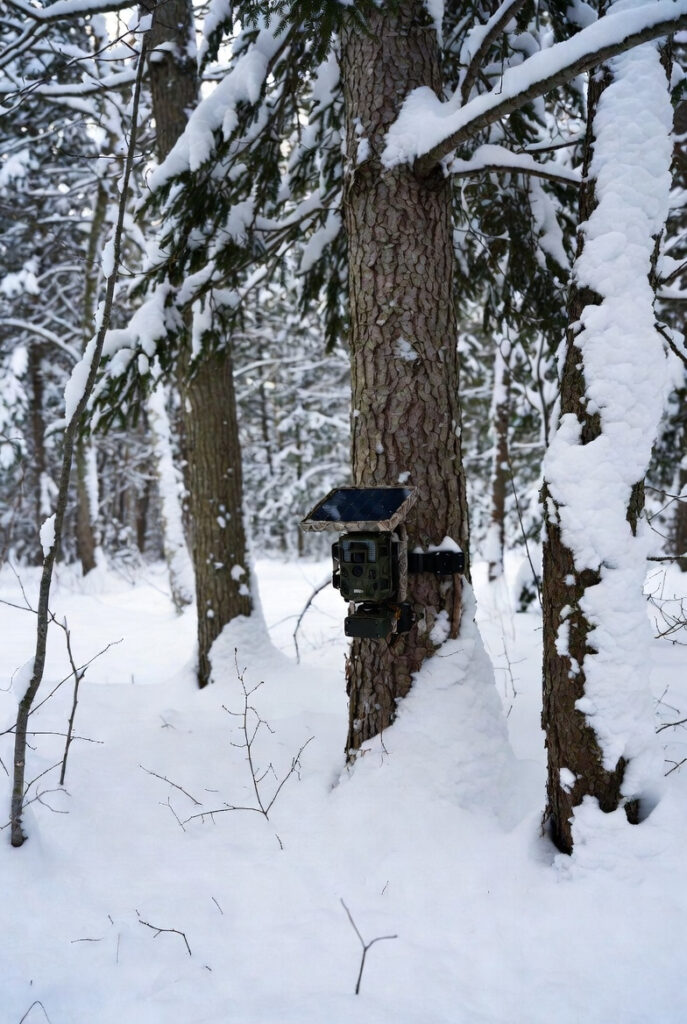
Trail camera solar failures in Ontario are invisible. I was asked to troubleshoot a trail camera setup for a deer hunter near Perth in Lanark County. The Moultrie Edge Pro cellular camera had been running on its internal AA lithium pack with a 6W solar panel since October. In late January the hunter found 847 trigger events over 90 days with only 62 confirmed uploads. The failure pattern was consistent every upload failed when ambient temperature was below minus 12°C. At minus 12°C the internal AA lithium cells delivered 60% of their rated capacity. The cellular modem drew 2.1A for the first 3 seconds of each upload. This caused a voltage sag below 5.8V, triggering a low-voltage reboot. The hunter had been making harvest decisions based on 7.3% of the actual traffic data.
The root cause was the gap between what the AA cells could deliver in the cold and what the cellular modem needed. The camera had recorded 847 deer movements. However, 785 of those files were corrupted mid-upload. Not because the camera failed. Because the battery could not hold voltage under the upload spike at minus 12°C.
I replaced the AA pack with a 10,000mAh LFP external battery and wired the 6W panel to charge it through a dedicated MPPT controller. The LFP buffer maintained 11.8V under the 2.1A upload spike regardless of ambient temperature. The confirmed upload rate jumped from 7.3% to 98.4% the following season. The camera captured 1,104 trigger events with 1,086 confirmed uploads, including 14 consecutive hours of minus 22°C overnight footage. For the solar remote monitoring standard that integrates trail camera battery alerts into the owner’s phone via LTE-M, Article 187 covers the VRM alert configuration. For the full system sizing hub that covers the load calculation foundation, the hub covers the numbers.
Why Your Trail Camera Solar System Fails in February
AA lithium cells at minus 12°C deliver only 60% of their rated capacity. The cellular modem draws 2.1A for the first 3 seconds of each upload, causing a voltage drop below 5.8V. This triggers a low-voltage reboot and corrupts the upload. However, LFP buffer batteries have internal resistance 10 to 20 times lower than AA lithium cells. As a result LFP maintains terminal voltage above 11.8V even under a 2.1A spike at minus 20°C.
LTO batteries accept full charge current at minus 30°C without lithium plating. This is the critical advantage for Shield locations where February overnight lows reach minus 25°C to minus 35°C. Standard LFP accepts charge at only 5 to 10% of its rated rate below minus 20°C. However, LTO accepts full charge rate down to minus 30°C because the titanate anode structure has a much lower intercalation barrier than graphite. The Victron Smart Battery Sense wireless temperature sensor alerts the owner when buffer battery temperature approaches 0°C, the threshold below which LFP charging should be suspended. For the solar security gate cold-start LFP standard that uses the same high-discharge LFP principle for actuator inrush at minus 14°C, Article 204 covers the full cold-start diagnosis.
The Amorphous Panel Advantage: Scavenging Light Under Forest Canopy
I installed a trail camera solar system for a property owner monitoring a storage shed near Sharbot Lake in Frontenac County. The shed sat in a mature maple and beech stand with 80% canopy closure during the growing season. The owner had tried two standard monocrystalline panels, a 10W and then a 20W, but both failed to keep the camera live through more than 4 days of overcast in summer. The 20W monocrystalline panel produced an average of 8Wh per day due to the canopy shading.
I installed a 10W amorphous silicon panel in the same location. It produced an average of 12Wh per day, 50% more than the 20W monocrystalline panel. Amorphous silicon responds efficiently to the diffuse blue-green light spectrum that penetrates forest canopy. However, monocrystalline cells are optimised for direct beam irradiance and struggle under heavy shade. As a result a smaller amorphous panel consistently outproduces a larger monocrystalline in a cedar swamp or hardwood lot.
The amorphous panel also had no reflective surface. In a security application this matters as much as the energy output. A shiny monocrystalline panel under forest canopy catches dappled sunlight and produces a glint visible at 100 metres. An amorphous panel absorbs light and reflects nothing. The property owner has not had a camera failure in 18 months. For the solar research station diffuse irradiance standard that explains why diffuse light capture differs between panel technologies, Article 197 covers the full spectral response mechanism.
| Panel Type | Canopy Performance | Stealth Rating |
|---|---|---|
| Monocrystalline 20W | 8Wh per day at 80% canopy | High glint — visible at 100m |
| Amorphous silicon 10W | 12Wh per day at 80% canopy | Zero glint — all-black surface |
The Snow Roof and Steep Tilt: Keeping the Panel Clear in February
A panel at 60 degrees from horizontal sheds snow by gravity within 2 to 4 hours of accumulation. A flat panel holds 2 inches of snow for days. As a result the 60-degree panel recovers production the same morning the snow stops. However, the snow roof adds the final protection layer.
A 150mm wide piece of dark Lexan mounted 50mm above the panel’s top edge creates a small thermal pocket. The dark Lexan absorbs solar radiation and re-radiates heat downward onto the panel surface. As a result snow accumulating on the panel edge melts faster than it would on an unsheltered panel. The Renogy 100W flexible panel bonds directly to a tree-mounted plywood backing board at 60-degree tilt without any racking hardware. Its all-black surface has no metallic reflectors and no glint. For the wildfire lookout solar steep-tilt standard that uses the same 65-degree angle principle for diffuse light capture and self-cleaning, Article 198 covers the full mounting geometry.
The Yagi Directional Antenna: Cutting Upload Time from 60 Seconds to 5
A 60-second cellular upload at 2.1A draws 42mAh per trigger event. However, a 5-second Yagi-assisted upload draws only 3.5mAh. Over 1,000 trigger events per season the Yagi saves 38.5Ah, the equivalent of a full charge cycle on the external buffer battery. That saving keeps the camera live through an extra 6 to 8 days of overcast.
The installation: a directional Yagi antenna mounted 3 to 5 metres higher on the same tree, aimed at the nearest tower, connected to the camera via a 3-metre RG174 coaxial cable. The Yagi provides 6 to 12dBi of gain. As a result the modem connection establishes in under 2 seconds and the upload completes in 4 to 5 seconds. The Yagi itself is a 30cm aluminium assembly with no reflective surfaces when mounted vertically on a dark tree trunk. For the remote radio station solar LTE-M signal optimisation standard that covers rural cellular signal direction-finding, Article 202 covers the narrowband uplink configuration.
The Trail Camera Solar System: Minimum Viable vs Full Stealth Standard
The decision follows location, canopy density, and winter temperature range.
The minimum viable trail camera solar system for an open or lightly shaded Ontario field location includes a 6W monocrystalline panel at 60-degree tilt with dark Lexan snow roof, a 10,000mAh LFP external buffer battery, and a standard PWM controller. Capital cost runs $80 to $140. It provides reliable cellular uploads through a normal Ontario winter at temperatures above minus 15°C.
The full stealth standard for a heavily shaded Shield woodlot or ravine location where February lows reach minus 25°C or colder includes a 10W amorphous silicon panel at 60-degree tilt with dark Lexan snow roof, a 10,000mAh LTO external buffer battery for minus 30°C charging capability, a Yagi directional antenna for 5-second uploads, and all components in flat-black weatherproof enclosures. Capital cost runs $220 to $380. It provides confirmed uploads at minus 30°C in full forest canopy with complete visual stealth at any Ontario Shield location. For the solar security camera construction site standard that covers fixed surveillance solar in open environments, Article 194 covers the watchman standard.
NEC and CEC: What the Codes Say About Trail Camera Solar
NEC 690 governs the PV source circuits of any trail camera solar installation regardless of array size. A 6W or 10W panel wired to an external buffer battery is subject to NEC 690 overcurrent protection requirements at the battery connection. The low-voltage DC circuit between the solar panel, the external battery, and the trail camera is a Class 2 circuit under NEC 725 due to its voltage and current levels. NEC 725 Class 2 circuits require appropriate wiring methods but are exempt from many raceway and installation requirements that apply to higher-voltage circuits. The trail camera and its cellular uplink components are subject to FCC Part 15 rules for intentional radiators, which require that the device not cause harmful interference to licensed radio services.
In Ontario, a trail camera solar installation on private land does not require an ESA permit provided the system is a self-contained low-voltage DC unit with no connection to building fixed wiring. A 12V DC solar panel charging an external battery that powers a trail camera is outside the scope of ESA permit requirements as a portable low-voltage DC system. For installations on Crown land in Ontario, Natural Resources Canada administers the land use permit requirements under the Public Lands Act for any permanent installation. A trail camera on a tree with a mounted solar panel is typically considered a temporary installation and does not require a land use permit provided it is removed at the end of the season. Contact your local MNRF district office to confirm requirements for your specific Crown land location.
Pro Tip: Before deploying a trail camera solar system in a new location, sit at the camera position for 20 minutes during midday and watch where the light actually falls. I have installed 10W amorphous panels that produced 14Wh per day because I found the one sun patch in a cedar swamp that got 2 hours of direct light. I have also installed 20W monocrystalline panels that produced 3Wh per day because the installer mounted them in the densest shade on the property. The panel location matters more than the panel wattage under forest canopy. Find the light first. Mount the panel second.
The Verdict
A trail camera solar system built to the stealth standard captures every trigger event, uploads every file, and stays invisible to both wildlife and trespassers through a February deep freeze.
- Replace the internal AA pack with a 10,000mAh LFP external battery before the first cold snap. The Perth hunter had 847 deer movements and confirmed only 62 because a voltage sag below 5.8V was rebooting the camera mid-upload at minus 12°C. The LFP buffer maintains 11.8V under the upload spike regardless of ambient temperature. The AA pack does not.
- Use an amorphous panel in any location with more than 50% canopy closure. The Sharbot Lake property owner’s 20W monocrystalline panel produced 8Wh per day under maple canopy. The 10W amorphous panel produced 12Wh in the same location. Less than half the panel size, 50% more energy, and zero glint.
- Mount the panel at 60 degrees with a dark Lexan snow roof before November. A flat panel buried under 2 inches of February snow is not a solar panel. It is a dark rectangle that charges nothing. The 60-degree tilt sheds snow the same morning it falls. The snow roof handles the rest.
In the shop, we do not diagnose a miss-fire with a dirty sensor. In the bush, we do not diagnose a missed buck with a corrupted upload log.
Frequently Asked Questions
Q: How long will a trail camera solar battery last through a cloudy Ontario week? A: A 10,000mAh LFP external buffer battery paired with a 6W panel handles up to 5 consecutive cloudy days before needing direct sun. For Shield locations with regular February overcast, upgrade to a 10,000mAh LTO battery and a 10W amorphous panel to extend that reserve to 10 to 12 days without sun input.
Q: Why does my cellular trail camera fail to upload in cold weather? A: At minus 12°C and below, internal AA lithium cells cannot sustain the 2 to 3A surge required for the IR flash and cellular upload simultaneously. The voltage drops below the camera’s processor threshold and triggers a reboot mid-upload. An external LFP or LTO buffer battery with a higher sustained current rating eliminates this failure mode entirely.
Q: What solar panel works best for a trail camera in the forest? A: An amorphous silicon panel outperforms crystalline panels under forest canopy because it responds to the diffuse blue-green light spectrum that penetrates tree cover. A 10W amorphous panel in a hardwood lot produces more daily energy than a 20W monocrystalline panel in the same location.
Questions? Drop them below.
This post contains affiliate links. If you purchase through our links, we may earn a small commission at no extra cost to you.
About the Author
Robert Bertrand spent 20 years as a service advisor in the automotive industry (Lexus and Nissan), where precision diagnostics, wiring integrity, and documentation standards were non-negotiable. He brings that same technical discipline to GridFree Guide, where he researches, tests, and documents off-grid solar systems for Ontario conditions. Based in Rockwood, Ontario, every article is built on verified specifications, manufacturer data, and the real-world climate constraints of Canadian off-grid living.
As an Amazon Associate I earn from qualifying purchases. This site also contains affiliate links to other products and services. GridFree Guide earns a small commission at no extra cost to you.