
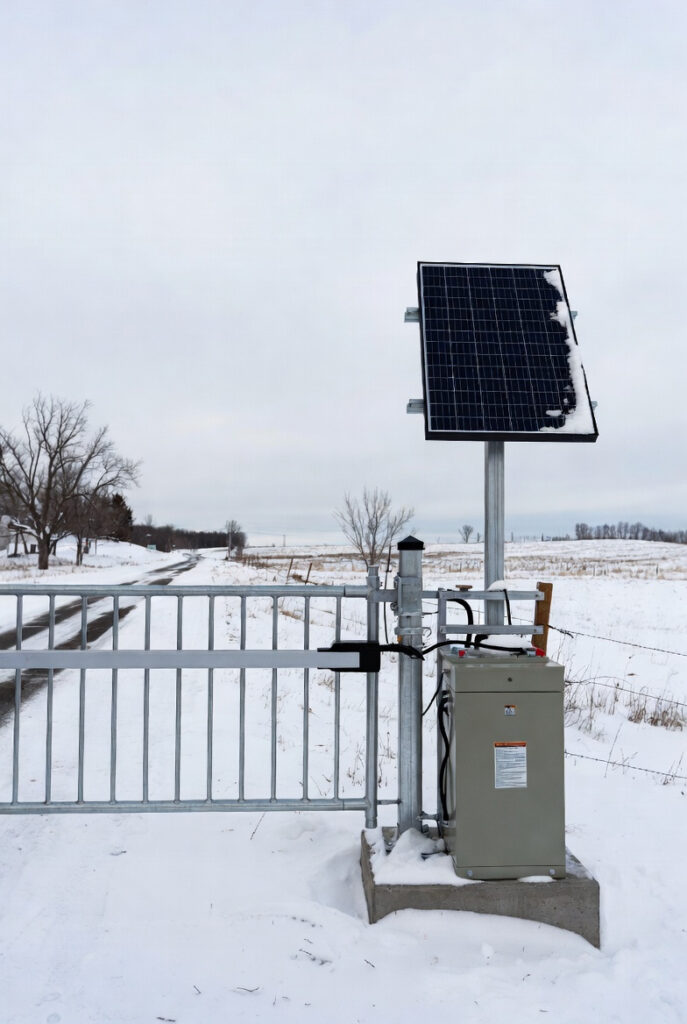
Solar security gate failures happen at the worst possible moment. The first hard freeze of November can turn a reliable system into a locked-out nightmare. I was called to troubleshoot a locked-out gate at a hobby farm near Fergus in Wellington County in early November. The property owner had installed a 20W panel and a 10Ah sealed lead-acid battery the previous spring to power a single-leaf iron gate on a hydraulic actuator. The system worked perfectly through summer and fall. However, on the morning of the first minus 14°C overnight the gate would not open. The actuator motor hummed for two seconds then stopped. The battery voltage had dropped to 10.8V under the inrush load. At 10.8V the actuator controller cut power to protect itself. The gate stayed shut. The property owner had a livestock delivery arriving at 7 AM and spent 45 minutes manually releasing the gate clutch in the dark with a flashlight and a wrench.
The root cause was straightforward. A 10Ah SLA battery cold-soaked at minus 14°C loses approximately 40% of its rated capacity. The effective capacity was 6Ah. The hydraulic actuator drew 22A for the first 3 seconds of movement, the inrush current required to break the gate loose from its cold hydraulic seals. At 6Ah of available capacity that 3-second 22A draw caused a voltage sag that triggered the low-voltage cutoff before the gate had moved 10 centimetres.
I replaced the 10Ah SLA with a 50Ah LFP battery and added a 100W panel on a remote pole mount in the sun patch at the edge of the laneway. The LFP battery delivered full capacity at minus 14°C. The gate has opened on the first attempt every morning since, including four mornings below minus 20°C that winter. For the off-grid cabin solar standard that covers the broader 12V battery bank sizing this gate system connects to on a rural Ontario property, Article 155 covers the full cabin standard. For the full system sizing hub that covers the load calculation foundation, the hub covers the numbers.
Why a Solar Security Gate Fails at Minus 14°C on the First Cold Morning
LFP batteries maintain approximately 95% of their rated capacity at minus 20°C when the cells are above 0°C at the start of discharge. Sealed lead-acid batteries lose 40 to 60% of rated capacity at minus 20°C due to reduced ionic mobility in the sulphuric acid electrolyte. A 50Ah LFP battery at minus 14°C delivers approximately 47.5Ah of usable capacity. However, a 50Ah SLA at minus 14°C delivers only 28 to 30Ah.
For a hydraulic actuator drawing 22A inrush for 3 seconds the voltage sag on the SLA at low temperature can drop the terminal voltage below the controller cutoff threshold even when the SLA shows 80% SoC on a room-temperature reading. The LFP delivers the full inrush current without voltage sag because its internal resistance is approximately 5 to 10 times lower than an equivalent SLA. The C-rating rule: the gate battery must deliver 22A from a 50Ah bank without voltage sag. That requires a minimum 0.44C continuous discharge rating. Every LFP battery designed for solar storage meets this. No SLA battery cold-soaked at minus 14°C does.
The 10AWG solar cable from the remote panel to the controller must be sized to prevent voltage drop that further reduces available charge current on cold mornings. For the solar remote monitoring standard that integrates gate battery voltage alerts into the property owner’s phone, Article 187 covers the full monitoring architecture.
The Remote Panel Mount: Getting Out of the Shade
Gate panels are typically mounted on the gate post under a tree canopy. In summer the canopy is full and shading reduces production by 40 to 80% during the afternoon peak. However, a remote pole mount 10 to 30 metres away in a clear sun patch eliminates this shading entirely.
The voltage drop rule for remote mounts: 20AWG wire over 30 metres at 5A produces 0.9V drop, 7.5% of a 12V system. However, 10AWG wire over the same 30 metres produces only 0.14V drop. As a result upgrading to 10AWG recovers 15 to 40Wh per day of lost charge on a 100W gate panel.
The remote pole mount height should be 2.4 metres minimum to clear snow accumulation. A 15-degree summer tilt and a 60-degree winter tilt maximise annual production on a fixed pole mount in southern Ontario. For the cold climate solar voltage and snow load standard that covers remote pole mounting in northern Ontario frost conditions, Article 160 covers the full installation standard.
The Ghost Load Audit: What Is Draining the Gate Battery While You Sleep
Solar security gate ghost load failures are invisible until the battery is flat. I reviewed the power system for a gated estate near Erin in Wellington County where the owner had reported that the gate stopped working every time they returned from a two-week vacation. The gate system included a 40W panel, a 20Ah SLA battery, a video intercom drawing 8W continuously, a keypad drawing 3W continuously, two magnetic safety loops drawing 2W each, and a cellular uplink drawing 4W. Total continuous ghost load: 19W.
At 19W the system consumed 456Wh per day regardless of whether the gate opened once or a hundred times. The 40W panel in southern Ontario in November produced approximately 120Wh per day on average. The daily deficit was 336Wh. After 6 days the 20Ah SLA battery at 50% usable capacity had exhausted its 240Wh reserve. The gate stopped working on day 6 every time. The owner had been away for two weeks each time, so the gate sat dead for the remaining 8 days.
I replaced the 40W panel with a 120W remote-pole-mounted panel, upgraded the battery to a 50Ah LFP, and switched the video intercom to an event-triggered model that drew 0.4W in standby instead of 8W continuously. As a result the daily ghost load dropped from 19W to 11.4W. The daily energy deficit reversed to a surplus. The gate has now survived a 3-week vacation period without a single failure.
The ghost load calculation for any solar security gate: add up every device that draws power when the gate is closed. Keypads, intercoms, safety loops, cellular modems, and controller boards all draw continuous standby current. As a result the ghost load often exceeds the actuator operating load over a 24-hour period. The Victron Smart Battery Sense monitors gate battery voltage wirelessly and sends an alert when voltage drops below 12.4V during an extended absence. For the solar weather station LTE-M telemetry standard that uses the same narrowband uplink for remote monitoring in rural Ontario, Article 199 covers the full configuration.
| Device | Standby Draw | Daily Wh Consumed |
|---|---|---|
| Standard video intercom | 8W continuous | 192Wh |
| Keypad | 3W continuous | 72Wh |
| Two magnetic safety loops | 4W continuous | 96Wh |
| Cellular uplink | 4W continuous | 96Wh |
| Event-triggered intercom | 0.4W average | 10Wh |
The 4G LTE Intercom: Cloud Access for a Remote Gate
A standard video intercom draws 6 to 10W continuously. However, an event-triggered LTE intercom draws 0.3 to 0.5W in standby and wakes only on motion or button press. The daily energy saving: 8W continuous versus 0.4W average equals 182Wh per day saved. On a 100W gate panel in a southern Ontario November producing 120Wh per day that 182Wh saving is the difference between a daily surplus and a 62Wh daily deficit.
The LTE intercom also provides cloud access from anywhere in Ontario. As a result the property owner can verify the visitor and open the gate from a phone regardless of their location. The cellular uplink draws 3 to 5W average during an active call and 0.1 to 0.3W in standby between events. For a gate with 5 to 10 daily activations the total cellular uplink energy is 15 to 25Wh per day. For the solar repeater station LTE-M standard that covers rural cellular signal optimisation for low-power gate telemetry, Article 193 covers the full configuration.
The Mechanical Release: The Override Every Solar Gate Must Have
The Ontario Building Code requires any automated gate on a property accessible to emergency services to have a mechanical clutch release operable from outside the gate without power or tools. For a solar security gate this means a clutch release key in a combination lockbox on the gate post, accessible to emergency services regardless of solar system status.
Operate the manual release every fall before the first freeze. Clutch mechanisms seize over a summer of non-use. However, a seized clutch at minus 14°C in the dark at 7 AM during a livestock delivery is not the time to discover it. Test it in October when the weather is still mild. The lockbox combination should be registered with the local fire department for emergency access. For a rural Wellington County or Simcoe County property, contact the local fire department for their gate access registration process before the gate goes live.
The Solar Security Gate System: Minimum Viable vs Full Access Standard
The decision follows gate weight, ghost load total, and whether the owner needs remote access during absences.
The minimum viable solar security gate for a single-leaf residential gate on a rural property includes a 100W remote-pole-mounted panel, a 50Ah LFP battery, a standard gate controller with low-voltage protection, and 10AWG wiring throughout. Capital cost runs $800 to $1,400. It provides reliable gate operation through a normal Ontario winter with ghost loads up to 15W continuous.
The full access standard for a property requiring cloud access during extended absences includes a 200W remote-pole-mounted panel, 100Ah LFP bank with Victron Smart Battery Sense wireless monitoring, event-triggered 4G LTE intercom at 0.4W standby, cellular uplink for cloud access from anywhere in Ontario, mechanical clutch release with combination lockbox registered with local fire department, and 10AWG wiring throughout. Capital cost runs $2,200 to $3,800. It provides complete autonomous solar security gate operation through a 3-week January absence without any manual intervention.
NEC and CEC: What the Codes Say About Solar Security Gates
NEC 690 governs the PV source circuits of any solar security gate installation. The panel, wiring, and battery bank are subject to NEC 690 overcurrent protection and disconnecting means requirements regardless of system voltage. NEC 250 governs grounding and bonding. The gate frame and actuator must be bonded to the solar system grounding electrode. However, the low-voltage control wiring between the gate controller and the intercom, keypad, and safety loops is subject to NEC Class 2 circuit requirements under NEC 725. The NFPA publishes the full NEC 725 requirements for Class 2 low-voltage control circuits applicable to gate automation systems.
In Ontario, a solar-powered automated gate installation is subject to CEC Section 64 for the PV source circuits if the system includes an inverter or grid connection. A standalone 12V DC solar gate system with no AC component and no grid connection does not require an ESA permit under CEC low-voltage DC exemptions. However, if the gate controller includes a 120V AC output for lighting or accessory power the installation becomes subject to CEC Section 64 and ESA permit requirements apply. The automated gate mechanism itself is subject to UL 325 certification requirements for gate operators, which mandate the safety loop, manual release, and entrapment protection features described in this article. Contact the ESA to confirm permit requirements for your specific solar security gate configuration in Wellington County or Simcoe County.
Pro Tip: Before sizing the battery bank for a solar security gate, drive to the gate at 7 AM on the coldest morning in October with a multimeter and measure the battery voltage under inrush load when the gate opens. The voltage should not drop below 11.5V on a 12V system during the first 3 seconds of gate movement. If it drops below 11.5V the battery cannot handle a colder January morning. That October morning test costs 20 minutes. The January morning failure at minus 22°C with a livestock delivery arriving costs considerably more.
The Verdict
A solar security gate built to the access standard opens on the first attempt at minus 22°C, survives a 3-week January absence, and never requires a 45-minute clutch release in the dark.
- Replace the SLA with a 50Ah LFP before the first November freeze. The Fergus gate failed because a 10Ah SLA at minus 14°C had 6Ah of effective capacity against a 22A inrush demand. A 50Ah LFP delivers 47.5Ah at that same temperature. The upgrade costs $180 and ends the cold-start lockout permanently.
- Audit every ghost load before sizing the panel. The Erin gate died on day 6 of every vacation because 19W of continuous standby draw outpaced a 40W panel in November. Switching to an event-triggered intercom dropped the ghost load to 11.4W and reversed the deficit to a surplus. Audit first. Size second.
- Test the mechanical clutch release every October. A seized clutch at minus 14°C during a livestock delivery is the worst possible time to learn that the release mechanism has not moved since spring. Ten minutes in October costs nothing. Forty-five minutes in the dark with a flashlight costs the morning.
In the shop, we do not skip the manual override check before a lift goes up. At the gate, we do not skip the clutch release test before the first freeze.
Frequently Asked Questions
Q: How long will a solar security gate battery last through a cloudy Ontario winter week? A: A 50Ah LFP battery with a 100W panel and 15W ghost load has approximately 3 days of reserve at zero solar input. However, a 100Ah LFP bank extends that to 6 to 7 days. Size the battery for the longest historically cloudy stretch in your region, typically 5 to 7 consecutive days in southern Ontario January.
Q: What causes a solar gate to stop working after a vacation? A: Ghost loads from intercoms, keypads, and safety loops drain the battery continuously whether the gate opens or not. A 19W total ghost load consumes 456Wh per day. A 40W panel in November produces only 120Wh per day. The battery goes flat in 4 to 6 days. Switching to an event-triggered intercom and auditing every standby draw fixes this permanently.
Q: Does a solar security gate need a permit in Ontario? A: A standalone 12V DC solar gate system with no AC component typically does not require an ESA permit under CEC low-voltage DC exemptions. However, if the system includes a 120V AC output or grid connection an ESA permit is required. Contact your local ESA district office to confirm requirements for your specific installation.
Questions? Drop them below.
This post contains affiliate links. If you purchase through our links, we may earn a small commission at no extra cost to you.
About the Author
Robert Bertrand spent 20 years as a service advisor in the automotive industry (Lexus and Nissan), where precision diagnostics, wiring integrity, and documentation standards were non-negotiable. He brings that same technical discipline to GridFree Guide, where he researches, tests, and documents off-grid solar systems for Ontario conditions. Based in Rockwood, Ontario, every article is built on verified specifications, manufacturer data, and the real-world climate constraints of Canadian off-grid living.
As an Amazon Associate I earn from qualifying purchases. This site also contains affiliate links to other products and services. GridFree Guide earns a small commission at no extra cost to you.