
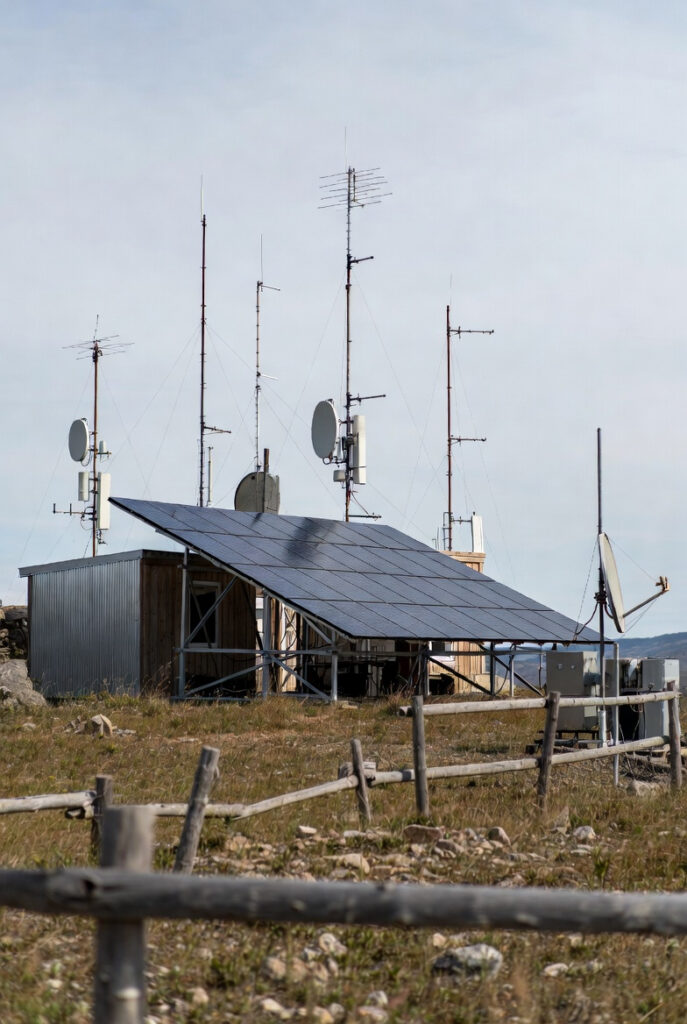
Remote radio station solar power failures do not always sound like static. (1) I was called to troubleshoot an audio quality problem at a volunteer community FM station near Haliburton that had switched to off-grid solar the previous summer. The station ran a 50W Inovonics transmitter, a small mixing console, and a computer playback system. However, since the solar switchover the on-air signal had developed a persistent 60Hz hum that appeared in every broadcast. The station manager had already replaced the microphone cables, the mixing board inputs, and the audio interface. None of that fixed it.
When I arrived I connected a spectrum analyser to the transmitter output. The hum was not in the audio chain. It was in the power supply. The station’s 2,000W modified sine wave inverter was producing a switching noise spike at 60Hz and its harmonics. That noise was travelling along the DC bus from the battery bank through the charge controller chassis into the mixing board’s power supply ground. Because the solar system ground and the audio equipment ground were bonded at the same point, the inverter switching noise had a direct path into the signal chain.
I separated the solar ground from the audio ground using a 1:1 isolation transformer on the mixing board’s AC feed. Total cost: $145. The hum disappeared immediately. The station has been broadcasting clean audio ever since, through three Ontario winters and one ice storm that took out the grid for 31 hours. For the solar research station sovereign data bank architecture that uses the same galvanic isolation principle to eliminate ground loop noise in scientific instruments, Article 197 covers the full isolation standard. For the full system sizing hub that covers the load calculation foundation, the hub covers the numbers.
Why Remote Radio Station Solar Produces a 60Hz Hum in the Signal Chain
The modified sine wave inverter produces a stepped waveform with THD of 20 to 40%. Harmonics at 60Hz, 120Hz, and 180Hz fall within the audible range of 20Hz to 20kHz. When the inverter’s chassis ground is shared with the audio equipment’s signal ground, these harmonics appear as audible buzz. However, a true sine wave inverter produces a smooth 60Hz waveform with THD below 3%, eliminating audible harmonic content entirely.
The 1:1 isolation transformer creates a galvanic break in the ground path between the inverter output and audio equipment. Type-31 ferrite cores wound 3 to 5 turns on DC cables provide 40 to 60dB of attenuation above 1MHz. This suppresses charge controller switching noise that extends into the FM broadcast band at 88 to 108MHz. The Victron SmartShunt installed on the battery bank monitors real-time current and SoC. However, its chassis must be bonded to the solar ground reference only, never to the audio equipment ground. For the solar repeater station 10:1 sizing rule that applies to the transmitter as a continuous 24/7 load, Article 193 covers the calculation.
| Inverter Type | THD | Audio Impact |
|---|---|---|
| Modified sine wave | 20 to 40% | Audible buzz |
| True sine wave | Below 3% | No hum |
The Galvanic Isolation Standard: Separating Solar Ground from Audio Ground
The ground loop mechanism in a broadcast facility creates a closed loop when the solar system ground and audio equipment signal ground are bonded at the same point. Any current flowing in the ground conductor, from inverter switching, charge controller commutation, or battery charging, appears as a voltage difference across the audio signal ground. That voltage difference is an audio signal. It appears in the mix as hum.
The correct installation separates the solar ground from the audio ground at every point. The solar system has its own grounding electrode. The audio equipment has its own signal ground reference. A 1:1 isolation transformer between the inverter AC output and the audio equipment AC distribution breaks the conductive path between the two ground systems. As a result no current from the solar system can reach the audio signal ground. For the solar weather station chemical grounding electrode standard that achieves below 5 ohms on Canadian Shield rock, Article 199 covers the low-impedance ground reference relevant for remote broadcast towers in northern Ontario geology.
The Bifacial Tower Array: Winter Production for a Remote Broadcast Station
The tower-base mounting geometry uses bifacial panels at 65-degree winter tilt facing south on the cleared ground at the tower base. In Ontario winter the cleared area around a radio tower is snow-covered for 4 to 5 months. Snow-covered ground reflects 70 to 90% of incident solar radiation. As a result the bifacial rear surface captures this reflection as additional production.
On a 400W bifacial array at a northern Ontario tower site the winter albedo gain is 80 to 100Wh per day compared to a monofacial array, the equivalent of running the transmitter for an additional 1.6 to 2 hours per day at no additional hardware cost. The tower-base location also keeps the array accessible for snow clearing and filter cleaning throughout the winter. However, the array must be positioned outside the tower’s guy wire exclusion zone. For the full bifacial winter albedo calculation for Ontario latitudes above 45 degrees, Article 160 covers the derate factors.
Solar-Direct DC Ventilation: Keeping the Transmitter Below 65°C
Remote radio station solar systems fail their most important test during heat events. I reviewed a service call for a community emergency alert station near Bancroft in Hastings County that had gone off-air for 4 hours during a July heat advisory, exactly the event the station existed to broadcast. The station’s 50W FM transmitter was housed in a small steel equipment cabinet inside an uninsulated equipment shed. On the day of the failure the outdoor temperature reached 34°C.
The transmitter’s internal cooling fan was drawing AC power from the solar inverter. However, the inverter had throttled its output due to high ambient temperature inside the inverter enclosure, reducing available AC power by 35%. As a result the transmitter’s cooling fan ran at reduced speed. The transmitter reached its internal thermal protection threshold of 65°C and shut down automatically. The station went silent. No emergency alerts were broadcast during the 4-hour outage.
The fix was a solar-direct DC ventilation fan drawing directly from the 12V battery bus through a dedicated thermostat. At 34°C ambient the DC fan ran at full speed from direct solar current without any inverter involved. As a result the transmitter cabinet stayed below 48°C throughout the following summer’s heat events. The DC fan cost $65 and draws 8W directly from the battery bank. It has never throttled and it has never failed. The Victron Smart Battery Sense wireless temperature sensor monitors enclosure temperature during heat events, alerting the station manager if the transmitter cabinet approaches the 55°C caution threshold. For the solar remote monitoring standard that integrates the temperature alert into the station manager’s phone via VRM, Article 187 covers the full monitoring architecture.
LTE-M Monitoring: Radio-Quiet Telemetry for a Broadcast Facility
WiFi at 2.4GHz and 5GHz does not overlap with FM or AM broadcast bands. However, WiFi’s 20 to 80MHz channel width produces a wide noise floor that raises the receive threshold of nearby FM receivers. LTE-M uses a 1.4MHz channel width. As a result its broadband noise floor in the broadcast environment is significantly lower than WiFi.
For a remote broadcast facility monitoring SoC, voltage, and transmitter temperature from a phone, LTE-M is both more reliable in rural Ontario and less disruptive to the broadcast signal. The monitoring setup includes a Victron SmartShunt on the battery bank reporting SoC and voltage to the LTE-M gateway. The gateway transmits a data packet every 15 minutes to the VRM portal. The station manager checks the battery status from anywhere without adding noise to the FM signal. For the solar weather station LTE-M telemetry standard that covers the narrowband protocol’s rural penetration advantage, Article 199 covers the full configuration.
The Remote Radio Station Solar System: Minimum Viable vs Full Voice Standard
The decision follows whether the station is a community broadcaster or a critical emergency alert facility.
The minimum viable remote radio station solar system (4) for a 50W FM community broadcaster includes a true sine wave inverter, a 1:1 isolation transformer on the audio equipment AC feed, Type-31 ferrite cores on all DC cables, a 400W bifacial array at 65-degree winter tilt, and a 200Ah LFP bank. Capital cost runs $3,800 to $5,500. It provides 48-hour autonomous broadcast operation through an Ontario grid outage with clean audio free of 60Hz hum.
The full voice standard for a critical emergency alert remote radio station solar installation (5) serving a rural Ontario region includes a 600W bifacial tower-base array, 300Ah LFP bank, galvanic isolation on audio ground, Type-31 ferrite chokes on all DC runs, solar-direct DC transmitter ventilation with thermostat, LTE-M battery and temperature monitoring via Victron SmartShunt and Smart Battery Sense, and a NEMA 4X grounded steel Faraday-shielded inverter enclosure. Capital cost runs $7,500 to $12,000. It provides studio-grade broadcast quality with commercial-grade power reliability for a station that must stay on air during every emergency event in its coverage area.
NEC and CEC: What the Codes Say About Remote Radio Station Solar
NEC 690 governs the PV source circuits of any remote radio station solar installation (7) regardless of the facility’s broadcast licence or tower height. NEC 250 governs grounding and bonding. The requirement to separate the solar system grounding electrode from the audio equipment signal ground is consistent with NEC 250’s bonding requirements, provided that both ground systems are separately bonded to the building’s main grounding electrode system at a single point. However, the audio equipment signal ground must not be directly bonded to the solar system DC negative bus. NEC 810 covers amateur radio and external wiring and applies to the antenna, transmission line, and tower grounding requirements. The tower grounding system must be coordinated with the solar array grounding to avoid creating ground loops through the tower structure.
In Ontario, a remote radio station solar installation (8) is subject to CEC Section 64 for the PV source circuits and to the Canadian Radio-television and Telecommunications Commission CRTC technical standards for broadcast facilities. The CRTC’s Broadcasting Equipment Technical Standards require that transmitter installations meet specified conducted and radiated emission limits that align with the ferrite choke and galvanic isolation measures described in this article. An ESA electrical permit is required for the solar installation. However, the internal audio equipment wiring and signal ground separation are not subject to ESA permit requirements as they involve low-voltage signal circuits below 50V. Contact the local ESA district office for remote radio station solar (9) installation requirements at licensed broadcast facilities in Haliburton County and Hastings County.
Pro Tip: Before commissioning a remote radio station solar system (10), do a conducted emissions test on the DC bus with a spectrum analyser from 10kHz to 200MHz while the charge controller is actively charging. Note the frequency and amplitude of every spike above the noise floor. Then install your ferrite chokes and repeat the test. Any spike that does not drop by at least 20dB after the ferrite installation needs a second choke pass or a different ferrite material. The test takes 20 minutes. The alternative is discovering the interference problem on the first live broadcast.
The Verdict
A remote radio station solar system (11) built to the voice standard stays on the air through the grid outage, the heat advisory, and the ice storm, with audio so clean the listeners never know the grid was off.
- Install the 1:1 isolation transformer on the audio equipment AC feed before the station goes live on solar. The Haliburton 60Hz hum cost three months of degraded broadcast quality and a full troubleshooting visit. A $145 transformer installed at commissioning prevents it entirely.
- Add the solar-direct DC ventilation fan before the first July heat event. The Bancroft transmitter went silent for 4 hours during a heat advisory because the inverter throttled and the AC cooling fan slowed. A $65 DC fan from the 12V bus runs faster when it is hottest and never throttles.
- Use LTE-M for remote monitoring, not WiFi. WiFi raises the noise floor across the broadcast band. LTE-M transmits on licensed narrowband spectrum that does not touch FM or AM frequencies. Check the battery from your phone without adding noise to the signal.
In the shop, we do not let electrical noise into the diagnostic computer. In the broadcast shed, we do not let solar switching noise into the signal chain. (12)
Questions? Drop them below.
This post contains affiliate links. If you purchase through our links, we may earn a small commission at no extra cost to you.
About the Author
Robert Bertrand spent 20 years as a service advisor in the automotive industry (Lexus and Nissan), where precision diagnostics, wiring integrity, and documentation standards were non-negotiable. He brings that same technical discipline to GridFree Guide, where he researches, tests, and documents off-grid solar systems for Ontario conditions. Based in Rockwood, Ontario, every article is built on verified specifications, manufacturer data, and the real-world climate constraints of Canadian off-grid living.
As an Amazon Associate I earn from qualifying purchases. This site also contains affiliate links to other products and services. GridFree Guide earns a small commission at no extra cost to you.