
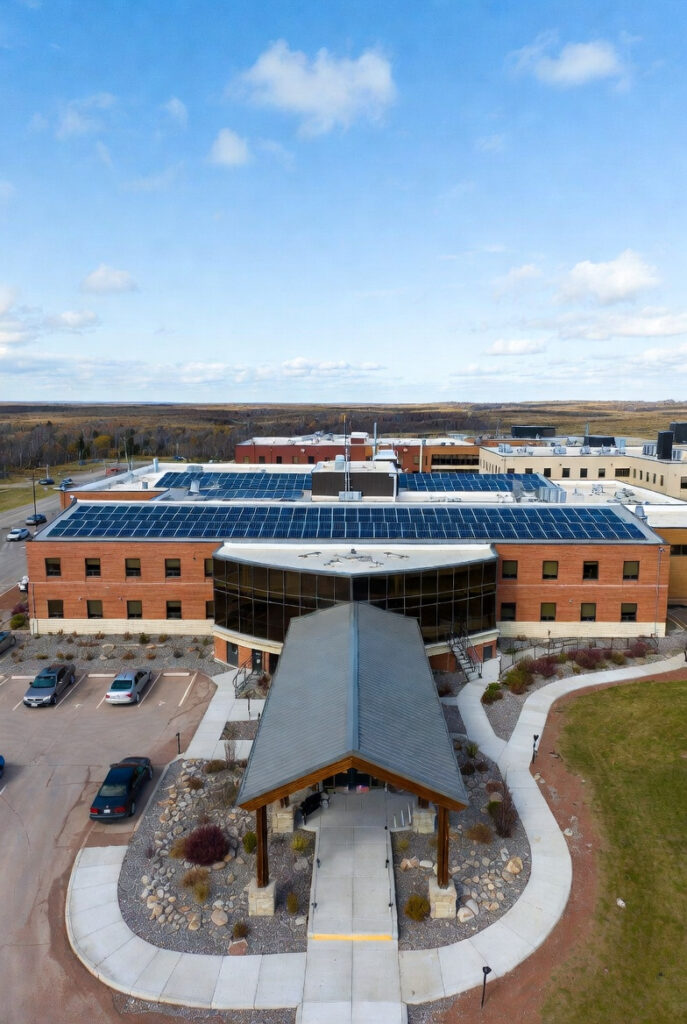
Off-grid hospital solar failures have a consequence that no other solar failure in this guide has. I was brought in to review the backup power specification for a remote nursing station in the Sioux Lookout zone in northwestern Ontario that had experienced a critical incident the previous January. The facility ran on diesel grid power from a local utility and had a standard automatic transfer switch connected to a backup generator. During a severe cold snap the utility feed failed at 2:47 AM. The transfer switch activated and the generator started. The measured transfer time was 14 seconds.
Fourteen seconds is within the normal operating specification for a standard ATS and generator combination. For the two patients in the facility that night it was not within normal. One patient was on a ventilator. The ventilator’s internal battery backup handled the 14-second gap without incident. But the bedside monitor connected to the same circuit did not have internal battery backup. It rebooted during the gap. When it came back online the waveform data from the previous 4 hours was lost and the alarm thresholds had reset to factory defaults. The attending nurse spent 22 minutes re-establishing the correct alarm parameters from the patient’s chart before the monitor was back at the correct clinical configuration.
The second patient was receiving a blood transfusion. The infusion pump, connected to a different circuit through a different ATS with a different generator, experienced its own 8-second transfer gap. The pump alarmed, stopped the infusion, and required manual restart and clinical verification before continuing. The transfusion was delayed 35 minutes. In that specific case the delay was not clinically significant. But the nursing station medical director told me afterward that in a trauma scenario the same 35-minute delay could be the difference between a recoverable blood loss and an irreversible one. I redesigned the facility’s power architecture around an online double-conversion UPS fed by a 30kW solar array and a 120kWh LFP battery bank. The load always runs from the batteries. When the utility feed fails nothing changes. The transfer time is zero milliseconds. The total cost of the redesigned system was $340,000. The original specification was $85,000. The $255,000 difference is the price of zero milliseconds. For the full system sizing hub that covers the load calculation foundation this off-grid hospital solar system is built on, the hub covers the numbers. For the community center solar emergency shelter standard that uses the same critical load partitioning principle at community scale, Article 196 covers the four-tier hierarchy.
Why Off-Grid Hospital Solar Needs Zero-Millisecond Transfer Time
In a line-interactive UPS the load runs from utility power and the inverter is on standby. When utility power fails the inverter transfers the load within 4 to 8 milliseconds. That is fast enough for most IT equipment but not fast enough for medical devices whose firmware interprets the brief gap as a power failure and initiates a controlled shutdown sequence.
In an online double-conversion UPS the load always runs from the DC bus through the inverter. The inverter is always on. The utility, solar, and generator charge the DC bus through a rectifier. When utility power fails the DC bus continues to power the inverter without interruption. The load never experiences any transition. The transfer time is zero milliseconds by definition because there is no transfer the topology never changes.
N+1 redundancy means installing one more inverter unit than the minimum required to carry the critical load. A medical facility with a 20kW critical load installs three 10kW parallel inverters. Two carry the 20kW load. One is the redundant spare. If one fails at 3 AM the remaining two carry the full load without alarming. The failed unit is hot-swapped during the next scheduled maintenance visit. The Victron MultiPlus-II is parallel-capable and forms the foundation of the N+1 architecture in facilities up to 100kW. For the solar repeater station 10:1 sizing rule that applies to any 24/7 mission-critical continuous load, Article 193 covers the calculation.
The Bifacial Medical Canopy: Winter Power for a Remote Hospital Array
The medical canopy serves three functions simultaneously: elevated panel mounting that preserves ground clearance for helicopter landing pads and emergency vehicle access, bifacial production gain of 15 to 25% from snow-covered concrete below, and weather protection for the facility entrance. The canopy minimum height for helicopter clearance is 6 metres above grade at the rotor clearance zone perimeter.
The panel mounting uses bifacial N-type panels at 65-degree winter tilt to maximise diffuse light capture during overcast northern Ontario winter days and to self-clean snow by gravity. On a 30kW bifacial canopy array in a Sioux Lookout zone facility the winter production gain versus a flat roof-mounted array is 4,500 to 7,500kWh per year, enough to run the entire cold chain circuit for 6 to 10 additional months at no additional hardware cost. For the full winter bifacial albedo calculation for Ontario northern latitudes above 50 degrees, Article 160 covers the derate factors.
The Off-Grid Hospital Solar Cold Chain: Vaccines That Survive a 72-Hour Blackout
Off-grid hospital solar cold chain failures do not announce themselves until it is too late to do anything about the vaccines. I reviewed the incident report for a First Nations health centre north of Kenora that had lost its entire quarterly vaccine inventory in February, 847 doses covering influenza, hepatitis B, and childhood immunisation series for a catchment population of 2,300 people. The loss occurred during a 61-hour power disruption caused by an ice storm that brought down the transmission line serving the community.
The health centre’s backup generator ran for 38 hours before running out of fuel. Road access was blocked by the same storm. The vaccine refrigerators ran on the same general power circuit as the building lighting and HVAC. When the generator failed the vaccines warmed from 4°C to 16°C over 23 hours. At 16°C the vaccines were outside the 2°C to 8°C cold chain and were quarantined and destroyed. The replacement cost of 847 doses was $47,000 at federal contract pricing. The logistical cost of re-establishing the immunisation schedule for 2,300 people was an additional $28,000. Total incident cost: approximately $75,000. The vaccines were on the same circuit as the coffee maker.
The fix for the rebuilt facility was a dedicated 5kW solar array feeding a 20kWh LFP bank that powered only the cold chain circuit, vaccine refrigerators, insulin storage, and the blood products refrigerator, completely isolated from the general building power. During the next major power disruption 14 months later the general building power failed for 29 hours. The cold chain circuit never dropped below 3.8°C. The vaccines were intact. The dedicated cold chain circuit cost $18,500 to install. It paid for itself on the first event it survived.
Phase-change material refrigerators use a water-based compound with a phase transition temperature of exactly 4°C. When powered the PCM is frozen solid below 4°C. When power is removed the PCM begins to melt, absorbing energy from the interior and maintaining it at approximately 4°C for 72 to 96 hours. A standard compressor refrigerator warms to 8°C within 4 to 6 hours of power loss. For a remote facility that may not receive resupply for 48 to 72 hours after a storm the PCM refrigerator is the difference between a functioning cold chain and a $75,000 vaccine loss. The Victron SmartShunt on the dedicated cold chain battery bank tracks SoC independently from the main medical microgrid, providing the facility manager with a dedicated alert when the cold chain reserve drops below the 48-hour autonomous threshold. For the solar remote monitoring standard that integrates the cold chain SoC alert into the facility manager’s phone, Article 187 covers the full monitoring architecture.
The Critical Load Partition: Surgical Suite Priority Over Administrative Wing
The load partition hierarchy for a medical facility keeps power where it matters most during an extended outage. Tier 1 critical loads, including the surgical suite, ventilators, ICU monitoring, operating theatre lighting, and sterilisation equipment, always run from the online double-conversion UPS at full battery priority. Tier 2 essential loads, including the emergency department, pharmacy, cold chain circuit, and communications, run from the UPS with lower priority than Tier 1 during extended low-battery conditions. Tier 3 general loads, including administrative offices, staff accommodation, non-clinical lighting, and kitchen, shed automatically when the main battery bank drops below 40% SoC.
| Load Tier | Examples | Battery Priority |
|---|---|---|
| Tier 1 Critical | Surgical suite, ventilators, ICU monitoring, operating theatre lighting | Full battery priority always |
| Tier 2 Essential | Emergency department, pharmacy, cold chain, communications | Lower priority during extended low-battery |
| Tier 3 General | Administrative offices, non-clinical lighting, kitchen | Auto-shed below 40% SoC |
The automatic load shedding controller costs $3,500 to $8,000 for a medical facility. During the Sioux Lookout incident the facility had no load shedding controller. The generator ran the entire building until it ran out of fuel. A load shedding controller that had shed the administrative wing at 60% SoC would have extended generator runtime from 38 hours to 52 hours, 14 additional hours of life support for the same fuel load.
The Islanding Architecture: Running the Hospital When the Grid Fails
The islanding function disconnects the hospital microgrid from the utility grid during a grid fault and operates it as a self-contained power island. The automatic transfer is managed by a microgrid controller that monitors grid frequency and voltage, detects a fault condition, opens the grid interconnect breaker, and confirms the microgrid is in stable island operation, all within 100 milliseconds. The hospital never experiences a power interruption during islanding because the online double-conversion UPS has already been powering the load from the battery bank throughout.
The grid separation is invisible to the clinical equipment. The islanding architecture requires a dedicated microgrid controller with anti-islanding protection certified for use in Canada under CAN/CSA-C22.2 No. 107.1. For a 30kW to 60kW medical microgrid the certified controller adds $15,000 to $35,000 to the system cost. It is not optional in a facility where a failure to island correctly could endanger both patients and grid workers trying to restore the utility.
The Off-Grid Hospital Solar System: Minimum Viable vs Full Life Standard
The decision follows the facility’s patient capacity and the maximum tolerable downtime for critical loads.
The minimum viable off-grid hospital solar system for a remote nursing station with 4 to 6 patient beds includes a 30kW online double-conversion UPS fed by a 30kW bifacial canopy array and a 120kWh LFP bank, a dedicated 5kW cold chain circuit with 20kWh LFP sub-bank and PCM refrigerators, N+1 parallel inverters on the critical load circuit, and an automatic load shedding controller. Capital cost runs $280,000 to $380,000 installed. It provides 72-hour autonomous operation with zero-millisecond transfer time for critical loads and 96-hour cold chain protection.
The full life standard for a 20-bed remote hospital or regional health centre includes a 60kW bifacial medical canopy array, 240kWh LFP bank with N+1 inverter architecture, dedicated cold chain circuit, islanding architecture with certified microgrid controller, diesel generator as tertiary backup with 7-day fuel reserve, and an automatic four-tier load shedding controller. Capital cost runs $650,000 to $1,200,000 installed. It provides Tier-1 medical resilience for the most remote communities in northern Ontario through any grid failure event, any ice storm, and any supply disruption that does not exceed 7 days of fuel reserve.
NEC and CEC: What the Codes Say About Off-Grid Hospital Solar
NEC 517 covers healthcare facilities and establishes the most stringent electrical requirements in the National Electrical Code. NEC 517.25 requires that essential electrical systems in healthcare facilities provide automatic restoration of power to critical loads within 10 seconds of normal power loss, a requirement that a standard ATS and generator combination meets but an online double-conversion UPS system exceeds by delivering zero-millisecond restoration. NEC 517.30 establishes the essential electrical system branch circuits required in healthcare facilities including the life safety branch, the critical branch, and the equipment branch. A medical microgrid solar installation must be designed to feed the essential electrical system as defined by NEC 517.30 and must be coordinated with the facility’s existing essential electrical system architecture. NEC 690 governs the PV source circuits and NEC 706 governs the energy storage system.
In Ontario, healthcare facilities are regulated by the Ministry of Health and Long-Term Care under the Public Hospitals Act and the Independent Health Facilities Act. Electrical installations in Ontario hospitals and independent health facilities must comply with the Ontario Electrical Safety Code and with the CSA Z32 standard for electrical safety and essential electrical systems in healthcare facilities. CSA Z32 establishes performance requirements for essential electrical systems that exceed NEC 517 requirements in several areas including transfer time, redundancy, and maintenance bypass provisions. A solar and storage installation intended to serve as the essential electrical system in an Ontario healthcare facility requires approval from the ministry in addition to ESA electrical permits. The microgrid islanding controller must be certified to CAN/CSA-C22.2 No. 107.1. Contact Health Infrastructure Ontario and the local ESA district office before beginning any electrical work on a healthcare facility’s essential electrical system in northern Ontario.
Pro Tip: Before specifying the battery bank for a remote medical facility, ask the facility administrator for the maximum clinically acceptable downtime for each load category, not the engineering assumption but the clinical reality. I have worked on facilities where the engineering specification assumed 4 hours of autonomy was sufficient and the clinical staff told me they had experienced a 6-hour road closure the previous winter. The engineering specification and the clinical reality were 2 hours apart. Size from the clinical reality, not the engineering assumption. The patient in the surgical suite does not know what the engineering specification says.
The Verdict
An off-grid hospital solar system built to the life standard means that when the grid fails at 2:47 AM in January, the ventilator continues without interruption, the monitor never reboots, the infusion pump never alarms, and the vaccines are still at 3.8°C when the road opens three days later.
- Specify online double-conversion, not line-interactive. The 14-second transfer gap at the Sioux Lookout nursing station was within specification. It rebooted a monitor and alarmed an infusion pump and delayed a transfusion 35 minutes. Zero milliseconds costs $255,000 more than 14 seconds. In a medical facility zero milliseconds is the only acceptable specification.
- Isolate the cold chain circuit from day one. The Kenora health centre lost $75,000 in vaccines because they were on the same circuit as the coffee maker. An $18,500 dedicated cold chain circuit paid for itself on the first event it survived. The vaccines and the coffee maker do not share a bank.
- Install the load shedding controller before the first extended outage. During the Sioux Lookout incident the generator ran the entire building until it ran out of fuel. A load shedding controller that had shed the administrative wing at 60% SoC would have extended generator runtime from 38 hours to 52 hours. Fourteen additional hours of life support for the same fuel load.
In the shop, we do not send a car on a cross-country trip without a spare tire. In a remote hospital, the N+1 inverter is the spare tire. It never gets used until the moment when nothing else matters.
Questions? Drop them below.
This post contains affiliate links. If you purchase through our links, we may earn a small commission at no extra cost to you.
About the Author
Robert Bertrand spent 20 years as a service advisor in the automotive industry (Lexus and Nissan), where precision diagnostics, wiring integrity, and documentation standards were non-negotiable. He brings that same technical discipline to GridFree Guide, where he researches, tests, and documents off-grid solar systems for Ontario conditions. Based in Rockwood, Ontario, every article is built on verified specifications, manufacturer data, and the real-world climate constraints of Canadian off-grid living.
As an Amazon Associate I earn from qualifying purchases. This site also contains affiliate links to other products and services. GridFree Guide earns a small commission at no extra cost to you.