
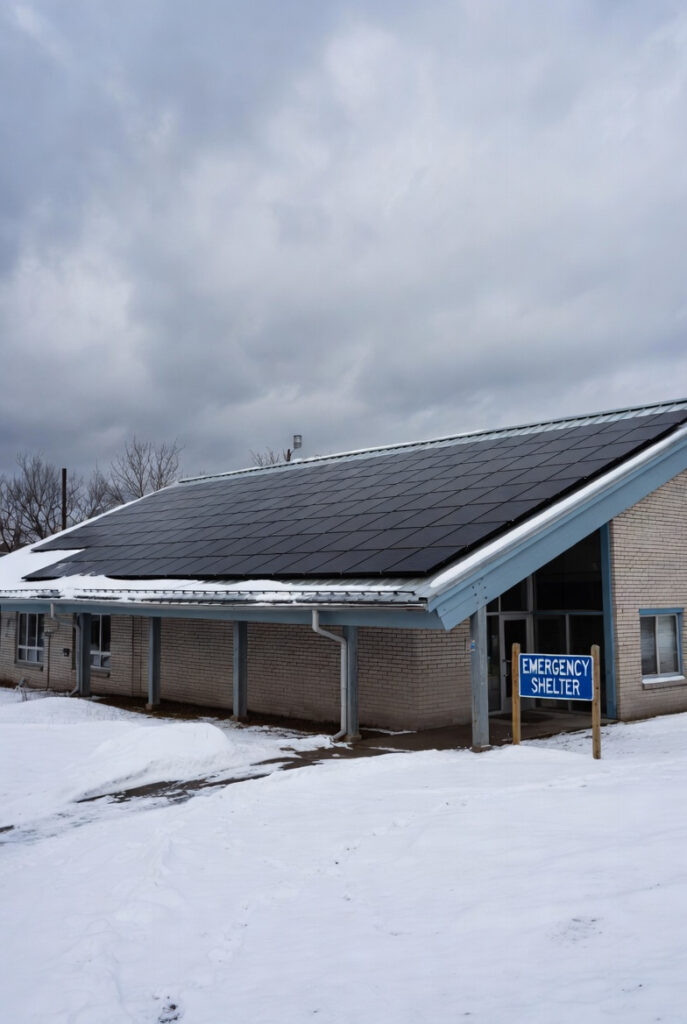
Community center solar sizing fails when designers use the building’s average daily load rather than its emergency shelter peak load. I was brought in to review the solar specification for a township community hall near Harriston in Minto Township that the municipality wanted to certify as an emergency shelter. The existing specification called for a 20kW rooftop array and a 40kWh LFP battery bank sized against the building’s average daily consumption of 85kWh. On a normal Tuesday the building consumed 85kWh, lighting, office equipment, a commercial refrigerator, and the gas-fired HVAC system’s air handlers. The specification looked adequate on paper. I ran the occupancy surge scenario: 200 residents sheltering during a January ice storm, no gas service because the distribution lines were down, the electric backup heating activated across the main hall’s four 5kW electric baseboards, and the air handling units running at full capacity to manage CO2 from 200 people in an enclosed space. The peak electrical load under shelter conditions was 38kW sustained, compared to 6kW average on a normal operating day. The 40kWh battery bank would have been depleted in 1.05 hours under the shelter load. The specification was wrong by a factor of 6. The correct specification for emergency shelter certification was a 50kW array and a 120kWh LFP container bank, three times the original proposal. The difference in cost was $95,000. The difference in outcome was whether the building could actually serve the function the municipality had promised its residents. For the full system sizing hub that covers the load calculation foundation this community center solar system is built on, the hub covers the numbers.
Why Community Center Solar Fails During a Shelter Event
The critical difference between normal building load and emergency shelter load in a community center is typically a factor of 4 to 8 times. Any solar specification sized against average daily consumption will fail within 2 hours of a full shelter activation because the occupancy surge load from electric heating, ventilation, and lighting is not reflected in the utility bills used to size the system. A community center that consumes 85kWh per day under normal operation may draw 38kW sustained under shelter conditions. At 38kW the 40kWh battery bank at 80% DoD providing 32kWh usable depletes in 50 minutes.
The shelter load calculation requires the number of occupants multiplied by ventilation requirement in Watts per person, plus electric backup heating for the shelter area, plus well pump cycling, plus communication and lighting. In Ontario a community hall designed for 200 occupants requires approximately 3 to 4 ACH for CO2 management, which for a 1,200 square metre hall at 4m ceiling height requires an AHU drawing 8 to 12kW continuously. The correct design basis for an emergency shelter solar system is the shelter load, not the operating load. The Victron MultiPlus-II handles the AHU and heating surge with its low-frequency transformer-core surge capability. For the community microgrid architecture that connects multiple municipal buildings into a resilient island-mode network, Article 177 covers the multi-building standard.
| Operating Mode | Peak Load | Battery Depletion Time at 40kWh |
|---|---|---|
| Normal operation | 6kW | 6.67 hours |
| Shelter activation | 38kW | 1.05 hours |
The Bifacial Carport: Winter Production for an Emergency Shelter Array
A bifacial solar carport over the municipal parking area serves the community center solar system in five ways simultaneously: power generation, emergency vehicle protection from snow, bifacial albedo production from snow-covered concrete below, reduced panel cleaning frequency during shelter activation, and planning approval through the parking lot rather than rooftop modification permits. Snow-covered concrete at 70 to 90% reflectance adds 15 to 20% to annual production from a bifacial carport array. On a 50kW bifacial carport in Ontario this represents 7,500 to 10,000 additional kWh per year, enough to cover the shelter event energy consumption 4 to 6 times over at zero additional panel cost. The winter production advantage is most significant exactly when shelter demand is highest: January storms produce snow coverage that boosts bifacial production on the days following the storm when the shelter may still be occupied. For the full winter bifacial albedo calculation for Ontario latitudes, Article 160 covers the December derate factors.
The Essential Services Partition: Critical Load Protection for Community Center Solar
Community center solar done right means the toilet still flushes and the vaccine fridge stays cold when the main hall’s electric heat has depleted 80% of the battery bank. I helped the facilities manager at a rural community centre near Mount Forest partition the electrical system into two distinct panels in November, an essential services panel and a general services panel. The essential services panel powered only four circuits: the submersible well pump at 750W, the vaccine and medication storage refrigerator at 180W continuous, the Starlink terminal and networking hub at 45W, and the emergency LED lighting at 120W. Total essential services load: 1,095W. A dedicated 20kWh LFP sub-bank fed exclusively from a separate 10kW array section powered this panel. The general services panel, covering gym lighting, kitchen equipment, office circuits, and the main hall heating, drew from the primary 100kWh bank.
During a simulated 72-hour grid outage test in December the essential services panel maintained all four circuits continuously. The well pump cycled 14 times over 72 hours at its standard duty cycle. The vaccine fridge never exceeded 4.2°C. The Starlink maintained connectivity throughout. The general services panel depleted the primary bank to 18% SoC by hour 54. The essential services panel was at 71% SoC at hour 72. The partition worked exactly as designed. The Victron SmartShunt on the essential services sub-bank provides independent SoC monitoring separated from the main bank monitor, allowing the facility manager to confirm the essential services reserve is intact regardless of what the general services bank is doing. For the solar remote monitoring standard that provides remote SoC alerts for both panels to the municipality’s emergency management coordinator, Article 187 covers the full monitoring architecture.
The DC Charging Wall: Communication Hub for Shelter Occupants
Fifty AC phone chargers through a 120V inverter draw 280 to 550W including conversion losses. A DC-native 48V USB-C PD charging wall with 30W outputs per port draws 1,578W maximum at 95% efficiency for 50 simultaneous charges. Each phone charges faster on the 30W DC output than on a standard 5W AC charger. The inverter overhead is eliminated entirely. The DC charging wall materials cost $200 to $400 and save 20% of the energy consumed in AC-DC conversion during the event. The communication value exceeds the energy value: a resident who can charge their phone and call their family is a calm resident who trusts the shelter. A resident with a dead phone in hour 3 of a 72-hour shelter event is a problem the facility manager does not need. The charging wall is communication infrastructure, not a convenience feature. For the DC-native USB charging hub architecture that powers multiple devices from the 48V bus without inverter overhead, Article 188 covers the full DC-native standard. For the battery bank winterization standard that ensures the LFP container bank accepts a charge on cold January mornings when the shelter is most likely to be activated, Article 190 covers the deep freeze protocol.
Occupancy-Linked Load Shedding: Managing the Surge Event
CO2 sensors and occupancy counters trigger the smart controller when occupied zone density exceeds the threshold. The controller automatically disconnects non-essential loads: storage room lighting, office circuits, decorative exterior lighting, and EV chargers if installed. The essential AHU, heating, well pump, and communication circuits remain energised throughout. The load shedding hierarchy runs as follows: Tier 1 critical loads of well pump, vaccine fridge, emergency lighting, and Starlink remain always on. Tier 2 shelter essential loads of main hall AHU, backup heating, and DC charging wall activate during a confirmed shelter event. Tier 3 general loads of office circuits, storage lighting, and gym equipment disconnect automatically on shelter activation. Tier 4 non-essential loads of exterior decorative lighting and EV chargers disconnect first. The smart controller implementation cost runs $1,500 to $3,500 for a municipal building. The alternative is a facility manager manually switching breakers at 2 AM during a January ice storm, and that is the implementation that fails. For the DC-native Starlink setup that keeps the Starlink terminal running on the essential services circuit at 20 to 40W instead of 75W, Article 175 covers the POE bypass standard.
The Community Center Solar System: Minimum Viable vs Full Haven Standard
The decision follows the municipality’s shelter certification requirement and the number of occupants the building is designated to serve.
The minimum viable community center solar system is the correct choice for a small township hall with a 100-occupant shelter designation. It includes a 20kW rooftop array, a 60kWh LFP battery bank, an essential services sub-panel with dedicated 20kWh sub-bank fed from a 10kW array section, a DC-native charging wall for 30 devices, and Starlink on a dedicated circuit. Capital cost runs $85,000 to $130,000. It provides 24 hours of essential services autonomy for 100 occupants with moderate solar production during the event.
The full haven standard is the correct choice for a regional community centre with a 200-occupant emergency shelter certification and 72-hour autonomy requirement. It includes a 50kW bifacial carport array, a 120kWh LFP container bank with CSA/ANSI C22.2 No. 340 certification for public buildings, an occupancy-linked load shedding controller, an essential services sub-panel with independent 20kWh sub-bank, a DC-native charging wall for 50 devices, a Victron MultiPlus-II for AHU and heating surge management, and Starlink on a dedicated circuit. Capital cost runs $220,000 to $380,000. It meets Ontario Emergency Management and Civil Protection Act requirements for a designated emergency shelter with full 72-hour autonomous operation.
NEC and CEC: What the Codes Say About Community Center Solar
NEC 708 covers critical operations power systems and applies to facilities designated as critical operations facilities including emergency shelters. NEC 708.4 requires that critical operations power systems be designed to remain operational during the conditions that require their use. For a community center designated as an emergency shelter this means the solar and storage system must be designed to the shelter load, not the average operating load. NEC 700 covers emergency systems and requires that emergency lighting, exit signs, and life safety systems be powered by a source that activates automatically on loss of normal power. The essential services sub-panel and its dedicated battery sub-bank must meet NEC 700 automatic transfer requirements for the emergency lighting circuits.
In Ontario, a community center solar installation on a municipally owned building is subject to CEC Section 64 for the PV source circuits and to the Ontario Building Code for the structural and fire separation requirements of the battery storage system. A 100kWh or larger LFP container battery system installed in or adjacent to a public building must comply with CSA/ANSI C22.2 No. 340 for stationary battery energy storage systems and must be located in a room or enclosure meeting the Ontario Building Code fire separation requirements for energy storage installations. The ESA electrical permit application must include a load study demonstrating that the system meets the shelter load requirement if the building is designated as an emergency shelter under the Ontario Emergency Management and Civil Protection Act. Contact the local ESA district office and the municipality’s building department for permit requirements for community center solar installations in Wellington County and Grey County.
Pro Tip: Before submitting a community center solar specification for municipal approval, ask the emergency management coordinator for the building’s shelter occupancy rating from the Ontario Emergency Management and Civil Protection Act designation. That number is the design basis for your battery bank, not the utility bills. A 200-person shelter rating requires a shelter load study. A 50-person rating requires a different study. The rating is the specification. The utility bills are irrelevant.
The Verdict
A community center solar system built to the haven standard means the lights stay on, the well keeps pumping, and the vaccines stay cold for 72 hours after the grid goes down.
- Size against the shelter load, not the operating load. The Harriston specification was wrong by a factor of 6 because the designer used utility bills instead of a shelter load study. A 200-person shelter activation draws 38kW. A normal Tuesday draws 6kW. Specify for the emergency, not the average.
- Partition the essential services before the first outage. The Mount Forest 72-hour test proved the partition works. The well pump cycled 14 times, the vaccine fridge held 4.2°C, and the Starlink never dropped. The general services bank hit 18% SoC. The essential services bank was at 71%. The partition is the reason the toilets still flush in hour 54.
- Install the DC charging wall on day one. A resident who can charge their phone and call their family at 2 AM is calm. The charging wall costs $200 to $400 and is the highest-value investment per dollar in the entire haven system.
In the shop, we do not let the radio drain the battery so much the car will not start. At the town hall, the party lights do not share a bank with the well pump.
Questions? Drop them below.
This post contains affiliate links. If you purchase through our links, we may earn a small commission at no extra cost to you.
About the Author
Robert Bertrand spent 20 years as a service advisor in the automotive industry (Lexus and Nissan), where precision diagnostics, wiring integrity, and documentation standards were non-negotiable. He brings that same technical discipline to GridFree Guide, where he researches, tests, and documents off-grid solar systems for Ontario conditions. Based in Rockwood, Ontario, every article is built on verified specifications, manufacturer data, and the real-world climate constraints of Canadian off-grid living.
As an Amazon Associate I earn from qualifying purchases. This site also contains affiliate links to other products and services. GridFree Guide earns a small commission at no extra cost to you.