
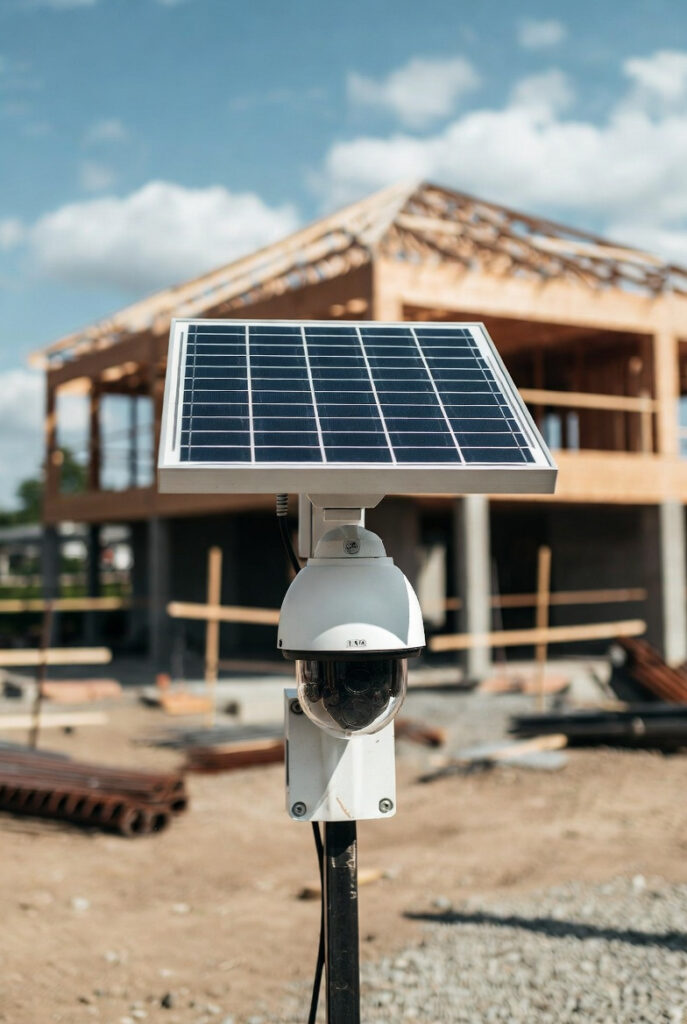
Solar security camera systems fail at the worst possible moment and the failure mode is specific. I diagnosed a construction site security failure at a townhouse development in Milton where the site supervisor had reported that the PTZ camera was rebooting every time it attempted to track movement after midnight. The camera would detect motion, begin to pan, and then reboot, leaving a 35-second blind spot during every tracking event. The system had a 100Ah AGM battery bank and a 200W solar panel powering a PTZ camera drawing 8W idle and 28W during pan-and-zoom movement with the IR illuminators active. The inrush current when the pan motor engaged dropped the terminal voltage from 12.6V to 10.9V for approximately 400 milliseconds. The camera’s control board required 11.2V minimum to remain operational. At 10.9V the board brown-out reset triggered. The camera came back online 35 seconds later. The thief had 35 seconds of unmonitored access on every motion event. The fix was a 50Ah LFP battery with a 2C continuous discharge rating replacing the 100Ah AGM. The LFP internal resistance was 8 times lower than the AGM at the same charge state. Terminal voltage under the same 28W pan load dropped to only 12.1V. No more reboots. For the battery selection standard that covers LFP internal resistance advantage over AGM in high-discharge applications, Article 190 covers the deep freeze standard.
Why a Solar Security Camera Reboots During Tracking: The Voltage Drop Problem
A 100Ah AGM battery at full charge has an internal resistance of approximately 3 to 6 milliohms, rising to 8 to 15 milliohms at 50% SoC. A 100Ah LFP battery maintains an internal resistance of approximately 0.5 to 1 milliohm at any SoC above 20%. Under a 28W PTZ inrush current draw of approximately 2.3A at 12V, the AGM voltage sag totals 18 to 80mV at 50% SoC. The LFP sag is 1 to 2mV. Practically: a 100Ah AGM drops terminal voltage by 0.4 to 0.8V under PTZ inrush. A 100Ah LFP drops it by 0.02V. The AGM causes camera reboots at 50% SoC. The LFP never causes reboots above 20% SoC. The minimum specification for a construction site solar security camera battery is 2C continuous discharge rated LFP. A 50Ah LFP at 2C delivers 100A continuously with stable terminal voltage. The PTZ inrush of 2.3A is 4.6% of the 2C rated current. The Victron SmartShunt installed on the battery measures real-time terminal voltage during PTZ inrush events, confirming whether voltage drop is causing reboots before the site manager spends time replacing the camera. For the construction site solar power standard that covers the broader site power architecture this security system connects to, Article 183 covers the heavy-duty standard.
| Battery Type | Internal Resistance at 50% SoC | Voltage Sag Under 28W PTZ Load |
|---|---|---|
| AGM | 8 to 15 milliohms | 0.4 to 0.8V |
| LFP | 0.5 to 1 milliohm | 0.02V |
The AI Edge Camera Standard: Reducing the Daily Power Budget by 90%
AI edge cameras using on-device inference for human and vehicle detection reduce average daily power draw by 85 to 95% compared to continuous streaming cameras. A continuous streaming PTZ camera draws 8 to 10W average over 24 hours, consuming 192 to 240Wh per day. An AI edge camera in event-trigger mode draws 0.5W in sleep mode and 12W during a detection event. On a construction site with 20 to 40 detection events per night averaging 30 seconds each, the daily active draw is approximately 4Wh per day in active mode plus 11.8Wh in sleep mode 16Wh total per day. The continuous streaming camera draws 192 to 240Wh per day. The AI edge camera draws 16Wh per day. The solar array and battery required for an AI edge camera are 12 times smaller than for a continuous streaming camera. Four AI edge cameras draw 64Wh per day total. Four continuous streaming cameras draw 800 to 960Wh per day. The correct 2026 standard for a construction site solar security camera is AI edge event-trigger. Continuous streaming is not the standard. It is the legacy approach that kills battery banks before sunrise. For the solar remote monitoring standard that provides real-time camera system SoC alerts to the site manager’s phone, Article 187 covers the monitoring architecture.
Panel Dust and the Weekly Cleaning Protocol
Solar security camera systems on active construction sites lose power to dust faster than any other application in this guide. I installed a 400W solar security system at a commercial foundation pour site near Burlington in April. The system was performing at 380 to 400W output on the commissioning day. I returned for a scheduled inspection 11 days later and production had dropped to 218W on a clear day, a 43% reduction in 11 days. The panels were coated in a white calcium-silicate dust from the concrete formwork and aggregate handling that had been operating 30 metres upwind of the panel array. The dust was not heavy enough to be visible at a glance but was consistent enough across the panel surface to block 43% of incident light. A 10-minute wipe-down with a damp microfibre cloth and a bucket of water restored output to 374W. The cleaning had recovered 156W of production, more than the output of a full additional 150W panel, at a cost of 10 minutes of labour. Weekly cleaning on a construction site is not optional maintenance. It is a power generation activity.
Concrete dust contains calcium oxide which deposits as a white film. Drywall dust contains calcium sulphate which absorbs moisture and becomes slightly adhesive, bonding dust particles to the panel surface. Standard rain does not clean construction site panel soiling because the calcium compounds are not fully water-soluble. Weekly manual wipe-down with a damp cloth is the only reliable cleaning method. A site security SOP that does not include weekly panel cleaning is not a complete security system.
The NEMA 4X Cabinet: Vandal-Resistant Enclosure for Site Electronics
All solar security camera electronics on a construction site must be housed in a locked 14-gauge steel NEMA 4X cabinet with concealed hinges and a hasp-and-padlock closure. Internal wire routing through box-section steel poles eliminates exposed cabling. A thief who can see the cables can cut them in 10 seconds. A thief who must open a locked steel cabinet to cut the power circuit will move to an easier target. The solar charge controller, battery BMS, and DC distribution equipment go in the NEMA 4X steel cabinet, not in the camera housing. Camera housings are IP66 or IP67 rated for weather but not for electrical equipment cooling or battery venting. Mixing battery electronics with a sealed camera housing creates a thermal management problem the camera housing was never designed to handle. All cable penetrations must be sealed with expanding foam or rubber grommets rated for outdoor use to prevent concrete dust ingress through the conduit path.
The Starlink Mini Event-Trigger: Satellite Uplink for Remote Sites
The event-trigger uplink protocol keeps the Starlink Mini in sleep mode consuming 2 to 5W standby. When the AI edge camera detects a human or vehicle signature and records a clip, it signals the router to wake the Starlink. The Starlink boots in 30 to 45 seconds and uploads the video clip to the cloud, then returns to sleep mode. Total daily Starlink energy for 5 events: approximately 75Wh. Without event-trigger mode a continuous Starlink connection draws 360 to 480Wh per day. The event-trigger protocol reduces Starlink energy consumption by 80% while maintaining 4K video evidence upload capability on every detected event. For the full DC-native Starlink POE bypass standard that reduces the standby draw from 75W to 20W, Article 175 covers the full configuration.
The Solar Security Camera System: Minimum Viable vs Full Watchman Standard
The decision follows site risk level and whether the site has cellular coverage or requires satellite uplink.
The minimum viable solar security camera system is the correct choice for a low-risk site with daytime working hours and good cellular coverage. It includes two AI edge cameras with individual 40W solar panels, a shared 100Ah LFP battery, an MPPT controller, and a NEMA 4X locked steel enclosure for the electronics. The Renogy 100W starter kit provides the panel and controller foundation. Capital cost runs $800 to $1,400. It provides 30 days of autonomous overnight AI-triggered security with zero fuel and zero grid dependency and zero voltage drop reboots.
The full watchman standard is the correct choice for a high-risk GTA construction site with copper theft exposure and no reliable cellular coverage. It includes four AI edge cameras with LPR capability, a 200Ah high-C-rate LFP bank, a 400W solar array, a Starlink Mini on event-trigger mode, a locked NEMA 4X 14-gauge steel cabinet with internal wire routing through box-section steel poles, and a weekly cleaning SOP integrated into the site security protocol. Capital cost runs $3,500 to $6,000. It provides commercial-grade 24/7 autonomous security with 4K video evidence upload on every detected event. For the full system sizing hub that covers the load calculation foundation, the hub covers the numbers.
NEC and CEC: What the Codes Say About Solar Security Cameras on Construction Sites
NEC 590 covers temporary electrical installations on construction sites and applies to any temporary power system including a solar security camera installation. NEC 590.6 requires GFCI protection for all 120V receptacles on construction sites. A 12V DC solar security camera system drawing only DC power does not require GFCI protection for the camera circuits, but any AC outlets powered from the system’s inverter output are subject to NEC 590.6 GFCI requirements. NEC 690 governs PV source circuits. The solar panel wiring from the panel to the charge controller is subject to NEC 690 overcurrent protection and disconnecting means requirements regardless of the temporary nature of the installation. Video transmission wiring from the camera to the router is subject to NEC 725 Class 2 circuit requirements.
In Ontario, a temporary solar security camera installation on a construction site is subject to CEC Section 76 for temporary wiring. A 12V DC solar system powering cameras and a router without connection to the building’s fixed wiring does not require an ESA permit as a temporary portable installation. If the security system connects to the site’s fixed temporary power distribution, an ESA permit is required for the connection point. The camera mounting pole and cabinet must comply with the Ontario Occupational Health and Safety Act requirements for temporary structures on construction sites. The pole must be secured against wind uplift and the cabinet must not create a tripping or striking hazard. Contact the local ESA district office for construction site temporary security installation requirements in Halton Region and Peel Region.
Pro Tip: Before installing a solar security camera on a construction site, measure the distance from the proposed panel location to the nearest active dust source concrete mixer, formwork crew, or aggregate pile. If the distance is less than 50 metres and the panel is downwind of that source, reposition the panel upwind or add a cleaning event to the site SOP every three days rather than weekly. At 30 metres downwind of active concrete work the 43% harvest loss from the Burlington site can happen in 5 days rather than 11.
The Verdict
A solar security camera system built to the watchman standard keeps the site under continuous AI-monitored surveillance from commissioning to project completion without a single fuel delivery or grid connection.
- Replace the AGM battery with a high-C-rate LFP. The voltage drop that causes PTZ reboots disappears. The 35-second blind spot that lets a thief walk through untracked costs far more than the $180 battery upgrade.
- Specify AI edge event-trigger cameras instead of continuous streaming. The daily energy draw drops from 240Wh to 16Wh per camera. The solar array required drops from 600W to 100W. The battery required drops from 200Ah to 50Ah. The security coverage is identical.
- Add weekly panel cleaning to the site security SOP. A 10-minute wipe-down recovers 156W of production, more than a full additional solar panel, at labour cost only. A dirty panel is a blind watchman.
In the shop, we do not let a car leave with a dirty windshield. On the job site, a dirty panel is a 40% blind spot that costs nothing to fix and everything to ignore.
Questions? Drop them below.
This post contains affiliate links. If you purchase through our links, we may earn a small commission at no extra cost to you.
About the Author
Robert Bertrand spent 20 years as a service advisor in the automotive industry (Lexus and Nissan), where precision diagnostics, wiring integrity, and documentation standards were non-negotiable. He brings that same technical discipline to GridFree Guide, where he researches, tests, and documents off-grid solar systems for Ontario conditions. Based in Rockwood, Ontario, every article is built on verified specifications, manufacturer data, and the real-world climate constraints of Canadian off-grid living.
As an Amazon Associate I earn from qualifying purchases. This site also contains affiliate links to other products and services. GridFree Guide earns a small commission at no extra cost to you.