
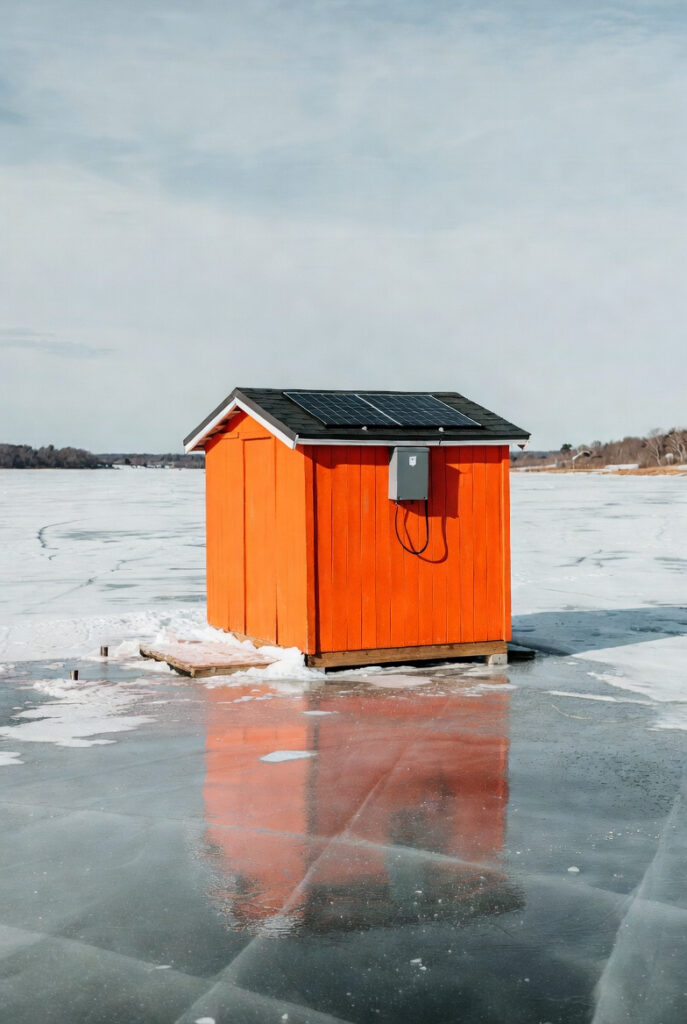
Ice fishing solar failures are brutally simple to diagnose and brutally expensive to discover at 6 AM on Lake Simcoe in January. I helped a client troubleshoot a diesel heater ignition failure on a portable ice hut on Kempenfelt Bay during a February trip. He had a 100Ah sealed lead-acid battery that he had charged fully the night before at home. The drive to the lake on the snowmobile sled took 40 minutes at minus 18°C ambient. By the time he set up the hut and attempted to start the diesel heater, the battery had cooled to approximately minus 8°C sitting on the ice floor of the trailer. He hit the start button. The glow plug startup sequence drew 12A at 12V for 105 seconds, 144W of surge current from a cold battery. The terminal voltage dropped to 10.8V within 15 seconds. The diesel heater’s control board detected the under-voltage condition and displayed a fault code. The heater did not ignite. He tried twice more. Same fault code both times. The battery was not depleted. It was cold. At minus 8°C a sealed lead-acid battery’s available capacity drops to approximately 50% of its rated 20°C capacity, and its internal resistance increases by 40 to 60%, causing the voltage to sag under the 12A startup load. The fix was a 50Ah LFP battery in an insulated pouch inside the heated hut, smaller, lighter, and delivering full startup current at minus 20°C because LFP discharge performance is maintained to minus 20°C unlike lead-acid. For the battery bank winterization thermal isolation principles that apply directly to the ice fishing battery setup, Article 190 covers the XPS foam floor break standard.
Why Ice Fishing Solar Fails at Cold-Start: The Voltage Sag Problem
The voltage sag mechanism is straightforward. A diesel heater’s glow plug startup sequence draws 12 to 15A at 12V for 90 to 120 seconds. At minus 8°C a sealed lead-acid battery’s internal resistance increases by 40 to 60% compared to its performance at 20°C. Under the 12A load the terminal voltage sags below the diesel heater’s minimum of 11V, triggering a fault code and shutting down the heater. An LFP battery maintains high ion mobility at low temperatures. At minus 20°C an LFP battery delivers 95 to 98% of its rated capacity with minimal voltage sag under the same startup load. The critical specification is not average current but the minimum terminal voltage under load. A battery that can deliver 50Ah total may still fail a diesel heater startup if its internal resistance causes terminal voltage to sag below 11V under the 12 to 15A startup current. A 50Ah LFP with a 1C continuous discharge rating delivers 50A continuously, far more than the 12 to 15A startup surge, with terminal voltage remaining above 12V throughout. The Victron SmartShunt installed inline displays real-time terminal voltage during startup so the owner can confirm the battery is delivering above 11V throughout the glow plug sequence. For the cold climate production context that determines how much solar charging is available on a February Ontario ice fishing day, Article 160 covers the derate factors.
| Battery Type | Capacity at Minus 20°C | Weight for 100Ah Equivalent |
|---|---|---|
| Sealed Lead-Acid (SLA) | 40 to 50% of rated capacity | 28kg |
| Lithium Iron Phosphate (LFP) | 95 to 98% of rated capacity | 5.5kg |
The Foldable Panel Standard: Ice Fishing Solar for February Production
ETFE-coated foldable panels are the correct choice for ice fishing solar setups. ETFE coating is flexible, scratch-resistant, and survives the vibration and compression stress of a sled ride. Rigid glass panels crack under impact and vibration. A 100W ETFE foldable panel weighs approximately 1.8 to 2.5kg and folds to a 35 by 50cm package that fits in a large duffel bag alongside the ice auger. Deployment time: under 3 minutes. The built-in kickstand sets the panel at 65 degrees, optimal for February solar angles in Ontario at 44 to 46 degrees north latitude where solar noon elevation is 22 to 26 degrees. At this angle snow slides off automatically and the panel face is nearly perpendicular to the low winter sun. The Renogy 100W starter kit provides the panel, controller, and wiring for the foundation of an ice fishing solar setup. Two kits provide 200W for a full hardwater standard system. On a clear February day in Ontario, 200W of panels at 65 degrees produces 600 to 800Wh over the 6 to 7 hour daylight window.
Vibration-Damped Mounting: Ice Fishing Solar on a Sled
Ice fishing solar on a sled is a different environment than a stationary cabin installation. I inspected a portable ice fishing power system at a hut near Innisfil on Lake Simcoe that had been towed approximately 3 kilometres across the lake on a snowmobile sled at 35 to 40km/h. When the owner arrived and connected his underwater camera system, the fish finder produced no image. I checked the 12V DC camera hub and found the positive terminal connection at the battery had worked loose during the sled ride. The terminal had been hand-tightened but not torqued with a wrench and secured with a lock washer. The vibration over 3 kilometres of ice had backed the terminal bolt out approximately 2.5 turns. The connection was intermittent, enough resistance to pass low current but not enough to power the camera illumination LEDs at full brightness. Five minutes with a wrench and a lock washer fixed the problem.
The correct assembly standard for any ice fishing solar system that travels by sled: all terminal connections torqued to specification, lock washers on every battery terminal bolt, and vibration-resistant silicone-filled wire connectors at every junction. If it is not torqued and locked, the sled will loosen it. Mount the MPPT controller and battery on 20mm rubber isolation grommets to dampen the vibration transmitted through the sled frame. Rubber grommets cost $0.50 each and eliminate the oscillating stress that loosens terminal connections over repeated sled rides. Secure all wiring with zip ties at 15cm intervals with no loose wire runs longer than 10cm unsupported.
Thermal Isolation: Keeping the Ice Fishing Solar Battery Off the Ice
Setting the portable power station directly on the ice floor creates a dual thermal problem. Heat from the battery melts the ice underneath, creating a puddle that refreezes and traps the equipment. Cold from the ice floor conducts into the battery, reducing its discharge capacity. A 2-inch XPS foam block eliminates both problems at a cost of $8 and a weight of 200g. A 50Ah LFP sitting on bare ice in a hut heated to 5°C loses 2 to 3°C per hour through the base. On a 6-hour ice fishing session starting at minus 5°C base temperature, the battery reaches minus 13 to minus 18°C by early afternoon, approaching the LFP charging threshold at minus 20°C. On a 2-inch XPS block the battery maintains the hut ambient temperature of 5°C throughout the session. The thermal bridge that Article 190 covers at cabin scale applies directly to the ice hut at portable scale.
The DC Camera Hub: Ice Fishing Solar for HD Underwater Electronics
High-definition underwater fishing cameras with LED illumination arrays draw 8 to 15W continuously at 12V DC. A fish finder with a colour display draws 5 to 8W. A sonar unit draws 3 to 5W. A full electronics package draws 16 to 28W continuously. At 22W average draw over a 6-hour ice fishing session the electronics package consumes 132Wh. On a 50Ah LFP battery at 80% DoD that is 600Wh usable. The diesel heater draws approximately 20Wh per hour at steady state after startup for 6 hours, consuming 120Wh. LED lighting draws 10W for 6 hours, consuming 60Wh. Total day draw: 312Wh from a 600Wh usable bank. At the end of a 6-hour session the battery is at 48% SoC, well above the 20% floor. Connect all electronics to a DC-native 12V USB hub with individual 5A fused outputs for each device. No inverter required. No AC conversion overhead. For the hunting camp solar system that applies the same DC-native electronics principle to a seasonal cabin setup, Article 186 covers the full outpost standard.
The Ice Fishing Solar System: Minimum Viable vs Full Hardwater Standard
The decision follows whether the owner runs a basic setup or a full electronics package.
The minimum viable ice fishing solar system for a basic hut with a diesel heater and fish finder includes a 50Ah high-discharge LFP battery in an insulated pouch, a 100W ETFE foldable panel, a small MPPT controller, a 2-inch XPS foam floor block, and all terminals torqued with lock washers. Capital cost runs $400 to $650. It covers the diesel heater all day, fish finder, and basic LED lighting on a single charge. The weight saving over a 100Ah SLA is 22.5kg. It fits entirely in a medium duffel bag.
The full hardwater standard for a serious angler running HD cameras, sonar, a diesel heater, and LED lighting for two-day ice fishing trips includes a 100Ah high-discharge LFP with a 1C discharge rating, a 200W ETFE foldable panel array, an MPPT controller with a load port for the camera circuit, a DC-native 12V camera hub with individual fused outputs, rubber grommet vibration-damped mounting for all electronics, and a 2-inch XPS foam floor isolation. Capital cost runs $900 to $1,500. It provides two full days of complete electronics operation before requiring solar recharge. For the solar remote monitoring standard that can alert the owner remotely if the battery drops unexpectedly between ice fishing sessions, Article 187 covers the monitoring architecture. For the full system sizing hub that covers the load calculation foundation this hardwater standard builds on, the hub covers the numbers.
NEC and CEC: What the Codes Say About Ice Fishing Solar
NEC 551 covers recreational vehicles and park trailers and applies by analogy to portable ice fishing hut electrical installations, as a portable hut on skis or runners shares many of the same transient electrical characteristics as a recreational vehicle. NEC 551.10 requires that DC electrical systems in recreational vehicles use wiring rated for the voltage and current of the circuit with appropriate overcurrent protection at the battery. The 12V battery circuit powering a diesel heater and camera hub must be fused at the battery within 18 inches of the battery terminal per NEC 551.46. The foldable solar panel wiring and MPPT controller are subject to NEC 690 for PV source circuit requirements regardless of the portable nature of the installation.
In Ontario, a portable ice fishing hut is not subject to ESA permit requirements for its 12V DC electrical installation provided the system does not connect to utility power and does not include 120V AC wiring. A 12V DC system powered by a portable solar panel and LFP battery is a self-contained portable electrical system outside the scope of the Ontario Electrical Safety Code permit requirements. The ice fishing solar system is subject to Transport Canada regulations when the hut is towed on a public road as a trailer. The electrical system must not create a fire hazard and must not interfere with the hut’s navigation lights if required by provincial highway traffic regulations. In Ontario, ice huts on public ice surfaces are subject to the provincial Motorized Snow Vehicles Act and the Public Lands Act, which require that huts be removed at the end of the ice fishing season and prohibit permanent electrical connections to shore power without approval.
Pro Tip: Before the first ice fishing trip of the season, do a cold soak test on your battery. Leave it outside overnight at the forecast temperature, then measure the terminal voltage under the diesel heater startup load the next morning. If voltage drops below 11V during the glow plug sequence, the battery cannot handle the cold-start surge reliably. Discover that in your driveway, not at 6 AM on Lake Simcoe.
The Verdict
Ice fishing solar built to the hardwater standard means the diesel heater lights on the first try, the cameras run all day, and the battery comes home with power to spare.
- Replace the sealed lead-acid with a 50Ah or larger high-discharge LFP rated at 1C continuous discharge. At minus 20°C it delivers full startup current where a 100Ah SLA delivers 40 to 50% of rated capacity. It weighs 22.5kg less. There is no reason to carry the lead-acid to the ice.
- Torque every terminal connection and install a lock washer on every battery bolt before the first sled ride of the season. The 3-kilometre Innisfil terminal failure happens in the first trip. It takes 5 minutes to prevent and a cold dark afternoon to discover.
- Put a 2-inch XPS foam block under the battery. It costs $8, weighs 200g, and prevents both the refreeze-trap and the battery temperature drop that reduces capacity during a long afternoon session.
In the shop, we torque every bolt and lock every connection. On the ice, if it moves, it will fail.
Questions? Drop them below.
This post contains affiliate links. If you purchase through our links, we may earn a small commission at no extra cost to you.
About the Author
Robert Bertrand spent 20 years as a service advisor in the automotive industry (Lexus and Nissan), where precision diagnostics, wiring integrity, and documentation standards were non-negotiable. He brings that same technical discipline to GridFree Guide, where he researches, tests, and documents off-grid solar systems for Ontario conditions. Based in Rockwood, Ontario, every article is built on verified specifications, manufacturer data, and the real-world climate constraints of Canadian off-grid living.
As an Amazon Associate I earn from qualifying purchases. This site also contains affiliate links to other products and services. GridFree Guide earns a small commission at no extra cost to you.