
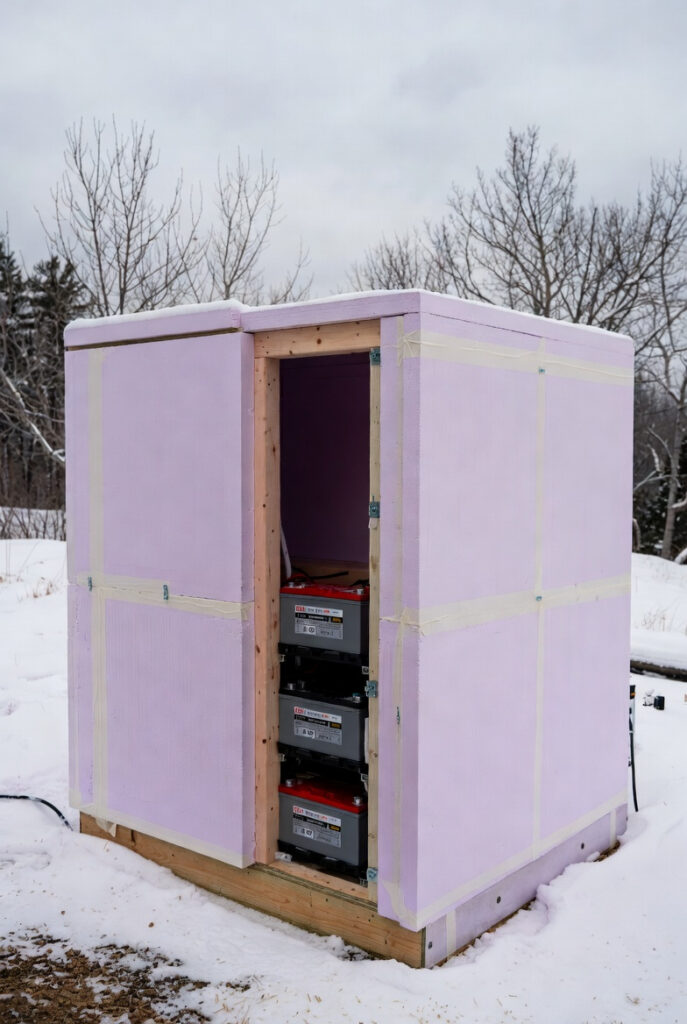
Battery bank winterization is a lesson most Ontario off-gridders learn the expensive way. In early March I inspected a 200Ah LFP battery bank at a remote cabin north of Parry Sound that had been installed the previous August. The owner had noticed his battery capacity had dropped significantly over the winter but assumed it was normal cold-weather performance reduction. I ran a full capacity test: the bank that was rated for 200Ah delivered 141Ah under a 20A discharge load to 20% SoC. The bank had permanently lost 59Ah, or 29.5% of its rated capacity, in one winter. I checked the charge controller logs. The data showed 14 separate charging events between December and February where the battery temperature was below 0°C when the solar array began pushing current into the bank. The lowest recorded charging temperature was minus 7°C. Each of those 14 events had deposited metallic lithium onto the anode plates, a process called lithium plating, that cannot be reversed and does not recover with cycling. The cells were permanently damaged. The owner had spent $1,400 on the battery bank in August. By March it was performing as a $990 bank at best. The entire capacity loss could have been prevented with a $45 XPS foam enclosure and a $28 silicone heating pad on the MPPT load port. For the full off-grid system sizing hub that covers the battery bank capacity calculation this winterization standard protects, the hub covers the numbers.
Why Battery Bank Winterization Starts With the Charge Controller Log
Below 0°C, lithium ions cannot intercalate into the graphite anode fast enough. Current pushed faster than the intercalation rate deposits metallic lithium on the anode surface. Metallic lithium does not dissolve on discharge. Each cold charging event adds permanent plating. Fourteen events at minus 7°C equals 29.5% permanent capacity loss. The standard LFP BMS cuts charging below 0°C if the temperature sensor reads cell surface temperature accurately. A sensor reading ambient air rather than cell surface may not trigger the cutoff until the cells are already below 0°C. The charge controller log check: pull the temperature log from the MPPT controller for December through February and count any charging events where battery temperature was below 0°C at the start of the charge cycle. Each one is a plating event. The Victron SmartShunt logs battery temperature continuously and provides VRM alerts when charging attempts occur below the configured temperature threshold. For the full MPPT charge controller temperature compensation setting that triggers automatic charge suspension when cell temperature drops below 0°C, Article 16 covers the configuration.
The XPS Foam Enclosure: Passive Thermal Protection for Battery Bank Winterization
A 2-inch extruded polystyrene foam board enclosure with spray foam sealing all air gaps provides R-10 insulation value. LFP batteries generate 8 to 12W of heat during discharge from internal resistance losses. In a sealed R-10 enclosure this operating heat maintains internal temperature above 5°C for 12 to 16 hours at minus 20°C ambient without any active heating. The concrete floor comparison: concrete thermal conductivity is 0.8 to 1.4 W/m·K versus XPS foam at 0.03 W/m·K, a 25 to 45 times faster heat loss rate through the concrete floor compared to 2-inch foam. A $15 XPS floor break saves more heat per dollar than any other single battery bank winterization improvement. The construction sequence: floor break first, then XPS walls on all four sides and top, spray foam all joints, leave only a small ventilation opening for the battery cables and BMS communication wiring. Total material cost for a 200Ah bank enclosure: $40 to $60. For the full cold climate solar production standard that determines how much charging the array produces on the Ontario winter days when the enclosure is working hardest, Article 160 covers the derate factors.
The Heating Pad Standard: Active Thermal Protection for Battery Bank Winterization
Battery bank winterization done wrong costs more power than it saves. I reviewed the winter energy logs for a cabin owner near Kapuskasing who had installed two 50W silicone heating pads wired directly to the battery bank on a manual switch. He turned the pads on in November and left them on until April. Each 50W pad running continuously drew 100W total, 2,400Wh per day, 72kWh per month. In Kapuskasing in December the system had a 400W array producing approximately 200 to 400Wh per day on clear days and near zero on overcast days. The heating pads were consuming 2,400Wh per day on a system producing 200 to 400Wh per day in good conditions. The heating pads were draining the battery bank faster than the sun could replenish it. The correct configuration was a thermostat set to activate the pads at 2°C and deactivate at 5°C. With the thermostat installed the average daily heater draw dropped from 2,400Wh to approximately 380Wh in a Kapuskasing January, an 84% reduction. The battery bank stopped discharging to low-voltage cutoff by mid-January.
The thermostat setpoint logic: 2°C activates the pads, 5°C deactivates. The batteries need to be above 0°C to accept a charge without plating, not at room temperature. The 3°C operating band between 2°C and 5°C is the minimum viable thermal management window. A 50W pad cycling between 2°C and 5°C in an R-10 enclosure runs approximately 3 to 5 hours per day in a Kapuskasing January, consuming 150 to 250Wh per day instead of 2,400Wh. Power the heating pad from the MPPT controller’s load port with a load disconnect programmed to disable the pad when battery SoC falls below 30%, preserving the remaining charge for essential loads rather than heating.
The Self-Heating LFP Option: Battery Bank Winterization Without External Pads
Self-heating LFP batteries with BMS-controlled internal heaters are the simplest battery bank winterization solution for a new installation. The internal heater activates automatically when cell temperature drops below the configured threshold, warms the cells to 5°C before accepting any charge current, and deactivates when the cells reach operating temperature. The BMS ensures the heater never activates when SoC is below 20%, preventing the self-discharge loop that destroyed the Kapuskasing bank. For a new installation in northern Ontario, self-heating LFP is worth the 15 to 25% price premium over standard LFP. For an existing standard LFP installation, the external XPS enclosure and heating pad with thermostat provides equivalent protection at lower cost. The Victron Smart Battery Sense wireless temperature sensor feeds real-time cell temperature data to the MPPT controller, enabling automatic charge suspension when cell temperature drops below 0°C regardless of whether the batteries have internal heaters or rely on external pads. For the solar remote monitoring standard that integrates temperature alerts into the VRM dashboard for remote cabin owners who cannot check the battery bank daily, Article 187 covers the full monitoring architecture.
The Battery Bank Winterization System: Minimum Viable vs Full Thermal Fortress
The decision follows the installation location and winter severity.
The minimum viable battery bank winterization system is the correct choice for an Ontario cabin south of Sudbury where temperatures rarely drop below minus 20°C for more than a few days. It includes a 2-inch XPS foam enclosure with spray foam joints, a 2-inch XPS floor break, one 50W silicone heating pad on the MPPT load port, and a $15 thermostat set to 2°C on / 5°C off. Total cost runs $88 to $130. It prevents lithium plating in all but the most extreme cold events and reduces heating pad energy consumption to 150 to 250Wh per day.
The full thermal fortress is the correct choice for a northern Ontario installation in Sudbury, Kapuskasing, Timmins, or Parry Sound where minus 30°C is a regular January event. It includes self-heating LFP batteries with BMS-controlled internal heaters, a 2-inch XPS external enclosure as an additional insulation layer, a 2-inch XPS floor break, Victron Smart Battery Sense wireless temperature monitoring, a VRM low-temperature alert configured at 2°C, and an MPPT controller load port backup heater as redundant protection. Total additional cost over standard LFP: $400 to $800.
| Protection Method | Cost | Daily Heating Energy |
|---|---|---|
| XPS foam enclosure + floor break | $55 to $75 | 0Wh (passive only) |
| Silicone pad – no thermostat | $28 | 2,400Wh |
| Silicone pad – thermostat controlled | $43 | 150 to 250Wh |
| Self-heating LFP batteries | $400 to $800 premium | BMS-managed, minimal |
For the battery room venting standard that governs the ventilation opening required in the XPS enclosure for hydrogen gas management, Article 165 covers the active air requirement.
NEC and CEC: What the Codes Say About Battery Bank Winterization
NEC 706 covers energy storage systems and applies to LFP battery banks used in off-grid solar installations. NEC 706.20 requires that energy storage systems be installed with appropriate overcurrent protection and disconnecting means. For a battery bank winterization installation that adds a heating pad powered from the MPPT load port, the heating pad circuit is a branch circuit subject to NEC 706 overcurrent protection requirements at the battery connection. The heating pad must be rated for the voltage of the load port output, typically 12V or 24V, and must be fused at the source. NEC 706.15 requires that energy storage systems be protected from environmental conditions that could affect safety, which includes protection from freezing temperatures that could cause lithium plating in LFP systems.
In Ontario, modifications to an existing permitted solar installation including the addition of a heating pad circuit and enclosure are subject to CEC Section 64 for any changes to the PV source circuit connections. A heating pad powered from the MPPT load port is a DC load circuit subject to CEC Section 26 for branch circuit wiring. An ESA notification may be required for modifications to an existing permitted installation depending on the scope of the change. Contact the local ESA district office for battery bank winterization modification requirements. The XPS foam enclosure construction around a battery bank may also be subject to the Ontario Building Code combustibility requirements for electrical equipment enclosures. XPS foam must be protected from direct ignition sources and should not be installed directly against components that produce significant heat such as charge controllers or inverters.
Pro Tip: Test your battery bank winterization before the first hard frost. On the first night in October when the forecast drops to minus 5°C, check the battery temperature in the morning before the sun hits the panels. If the cell temperature is below 2°C before sunrise, the enclosure is insufficient for January conditions in your location. Fix it in October, not in January when you are trying to diagnose a 30% capacity loss from a cabin three hours away.
The Verdict
Battery bank winterization built to the deep freeze standard keeps LFP cells in the 2°C to 5°C charging window through a Sudbury January without consuming more than 250Wh per day in heating energy.
- Build the XPS enclosure and floor break first. At $55 to $75 in materials, passive insulation is the highest return on investment in any battery bank winterization project. The operating heat from the batteries themselves maintains cell temperature for 12 to 16 hours at minus 20°C without any active heating.
- Wire the heating pad to the MPPT load port with a thermostat set to 2°C on and 5°C off. Never wire a heating pad directly to the battery bank terminals without a thermostat and a load disconnect at 30% SoC. The Kapuskasing 2,400Wh per day failure happens when the pad runs 24/7 with no thermostat and no SoC cutoff.
- Pull the charge controller temperature log every March. Count the charging events below 0°C. Each one is a plating event. If the count is above zero, the enclosure or heating is insufficient and the capacity loss is already happening.
In the shop, we do not start a cold engine without the glow plugs cycling first. In the battery room, we do not push current into a cold cell.
Questions? Drop them below.
This post contains affiliate links. If you purchase through our links, we may earn a small commission at no extra cost to you.
About the Author
Robert Bertrand spent 20 years as a service advisor in the automotive industry (Lexus and Nissan), where precision diagnostics, wiring integrity, and documentation standards were non-negotiable. He brings that same technical discipline to GridFree Guide, where he researches, tests, and documents off-grid solar systems for Ontario conditions. Based in Rockwood, Ontario, every article is built on verified specifications, manufacturer data, and the real-world climate constraints of Canadian off-grid living.
As an Amazon Associate I earn from qualifying purchases. This site also contains affiliate links to other products and services. GridFree Guide earns a small commission at no extra cost to you.