
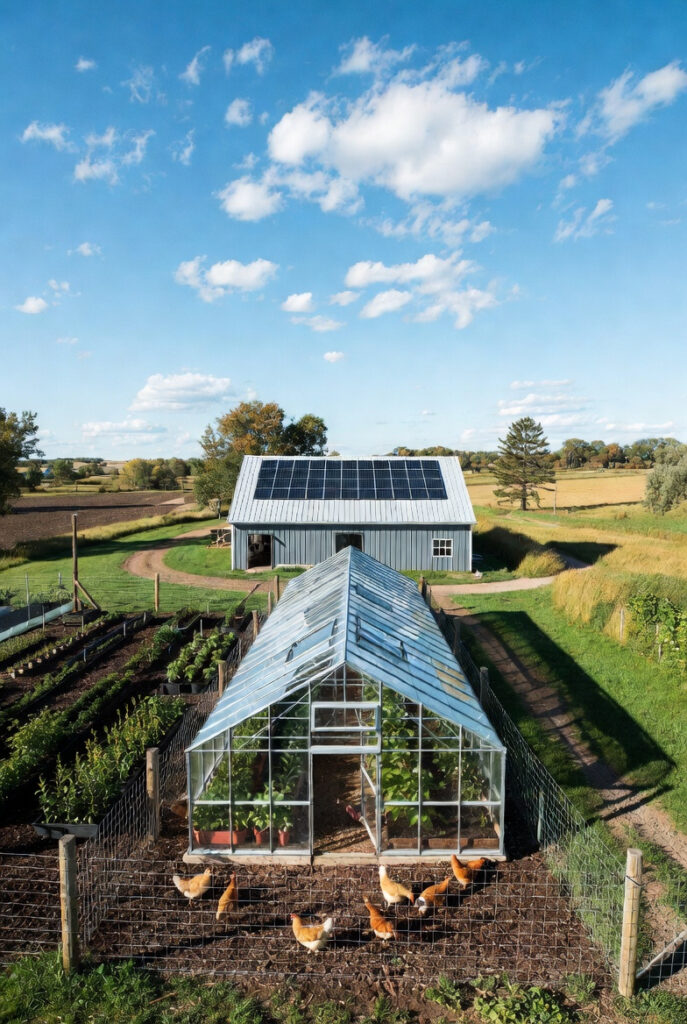
Hobby farm solar fails differently from residential solar because the consequences are biological. I got a call at 6:30 AM from a heritage breed poultry farmer near Fergus who had lost a 42-egg incubation run overnight. His solar system had hit low-voltage cutoff at 2:47 AM. The incubator had been running on the same battery bank as the water pump, the shop lights, and a chest freezer. He had run the pump the previous afternoon to top up the stock tanks before a forecast cold night, three pump cycles at approximately 1,200W each for 8 minutes per cycle consuming 480Wh from the bank in 24 minutes. The bank had been at 68% SoC before the pump ran. After three pump cycles the bank was at 53% SoC. By 2:47 AM the cumulative draw from the incubator at 45W, the chest freezer cycling through the night, and the shop light left on in the barn had depleted the bank to 20% where the low-voltage cutoff triggered. The incubator temperature dropped from 37.5°C to 34.1°C over the following 4 hours before he arrived to find the system dark. At 34.1°C for 4 hours the embryo development was irreversibly compromised. The replacement cost of a 42-egg heritage breed Dorking run including the hen setback was approximately $380. The fix was a dedicated 100Ah LFP battery and a 200W panel for the incubator circuit alone, isolated from every other farm load. Total cost: $480. He has not lost a run since. For the farm solar agrivoltaic standard that covers the full farm power architecture this incubator circuit connects to, Article 184 covers the elevated array and dual income stream standard.
Why Hobby Farm Solar Needs Critical Circuit Partitioning
The single-bank failure mode runs like this: incubator, chest freezer, pump, and shop lights all draw from one battery bank. The afternoon pump cycles deplete the bank significantly. By nightfall the cumulative draw completes the discharge, triggering low-voltage cutoff at 2:47 AM. The incubator goes cold.
The partitioned solution dedicates a 100Ah LFP battery and a 200W panel for the incubator and brooder only. The main house bank powers the pump, tools, and everything else. At 105W combined draw from the incubator and brooder lamp, the 100Ah bank at 80% DoD provides 11.4 hours of autonomous overnight operation, covering the 4 hours and 43 minutes from 2:47 AM to sunrise with 6.77 hours of reserve to spare. The Victron SmartShunt on each partitioned bank confirms the incubator circuit is drawing within design parameters and provides early warning at 30% SoC before the cutoff triggers. For the full system sizing hub that determines the main house bank capacity required to support pump and tool loads independently from the life-support circuits, the hub covers the calculation.
| Circuit | Load | Correct Battery Bank |
|---|---|---|
| Life-support | Incubator (45W), brooder lamp (60W) | Dedicated 100Ah LFP – isolated |
| Main house | Pump, tools, chest freezer, lighting | Main house bank |
| Greenhouse fans | VPD-controlled fans (variable) | Main house bank |
The Incubator Standard: Scheduling Pump Loads Away from the Biological Window
Egg incubators draw a constant low-wattage load for 21 to 28 days, making them one of the most predictable loads in a hobby farm solar system. They are also among the most sensitive to power interruption because embryo development is a continuous biological process that cannot be paused. A chicken egg requires 37.5°C plus or minus 0.5°C for 21 days. A temperature drop below 35°C for more than 2 hours during days 7 to 14 results in approximately 80% embryo mortality.
The correct approach treats the incubator as a life-support load and the pump as a scheduled load. Run all pump cycles between 10 AM and 2 PM when the array is producing at peak output and can supply the pump directly from solar without drawing from the bank. The bank never gets depleted by the pump before the 9 PM to 7 AM overnight biological window. A pump timer or smart switch on the pump circuit set to block activation outside the 10 AM to 2 PM window costs $25 and eliminates the scheduling conflict entirely. The incubator circuit draws 45W continuously for 21 days, a total of 22,680Wh over the incubation run. On a dedicated 200W panel with 4 peak sun hours per day in Ontario spring, the dedicated panel produces 800Wh per day, covering the incubator’s 1,080Wh daily draw with 80% solar offset and the 100Ah bank covering the overnight deficit.
The Greenhouse VPD Controller: Hobby Farm Solar for Automated Cooling
Hobby farm solar in a greenhouse environment burns more energy on cooling than most growers realise until they measure it. I installed a smart plug on the fan circuit at a market garden greenhouse near Elora in July to measure the actual cooling load over a week. The greenhouse had three 16-inch AC fans running on a simple thermostat set to activate above 26°C. The fans ran continuously from approximately 10 AM to 7 PM on every sunny day. Nine hours at 360W total fan draw equals 3,240Wh per day in peak summer. The battery bank was a 400Ah LFP, adequate for everything else on the property but marginal when the fan circuit consumed 3,240Wh of the array’s daily production on its own.
I replaced the simple thermostat with a VPD-based controller that modulated fan speed proportionally to the vapour pressure deficit rather than switching all three fans on and off as a block. The following week under similar temperature conditions the measured fan energy dropped to 1,980Wh per day, a 38.9% reduction for identical plant transpiration management. The battery bank stopped hitting 40% SoC by sunset.
VPD-based control saves energy because vapour pressure deficit is the evaporative demand of the air, the combined function of temperature and humidity. A VPD controller modulates fan speed to maintain target VPD rather than switching all fans on above a temperature threshold. On a hot humid morning with low VPD, fans run at 30% speed. On a hot dry afternoon with high VPD, fans run at 100%. The energy saving comes from the hours of partial-speed operation that replace full-speed operation. A simple thermostat runs fans at 100% or 0%. A VPD controller runs fans at the minimum speed required. The difference over a 9-hour hot summer day is 1,260Wh, the equivalent of two days of incubator power.
The Pump Inverter Standard: Hobby Farm Solar for High-Torque Loads
The startup surge current of a 1.5HP deep-well pump motor is 3 to 6 times the running current and lasts 0.3 to 0.8 seconds. A 1.5HP pump motor draws approximately 1,200W running and 3,600 to 7,200W on startup surge. Most residential inverters cannot sustain this surge without tripping or throttling. A standard 2,000W modified sine wave inverter with a 4,000W surge rating may handle a single clean startup but after three or four consecutive pump cycles in a hot afternoon, the inverter thermal protection reduces the available surge current and the pump fails to start on the third cycle.
The correct inverter for a hobby farm solar system running a deep-well pump is a low-frequency transformer-core unit rated 3,000W continuous with a 9,000W surge for at least 20 seconds. The Victron MultiPlus-II pure sine wave inverter-charger provides this capability, meeting the 300% surge requirement for a 1.5HP pump with substantial margin. The pump runs all three afternoon cycles without a startup failure. For the full low-frequency inverter standard that covers why transformer-core units handle motor surge loads without thermal stress, Article 173 covers the mechanism. For the pump circuit sizing standard that determines pipe diameter, pressure rating, and cycle duration for Ontario hobby farm well installations, Article 174 covers the hydraulic standard.
The Hobby Farm Solar System: Minimum Viable vs Full Cultivation Standard
The decision follows whether the goal is protecting the biological loads or automating the full farm energy chassis.
The minimum viable hobby farm solar system is the correct choice for a homesteader who wants to protect incubator and brooder from main bank depletion without changing the rest of the existing system. It includes a dedicated 200W panel, 100Ah LFP battery, MPPT charge controller, and automatic low-voltage cutoff relay isolating the incubator circuit from the main bank. Capital cost runs $480 to $800. It eliminates the biological load risk and pays for itself on the first incubation run it protects.
The full cultivation standard is the correct choice for a market garden operation with greenhouse, irrigation pump, and produce cold storage. It includes a partitioned life-support circuit for incubator and brooder, VPD-based greenhouse controller, low-frequency 3,000W inverter with 9,000W surge for pump loads, dedicated 5kW array and 20kWh LFP bank for the produce cold room, smart plug scheduling for all pump cycles within the solar production window, and Victron monitoring across all partitioned banks. Capital cost runs $8,000 to $18,000. It automates the farm’s biological rhythms and eliminates the single-point-of-failure battery bank that loses incubation runs, wilts greenhouse crops, and leaves stock tanks empty. For the solar remote monitoring standard that provides alerts when any partitioned bank approaches low SoC, Article 187 covers the full monitoring architecture.
NEC and CEC: What the Codes Say About Hobby Farm Solar
NEC 547 covers agricultural buildings and requires that all electrical installations in agricultural structures including greenhouses, barns, and pump houses be suitable for the wet, corrosive, and dust-laden environment. NEC 690 governs the PV source circuits. NEC 705 covers the interconnection of multiple power sources and applies when the hobby farm solar system includes both a main bank circuit and a partitioned incubator circuit fed by separate charge controllers from separate PV source circuits. The overcurrent protection on each partitioned circuit must be rated for the specific battery bank and charge controller it serves. A 100Ah LFP bank for the incubator circuit requires its own dedicated fuse and disconnect, not sharing the overcurrent protection of the main bank circuit.
In Ontario, hobby farm solar installations are subject to CEC Section 64 for the PV source circuits and to CEC Section 38 for the agricultural building wiring. A partitioned incubator circuit with its own panel, charge controller, and dedicated PV source requires a separate ESA permit application from the main house system if it is installed as a new addition to an existing permitted installation. Contact the local ESA district office for permit requirements. The greenhouse fan controller and automation wiring are low-voltage control circuits subject to CEC Section 16 and do not require a separate ESA permit provided the control wiring does not exceed 30V and is supplied through a listed Class 2 power supply. The deep-well pump circuit is subject to CEC Rule 28-106 which governs motor branch circuits and requires that the branch circuit be rated at 125% of the motor full-load current for continuous duty motors.
Pro Tip: Before building the incubator circuit, run the incubator on a smart plug for one full week and log the actual Wh consumed per day. In my experience the nameplate wattage on poultry incubators runs 20 to 30% lower than actual measured draw because the thermostat cycling and the turning motor add load that the nameplate does not reflect. Size the dedicated battery bank from the measured draw, not the nameplate. The difference between a nameplate-sized bank and a measured-draw-sized bank is often 20Ah, which is the difference between making it through a cloudy Ontario night and losing the run.
The Verdict
Hobby farm solar built to the cultivation standard keeps the incubator warm, the greenhouse plants breathing, and the stock tanks full regardless of what any single load does to the battery bank.
- Partition the incubator circuit from the main bank. A $480 dedicated panel and battery protects a 42-egg run worth $380 in replacement value and years of breeding program investment. The bank that powers the pump cannot be the bank that powers the incubator.
- Schedule pump cycles to the solar production window between 10 AM and 2 PM. A $25 timer on the pump circuit prevents the afternoon pump load from depleting the bank before the overnight biological window begins.
- Replace the greenhouse thermostat with a VPD-based controller. A 38.9% reduction in fan energy is not a theory. It is a measured outcome from a market garden in Wellington County in July. The VPD controller pays for itself in battery bank capacity it frees up for the rest of the farm.
In the shop, we do not use a quarter-inch drive on a lug nut. On the hobby farm, we do not run the incubator and the pump on the same bank.
Questions? Drop them below.
This post contains affiliate links. If you purchase through our links, we may earn a small commission at no extra cost to you.
About the Author
Robert Bertrand spent 20 years as a service advisor in the automotive industry (Lexus and Nissan), where precision diagnostics, wiring integrity, and documentation standards were non-negotiable. He brings that same technical discipline to GridFree Guide, where he researches, tests, and documents off-grid solar systems for Ontario conditions. Based in Rockwood, Ontario, every article is built on verified specifications, manufacturer data, and the real-world climate constraints of Canadian off-grid living.
As an Amazon Associate I earn from qualifying purchases. This site also contains affiliate links to other products and services. GridFree Guide earns a small commission at no extra cost to you.