
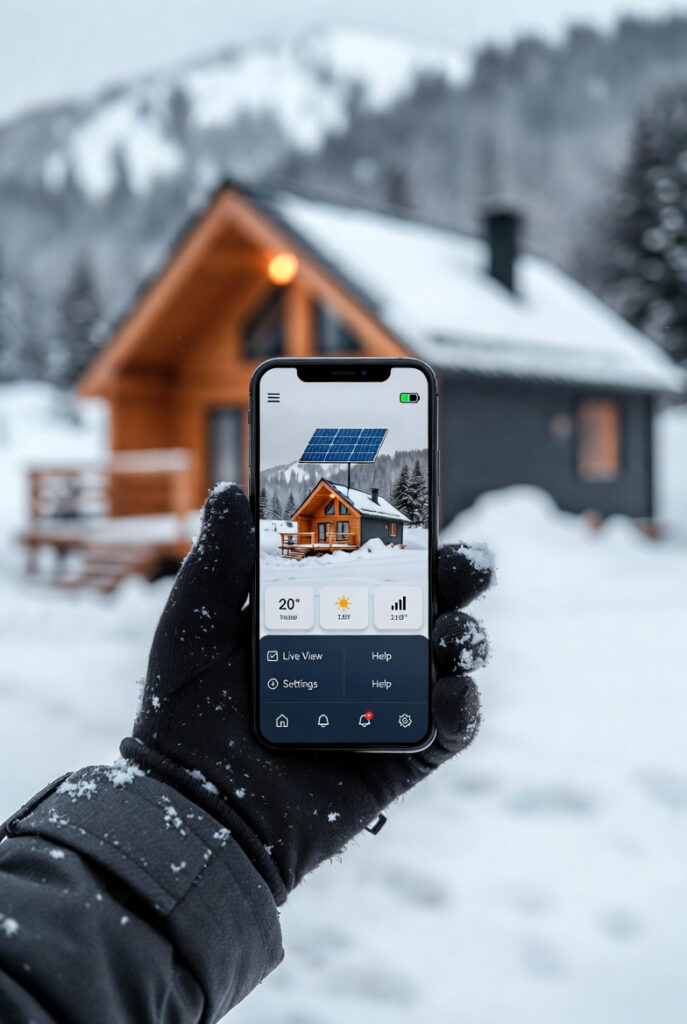
Solar remote monitoring saved a cabin owner in Muskoka from a complete system failure last February. I got a call on a Tuesday afternoon from a client who had installed a 600W system on his seasonal property north of Bracebridge the previous summer. He had not been up since Christmas. The Victron VRM portal on his phone was showing battery SoC at 14% and dropping. The portal showed that solar production had been near zero for six days, a combination of heavy snow cover on the panels and four consecutive overcast days. The cabin’s monitoring system was drawing 110W continuously: a cellular router left running full time, a 4-camera NVR recorder, and the Victron inverter in standby. At 14% SoC with a 200Ah LFP bank the system had approximately 4 hours of runtime left before the low-voltage cutoff triggered. I talked him through remotely shutting down the NVR and router via a smart plug he had installed on the monitoring circuit. The bank stabilised at 11% over the following 48 hours as the low-power Victron monitoring circuit held its own. When the sun returned on day seven the bank recovered to 80% by the end of the day. The NVR and router had been the problem. The Victron GlobalLink, drawing 0.5W, had been the solution. For the hunting camp solar system that forms the power foundation this monitoring stack sits on, Article 186 covers the outpost standard.
Why Solar Remote Monitoring Must Sip Power, Not Drain It
A monitoring system that draws too much power runs the battery bank flat before the owner arrives. A full cellular router draws 8 to 15W, an NVR recorder 15 to 25W, and a Starlink Mini 15 to 20W when active. In Ontario October with 2 to 3 peak sun hours, a 400W array produces 800 to 1,200Wh on clear days. A router plus NVR drawing 30W total consumes 720Wh per day, 60 to 90% of clear-day production. On an overcast day the monitoring system becomes the primary load. The tiered connectivity solution: the Victron GlobalLink 520 handles all telemetry at 0.5W continuously. Starlink activates for 4 hours per day for video events and security feeds. The always-on power budget drops from 30W to 2W. For the winter production calculation that determines the available solar budget for monitoring loads in Ontario November, the cold climate guide covers the derate factors.
| Device | Always-On Draw | Daily Consumption |
|---|---|---|
| Cellular router + NVR | 30 to 40W | 720 to 960Wh |
| Starlink Mini continuous | 15 to 20W | 360 to 480Wh |
| Starlink Mini on 4-hour schedule | 15 to 20W active | 60 to 80Wh |
| Victron GlobalLink 520 | 0.5W | 12Wh |
The Victron GlobalLink 520: Solar Remote Monitoring via LTE-M
The Victron GlobalLink 520 reads battery voltage, SoC, solar yield, and load data from the Victron system via VE.Direct or VE.Can and transmits to the VRM portal every 15 minutes over LTE-M. The 5-year data plan is included in the purchase price of approximately $150 to $180 CAD with zero ongoing cellular subscription cost. The Victron SmartShunt is the companion device that feeds the GlobalLink the current and SoC data it reports to VRM. Together they provide a complete battery telemetry picture: voltage, current, SoC percentage, state of health, and solar yield, all accessible on the VRM app from anywhere with cellular coverage. Setup time: approximately 30 minutes. The VRM portal provides configurable alerts for low SoC threshold, low voltage, high temperature, and generator run-time. A low SoC alert set at 20% is the check engine light that triggers the call before the system reaches 4 hours of runtime.
The Starlink Mini Sleep Protocol: Solar Remote Monitoring for Video Events
The Starlink Mini draws 15 to 20W when active. Scheduled to a 4-hour daily window it consumes 60 to 80Wh per day instead of 360 to 480Wh continuously. On a system where the solar array produces 200 to 400Wh on an Ontario November overcast day, continuous Starlink operation consumes 90 to 240% of available production. On a 4-hour schedule it consumes 15 to 40% of available production. Set the Starlink to active from noon to 4 PM daily. During those 4 hours all security camera footage from the previous 20 hours uploads to the cloud, motion alerts transmit, and remote access is available for any detailed system inspection. During the remaining 20 hours the cellular GlobalLink handles all battery telemetry at 0.5W. For the full DC-native Starlink setup standard that covers the POE bypass reducing active draw from 75W to 20W, the Starlink guide covers the full configuration.
Standalone Solar Cameras: Security That Survives a Main Power Failure
A main system power failure at a remote cabin is the highest security risk event. A camera system wired to the main bank goes dark with the main bank. A standalone solar security camera operates independently: internal 10 to 20Wh LFP battery plus a 5 to 10W panel on the camera housing, motion alerts over cellular, operating temperature to minus 20°C, no wiring to the main electrical system required. Brands including Reolink and Eufy offer standalone solar cameras at $80 to $150 per unit. Two cameras covering the driveway approach and the main entry cost $160 to $300 and draw zero watts from the cabin’s main battery bank. They continue recording regardless of what the main system is doing.
The Low-Temperature Alarm: Solar Remote Monitoring for Pipe Freeze Protection
Solar remote monitoring does its most important work in the middle of the night when nobody is watching. I set up a temperature monitoring integration for a cottage owner near Haliburton whose property had suffered a pipe burst the previous winter while he was in Guelph. The following season I installed a $40 Govee Bluetooth temperature sensor with a WiFi bridge drawing 1.5W continuous, set to send a push notification when the indoor temperature dropped below 5°C. In early January the alert fired at 2:47 AM on a Thursday. The indoor temperature had dropped to 4.1°C. The propane furnace had locked out on a fault code. He called a neighbour with a key who reset the furnace by 6 AM. The indoor temperature had recovered to 14°C by the time he checked the monitoring app at 7:30 AM. The pipe repair from the previous year had cost $4,200. The temperature sensor and WiFi bridge cost $52. The alert fired once and paid for itself approximately 80 times over.
Water begins freezing at 0°C but copper pipe joints fail from freeze expansion starting at minus 2 to minus 5°C interior temperature. A 5°C alert threshold provides a 7 to 10 degree margin before pipe failure risk begins. At 5°C the heating system has clearly failed and there is time to intervene before pipes freeze. At minus 5°C the intervention window may already be closed. Sensor options include a Govee WiFi temperature sensor at $30 to $50 drawing 1 to 2W, or a Victron temperature sensor feeding directly into the VRM alert system at zero additional draw if the GlobalLink is already installed.
The Solar Remote Monitoring System: Minimum Viable vs Full Digital Sentry
The decision follows whether the owner needs video security or is satisfied with battery telemetry and temperature alerts alone.
The minimum viable solar remote monitoring system is the correct choice for a seasonal cabin closed from December to April. It includes a Victron GlobalLink 520 drawing 0.5W for battery telemetry and one Govee WiFi temperature sensor drawing 1.5W for pipe freeze alerts. Total always-on draw: 2W, 48Wh per day. Capital cost runs $190 to $220. It provides battery SoC, solar yield, and indoor temperature with push notifications for low SoC and low temperature. No video, no motion alerts. Appropriate for owners who visit regularly and need a check engine light, not a security system.
The full digital sentry is the correct choice for a cabin left unattended for months at a time. It includes a Victron GlobalLink 520 plus Victron Cerbo GX for the full system dashboard, Starlink Mini on a 4-hour daily schedule for video and remote access, two standalone solar cameras with independent LFP batteries, and Govee temperature sensors at the cabin interior and pipe chase. Total always-on draw: 6 to 8W, 144 to 192Wh per day. Capital cost runs $800 to $1,200. Provides complete video security, full system telemetry, and multi-zone temperature monitoring. For the full system sizing hub that determines whether the existing array can support the full digital sentry draw in Ontario winter, the hub covers the calculation.
NEC and CEC: What the Codes Say About Solar Remote Monitoring
NEC 725 covers remote control, signalling, and communications circuits and applies to the low-voltage wiring used for temperature sensors, door contacts, and camera signal wiring in a solar remote monitoring installation. Class 2 circuits under NEC 725 are limited to 100VA and are subject to simplified wiring methods compared to power circuits. The cellular gateway, temperature sensors, and camera signal wiring are Class 2 circuits not subject to the full NEC 690 requirements that govern the solar power circuits. A dedicated 5A DC fused circuit from the battery bank to the monitoring equipment panel is the correct installation method.
In Ontario, the low-voltage signal wiring for temperature sensors, cameras, and cellular gateways is subject to CEC Section 16 which covers low-energy circuits. Section 16 wiring is not subject to ESA permit requirements provided the circuit voltage does not exceed 30V and the circuit is supplied from a listed Class 2 power supply or from the battery bank through a current-limited supply rated at 100VA or less. A Victron GlobalLink 520 drawing 0.5W from the 12V battery bank through a 1A inline fuse is a CEC Section 16 installation not requiring an ESA permit. The solar array and battery bank powering the monitoring system remain subject to CEC Section 64 and require an ESA permit if connected to the cabin’s fixed wiring. For the best solar generators that can supplement the cabin bank during extended overcast periods where even the minimal monitoring draw exceeds daily production, Article 162 covers the portable unit comparison.
Pro Tip: Set your VRM low SoC alert at 20%, not 10%. At 20% you have time to intervene. Shut down non-essential loads remotely, call a neighbour with a key, or check the weather forecast and decide whether to make the drive. At 10% the system has 2 to 3 hours of runtime left. At 20% you have a day. Always give yourself a day.
The Verdict
Solar remote monitoring built to the peace of mind standard means the owner knows the cabin is healthy before they leave the driveway on Friday morning.
- Install the Victron GlobalLink 520 first. At 0.5W and $180 it provides battery SoC, solar yield, and low-voltage alerts via the VRM portal. It is the check engine light the cabin has always needed. Install it before anything else.
- Add a temperature sensor at the 5°C alert threshold. A $40 to $50 WiFi sensor drawing 1.5W catches a furnace lockout before the pipes freeze. The pipe repair it prevents costs 80 times more than the sensor.
- Schedule the Starlink to 4 hours per day if video monitoring is required. Continuous satellite internet in Ontario November consumes more power than most seasonal systems can produce. Four hours of scheduled uptime provides the same security coverage at 15% of the energy cost.
In the shop, we monitor coolant temperature to save the engine. At the cabin, we monitor battery voltage and indoor temperature to save the investment.
Questions? Drop them below.
This post contains affiliate links. If you purchase through our links, we may earn a small commission at no extra cost to you.
About the Author
Robert Bertrand spent 20 years as a service advisor in the automotive industry (Lexus and Nissan), where precision diagnostics, wiring integrity, and documentation standards were non-negotiable. He brings that same technical discipline to GridFree Guide, where he researches, tests, and documents off-grid solar systems for Ontario conditions. Based in Rockwood, Ontario, every article is built on verified specifications, manufacturer data, and the real-world climate constraints of Canadian off-grid living.
As an Amazon Associate I earn from qualifying purchases. This site also contains affiliate links to other products and services. GridFree Guide earns a small commission at no extra cost to you.