
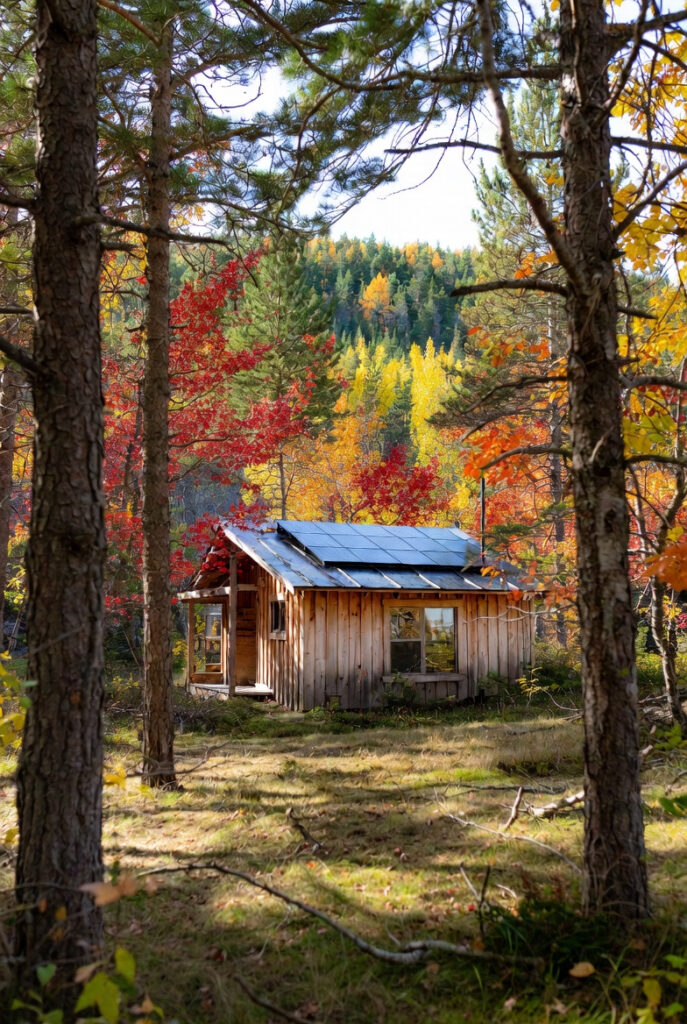
Hunting camp solar systems fail in one of two ways and both happen while the owner is at work. I drove up to a deer camp near Bancroft in November with a client who had installed a 200W all-in-one solar kit the previous spring. He had not been to the camp since September. We arrived at 9 PM after a 3.5 hour drive from Guelph. He flipped the switch. Nothing. The battery voltage read 9.8V on the controller display. The battery was a 100Ah AGM that had been sitting at partial state of charge for eight weeks in temperatures that had dropped to minus 14°C twice during October. The battery was chemically dead from combined deep discharge and cold temperature sulfation. The 200W panel had been producing power during the week but the inverter’s 2.5W standby draw had been consuming 420Wh per week with nothing to show for it. The panel was producing enough to offset the parasitic drain on sunny days and losing ground on cloudy days. By the time we arrived the bank had been cycling through partial charge and deep discharge for two months. The replacement cost was $340 for a new AGM battery and two days of waiting for delivery to the nearest town. The correct system for that application would have cost $180 more at the outset. For the full off-grid system sizing hub that covers the load calculation foundation every camp system starts from, the hub covers the numbers.
Why Hunting Camp Solar Fails on Friday Night
Hunting camp solar systems fail in one of two ways, both happening while the owner is away during the work week. The first failure mode is parasitic drain from inverter standby. A standard 1,000W modified sine wave inverter draws 2 to 4W in standby mode. At 3W continuous that is 72Wh per day, 504Wh per week. On a 100Ah 12V battery bank with 600Wh usable capacity, the inverter alone depletes the bank in 8.3 days without solar input. In Ontario November with 2 to 3 effective solar hours on cloudy days, a 200W panel cannot consistently offset this drain.
The second failure mode is lead-acid sulfation from sitting at partial state of charge in cold temperatures. Below minus 10°C a partially discharged lead-acid battery develops sulphate crystals on the plates within weeks. By November a bank that has been cycling through partial charge and deep discharge since September has lost 30 to 60% of its original capacity. The combined failure is not dramatic. It is a slow drain that the owner never sees because they are not there during the week. The Victron SmartShunt installed at the camp makes the weekly drain visible. The owner can check the SoC remotely before the Friday drive and know whether the system is healthy before leaving the driveway.
The Storage Mode Protocol: Keeping the Bank Healthy All Week
Storage mode on an MPPT controller holds the battery at 13.2 to 13.4V float charge after reaching full charge, then disconnects the inverter load via a programmable low-voltage relay when the battery falls below 12.2V. The result: the bank charges fully on the first sunny day of the week, the inverter standby is disconnected when the sun goes down, and the bank sits at near-full charge until Friday. On cloudy weeks the low-voltage cutoff prevents deep discharge that causes sulfation. The float charge current required to maintain a fully charged 100Ah lead-carbon bank against self-discharge is approximately 0.5 to 1A. A 100W panel in storage mode produces this on any day with more than 30 minutes of direct sun. For the full MPPT charge controller selection standard that covers programmable low-voltage relay outputs, the MPPT guide covers the configuration.
Battery Chemistry: Lead-Carbon vs Heated LFP for Seasonal Camps
Lead-carbon batteries are the correct chemistry for a seasonal camp that spends five days per week at partial state of charge. The carbon additive in the negative plate prevents sulphate crystallisation at partial state of charge. A lead-carbon battery can sit at 50 to 70% SoC for weeks without damage and costs 60 to 70% of equivalent LFP capacity.
Heated LFP batteries are the better choice if the camp is occupied in winter and the battery needs to charge below minus 10°C. A heated LFP battery with internal heating elements activates the heater before charging begins, allowing safe charging to minus 30°C. The decision logic: if the camp is closed by December and reopened in April, lead-carbon is the correct chemistry. If the camp is used for ice fishing, snowmobiling, or winter hunting with overnight stays below minus 10°C, heated LFP is the correct chemistry. For the full battery room temperature management standard that covers heated LFP requirements in winter camp environments, the venting guide covers the active air requirement.
| Chemistry | Best For | Cold Temperature Limit |
|---|---|---|
| Lead-Carbon | Seasonal camps closed by December | Charging stops below minus 10°C |
| Heated LFP | Year-round camps used in winter | Safe charging to minus 30°C |
Panel Angle: The 60 to 70 Degree Hunting Season Standard
Hunting camp solar in Ontario changes character in October when the sun drops to 25 to 30 degrees above the horizon at solar noon. I re-angled a 400W array at a hunting camp near Algonquin Park from the standard 35-degree summer tilt to 65 degrees in the first week of October. The change took 20 minutes with the adjustable ground mount already installed. The following two weeks of production data from the charge controller showed 18% more daily harvest compared to the same period the previous year at 35 degrees. Two factors contributed: the steeper angle brought the panel face closer to perpendicular with the low autumn sun, and the 65-degree angle shed two early snowfalls completely without requiring any manual clearing. The first year at 35 degrees the owner had driven up on a Wednesday specifically to brush snow off the panels before the hunting weekend. At 65 degrees the snow was gone before he finished his coffee on Friday morning.
At Ontario latitude in October and November the sun is 25 to 30 degrees above the horizon at solar noon. A panel tilted at 65 degrees presents a face that is 5 to 15 degrees from perpendicular to the sun compared to 30 to 40 degrees off perpendicular at 35-degree tilt. The cosine efficiency loss at 35-degree tilt in October is approximately 15 to 20% compared to 65-degree tilt. At 65 degrees a wet snow load slides off within 2 to 4 hours of accumulation. At 35 degrees wet snow adheres and can reduce output by 80 to 100% until manually cleared. For the full cold climate solar production standard that covers seasonal tilt angle optimisation for Ontario latitudes, the cold climate guide covers the full calculation.
DC-First Lighting: Hunting Camp Solar Without the Inverter Tax
A 1,000W inverter drawing 3W standby powers 12V LED lights at AC voltage through a 12V AC adapter at each fixture. Total overhead per light: 3 to 4W inverter standby plus 0.5 to 1W adapter loss per fixture. Six lights drawing 5W each through AC: 30W of light plus 18 to 24W of overhead equals 48 to 54W from the battery for 30W of light output. Six 12V DC LED puck lights drawing 5W each directly from the battery: 30W total, no overhead. On a 3-night weekend with 4 hours of lighting per evening the DC circuit draws 360Wh. The AC circuit draws 576 to 648Wh. The DC circuit saves 216 to 288Wh per weekend, equivalent to one full day of 200W panel production. Install 12V puck lights on a dedicated DC circuit from the battery bank with a 10A fuse. The cabin has instant light the moment the owner arrives, the inverter stays off until needed for a drill or a kettle, and the battery bank starts the weekend 216Wh fuller than the AC alternative. For the best solar generators for camp backup that can supplement the camp bank during extended overcast periods, Article 162 covers the portable unit comparison.
The Hunting Camp Solar System: Minimum Viable vs Full Outpost Standard
The decision follows weekend load requirements and whether the camp is used in winter.
The minimum viable hunting camp solar system is the correct choice for a 3-night weekend with lights, radio, and phone charging. It includes a 400W panel at 60-degree tilt, a 100Ah lead-carbon battery, an MPPT controller with low-voltage cutoff at 12.2V, and a 12V DC lighting circuit on a dedicated fuse with no inverter. The Renogy 100W starter kit provides the panel, controller, and wiring foundation. Add a second 100W panel and a lead-carbon battery to complete the system. Capital cost runs $800 to $1,400. Covers lights, radio, and phone charging for a 3-night weekend with a full bank on Friday regardless of weekday weather.
The full outpost standard is the correct choice for a camp with a water pump, small fridge, and weekend appliances. It includes 800W of panels at 60-degree tilt, a 200Ah lead-carbon or 100Ah heated LFP bank, an MPPT controller with storage mode and low-voltage relay, a 600W pure sine wave inverter for weekend appliances, and a 12V DC lighting circuit throughout the cabin. Capital cost runs $2,500 to $4,500. Handles the full weekend load including water pumping, small fridge, and power tools for camp maintenance. Generator on standby for extended overcast periods only.
NEC and CEC: What the Codes Say About Hunting Camp Solar
NEC 690 governs photovoltaic systems and applies to hunting camp solar installations regardless of whether the camp is a primary or secondary dwelling. A seasonal cabin with a solar installation is subject to NEC 690 for the PV source circuits and to NEC 551 if the cabin is classified as a park trailer or recreational vehicle. For a fixed cabin structure, NEC 690.12 requires rapid shutdown capability for roof-mounted arrays. NEC 551.40 covers the 12V DC systems commonly used in recreational structures and requires that DC branch circuits be protected by fuses or circuit breakers rated for DC voltage. A 12V DC lighting circuit in a hunting camp must be protected by a DC-rated fuse at the battery connection, not an AC-rated circuit breaker which may not interrupt DC arc faults reliably.
In Ontario, a seasonal cabin with a solar installation is an electrical installation subject to the CEC regardless of how many months per year it is occupied. CEC Section 64 governs the PV source circuits. An ESA electrical permit is required for any solar installation connected to the cabin’s wiring. A stand-alone solar panel charging a battery through a portable charge controller without connecting to the cabin’s fixed wiring does not require an ESA permit. The moment the solar system connects to fixed wiring in the cabin, whether for 12V DC lighting or 120V AC outlets, an ESA permit is required. Contact the local ESA district office for seasonal camp solar permit requirements in the Bancroft, Haliburton, and Algonquin region.
Pro Tip: Before you leave for camp on the first weekend of hunting season, check the battery SoC remotely if your controller has a Bluetooth app. If the bank is below 80% on a Friday morning after a sunny week, the inverter standby drain is larger than the panel is replacing. That is the diagnosis. The fix is a low-voltage cutoff relay, not a bigger panel.
The Verdict
Hunting camp solar built to the outpost standard means the lights are on before the boots are off on Friday night.
- Kill the inverter standby drain. Install a low-voltage cutoff at 12.2V on the MPPT controller and disconnect the inverter from the battery during the work week. The bank charges during the week and stays charged until Friday.
- Use lead-carbon batteries for a camp closed by December. They handle partial state of charge during the work week without sulfation damage. They cost 60 to 70% of equivalent LFP and last 5 to 8 years in this duty cycle.
- Tilt the panels at 60 to 70 degrees for the hunting season. The steeper angle recovers 15 to 20% more production in October and November and sheds snow without requiring a Wednesday drive to clear the panels.
In the shop, we do not let a car leave with a blocked radiator. At the camp, a buried panel is a blocked intake. Tilt it steep and let the weather work for you.
Questions? Drop them below.
This post contains affiliate links. If you purchase through our links, we may earn a small commission at no extra cost to you.
About the Author
Robert Bertrand spent 20 years as a service advisor in the automotive industry (Lexus and Nissan), where precision diagnostics, wiring integrity, and documentation standards were non-negotiable. He brings that same technical discipline to GridFree Guide, where he researches, tests, and documents off-grid solar systems for Ontario conditions. Based in Rockwood, Ontario, every article is built on verified specifications, manufacturer data, and the real-world climate constraints of Canadian off-grid living.
As an Amazon Associate I earn from qualifying purchases. This site also contains affiliate links to other products and services. GridFree Guide earns a small commission at no extra cost to you.