
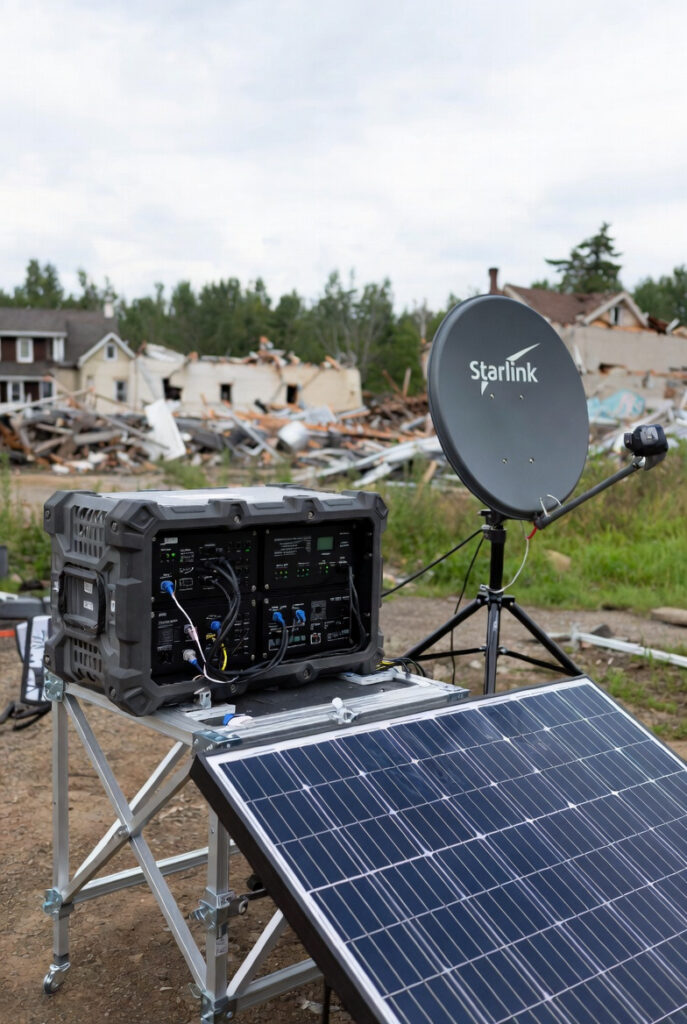
Disaster relief solar is most useful in the hour when no one thinks to set it up. I helped coordinate a neighbourhood power hub during the March 2024 ice storm near Fergus that left approximately 1,400 Hydro One customers without power for 41 hours. The street had four houses with generators. By hour 14 two of them had run out of fuel. The third was running but the noise covered the emergency radio traffic the block captain was trying to monitor. The fourth had been moved indoors for warmth and caused a carbon monoxide evacuation at 2 AM. The one house on the street with a functional solar-plus-storage system became the default community hub. It had a 5kWh LFP battery bank, a 1,200W array, and a Starlink dish. By hour 20 there were eleven people in that living room charging phones, accessing emergency information, and keeping warm. The system never tripped. It ran for the full 41 hours without generator backup. The total solar energy consumed over the event was 22kWh. The system had cost $8,500 installed. For the community microgrid architecture that scales this neighbourhood hub concept to a full community system, Article 177 covers the island mode and load priority standard.
Why Disaster Relief Solar Outlasts the Gasoline Generator
The gasoline generator failure chain in a major disaster is predictable: fuel stations lose power, roads become impassable, and jerry cans run dry in 14 to 20 hours at typical generator consumption. Health Canada data shows that carbon monoxide poisoning from portable generators kills approximately 70 Canadians per year during power outages, with the majority occurring during extended outages when generators are moved indoors for warmth or noise reduction. A disaster relief solar system with an LFP battery bank produces zero CO and operates silently. The silence benefit is not secondary in an emergency, the ability to monitor radio traffic, hear calls for help, and communicate with neighbours without generator noise is operationally significant. A 5kWh LFP bank at 80% DoD provides 4kWh of usable storage. At a community hub baseload of 200W for communications, lighting, and phone charging, that is 20 hours of autonomy with no solar input. For the residential Fortress sizing hub that determines the base system capacity before disaster deployment additions, the hub covers the load calculation foundation.
| Power Source | Fuel Dependency | CO Risk | Noise Level |
|---|---|---|---|
| Gasoline generator | Runs dry in 14 to 20 hours | High – kills 70 Canadians per year | 65 to 75 decibels |
| Disaster relief solar + LFP | Zero fuel required | Zero CO | 35 to 45 decibels |
| Solar plus generator on standby | Generator for surge loads only | Minimal — generator runs outdoors only | Near-silent for 90% of operation |
The Flyaway Kit: Rapid-Deployment Disaster Relief Solar for a 10-Person Hub
A minimum viable flyaway kit contains 400W of foldable or peel-and-stick panels that deploy in under 10 minutes, a 1 to 2kWh LFP portable power station with multiple AC and USB-C outputs, a Starlink Mini drawing 20 to 40W for community internet access, a 12V LED light string for the hub space, and a USB charging station for 10 to 15 phones simultaneously. Total packed weight under 25kg. Fits in two duffel bags. The Jackery HomePower 3000 provides 3,072Wh of LFP storage in a portable unit with multiple AC outlets and USB-C ports. At 200W hub baseload it provides 15 hours of autonomy. With 400W of foldable panels producing 6 to 8 hours of daylight charging, the kit runs indefinitely in Ontario spring and summer conditions. For the DC-native Starlink power standard that minimises the draw on the kit battery bank, the Starlink guide covers the POE bypass that reduces draw from 75W to under 40W.
LFP Safety: Why Disaster Relief Solar Must Use LFP Chemistry
NMC and NCA lithium chemistries can enter a self-sustaining exothermic reaction if punctured, overcharged, or severely discharged. In a disaster environment with physical impact, fire exposure, and non-technical users, this is not a theoretical risk. LFP chemistry requires temperatures above 270°C to initiate thermal runaway and does not propagate the reaction under normal abuse conditions. An LFP battery dropped from a truck bed, knocked over during evacuation, or operated by someone who has never used a solar system before does not become a fire hazard. Every disaster relief solar kit deployed in a public or multi-user environment must use LFP chemistry. No exceptions. For the cold climate solar production standard that determines how much charging the kit array produces during an Ontario winter emergency, the cold climate guide covers the derate factors.
The Thermal Battery: Protecting the Medical Fridge Overnight
The thermal battery trick sounds like improvisation but it is applied physics. I demonstrated it at a rural emergency preparedness workshop in Wellington County last autumn. I brought a standard bar fridge loaded to 60% capacity with vaccine-temperature water bottles, 1.5 litres each, six bottles, 9 litres total. The fridge was pre-cooled to 4°C and then the power was disconnected. With the thermal mass of the water bottles inside, the fridge temperature held below 8°C for 7 hours and 20 minutes before reaching the upper limit. The same fridge without the thermal mass held below 8°C for only 2 hours and 40 minutes before the temperature climbed. The difference was 4 hours and 40 minutes of additional cold chain protection at zero electrical cost. Nine litres of frozen water bottles replaced the equivalent of approximately 80Wh of battery capacity in cold chain protection. In a disaster scenario where the solar array is cloud-covered and the battery is conserved for communications, those 4 hours and 40 minutes can be the margin between saving and losing a medication supply. For the full solar power for medical clinics cold chain standard that covers WHO-qualified SDD refrigerators for permanent installations, Article 178 covers the life-support architecture.
The Disaster Relief Solar Kit: Minimum Viable vs Full Recovery Hub
The decision follows the number of people being served and whether medical equipment is in the load.
The minimum viable kit is the correct choice for a 10 to 15 person communications and charging hub for 24 to 48 hours. It includes a 400W foldable panel array, a 1 to 2kWh LFP portable power station, a Starlink Mini, LED lighting, and a USB charging station. Capital cost runs $1,200 to $2,000. It fits in two duffel bags, deploys in under 15 minutes, and covers communications and phone charging only. No medical equipment, no space heating, no water pumping.
The full recovery hub is the correct choice for a 20-person community hub sustaining communications, medical equipment, and water pumping for 5 to 7 days. It includes a 2 to 5kW foldable or rapid-mount panel array, a 10 to 20kWh LFP battery bank, a pure sine wave inverter for medical equipment, a dedicated Starlink Mini circuit, thermal mass fridge protection, and a pressurised water circuit for hand washing. The EcoFlow DELTA Pro 3 provides 4,096Wh expandable to 48kWh as the battery backbone. Capital cost runs $4,000 to $12,000. It handles all three survival pillars simultaneously and reserves the generator for medical equipment surge loads and extended solar blackout recharge only.
NEC and CEC: What the Codes Say About Disaster Relief Solar
NEC 706 covers energy storage systems and applies to LFP battery banks deployed in emergency response applications. NEC 706.20 requires that energy storage systems be listed for the purpose and installed with appropriate disconnecting means and overcurrent protection. For a portable disaster relief solar kit operating as a temporary installation, NEC 590 covers temporary wiring and requires that all temporary electrical connections be made with listed equipment suitable for the environment. A portable LFP power station with factory-installed outlets and charging inputs does not require a permit for temporary disaster relief deployment. Field-wired temporary connections from a solar array to a portable power station must use listed connectors rated for the current and voltage of the array.
In Ontario, temporary electrical installations for emergency relief purposes are subject to CEC Section 76 for temporary wiring. Emergency management organisations deploying disaster relief solar systems under the Emergency Management and Civil Protection Act are exempt from standard ESA permit requirements for temporary installations deployed at the direction of the provincial or municipal Emergency Management Coordinator. For a homeowner deploying a personal disaster relief solar kit on their own property, the installation is a temporary connection not subject to ESA permit requirements provided it uses listed equipment and does not connect to the building’s permanent wiring. Any permanent integration of a disaster relief solar system into the home’s electrical panel requires an ESA permit under CEC Section 64.
Pro Tip: Before a storm season, run a full discharge test on your disaster relief solar kit. Deplete the battery to 20% SoC on a cloudy day and time how long the kit powers your hub baseload. That number is your real autonomy figure, not the nameplate capacity. Every kit should be tested before it is needed, not after.
The Verdict
Disaster relief solar built to the recovery standard keeps the three survival pillars live when the grid and the fuel supply chain both fail at the same time.
- Deploy the minimum viable kit first. A 400W foldable panel, a 2kWh LFP station, and a Starlink Mini fit in two duffel bags and keep a 15-person hub on communications for 48 hours. That kit pays for itself the first time it gets used.
- Fill the medical fridge with water bottles before the storm hits. Nine litres of thermal mass adds 4 hours and 40 minutes of cold chain protection at zero battery cost. Physics is free.
- Reserve the generator for medical equipment surge loads only. Every hour the generator runs for lights and phone charging is an hour of fuel consumed on a task the solar battery handles for free.
In the shop, we ensure the ambulance has 100% uptime. In the neighbourhood, the disaster relief solar hub is the ambulance.
Questions? Drop them below.
This post contains affiliate links. If you purchase through our links, we may earn a small commission at no extra cost to you.
About the Author
Robert Bertrand spent 20 years as a service advisor in the automotive industry (Lexus and Nissan), where precision diagnostics, wiring integrity, and documentation standards were non-negotiable. He brings that same technical discipline to GridFree Guide, where he researches, tests, and documents off-grid solar systems for Ontario conditions. Based in Rockwood, Ontario, every article is built on verified specifications, manufacturer data, and the real-world climate constraints of Canadian off-grid living.
As an Amazon Associate I earn from qualifying purchases. This site also contains affiliate links to other products and services. GridFree Guide earns a small commission at no extra cost to you.