
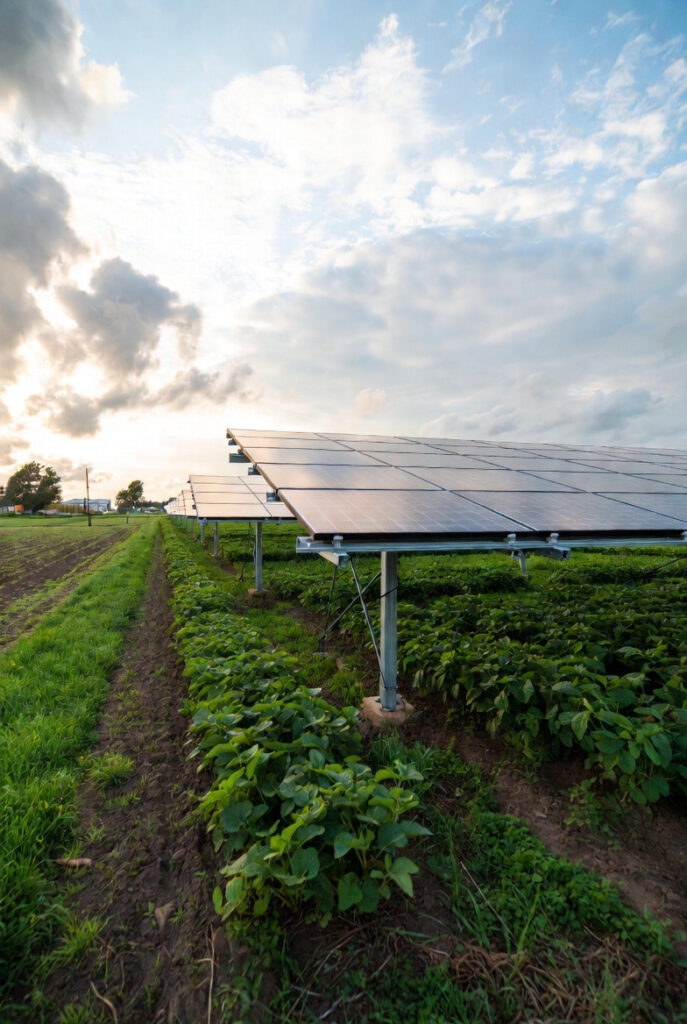
Farm solar power changed the conversation for me when a grain farmer near Fergus asked the right question. He had been approached by a solar developer who wanted to lease 40 acres of his best Class 1 farmland for a ground-mounted solar farm at $1,200 per acre per year. He was tempted by the $48,000 annual income but troubled by the idea of permanently removing 40 acres from production. His yield on that ground was approximately 180 bushels of corn per acre at $6.50 per bushel, which is $1,170 per acre in gross revenue before input costs. The developer’s lease offer was essentially replacing his crop income dollar for dollar while permanently degrading the land’s agricultural capability. I walked him through the agrivoltaic alternative: elevated panels at 3.5 metres mounted on galvanised posts with 6-metre inter-row spacing allow a standard tractor with a 5-metre header to pass through without modification. The same 40 acres under an agrivoltaic array produces solar power from the panels above and continues producing corn, hay, or shade-tolerant crops below. He did not have to choose between farming and solar. He could do both on the same ground. For the solar well pump system that handles irrigation in an agrivoltaic installation, Article 174 covers the hydraulic standard.
Why Farm Solar Power Does Not Have to Choose Between Crops and Kilowatts
Traditional ground-mount arrays at 0.5 to 1 metre mounting height block tractor access, kill the grass below, and require permanent removal of the land from agricultural production. Elevated agrivoltaic arrays at 3 to 4 metres on galvanised structural posts with 6-metre inter-row spacing allow standard agricultural equipment to operate below the panels without modification. Partial shade from elevated panels reduces midday soil surface temperature by 4 to 8°C and reduces evapotranspiration by 14 to 29% in hot dry summer conditions. In Ontario’s increasingly dry July and August periods, this reduces irrigation demand for crops planted in the inter-row zones. Shade-tolerant crops including leafy greens, strawberries, and brassicas show yield parity or improvement under agrivoltaic shade. Shade-intolerant crops like corn and soybeans are better suited to the inter-row open zones where they receive full sun. For the winter solar production calculation that determines how much energy the agrivoltaic array produces during Ontario’s barn heating and livestock watering season, the cold climate guide covers the derate factors
| Land Use Approach | Agricultural Output | Solar Output |
|---|---|---|
| Traditional ground-mount array | 0 acres in production (land removed) | 25kW per acre |
| Agrivoltaic elevated array | 40 acres of crops continue below | 25kW per acre above |
The Agrivoltaic Array: Mounting Geometry for a Working Farm
The critical dimensions for tractor clearance: panel bottom edge at minimum 3.5 metres above grade allows a standard combine header with 5-metre working width to pass through 6-metre inter-row spacing without modification. Panel tilt angle of 15 to 20 degrees from horizontal provides optimal winter albedo capture and self-cleaning rain runoff while minimising shade casting on the inter-row crop zone. Post spacing of 6 metres longitudinal with galvanised steel H-frame supports rated for 1.5kPa ground snow load and 0.48kPa wind pressure per Ontario Building Code zone 2. The bifacial advantage in an agrivoltaic installation: at 3.5 metre mounting height above snow-covered ground, bifacial panels capture 15 to 25% additional winter production from ground albedo reflection. For the full bifacial albedo calculation standard that quantifies the winter production boost, Article 181 covers the measurement methodology.
Solar Fence Energizers: Farm Solar Power for Perimeter Security
A buried cable run from the farmhouse panel to a remote energizer on a 200-acre farm can exceed 2 kilometres at $8 to $15 per metre installed, totalling $16,000 to $30,000 in wiring alone. A solar-powered IoT fence energizer costs $150 to $400, installs in 30 minutes, and sends a push notification when fence voltage drops below the configured threshold. The Renogy 100W starter kit powers a remote fence energizer and a trail camera on a single dedicated circuit with no grid connection required. Voltage alert arrives within 60 seconds of a fence breach — before the livestock have time to travel far from the breach point. On a 200-acre operation with 4 remote energizer locations, solar-powered IoT energizers eliminate $64,000 to $120,000 in buried cable infrastructure.
Panel Soiling: The Bio-Film Problem in Livestock Environments
Farm solar power in a livestock environment has a soiling problem that residential installers consistently underestimate. I inspected a 24-panel system on a beef cattle operation near Elora fourteen months after installation. The panels had never been cleaned. The production log from the Victron monitoring system showed a 23% decline in output over the fourteen months compared to the first three months of operation. The panels were coated in a combination of dried manure aerosol, hay dust, and fine soil, a bio-film approximately 1 to 2mm thick on the lower third of each panel. The bio-film was not uniform. It was heaviest on the panels closest to the barn and lightest on the panels furthest from the livestock pen. I cleaned one panel with a pressurised water rinse and measured its output against an adjacent uncleaned panel. The cleaned panel produced 31% more power in the hour following cleaning. The output difference between a clean panel and a bio-film-coated panel on that farm was not 5 or 10%. It was 31%.
The Victron SmartShunt production log is what caught the 23% decline without monitoring the soiling loss is invisible until the power system fails during a cold snap. Annual cleaning schedule: minimum twice per year, spring and fall, with spot cleaning after any period of prolonged dry wind from the direction of the barn. Hydrophobic nano-coating applied to the panel surface at installation reduces bio-film adhesion by approximately 60% and extends the effective cleaning interval from twice per year to once per year. Cost of coating for a 24-panel system: $200 to $400. For the panel maintenance and end-of-life standard that covers cleaning protocols in agricultural environments, Article 176 covers the full circular standard.
The Farm Solar Power System: Minimum Viable vs Full Agrivoltaic Standard
The decision follows whether the goal is energy independence for critical loads or a dual income stream from the same land.
The minimum viable farm solar power system is the correct choice for a producer who wants to eliminate grid dependency for critical agricultural loads. It includes a 5kW array on the existing barn roof or ground mount, 20kWh LiFePO4 bank, single inverter-charger, solar-powered fence energizers at perimeter locations, and livestock waterer circuits on DC power. Capital cost runs $18,000 to $28,000. It covers barn lighting, fence energizers, livestock waterers, and communications without requiring any agrivoltaic geometry. The existing barn roof provides the mounting surface. Payback from eliminated grid power and diesel generator fuel: 6 to 10 years.
The full agrivoltaic standard is the correct choice for a producer who wants a dual income stream from the same land. It includes elevated panels at 3.5 metres over 2 to 5 acres on a galvanised H-frame structure, bifacial panels with 6-metre inter-row spacing for full tractor clearance, a 15 to 30kW array feeding the full farm load with grid-tie or battery storage option, hydrophobic panel coating, pressurised rinse line, and IoT fence energizers at all perimeter locations. Capital cost runs $120,000 to $250,000. Engineering design and municipal permit required. Payback from combined fuel displacement and crop continuation: 8 to 14 years depending on crop type and solar incentive programs available. For the full system sizing hub that covers the load calculation foundation, the hub covers the numbers.
NEC and CEC: What the Codes Say About Farm Solar Power
NEC 690 governs photovoltaic systems and applies to farm solar power installations regardless of whether they are grid-tied or off-grid. NEC 690.12 requires rapid shutdown capability for roof-mounted arrays on agricultural buildings where firefighter access may be required. NEC 547 covers agricultural buildings and requires that all electrical installations in agricultural buildings be suitable for the wet, corrosive, and dust-laden environment typically found in barns and livestock facilities. Wiring methods in agricultural buildings must be rated for the environment — standard NM cable is not permitted in wet or corrosive agricultural locations. The solar array wiring from the roof or agrivoltaic structure to the inverter and battery bank must use wiring methods rated for outdoor and agricultural use per NEC 547 and NEC 690.
In Ontario, farm solar power installations are subject to CEC Section 64 for the PV source circuits and to the Ontario Building Code for any structural components including agrivoltaic mounting structures. An agrivoltaic array on a structural steel frame is a farm building structure subject to building permit requirements in most Ontario municipalities. Contact the local township or county building department for agricultural solar structure permit requirements before installation. Grid-tied farm solar installations require a net metering agreement with the local distribution company under the Ontario Net Metering regulation. Off-grid farm installations require an ESA electrical permit. CEC Section 38 covers wiring in agricultural buildings and requires that all wiring in livestock facilities be protected from mechanical damage and from the corrosive atmosphere created by manure and urine vapours. Use wet-rated conduit and fittings rated for agricultural environments throughout the barn wiring runs.
Pro Tip: Before installing any farm solar power system in a livestock environment, walk the prevailing wind direction from the barn to the array location. If the array is downwind of the manure yard or the feedlot, bio-film soiling will be severe. Reposition the array upwind of the livestock area if the site allows it. A 50-metre repositioning can reduce soiling rate by 40 to 60% and extend your cleaning interval from twice per year to once per year.
The Verdict
Farm solar power done correctly is not a land use decision. It is a land multiplication decision.
- Size the minimum viable system for critical agricultural loads first. Barn lighting, fence energizers, and livestock waterers draw 2 to 4kW. A 5kW array and 20kWh bank covers these loads at zero grid cost and zero fuel cost. That is the foundation every farm system starts with.
- If the goal is a dual income stream, specify elevated agrivoltaic geometry from the start. Retrofitting tractor clearance into a low-mount array costs more than designing for clearance at the beginning. Get the H-frame posts in the ground at 3.5 metres and 6-metre inter-row spacing before the panels go up.
- Budget for panel cleaning and coat the panels at installation. A 31% output loss from bio-film in a livestock environment is not a theoretical risk. It is a fourteen-month outcome on an unmonitored farm in Wellington County.
In the shop, we do not let grease cake up on the radiator. On the farm, a dirty panel is a clogged intake. Clean it before it costs you.
Questions? Drop them below.
This post contains affiliate links. If you purchase through our links, we may earn a small commission at no extra cost to you.
About the Author
Robert Bertrand spent 20 years as a service advisor in the automotive industry (Lexus and Nissan), where precision diagnostics, wiring integrity, and documentation standards were non-negotiable. He brings that same technical discipline to GridFree Guide, where he researches, tests, and documents off-grid solar systems for Ontario conditions. Based in Rockwood, Ontario, every article is built on verified specifications, manufacturer data, and the real-world climate constraints of Canadian off-grid living.
As an Amazon Associate I earn from qualifying purchases. This site also contains affiliate links to other products and services. GridFree Guide earns a small commission at no extra cost to you.