
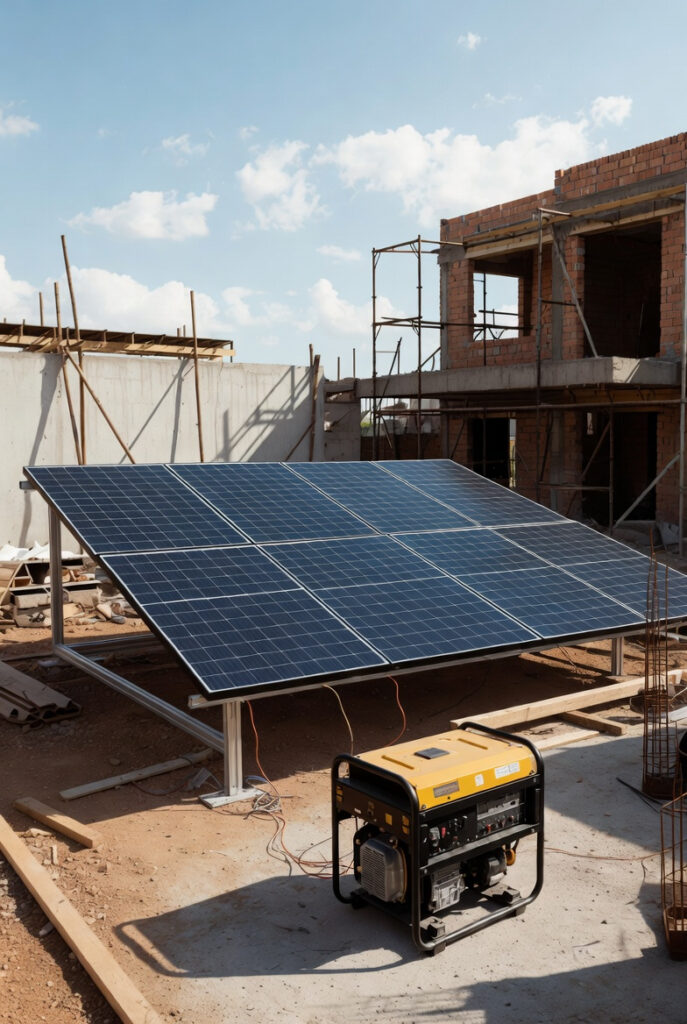
Construction site solar saves money that most site managers do not realise they are wasting. I walked a construction site in Guelph in February where a 20kW Kohler diesel generator had been running continuously for eleven days. The site had been shut down for the weekend but the generator stayed on to power two Hikvision security cameras, a Starlink dish, and the site office LED lighting. Total overnight load: approximately 400W. The 20kW generator was running at 2% of its rated capacity for 60 consecutive hours over the weekend. At 2% load the combustion chamber never reaches operating temperature. The exhaust manifold was coated in black carbon deposits visible from three metres away. The generator’s fuel consumption log showed 8.2 litres per hour at that load, well above the rated 2.1 litres per hour at 10% load because wet stacking increases fuel consumption as unburnt fuel washes the cylinder walls. Over the eleven-day site closure the generator had burned approximately 5,330 litres of diesel at $1.89 per litre, totalling $10,074 just to keep two cameras and a Starlink running. A 3kW solar skid with a 15kWh LiFePO4 bank would have powered that load for the entire closure period at zero fuel cost after the initial capital investment of approximately $8,000. For the remote mining skid architecture that this construction skid design is derived from, Article 181 covers the full expedition standard.
Why Construction Site Solar Outlasts the Diesel Tower
Generators sized for peak tool loads spend 70 to 80% of their operating time at 5 to 15% of rated capacity during non-working hours. The fuel consumption at low load exceeds the fuel consumption at moderate load because wet stacking reduces combustion efficiency. The hybrid logic that fixes this runs solar and battery on the 400W overnight baseload at zero fuel cost. The generator starts at 7 AM when tools begin operating and runs at 60 to 80% of rated capacity for 6 to 8 hours during the working day. Generator off at shift end. Total daily fuel consumption drops from 24 hours at 8 litres per hour to 8 hours at 6 litres per hour. Fuel saving: 144 litres per day at $1.89 per litre equals $272 per day, $1,904 per week, $8,256 per month on a typical Ontario construction project.
| Generator Mode | Daily Fuel Use | Daily Fuel Cost |
|---|---|---|
| 24/7 at low load (current) | 192 litres | $363 |
| Hybrid solar – working hours only | 48 litres | $91 |
| Daily saving with construction site solar | 144 litres | $272 |
The Hybrid Solar-Diesel Logic: Snap Loads vs Sustained Loads
A circular saw draws 1,800W for 30 to 90 seconds per cut. A nail gun compressor draws 1,500W for 20 seconds to refill the tank. An impact wrench draws 800W for 10 seconds. A 10kWh LiFePO4 bank absorbs these snap loads from stored energy and recharges between uses. The generator does not need to run for snap loads. Sustained loads that justify generator operation are different in character: a concrete mixer drawing 3kW continuously for 20 minutes, a large air compressor running 45 minutes to pressure a pneumatic line, or a welder running hot for an extended joint. The operating logic that makes construction site solar work is not complicated. Solar and battery carry lighting, communications, and snap loads continuously. The generator starts for sustained loads above 5kW and for bank recharge during extended cloudy periods. For the low-frequency inverter standard that handles construction tool surge loads without thermal stress, the workshop solar guide covers the mechanism.
Skid vs Trailer: The Construction Site Solar Deployment Decision
A skid has no wheels to steal and no tires to go flat. It sits on forklift pockets and can be repositioned daily by the site’s existing equipment without any electrician involvement. A trailer is road-towable between sites, faster to deploy initially, and lower capital cost. The decision logic follows site duration. For a site running longer than four weeks in a fixed location, the skid is the correct choice. The site progresses from excavation to framing to finishing, and the skid moves to within 15 metres of the active work area each morning. No electrician. No permit. The power follows the work. For a company running multiple one to two-week projects across different locations, a trailer-mounted system provides the flexibility to move between sites without crane equipment. For the Starlink DC-native setup that keeps the site communications running from the skid battery bank overnight, the Starlink guide covers the POE bypass that eliminates inverter overhead from the communications circuit.
NEMA 4X and Dust: The Construction Site Solar Enclosure Standard
Concrete dust contains calcium oxide which attacks copper PCB traces through alkaline chemical corrosion. Drywall dust contains calcium sulphate which absorbs moisture and becomes conductive on circuit boards. Both destroy inverters within 60 to 90 days in an unprotected enclosure. NEMA 4X enclosures prevent both failure modes. The filter maintenance interval on a construction site is weekly, not monthly. Concrete dust loading is 10 to 20 times higher than a woodworking shop. A clogged filter creates positive pressure failure and forces dust through enclosure seams. The Victron MultiPlus-II inverter-charger requires NEMA 4X protection in the construction environment. The Victron SmartShunt logs generator run hours and confirms the hybrid logic is performing correctly if the generator is running more than 10 hours per day, the solar production is not meeting the baseload and the array needs to be larger. For the battery room venting standard that governs filter maintenance intervals and active ventilation requirements, the venting guide covers the full specification.
The Noise Bylaw Dividend: Construction Site Solar After Dark
A developer on a townhouse project in Milton called me after receiving a formal noise complaint and a stop-work order from the City of Milton bylaw enforcement at 11:30 PM on a Tuesday. The site’s diesel generator had been running to power security lighting and a cellular booster. The generator was producing 72 decibels at the property line, above the Milton residential noise bylaw limit of 50 decibels between 11 PM and 7 AM. The stop-work order came with a $500 fine and a requirement to cease generator operation during restricted hours. The project manager’s solution was to disconnect the generator at 11 PM and leave the site dark, which triggered three separate security incidents over the following two weeks. The solar skid solution was a 4kW array on the site office container with a 20kWh LiFePO4 bank. The security system, Starlink, and LED perimeter lighting ran silently from 11 PM to 7 AM every night. Zero noise bylaw violations since commissioning. Zero security incidents in the four months since the skid was installed.
Most Ontario municipalities including Guelph, Milton, Halton Hills, and Wellington County townships enforce residential noise limits of 45 to 55 decibels between 11 PM and 7 AM. A diesel generator produces 65 to 80 decibels at 7 metres. A solar-plus-storage system operating overnight produces 35 to 45 decibels from cooling fans at the enclosure, below all Ontario residential limits. The site stays live, legal, and monitored without a single bylaw violation.
The Construction Site Solar System: Minimum Viable vs Full Site Standard
The decision follows site duration, load profile, and whether the generator is being retired or supplemented.
The minimum viable construction site solar system is the correct choice for a project under 8 weeks with a security and communications overnight load only. It includes a 3kW array, 15kWh LiFePO4 bank on a skid with NEMA 4X enclosure, and a single charge controller. The generator still handles all tool loads during the day. Capital cost runs $8,000 to $12,000. Fuel saving of $80 to $120 per day from eliminating overnight generator run time produces a payback on a 3-month project of 67 to 100 days.
The full site standard is the correct choice for a project over 3 months where the generator is being reduced to 2 to 4 hours per day of sustained heavy load operation only. It includes a 10kW array, 30kWh LiFePO4 bank, Victron MultiPlus-II hybrid inverter-charger with generator auto-start at 30% battery SoC, NEMA 4X vibration-damped enclosures, skid with forklift pockets and crane points, and Starlink and security on a dedicated DC circuit. Capital cost runs $25,000 to $45,000. Fuel saving of $272 per day produces a payback on a 6-month project of 92 to 165 days. For the full system sizing hub that covers the load calculation foundation this architecture scales from, the hub covers the numbers.
NEC and CEC: What the Codes Say About Construction Site Solar
NEC 590 covers temporary installations including construction site electrical power and requires that temporary power systems on construction sites be protected by GFCI devices and that all temporary wiring be suitable for the environment. NEC 590.6 requires GFCI protection for all 125V 15A and 20A receptacles on construction sites. A solar-powered temporary distribution panel on a construction site is subject to NEC 590 requirements regardless of whether it is connected to the utility grid or powered by a solar-plus-storage system. NEC 690 governs the PV source circuits. The temporary nature of the installation does not exempt it from NEC 690 requirements for overcurrent protection and disconnecting means on the solar array.
In Ontario, temporary electrical installations on construction sites are governed by CEC Section 76 which covers construction site wiring. CEC Rule 76-100 requires that construction site wiring be protected against physical damage and that all temporary receptacles be GFCI protected. A solar-plus-storage skid providing power to a construction site is a temporary electrical installation subject to CEC Section 76 and requires an electrical permit from the ESA. The permit covers the temporary power distribution from the skid to the site loads. The skid’s internal PV source circuits are subject to CEC Section 64. Contact the local ESA district office for construction site temporary power permit requirements in Wellington County and Halton Region.
Pro Tip: Before you spec the solar skid size, pull the generator’s fuel log for the last 30 days and separate the working-hours consumption from the overnight and weekend consumption. On most Ontario construction sites the overnight and weekend fuel accounts for 40 to 60% of total consumption. That is your solar opportunity. The skid pays for itself in the overnight fuel it eliminates.
The Verdict
Construction site solar built to the heavy-duty standard eliminates the overnight generator run that wastes $272 per day in fuel and produces zero value after shift end.
- Size the solar skid for the overnight baseload first. Security cameras, Starlink, and LED perimeter lighting draw 300 to 500W. A 3kW array and 15kWh bank covers this at zero fuel cost. That is the minimum viable starting point.
- Add hybrid controller logic for sites running longer than 8 weeks. The generator runs 6 to 8 hours per day at 60 to 80% load instead of 24 hours at 2 to 5% load. Fuel consumption drops by 75%. The engine runs clean.
- Specify NEMA 4X enclosures with weekly filter maintenance. Concrete dust in an unprotected inverter is a 60-day countdown to replacement. The filter maintenance takes 10 minutes per week.
In the shop, we do not leave the hood open during a sandstorm. On the site, the NEMA 4X enclosure is the hood.
Questions? Drop them below.
This post contains affiliate links. If you purchase through our links, we may earn a small commission at no extra cost to you.
About the Author
Robert Bertrand spent 20 years as a service advisor in the automotive industry (Lexus and Nissan), where precision diagnostics, wiring integrity, and documentation standards were non-negotiable. He brings that same technical discipline to GridFree Guide, where he researches, tests, and documents off-grid solar systems for Ontario conditions. Based in Rockwood, Ontario, every article is built on verified specifications, manufacturer data, and the real-world climate constraints of Canadian off-grid living.
As an Amazon Associate I earn from qualifying purchases. This site also contains affiliate links to other products and services. GridFree Guide earns a small commission at no extra cost to you.