
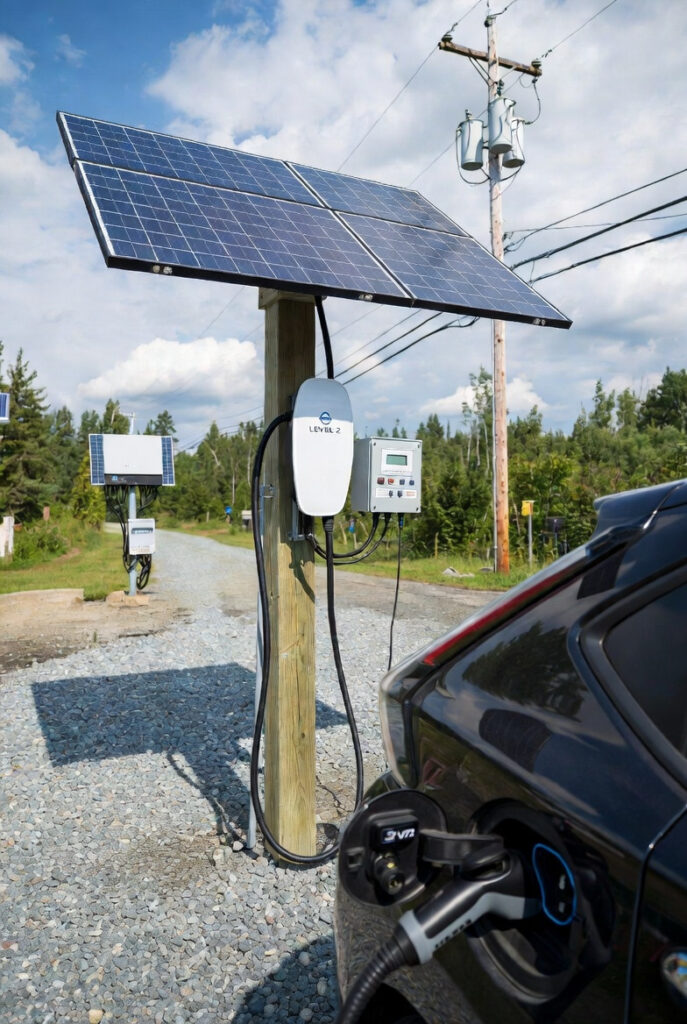
Off-grid EV charging done wrong is a slow thermal failure that announces itself at 2 AM. A client north of Guelph installed a 32A Level 2 charger on a 40A breaker fed from a 3,000W inverter. He charged the car every night from 10 PM to 6 AM, eight hours at 32A and 240V, which is 7,680W continuous. The inverter was rated for 3,000W continuous and 6,000W surge. It was running at 256% of its continuous rating for eight hours every night. After six weeks the inverter’s thermal protection began tripping at 4 AM. After nine weeks the 40A breaker showed visible heat discolouration on the neutral bar connection. The car was getting 40 to 60km of range per charge cycle instead of the expected 80km because the inverter was throttling to protect itself. The fix was a 6,000W low-frequency inverter, a dedicated 50A breaker on 6AWG wire, and a solar diversion controller that matched the charge rate to real-time solar production rather than drawing the full 32A from the battery overnight. For the cold climate solar production context that determines how much surplus is available for EV charging in Ontario winter, the cold climate guide covers the derate factors.
Why Off-Grid EV Charging Requires a Solar Diversion Controller, Not an Overnight Draw
The overnight draw failure mode is clear: every amp used to charge the car overnight comes from the battery bank. At 32A and 240V for 8 hours that is 61.44kWh drawn from the bank, three times the daily Fortress baseload. The bank cycles an extra 20kWh per night, reducing its service life by 25 to 35%. A solar diversion controller operates differently. It monitors the real-time balance between solar production and house load, diverting surplus to the EV at whatever current the surplus supports, from 6A minimum up to the charger’s maximum ceiling. On a day with 8kWh surplus the car receives 8kWh at zero battery cost. On a cloudy day the car does not charge. The battery bank is never cycled to fuel the car.
The continuous load derating rule under NEC 210.19(A)(1) requires that a circuit supplying a continuous load have an ampacity of at least 125% of the continuous load current. A 32A Level 2 charger is a continuous load, not an intermittent one. It requires a minimum 40A circuit and 8AWG wire. Never run a Level 2 charger on a circuit sized to the charger’s nominal current. The Victron SmartShunt installed on the inverter output confirms the charging circuit is operating within the inverter’s continuous rating and logs any thermal derating events that indicate the system is undersized.
The 80% Rule: Circuit Sizing for Off-Grid EV Charging
NEC 210.19(A)(1) requires that conductors supplying continuous loads be sized at 125% of the continuous load current. For a 32A charger the branch circuit conductor must be rated at 40A minimum, requiring 8AWG copper in a residential installation. The inverter sizing rule follows the same logic: the inverter continuous rating must exceed 125% of the charger’s maximum draw. A 32A at 240V charger draws 7,680W continuous, so the inverter must be rated for at least 9,600W continuous. A 3,000W inverter cannot power a Level 2 charger. The correct inverter for off-grid EV charging is a low-frequency pure sine wave unit rated for at least 8,000W continuous with a 16,000W or higher surge rating. For the low-frequency inverter standard that covers why transformer-core inverters handle continuous high-current loads without thermal stress, the workshop solar guide covers the mechanism.
| Charger Amperage | Minimum Circuit Rating | Wire Gauge |
|---|---|---|
| 32A | 40A | 8AWG copper |
| 40A | 50A | 6AWG copper |
| 48A | 60A | 4AWG copper |
Solar Array Sizing: The Production Ratio for Off-Grid EV Charging in Ontario
Adding 100km of range to a typical EV requires approximately 18 to 22kWh depending on the vehicle and Ontario winter conditions. A 10kW array in Ontario winter produces approximately 20 to 30kWh per day on a clear day and 6 to 10kWh on an overcast day. The Fortress baseload of 8kWh per day leaves 12 to 22kWh of surplus for EV charging on clear days. For daily guaranteed charging the full standard array specification is 10 to 12kW of panels with a 20kWh LiFePO4 bank. For 3 to 4 days per week from surplus only, the minimum viable system works with an existing 6kW array and a solar diversion controller. The array sizing decision follows the driving pattern, not a default specification. For the full system sizing hub that covers the combined Fortress plus EV load calculation, the hub covers the numbers.
The V2H Bridge: Using the EV as a Battery Bank During Extended Cloudy Periods
A client with a Ford F-150 Lightning Standard Range (98kWh usable) asked me last winter whether the truck could carry the house through a week of overcast weather in January. We ran the numbers at the kitchen table. The Fortress daily baseload was 8kWh per day. Seven days of zero solar production required 56kWh. The truck at 80% SoC had 78kWh available. With a bidirectional EVSE and the V2H connection, the truck could theoretically carry the house for 9.75 days at baseload before dropping to 20% reserve. In practice I recommended sizing for 5 days maximum to protect the traction battery warranty and leave a commuting reserve. The truck became a 5-day backup generator that refuels itself from the solar array every sunny day. That is a different way to think about a $70,000 vehicle sitting in the driveway.
The V2H architecture requires a bidirectional EVSE and a properly configured transfer switch. When the forecast shows 5 or more consecutive days of heavy cloud, plug in the V2H connection before the bank drops below 70%. Use the car’s stored energy to carry the Fortress through the overcast period. When the sun returns, the solar array recharges both the house bank and the car simultaneously. For the full bidirectional EV charging architecture covering V2L, V2H, and V2G in detail, the bidirectional guide covers everything this section references. For the transfer switch connection that makes V2H safe and code-compliant, the transfer switch guide covers the isolation requirement.
The Off-Grid EV Charging System: Minimum Viable vs Full Standard
The decision between two systems comes down to one question: how many kilometres does the household drive per day and how much flexibility exists around cloudy days.
The minimum viable system is the right choice for a Fortress owner driving 40 to 50km per day who can accept not charging on overcast days. It uses the existing 6kW array, the existing 20kWh LiFePO4 bank, a solar diversion controller added to the surplus circuit, and a 40A dedicated breaker on 8AWG wire feeding the Level 2 EVSE. Total additional cost runs $800 to $1,500. The car charges on sunny days from surplus production. The battery bank is never cycled for EV charging. This is the correct starting point for a household that already has a Fortress and wants to add off-grid EV charging without a major system upgrade.
The full standard system is the right choice for a Fortress owner driving 80 to 120km per day who needs guaranteed daily charge availability. It requires a 10 to 12kW array, a 20 to 30kWh LiFePO4 bank, a solar diversion controller with V2H capability, and a 6,000W or larger low-frequency pure sine wave inverter on a 50A dedicated circuit with 6AWG wire. The EcoFlow DELTA Pro 3 provides portable emergency backup for the EV circuit during system maintenance windows or unexpected inverter failure. Total system upgrade cost runs $8,000 to $15,000 depending on existing infrastructure. The car charges every day from solar production and the V2H bridge carries the Fortress through extended winter cloud periods.
NEC and CEC: What the Codes Say About Off-Grid EV Charging
NEC 625 covers electric vehicle charging systems and requires that EVSE be listed for the purpose and installed with a dedicated branch circuit. NEC 625.17 requires that the branch circuit supplying the EVSE be rated at no less than 125% of the maximum load of the EVSE, the continuous load derating rule applied specifically to EV chargers. For a 32A EVSE the branch circuit conductor must be rated at 40A minimum, requiring 8AWG copper in a residential installation. The EVSE must be installed on a dedicated circuit with no other loads connected.
In Ontario, EVSE installation is governed by CEC Rule 86-300 series covering electric vehicle supply equipment. CEC Rule 86-304 requires that the branch circuit supplying the EVSE be a dedicated circuit rated at no less than 125% of the EVSE maximum load. For a 32A EVSE the dedicated circuit must be rated at 40A minimum. An ESA permit is required for EVSE installation in Ontario. The permit requirement applies to both grid-connected and off-grid EVSE installations. For an off-grid EVSE fed from an inverter output, the inverter output circuit is the branch circuit subject to CEC Rule 86-304. The inverter must be sized to meet the continuous load requirement of the EVSE without thermal derating. Contact the local ESA district office for permit requirements in Wellington County.
Pro Tip: Before commissioning off-grid EV charging, run the car charger for 4 hours at full current and put your hand on the breaker panel and the wire run at the halfway point. If either is warm to the touch, the circuit is undersized for continuous load. Warm means heat loss. Heat loss means efficiency loss. Find it before the breaker finds it for you.
The Verdict
Off-grid EV charging built to the high-voltage standard makes the driveway a fuelling station and the car a backup battery but only if the circuit, the inverter, and the charge management are specified correctly for continuous load.
- Size the inverter for 125% of the charger’s continuous draw, not the charger’s nameplate rating. A 32A charger needs a 9,600W-capable inverter, not a 3,000W unit with a 6,000W surge sticker.
- Install a solar diversion controller that charges the car from surplus production, not from the battery bank overnight. The bank is for the Fortress. The surplus is for the car.
- Choose the minimum viable system if daily driving is under 60km and the existing array is 6kW or larger. Choose the full standard if daily driving exceeds 80km or guaranteed daily charge is required.
In the shop, we do not run an engine at the redline for 8 hours. In the garage, we over-spec the copper so the system stays cool under pressure.
his post contains affiliate links. If you purchase through our links, we may earn a small commission at no extra cost to you.
Questions? Drop them below.
About the Author
Robert Bertrand spent 20 years as a service advisor in the automotive industry (Lexus and Nissan), where precision diagnostics, wiring integrity, and documentation standards were non-negotiable. He brings that same technical discipline to GridFree Guide, where he researches, tests, and documents off-grid solar systems for Ontario conditions. Based in Rockwood, Ontario, every article is built on verified specifications, manufacturer data, and the real-world climate constraints of Canadian off-grid living.
As an Amazon Associate I earn from qualifying purchases. This site also contains affiliate links to other products and services. GridFree Guide earns a small commission at no extra cost to you.