
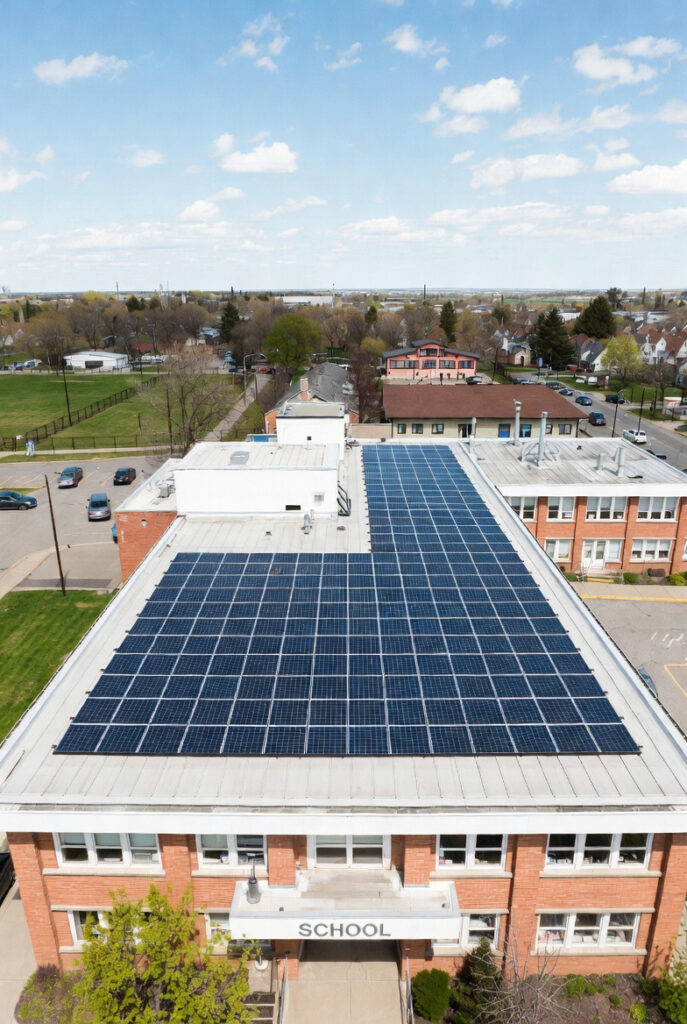
A community solar microgrid is not a scaled-up residential system. I learned this during a conversation with a township facilities manager in Wellington County. He was responsible for three community buildings: a school, a community centre, and a volunteer fire hall that collectively served as emergency shelters during winter grid outages. All three ran on diesel generators. The generator fuel supply for all three buildings was approximately 2,000 litres stored on-site. During a major ice storm event with road closures, that fuel would last approximately 72 hours at full emergency shelter load. After 72 hours the shelters went dark. His question was not whether solar made financial sense. His question was how many days of autonomous operation a properly sized solar-plus-storage system could provide without any fuel delivery. The answer for a 500kWh battery energy storage system with a 150kW solar array was approximately 4 to 7 days of emergency shelter operation depending on winter solar production and load management. That conversation is why community solar microgrid design is not an energy cost question. It is a community safety question. For the residential Fortress logic that this architecture scales from, the system sizing hub covers the load calculation foundation.
Why a Community Solar Microgrid Outlasts Diesel When the Roads Are Closed
The diesel dependency failure mode is clear: fuel runs out, roads are blocked, shelter goes dark. The solar-plus-storage advantage is autonomy from stored energy and daily solar production with no fuel delivery required. A 500kWh BESS at 80% DoD provides 400kWh of usable storage. A school operating as an emergency shelter draws approximately 50 to 80kWh per day for heating, lighting, communications, and kitchen loads. At 65kWh per day the 400kWh bank provides 6.1 days of full autonomy with no solar input. With winter solar production at 20 to 30% of rated daily output, a 150kW array adds 30 to 45kWh per day, extending autonomy to 8 to 10 days. The diesel generator providing the same coverage requires 800 to 1,200 litres of fuel that must be delivered by road.
| Power Source | Fuel / Storage | Days of Emergency Shelter Autonomy |
|---|---|---|
| Diesel Generator only | 2,000 litres on-site | 3 days (72 hours) |
| Solar-Plus-Storage (500kWh BESS + 150kW array) | Battery plus daily production | 6 to 10 days |
| No backup power | Grid only | 0 days when grid fails |
The Community Solar Microgrid Architecture: Controller, BESS and Island Mode
The architecture of a community solar microgrid consists of three layers: building-level inverters and monitoring, a central BESS, and a microgrid controller. At the building level, each facility has its own inverter-charger such as the Victron MultiPlus-II and a Cerbo GX monitoring hub feeding real-time data to the central dashboard. The central 500kWh battery energy storage system balances loads across all facilities and stores excess solar production. The microgrid controller monitors utility grid status, triggers automatic islanding when the grid fails, manages BESS charge and discharge priority across facilities, and re-synchronises when utility power returns.
The island mode protocol detects utility grid loss within 100ms and opens the utility interconnect breaker, isolating the community microgrid from dead utility lines. This is the positive isolation standard from the DC disconnect guide applied at utility scale. The community loads continue without interruption. For the transfer switch standard that governs the utility interconnect breaker at the building level, the transfer switch guide covers the isolation requirement. For the sub-panel wiring that distributes power within each building, the sub-panel wiring guide covers the circuit isolation standard.
Load Prioritisation: Managing Critical Loads Across Multiple Buildings
During an extended grid outage, a community solar microgrid prioritises critical loads to extend autonomy. Tier 1 critical loads are always on: heating system, emergency lighting, communications, and medical equipment. Tier 2 essential loads run when the battery is above 50% state of charge: kitchen, hot water, and security systems. Tier 3 comfort loads run only when the battery is above 70% SoC with active solar production: classroom equipment, gymnasium, and non-essential lighting. The microgrid controller enforces these tiers automatically based on BESS state of charge. Without priority management, a community running full normal load during an outage depletes the BESS in 6 hours. With priority management, the same BESS sustains critical loads for 6 days.
Virtual Net Metering: The Community Solar Microgrid Revenue Standard
Ontario’s Net Metering regulation allows schools and community organisations to earn bill credits for excess solar production exported to the grid, which can be applied to electricity bills at other facilities owned by the same organisation. A 150kW array on a school produces 150,000 to 175,000 kWh annually in Ontario using a capacity factor of approximately 12 to 13%. With a summer school load of approximately 30,000 kWh, the system exports 120,000 to 145,000 kWh during the summer months. At current Ontario electricity rates of 12 to 20 cents per kWh, that represents $14,400 to $29,000 in annual bill credits applicable across the school board portfolio.
For Indigenous and remote communities in northern Ontario, a 500kWh BESS with 200kW of solar replacing 50% of diesel consumption at 60 cents per kWh saves approximately $180,000 per year on 600,000 kWh annual consumption. The system capital cost of $800,000 to $1,200,000 has a payback period of 4 to 7 years at northern diesel prices. For the full ROI calculation framework that applies to community-scale projects, the ROI guide covers the payback period math.
STEM Integration: The Community Solar Microgrid as a Living Curriculum
A principal at a rural school north of Guelph shared an insight that has stayed with me. She said the solar monitoring dashboard in the main hallway had changed how her Grade 7 and 8 students talked about energy. Before the system, energy was an abstract concept, something that came from a plug in the wall. After the dashboard went live, students were checking the production numbers before class, calculating how many days of school the array could power, and asking questions about battery chemistry that she had not covered in curriculum yet. One student built a project tracking the system’s winter production decline and recovery that won a regional science fair. The dashboard cost $400 to install. The curriculum impact was not measurable in dollars.
The monitoring dashboard serves as STEM infrastructure: real-time production data, battery state of charge, grid import and export status, and load breakdown by facility. Students calculate the carbon offset, the fuel displacement, and the payback period as applied mathematics. The system becomes a living energy literacy curriculum that no textbook can replicate.
NEC and CEC: What the Codes Say About Community Solar Microgrids
NEC 705 covers interconnected electric power production sources and applies to community solar microgrid installations where the solar array connects to utility distribution circuits. NEC 705.12 requires that the total of all power sources connected to a distribution panel not exceed the panel’s busbar rating. For community-scale systems with multiple inverters, a load flow study is required to verify that the aggregated solar output does not exceed the busbar capacity of the distribution system. NEC 700 covers emergency systems and applies to any facility designated as an emergency shelter, requiring that the emergency power system sustain critical loads for a defined minimum period. NEC 702 covers optional standby systems for non-emergency loads.
In Ontario, community solar microgrid installations are subject to CEC Section 64 for the PV source circuits and to Ontario Regulation 22/04 for the utility interconnection agreement. Any installation that exports power to the utility grid requires a formal interconnection application to the local distribution company and approval from the Independent Electricity System Operator for systems above 10kW. School boards and municipal organisations are subject to the same interconnection requirements as commercial installations. The Ontario government’s Save ON Energy program has offered incentives for community energy storage projects. Contact the IESO for current program availability. In northern Ontario communities, the Ontario First Nations Economic Fund and federal Indigenous community programs have provided capital funding for diesel displacement solar projects. An electrical engineer licensed in Ontario must stamp the design and submit to the ESA for permit and inspection.
Pro Tip: Before presenting a community solar microgrid proposal to a school board or town council, build the 72-hour fuel window calculation into the first slide. The question is not whether solar costs less than the grid. The question is how many days the community stays safe when the grid fails and the roads are closed. That is the conversation that moves budgets.
The Verdict
A community solar microgrid built to the resilience standard converts a public building from a diesel-dependent emergency shelter into a self-sustaining community life-support hub.
- Size the BESS for 6 to 10 days of critical load autonomy, not 72 hours. The diesel generator fails when the fuel runs out. The solar-plus-storage system keeps running.
- Install a microgrid controller that handles automatic islanding, load priority management, and utility re-synchronisation as a single integrated function. A collection of inverters without a controller is not a microgrid.
- Build the monitoring dashboard into the public space from day one. The STEM curriculum value and community energy literacy impact are not secondary benefits. In a school, they are the primary ones.
In the shop, we train the next generation of technicians. In the school, the solar array trains the next generation of energy-independent citizens.
This post contains affiliate links. If you purchase through our links, we may earn a small commission at no extra cost to you.
Questions? Drop them below.
About the Author
Robert Bertrand spent 20 years as a service advisor in the automotive industry (Lexus and Nissan), where precision diagnostics, wiring integrity, and documentation standards were non-negotiable. He brings that same technical discipline to GridFree Guide, where he researches, tests, and documents off-grid solar systems for Ontario conditions. Based in Rockwood, Ontario, every article is built on verified specifications, manufacturer data, and the real-world climate constraints of Canadian off-grid living.
As an Amazon Associate I earn from qualifying purchases. This site also contains affiliate links to other products and services. GridFree Guide earns a small commission at no extra cost to you.