
This post contains affiliate links. If you purchase through our links, we may earn a small commission at no extra cost to you.
Solar panel recycling conversations usually start with the wrong question. A client called asking what to do with 16 panels from a 2001 system that a contractor had told him needed to be replaced. The panels were showing 82% of their original output after 24 years. The contractor had quoted $8,000 for a full replacement and disposal. I pulled the production data from the monitoring system and did the math. At 82% output the system was still producing 4.1kWh per day from a 5kWh rated array. The new system would produce 5kWh per day. The difference was 0.9kWh per day. At current Ontario electricity rates the 0.9kWh delta was worth approximately $0.18 per day. The $8,000 replacement would take 44,000 days 120 years to pay back in additional production. Those panels did not need to be replaced. They needed to be left alone until they actually failed or until the incremental output gain was worth the investment. Solar panel recycling is a 25-year decision, not a 20-year decision. For the off-grid solar ROI calculation that determines when replacement is actually financially justified, the ROI guide covers the full payback period math.
Why Solar Panel Recycling Starts With Output Data, Not Calendar Age
Panels degrade at approximately 0.5% per year under the LeTID degradation model, which means a 25-year-old panel from a reputable manufacturer is producing approximately 87 to 90% of its rated output, not failing. The IEC 61215 standard requires that panels retain at least 80% of their rated output after 25 years. Most panels from tier-1 manufacturers outperform this standard. A panel producing 85 to 90% at year 25 has 5 to 10 more years of productive service life before reaching the 80% threshold. The decision to initiate solar panel recycling should be based on measured output data, not on reaching the warranty end date. The Victron SmartShunt provides the production data that makes the retain versus replace decision a numbers question rather than a calendar question. For the full panel degradation rate standard that covers how to measure actual vs rated output, the degradation guide covers the calculation. For the system sizing hub that determines when incremental output gain justifies replacement cost, the hub covers the numbers.
The Material Value Ledger: What a Solar Panel Is Actually Worth at End of Life
I walked through a First Solar panel recycling facility a few years ago and the number that surprised me was the aluminium. A standard 400W residential panel contains approximately 1.2 to 1.5kg of aluminium frame material. At current scrap aluminium prices of approximately $1.50 to $2.00 CAD per kilogram, a 16-panel residential system contains $28 to $48 worth of scrap aluminium alone. The glass substrate, approximately 10 to 12kg per panel, adds another layer of recovered value at certified facilities. The silver in the cell contacts is the high-value item: approximately 0.5 to 1g of silver per panel at current silver prices of approximately $35 CAD per troy ounce represents $0.56 to $1.13 per panel. On a 16-panel system that is $9 to $18 in silver alone. The panel is not waste. It is a material resource with a specific recovery value at the end of its productive life.
| Material | Weight per Panel | Approximate Recovery Value (CAD) |
|---|---|---|
| Glass Substrate | 10 to 12kg | $5 to $7 |
| Aluminium Frame | 1.2 to 1.5kg | $1.80 to $3.00 |
| Silicon Cells | 0.5 to 0.6kg | $1.00 to $1.50 |
| Silver Contacts | 0.5 to 1g | $0.56 to $1.13 |
| Copper Ribbon | 0.1 to 0.15kg | $0.20 to $0.30 |
| EVA Encapsulant | 0.8 to 1kg | $0.40 to $0.50 |
| Backsheet Polymer | 0.4 to 0.5kg | $0.20 to $0.30 |
| Total per panel | $8 to $15 CAD |
At 2026 material prices, the recoverable commodity value of a single panel at a certified facility is approximately $8 to $15 CAD. The panel is not waste. It is a material resource.
The Solar Panel Recycling Pathway: Universal Waste, Material Recovery and Second Life
The three pathways in order of preference are second-life redeployment, Universal Waste recycling, and hazardous waste disposal as a last resort for physically damaged panels.
Panels producing 70 to 80% of rated output with no physical damage belong in the second-life market. A 400W panel at 75% delivers 300W, adequate for dozens of small off-grid applications including livestock waterers, workshop lighting circuits, gate openers, and seasonal cabins. Second-life panel pricing runs 20 to 40% of new panel price. For comparison, a new Renogy 100W panel lists at approximately $65 to $80 USD. A second-life 400W panel in good condition typically sells for $40 to $80 CAD. For battery sizing guidance for second-life panel applications, the sizing guide covers the calculation for smaller low-load systems.
Under the EPA Universal Waste rule, crystalline silicon and CdTe panels can be transported to certified recyclers without a full hazardous waste manifest. Label the panels as Universal Waste with the accumulation start date, store for no more than one year, and deliver to a certified facility. In Ontario, the WEEE program under Electronics and Electrical Equipment regulations covers solar panels. Contact the manufacturer or a certified e-waste recycler for drop-off options in Wellington County.
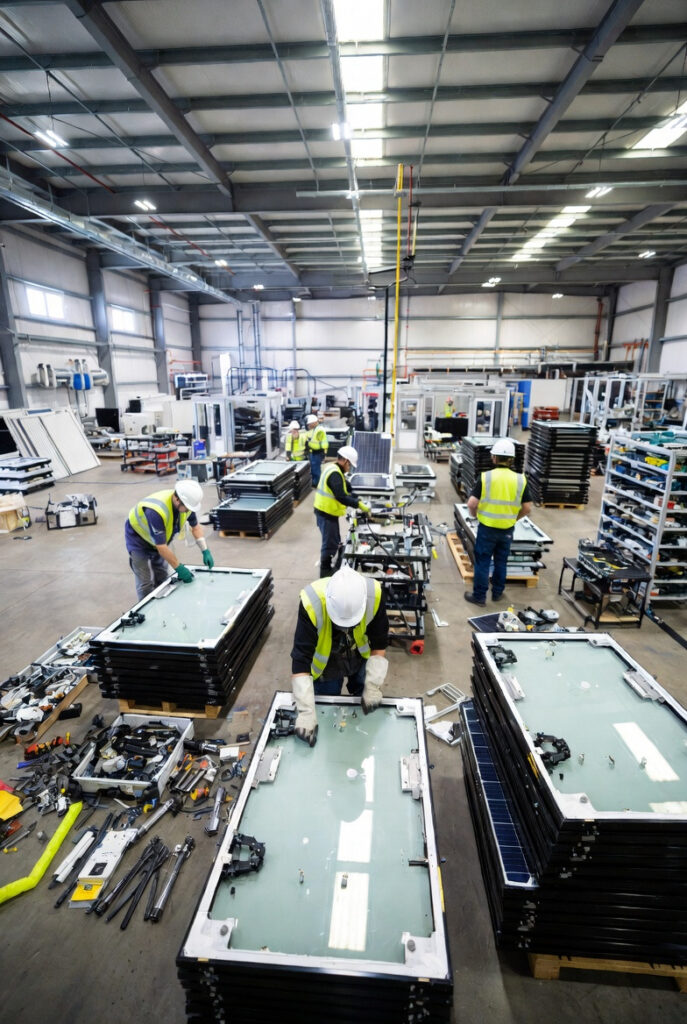
At certified facilities, mechanical stripping removes the aluminium frame and junction box for 100% aluminium recycling. Thermal processing at approximately 500°C evaporates the EVA encapsulant, freeing the glass substrate with an 85 to 90% recovery rate at advanced facilities. Chemical refining recovers silicon, silver, and copper from the cell layer. Advanced 2026 European facilities report recovery rates of 85 to 95% by weight for crystalline silicon panels. Canadian facilities are at 75 to 85% as of 2026.
Producer Responsibility: The Take-Back Programs Worth Asking About
Some tier-1 panel manufacturers include a take-back or recycling fee in the original purchase price or warranty terms. Canadian Solar, LONGi, and SunPower have published end-of-life programs as of 2025 to 2026. Before purchasing panels for a new Fortress build, ask the distributor specifically whether a take-back program exists and what the terms are. A manufacturer that charges a recycling fee up front and guarantees certified disposal is a better long-term partner than one that offers no end-of-life pathway. In the shop, we do not pay for oil disposal. The recycler pays us for the waste. The equivalent in the solar industry is the producer that takes responsibility for the material at end of life rather than leaving it to the homeowner to manage.
NEC and CEC: What the Codes Say About Solar Panel Recycling and Disposal
The EPA Universal Waste rule (40 CFR Part 273) added solar panels as a category of Universal Waste in 2023, covering both crystalline silicon and cadmium telluride panels. Under Universal Waste classification, panels can be stored on-site for up to one year, must be labelled with the accumulation start date, and must be sent to a certified Universal Waste handler or recycler. Panels cannot be disposed of in standard municipal solid waste streams. A landfill that accepts solar panels without Universal Waste documentation is in violation of EPA regulations.
In Ontario, solar panels at end of life are regulated under the Resource Recovery and Circular Economy Act and the Electronics and Electrical Equipment program administered by Recycling Ontario. Producers who sell solar panels in Ontario are required to register with Recycling Ontario and fund the collection and recycling of equivalent quantities of EEE products. For homeowners decommissioning a system, the first step is to contact the original equipment manufacturer for their registered take-back pathway. If no manufacturer program exists, contact Recycling Ontario for a certified collector in Wellington County. Solar panels cannot legally be disposed of in regular waste streams in Ontario.
Pro Tip: Before decommissioning any panel, take a thermal camera scan of the array under load. Hot spots indicate bypass diode failures or delamination that make a panel unsafe for second-life redeployment. A panel with thermal damage goes directly to a certified recycler. A panel with a clean thermal profile at 75% output goes to the second-life market.
The Verdict
Solar panel recycling done correctly starts with a decision: retain, redeploy, or recycle.
- Check the output data before replacing. A panel producing 82% at year 24 has years of productive life remaining. The $8,000 replacement that pays back in 120 years is not a maintenance decision. It is a sale.
- Sell panels producing 70 to 80% into the second-life market. A 300W output panel at 40% of new panel price is a resource, not a liability.
- Use the Universal Waste pathway for panels that are genuinely end-of-life. Label them correctly, store them under one year, and deliver to a certified facility. The landfill is not an option in Ontario.
In the shop, the core always goes back to the supplier. In the Fortress, the panel always goes to a certified facility. The material is too valuable to waste.
Questions? Drop them below.
About the Author
Robert Bertrand spent 20 years as a service advisor in the automotive industry (Lexus and Nissan), where precision diagnostics, wiring integrity, and documentation standards were non-negotiable. He brings that same technical discipline to GridFree Guide, where he researches, tests, and documents off-grid solar systems for Ontario conditions. Based in Rockwood, Ontario, every article is built on verified specifications, manufacturer data, and the real-world climate constraints of Canadian off-grid living.
As an Amazon Associate I earn from qualifying purchases. This site also contains affiliate links to other products and services. GridFree Guide earns a small commission at no extra cost to you.