
This post contains affiliate links. If you purchase through our links, we may earn a small commission at no extra cost to you.
A solar powered chicken coop in a Rockwood January is not a hobby project. It is a necessity. In February of last year, a client called me after losing four hens over three days. The waterer had frozen solid because the 50W immersion heater had been running off a battery that had not been sized for winter discharge. The battery was sitting at minus 8°C in an uninsulated coop, which reduces LiFePO4 usable capacity by approximately 30% below the 0°C threshold. The heater load exceeded what the cold-derated battery could sustain overnight. The water froze. The hens dehydrated. The fix was a well-insulated waterer inside a foam-lined cabinet that reduced the heater run time from 24 hours per day to approximately 6 hours per day in the coldest weather. The system has run three winters since without a frozen waterer. For the full system sizing hub that covers every principle this mini-Fortress applies at scale, the hub covers the load calculation foundation.
Why a Solar Powered Chicken Coop in Ontario Needs Winter Sizing, Not Summer Specs
The winter load is the design load, not the summer load. In a chicken coop there are three primary loads: LED supplemental lighting at 5W for 14 hours per day equals 70Wh, the automatic door motor at under 1Wh per day, and the water de-icer at 50W with variable run time based on insulation. The winter total with an uninsulated waterer is approximately 1,270Wh per day. With a thermally insulated waterer running 6 hours per day, the daily load drops to approximately 370Wh. Size for the insulated approach. It is cheaper and more reliable. The coop door motor and LED strip should both be wired native 12V DC, never through an inverter. The DC lighting systems guide covers the inverter tax calculation that explains exactly why a 5,000W inverter should never be left running to power a 5W coop light.
The Water De-Icer: The Dominant Load in a Solar Powered Chicken Coop
A 50W heater running 24 hours per day consumes 1,200Wh. A 100Ah 12V LiFePO4 at 80% depth of discharge provides 960Wh. The heater exceeds the bank on a 24-hour cycle. The thermal battery approach involves an insulated foam-lined cabinet around the waterer with a lid, reducing the heater run time to 4 to 8 hours per day in Ontario winter. The daily load drops from 1,200Wh to 200 to 400Wh. A LiFePO4 bank sitting at minus 8°C operates at approximately 70% of rated capacity. Size the bank with a 30% cold-weather margin for Ontario installations. A 100Ah bank at 80% DoD provides 80Ah usable at room temperature and approximately 56Ah usable at minus 8°C. Account for this before commissioning in October.
| Load | Daily Wh — Uninsulated | Daily Wh — Insulated |
|---|---|---|
| LED Supplemental Light | 70Wh | 70Wh |
| Automatic Coop Door | less than 1Wh | less than 1Wh |
| Water De-Icer | 1,200Wh | 200 to 400Wh |
| Total | 1,270Wh | 370Wh |
The Automatic Coop Door: DC-Native, Never Through an Inverter
A 12V DC linear actuator draws 2 to 5W for approximately 30 seconds at dawn and 30 seconds at dusk. Daily energy use is under 1Wh. Wire directly to the 12V fuse block on a 5A dedicated fuse with a light-sensing relay or programmable timer. A 5,000W inverter at 85W idle running to power a door motor that uses under 1Wh per day is the service failure the DC lighting guide describes. Never run the coop door through the inverter. For the panel tilt angle and positioning standard that determines what the light sensor sees at dusk for triggering the door close sequence, the panel placement guide covers the Ontario-specific tilt angles.
LED Supplemental Lighting: The 14-Hour Winter Standard
Hens require 12 to 14 hours of light per day for consistent winter laying. A 12V 5W LED strip on a timer provides sufficient light for a coop up to 12 square metres. Daily load is 70Wh. The timer prevents 24-hour operation which disrupts the hens’ sleep cycle and reduces laying. A 12V DC mechanical or electronic timer costs $10 to $20 and pays for itself in eggs within the first month. Wire the LED strip directly to the 12V fuse block on a 3A fuse. No inverter required. No inverter overhead applied.
Building Your Solar Powered Chicken Coop: The Load Calculation and Component Standard
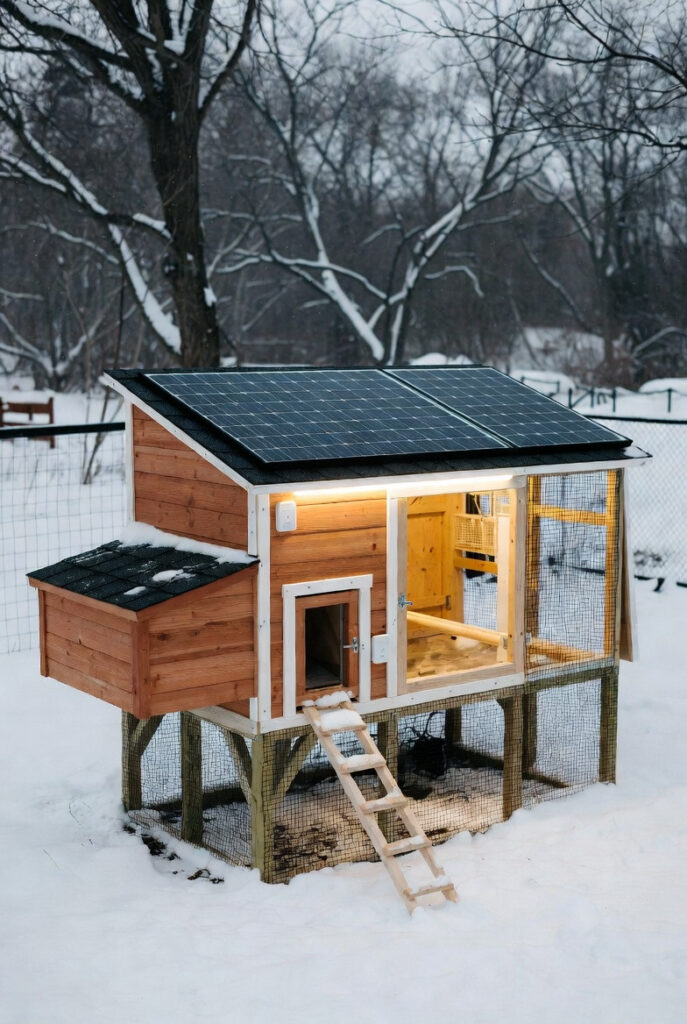
The complete mini-Fortress component list for a solar powered chicken coop: a 100 to 200W rigid panel mounted on the coop roof or a dedicated ground post at 55 to 60° winter tilt angle for Rockwood latitude, which provides snow shedding and maximum winter production. The Renogy 100W starter kit provides the panel and charge controller as a verified starting point for the coop build. A 50 to 100Ah 12V LiFePO4 battery bank with a BMS rated for low-temperature operation. A 12V DC fuse block with individually fused circuits for the light timer, door motor, and heater. The 10AWG solar cable for the panel run from roof to battery, rated for outdoor UV exposure. Total system cost for a well-insulated coop build runs $600 to $900 in components. For the battery bank sizing calculation that determines exactly how many amp-hours the thermal approach requires at Ontario winter temperatures, the battery sizing guide covers the math.
Predator-Proof Wiring: The Solar Powered Chicken Coop Conduit Standard
In the shop, we do not leave harnesses exposed to road debris or engine heat. We route them through protective conduit and secure them against abrasion. In a chicken coop the threat is different but the principle is identical. I rewired a client’s coop after a weasel had chewed through the insulation on the automatic door motor wire, leaving a bare conductor against the metal door frame. The door motor shorted, blew the 10A fuse, and the door stayed open overnight. Two hens were lost to predators before morning. Every wire run inside that coop is now in flexible metal conduit. The weasel can still get into the coop. It cannot get through the conduit. For the full conduit selection standard, the conduit wiring guide covers the pipe type and fitting standard for each environment. The coop wiring standard: flexible metal conduit on all internal runs, weatherproof cable entry glands at every wall penetration, and a waterproof enclosure for the fuse block mounted outside the coop and accessible without entering.
NEC and CEC: What the Codes Say About Solar Powered Chicken Coop Installations
NEC Article 547 covers agricultural buildings and requires that electrical installations in livestock housing meet specific wiring method requirements. NEC 547.5 requires that wiring in areas subject to physical damage, moisture, and corrosive atmosphere, which describes the interior of a chicken coop, use wiring methods listed for the environment including rigid metal conduit, intermediate metal conduit, or liquidtight flexible metal conduit. Standard NM cable and PVC conduit do not meet NEC 547.5 in a coop environment. A 12V solar powered chicken coop system using flexible metal conduit with waterproof fittings meets the intent of NEC 547.5 for low-voltage DC circuits.
CEC Section 22 covers special occupancies including farm buildings and requires that wiring in livestock housing be protected from mechanical damage and moisture. In Ontario, a solar installation on a farm outbuilding including a chicken coop may require an ESA permit depending on the scope of the work. A 12V DC system below the permit threshold (typically 30V and under 100W for agricultural outbuildings in Ontario) may be exempt, but the homeowner should confirm the current ESA threshold with their local district office before installation. The installation should meet CEC wiring method requirements regardless of permit status.
Pro Tip: Before you commission the coop system in October, put a thermometer inside the battery enclosure and check it on the first cold night below minus 5°C. If the battery temperature is below 5°C when the sun comes up, the charge controller will not allow charging and the heater will drain the bank overnight without recovery. Insulate the battery enclosure before the first freeze, not after.
The Verdict
A solar powered chicken coop is the Fortress in miniature. Every principle scales.
- Size for the insulated waterer load, not the 24-hour heater load. The thermal approach reduces the daily energy budget from 1,270Wh to under 400Wh and makes the whole system viable on a 100W panel.
- Wire everything native 12V DC. Door motor, LED strip, heater, all on the fuse block. No inverter in the coop.
- Put every wire inside flexible metal conduit. The weasel will find the coop. It should not find the wires.
- Size the battery with a 30% cold-weather margin. A 100Ah bank provides 56Ah usable at minus 8°C. Know the number before October.
In the shop, we do not leave harnesses exposed to road debris. In the coop, we do not leave wires exposed to beaks and teeth.
Questions? Drop them below.
About the Author
Robert Bertrand spent 20 years as a service advisor in the automotive industry (Lexus and Nissan), where precision diagnostics, wiring integrity, and documentation standards were non-negotiable. He brings that same technical discipline to GridFree Guide, where he researches, tests, and documents off-grid solar systems for Ontario conditions. Based in Rockwood, Ontario, every article is built on verified specifications, manufacturer data, and the real-world climate constraints of Canadian off-grid living.
As an Amazon Associate I earn from qualifying purchases. This site also contains affiliate links to other products and services. GridFree Guide earns a small commission at no extra cost to you.