
This post contains affiliate links. If you purchase through our links, we may earn a small commission at no extra cost to you.
DC disconnect switch types are not interchangeable with AC switchgear, and the difference is not academic. I had a client bring in a system after a short circuit event on a 48V 400Ah lithium bank. The DC breaker on the battery output had tripped, or appeared to have tripped. The handle was in the off position. The system was still live. When I opened the enclosure and measured across the breaker terminals with a meter, both sides were hot. The contacts had welded during the arc event. The breaker handle said off. The contacts said otherwise. That is contact welding, and it is the reason a visible-break knife switch or a fused disconnect belongs on every high-current battery bank, not a plastic-bodied AC-rated breaker with a DC sticker on the box. For the kill switch selection overview that covers when each type is appropriate, the kill switch guide covers the 48V-specific context. For the Class T fuse comparison, the Class T fuse guide covers the speed-of-protection standard.
Why DC Disconnect Switch Types Fail Differently Than AC Breakers
The zero-crossing problem is fundamental. AC arcs self-extinguish because the current reverses polarity 60 times per second and passes through zero volts on each cycle. That zero-crossing is the natural extinguishing point for an AC arc. DC current is constant and unidirectional. An arc in a DC circuit will sustain itself as long as the voltage is sufficient to maintain ionisation of the air gap. At 48V with 400A available fault current, the arc energy is approximately 19,200W instantaneous. That arc does not stop until the circuit is broken by mechanical separation of sufficient distance or by a device specifically rated to interrupt DC current at that voltage and amperage.
The interrupting rating of the switchgear must exceed the available fault current of the battery bank, not just the operating current. A 200A knife switch rated for 200A continuous operation may have an interrupting rating of only 500A DC. A 400Ah LiFePO4 battery bank can deliver 2,000 to 4,000A of fault current for the fraction of a second before the BMS protection activates. If the switchgear interrupting rating is below the available fault current, the switch will fail to interrupt the arc and may weld, explode, or catch fire. Always specify DC disconnect switch types by both continuous current rating and DC interrupting rating. For DC current and voltage context, the DC voltage drop guide covers the conductor sizing that works alongside the switchgear.
| Type | Best Application | Voltage Range | Key Feature |
|---|---|---|---|
| Knife Switch | 48V battery bank main disconnect | 12V to 96V | Visible air gap — positive isolation |
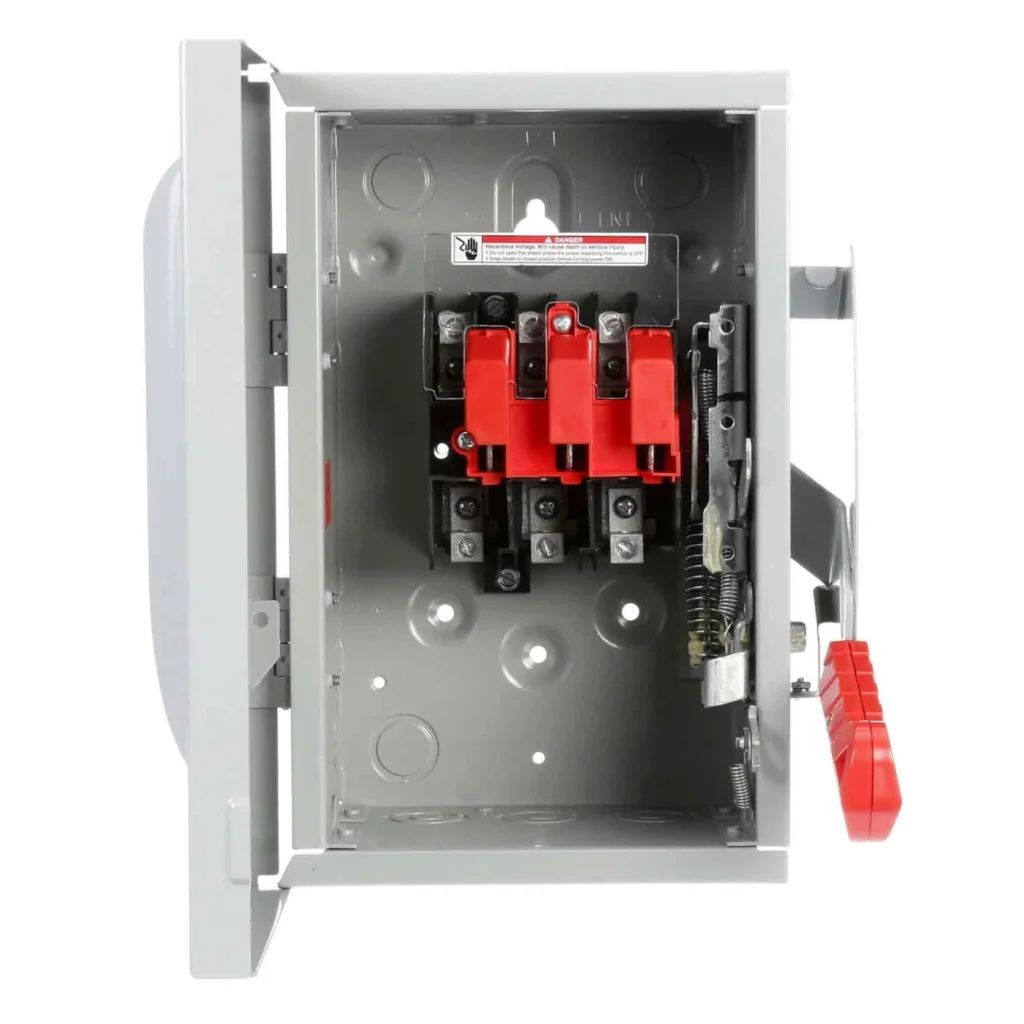
| Fused Disconnect | High-current battery output protection | 12V to 96V | Switch plus Class T fuse in one housing |
| DC MCCB | PV string protection 150V and above | 150V to 600V | Magnetic blowout arc quenching |
The Knife Switch: The Visible Break Standard for DC Disconnect
In the shop we have a rule: we do not trust the dash light. If the oil pressure warning light goes out, we still check the dipstick. Same principle applies to a battery disconnect. A plastic lever in the off position is a dash light. A knife switch with a visible air gap between the blade and the jaw is a dipstick. I can see the gap. I can verify the circuit is open without a meter, without power, without any instrument at all. When I am working on a 400Ah lithium bank at minus 22 in a barn with gloves on, that visible gap is not a convenience. It is the standard.
A knife switch provides physical air gap between blade and jaw that is visually verifiable without instruments. The positive isolation standard means you can see the circuit is open before you touch anything downstream. Best application is the 48V battery bank main disconnect and any location where maintenance will be performed with the system de-energised. The high-current busbar that the knife switch protects carries the full bank output current and must be rated to match. One important limitation: knife switches are isolation devices, not operational switching devices. They are not rated for frequent switching under load and should not be used as daily on-off controls.
The Fused Disconnect: Protection and Isolation in One Device
A fused disconnect combines a mechanical switch with a Class T or NH fuse in a single housing. The switch provides visible isolation. The fuse provides faster-than-switch overcurrent protection. A Class T fuse opens in under 8ms at 300% of rated current. A mechanical switch requires human action or a trip mechanism. In a 48V lithium system where a hard short can reach full fault current in under 1ms, the fuse is the first line of protection and the switch provides the isolation that allows safe fuse replacement afterward. The Victron SmartShunt installed on the same battery output records the current event data that helps diagnose what caused the fault before the fuse is replaced. Best application is main battery output protection where both overcurrent interruption and visible isolation are required in a single enclosure.
The DC MCCB: Magnetic Blowout for High-Voltage String Protection
Magnetic blowout technology uses a permanent magnet field to deflect the arc sideways into a cooling chute of metal plates that divide and extinguish it. The arc is physically moved away from the contacts before it can weld them. DC MCCBs are rated for 150V to 600V DC string protection, which covers applications where a knife switch or fused disconnect cannot safely interrupt the available arc energy. The voltage rating is a critical specification: a breaker rated for 240V AC is not rated for 240V DC. The DC voltage rating must appear explicitly on the device nameplate. If it says only AC rating, it is an AC breaker regardless of the voltage number. Best application is PV string protection at 150V to 600V and high-voltage battery strings in large off-grid systems.
Switchgear Selection: Matching DC Disconnect Switch Types to the Application
The selection logic follows the voltage and the required function. For a 48V battery bank main disconnect, a knife switch with visible break is the correct choice. For high-current battery output protection where overcurrent interruption and visible isolation are both required, a fused disconnect with a Class T fuse is the correct choice. For PV string protection at 150V or above, a DC MCCB with magnetic blowout and an explicit DC voltage rating on the nameplate is the correct choice. Never substitute an AC-rated breaker on a DC circuit regardless of voltage similarity. The AC and DC ratings reflect different test standards and different failure modes. For the grounding standard that the switchgear installation must integrate with, the off-grid grounding guide covers the earth path requirements. For the full system sizing context that determines the fault current the switchgear must handle, the hub covers the battery bank sizing that drives the interrupting rating calculation.
NEC and CEC: What the Codes Say About DC Disconnect Switch Types
NEC 690.17 requires that each PV system have a disconnecting means that is accessible, capable of being locked in the open position, and rated for the DC voltage and current of the system. NEC 690.71 covers battery system disconnecting means and requires that the disconnecting means be rated for the available fault current of the battery system, not just the operating current. A disconnect rated for operating current only and installed on a battery bank capable of delivering 2,000A fault current does not meet NEC 690.71 regardless of whether the operating current is within the device’s continuous rating.
CEC Rule 64-112 requires that PV source circuit disconnecting means be rated for the maximum open-circuit voltage at minimum temperature and for the available short-circuit current. In Ontario, the ESA requires that battery system disconnects be rated for the available fault current of the installed battery bank. A fused disconnect or DC MCCB with an explicit interrupting rating at the system voltage that exceeds the battery fault current meets this requirement. An AC-rated breaker installed on a DC circuit does not, regardless of the continuous current rating match.
Pro Tip: Before you buy any disconnect switch for a DC battery circuit, find the interrupting rating on the nameplate. Not the continuous current rating. The interrupting rating. If it is not on the nameplate, the device is not rated for DC fault interruption. Do not install it.
The Verdict
DC disconnect switch types are not a preference. They are a specification.
- Use a knife switch with a visible break for any battery bank main disconnect where maintenance will be performed. See the gap. Trust the gap.
- Use a fused disconnect for high-current battery output protection where both overcurrent interruption and visible isolation are required in one device.
- Use a DC MCCB with magnetic blowout and an explicit DC voltage rating for PV string protection at 150V and above. Never substitute an AC-rated breaker.
In the shop, we do not trust the dash light. We check the dipstick. In the Fortress, the visible blade is the dipstick.
Questions? Drop them below.
About the Author
Robert Bertrand spent 20 years as a service advisor in the automotive industry (Lexus and Nissan), where precision diagnostics, wiring integrity, and documentation standards were non-negotiable. He brings that same technical discipline to GridFree Guide, where he researches, tests, and documents off-grid solar systems for Ontario conditions. Based in Rockwood, Ontario, every article is built on verified specifications, manufacturer data, and the real-world climate constraints of Canadian off-grid living.
As an Amazon Associate I earn from qualifying purchases. This site also contains affiliate links to other products and services. GridFree Guide earns a small commission at no extra cost to you.