
This post contains affiliate links. If you purchase through our links, we may earn a small commission at no extra cost to you.
Solar battery room venting standards exist because heat kills electronics faster than anything except water. I apply the same rule in the shop that applies in the Fortress: we never run an engine in a closed bay without an exhaust hose. A 5,000W inverter pushing 80% load in a sealed wooden cabinet in a Rockwood July is doing exactly that. The inverter is generating approximately 150 to 200W of waste heat. The charger running at 50A is adding another 100W. The cables carrying 100A are resistive heaters. A sealed cabinet with 300 to 400W of continuous heat input and no air path will reach 60 to 70°C inside within 30 minutes. The inverter thermal protection trips at 65°C on most Victron units. The system shuts down at the moment of peak demand and the owner calls me wondering why the inverter failed on the hottest day of summer. For the full inverter thermal shutdown standard, the inverter ventilation guide covers the airflow requirements inside the inverter cabinet specifically.
Why Solar Battery Room Venting Standards Cannot Be Passive Alone
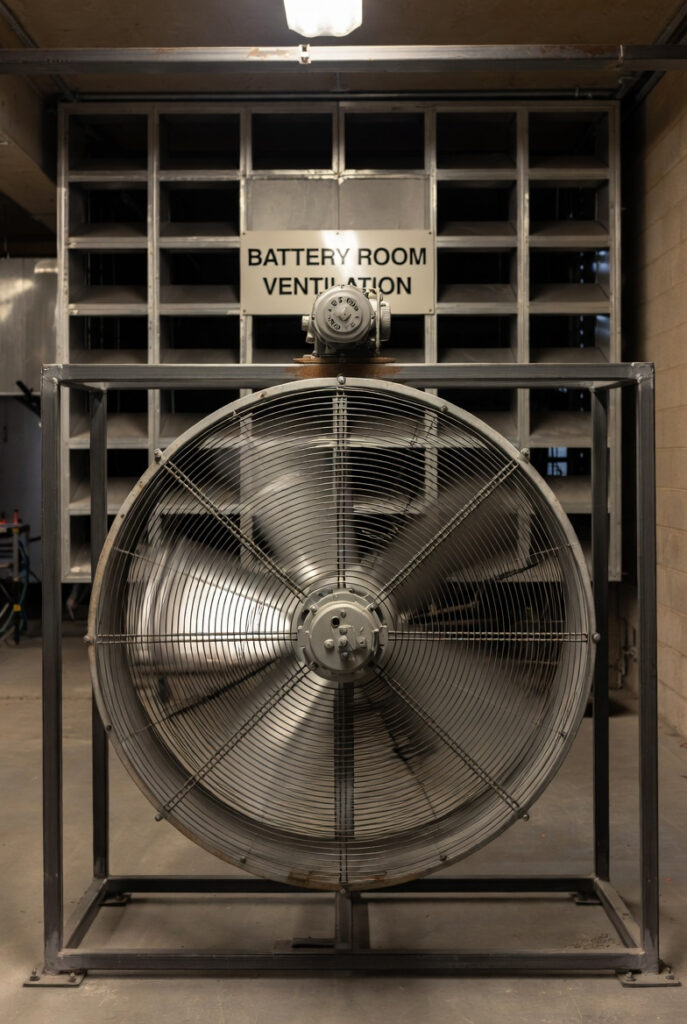
Passive vents work for storage: no heat load, no charging activity. Under production load, passive vents cannot move enough air volume to offset the heat generated by a charging and inverting system. A 120mm fan at 100 CFM moves approximately 2.8 cubic metres of air per minute. A typical battery room of 2 cubic metres exchanges its full air volume every 43 seconds under active fan operation. A passive vent of equivalent cross-section moves air only by convection, at approximately 10 to 15% of the forced flow rate under the same temperature differential. At 100A charge current, passive ventilation is inadequate. Active fans triggered by a thermal relay set to 25°C are the solar battery room venting standard.
The Cross-Flow Air Path: Designing Solar Battery Room Venting That Actually Works
Intake low, exhaust high, opposite walls. Heat rises. An intake and exhaust on the same wall create a short-circuit air path where cool air enters, immediately mixes with the warm exhaust air, and exits without crossing the heat sources. The intake must be at the lowest point of the opposite wall from the exhaust fan. In a 1.2 metre deep cabinet, the difference between same-wall and cross-wall placement is 8 to 12°C in steady-state cabinet temperature under load. The exhaust fan goes at the highest accessible point of the space, not just high on the wall. The intake vent sits at the lowest point of the opposite wall with a filter screen to capture dust before it enters the cabinet. The Cerbo GX provides a dry contact relay output that can trigger the exhaust fan directly from a temperature sensor reading, automating the 25°C activation threshold without a separate thermal relay controller.
The Capacitor Lifespan Calculation: Why a $25 Fan Protects a $3,000 Inverter
I explain this to every client who questions the cost of a proper ventilation system. Electrolytic capacitors in an inverter follow the Arrhenius rule: every 10°C increase in operating temperature cuts the component’s rated lifespan in half. A Victron MultiPlus-II has a rated MTBF of approximately 200,000 hours at 25°C operating temperature. Run it at 35°C and the effective capacitor lifespan drops to 100,000 hours. At 45°C it drops to 50,000 hours. At 55°C, which is achievable in a sealed cabinet in a Rockwood July, the effective lifespan is 25,000 hours. That is less than three years of daily operation. A 120mm thermostatically controlled fan costs $25 and draws 5W. The inverter it protects costs $2,000 to $4,000. The math requires no further explanation.
| Operating Temperature | Effective Capacitor Lifespan |
|---|---|
| 25°C | 200,000 hours |
| 35°C | 100,000 hours |
| 45°C | 50,000 hours |
| 55°C | 25,000 hours |
The rule applies to every electrolytic capacitor in the room: charge controller, DC-DC converter, battery charger. The Victron SmartShunt temperature sensor input confirms that the battery room is staying within the operating range the electronics were designed for. For the thermal camera scan that verifies no hot spots are developing in the room before they become failures, the thermal audit guide covers the full inspection standard.
Pro Tip: Put a $15 digital thermometer inside the battery cabinet and check it after two hours of charge at full current. If it reads above 35°C, the ventilation is inadequate. If it reads above 45°C, the system is already in the damage zone. Fix it before the next charge cycle.
The Hydrogen Standard: Lead-Acid and AGM Legacy Installations
LiFePO4 batteries in a well-designed system do not off-gas hydrogen under normal operating conditions. The thermal management requirement for a LiFePO4 installation is about inverter and charger heat, not battery gas. Lead-acid and AGM batteries are a different calculation. They off-gas hydrogen during the bulk and absorption charge phases, and hydrogen is explosive at 4% concentration in air. A single 100Ah AGM battery off-gassing at the end of a charge cycle can produce enough hydrogen in a sealed 0.5 cubic metre cabinet to reach explosive concentration within 20 minutes. NFPA 1 Section 52.3 and NEC 480.9 both require that battery rooms containing vented lead-acid or AGM batteries have mechanical ventilation to the exterior with the exhaust at the highest point of the space. Hydrogen is lighter than air and pools at ceiling level. The exhaust must be positioned to capture it before it accumulates. LiFePO4 thermal runaway can produce combustible gases, so the ventilation standard applies to LiFePO4 rooms as well, though the calculation basis is the heat management requirement rather than the off-gassing rate.
The Filter Maintenance Standard: The Choke That Kills the Fan’s Purpose
A filter that is 50% blocked reduces airflow by more than 50% due to the non-linear relationship between filter restriction and fan static pressure. A fan moving 40% of its rated airflow is not providing 40% of the cooling benefit. The airflow distribution inside the cabinet changes when the fan is starved and the heat sources that needed cross-flow cooling are no longer getting it. Check the intake filter every 30 days as part of the maintenance walk-around. The seasonal maintenance schedule includes the filter check as a line item in the full inspection protocol. In a barn installation in Rockwood, a filter can go from clean to 60% blocked in a single spring month when pollen and dust are at seasonal peaks.
NEC and CEC: What the Codes Say About Solar Battery Room Venting Standards
NEC 480.9 requires that battery installations be provided with ventilation sufficient to prevent the accumulation of explosive gases. For vented lead-acid and AGM batteries, NEC 480.9(A) requires that ventilation maintain hydrogen concentration below 1%, one quarter of the lower explosive limit. For sealed VRLA and LiFePO4 batteries, NEC 480.9(B) requires that the installation comply with the battery manufacturer’s ventilation recommendations. NEC 110.26 requires that electrical equipment remain accessible and that working space be free from obstructions. A battery room where heat buildup has caused component failure or enclosure deformation does not meet NEC 110.26.
CEC Section 64-400 covers battery installations for PV systems and requires that battery rooms be ventilated in accordance with the battery manufacturer’s specifications and that hydrogen-producing batteries be provided with ventilation to the exterior. In Ontario, a battery room containing lead-acid or AGM batteries in a permanent structure is subject to ESA inspection and must demonstrate compliance with the ventilation requirement before the installation is approved. LiFePO4 installations are subject to the heat management requirement under CEC Section 64-400(3), which requires that operating temperature remain within the manufacturer’s specified range. For the full system sizing context that determines the heat load the ventilation system must manage, the hub covers the charge current and inverter sizing that drives the thermal calculation.
The Verdict
Solar battery room venting standards protect the most expensive components in the Fortress from the most common and most preventable failure mode.
- Install a 120mm thermostatically controlled exhaust fan triggered at 25°C at the highest point of the battery room or cabinet, with the intake vent at the lowest point of the opposite wall.
- If the installation contains lead-acid or AGM batteries, the exhaust must vent to the exterior and the fan must run continuously during any charge cycle. Hydrogen off-gassing at 4% concentration is explosive.
- Check the intake filter every 30 days. A blocked filter is a choke and a choked fan is the same as no fan at the temperatures that matter.
We do not run engines in closed bays. We do not seal battery rooms and call it clean. Heat is the slow failure that the thermal protection trips tell you about on the day you need power most. Prevent it before that day arrives.
Questions? Drop them below.
About the Author
Robert Bertrand spent 20 years as a service advisor in the automotive industry (Lexus and Nissan), where precision diagnostics, wiring integrity, and documentation standards were non-negotiable. He brings that same technical discipline to GridFree Guide, where he researches, tests, and documents off-grid solar systems for Ontario conditions. Based in Rockwood, Ontario, every article is built on verified specifications, manufacturer data, and the real-world climate constraints of Canadian off-grid living.
As an Amazon Associate I earn from qualifying purchases. This site also contains affiliate links to other products and services. GridFree Guide earns a small commission at no extra cost to you.