
This post contains affiliate links. If you purchase through our links, we may earn a small commission at no extra cost to you.
A van life solar setup guide that starts with residential mounting hardware is starting with the wrong assumption. I have seen this twice in the shop. A Sprinter comes in after a highway trip and the owner reports a rattle from the roof. Pop the ladder and find a 200W rigid panel that has lifted at the trailing edge and is flexing at speed. The adhesive bond on three of the four mounting feet has let go. The panel has been acting as a sail for several hundred kilometres. The cells inside are micro-cracked along the flex lines. The panel reads open circuit on two bypass diode groups. It looks fine from the ground but produces about 40% of its rated output and is getting worse with every trip. Residential mounting hardware on a vehicle roof is not a slower version of the right solution. It is the wrong solution. For inverter thermal throttling in mobile installs, the inverter ventilation guide covers the airflow standard that applies in a van cabinet just as much as a barn.
Rigid vs Flexible: Choosing the Right Panel for Your Van Life Solar Setup
For flat roofs or roof racks, rigid panels are the pro choice for maximum output and service life. The 40mm air gap under a rigid panel is not an aesthetic choice. It is a thermal management requirement. A panel surface temperature of 65°C on a black roof in summer is common. That is 40°C above Standard Test Conditions, representing approximately 16% output loss. A 40mm air gap allows convective cooling that reduces panel surface temperature by 10 to 15°C, recovering 4 to 6% of that lost output. On a 400W array that is 16 to 24W of continuous free production recovered at no additional cost. The Renogy 100W starter kit is a verified rigid panel option for flat roof rack installations and includes the charge controller and mounting hardware for a basic van life solar setup.
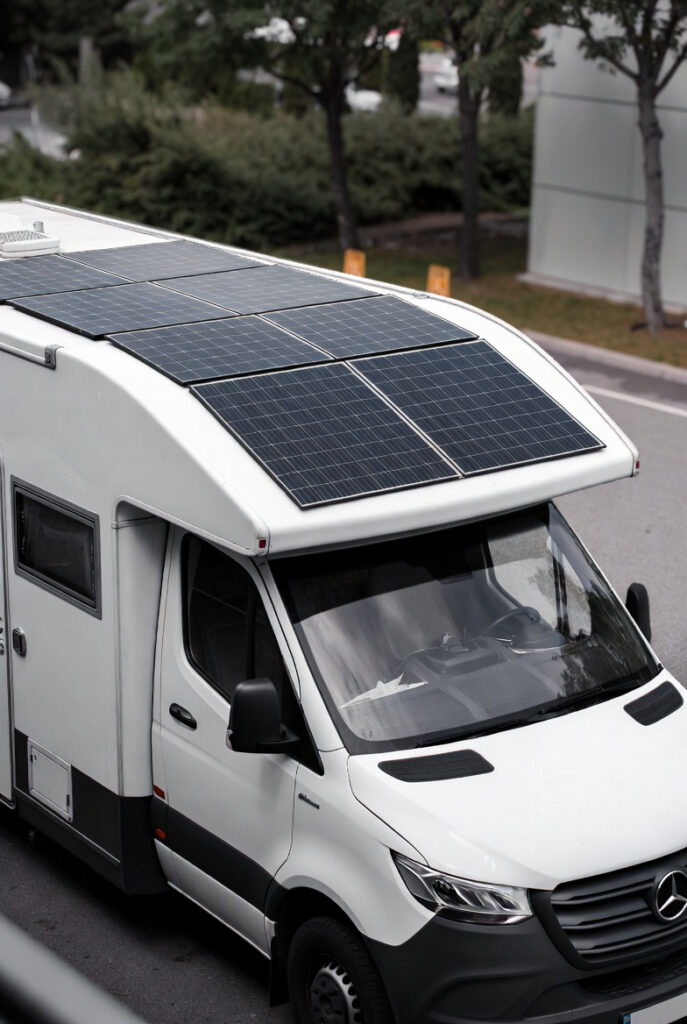
For curved Sprinter roofs, flexible panels are the correct choice. Not all flexible panels are acceptable. Cheap flexible panels use PET plastic as the front sheet. PET yellows and clouds with UV exposure, typically within 18 to 24 months in a mobile installation. ETFE-coated flexible panels resist UV degradation and maintain transparency for the panel’s rated life. The difference in cost between PET and ETFE flexible panels is approximately $30 to $50 per panel. The difference in service life is 3 to 5 years. For a full-time van build, ETFE is the only acceptable specification.
The Vibration-Proof Terminal Standard: Why Road Shock Kills Cheap Connections
Wire nuts and twist-on connectors are not rated for vibration environments. Road vibration at highway speed produces continuous micro-movements at every connection point. Over thousands of kilometres those micro-movements back the connector off. A backed-off DC connector does not produce a clean open circuit. It arcs. WAGO 221 lever-lock connectors use a spring-clamp mechanism that maintains constant contact force regardless of vibration. Serrated-flange nuts on busbars provide mechanical bite and resist backoff. These are not premium options. They are the minimum mobile standard.
For the panel-to-combiner connection in a van life solar setup, an MC4 branch connector provides the vibration-rated weatherproof connection that residential connectors cannot match. For the MC4 crimping standard that ensures those connections do not arc at the crimp point, the MC4 crimping guide covers the tooling requirement.
The DC-to-DC Alternator Bridge: Protecting the Vehicle Electrical System
A client brought in a Transit with a lithium house bank that kept tripping the BMS protection on the charge input. They had run a direct wire from the vehicle battery to the house bank through a 100A fuse. On a long highway run the alternator was pushing 14.4V into a depleted 100Ah LiFePO4 bank drawing maximum charge current. The alternator was sustaining 90 to 100A output for over an hour. On a vehicle alternator rated for 130A, that is 70 to 75% continuous load with no cooling pause. The alternator failed three weeks later. A Victron Orion DC-to-DC charger installed between the vehicle battery and the house bank would have limited the charge current to a programmable maximum and provided voltage isolation so the LiFePO4 charge profile did not stress the alternator. The repair cost more than the Orion would have.
The sizing rule is straightforward. The Orion charge current should not exceed 25% of the alternator rated output for continuous use on long highway runs. A 130A alternator supports a maximum 32A Orion charge current for sustained driving without thermal damage to the alternator. For the LiFePO4 charge profile programming that the Orion delivers correctly, the charge controller programming guide covers the voltage and current settings.
The Roof Penetration Standard: Every Entry Point Is a Future Water Damage Claim
The only acceptable roof penetration method for a van life solar setup is the cable entry gland. A drilled hole with sealant is not acceptable. A self-tapping bolt with butyl tape is not acceptable. The cable must exit the gland and drop below the gland entry point before routing inside, creating a drip loop so water follows the wire down and drips off the low point rather than following it into the van structure. For the full drip loop installation standard, the drip loop guide covers every detail of that penetration. For sealing the gland to an EPDM rubber roof, use Dicor self-levelling lap sealant. Silicone does not bond to EPDM and will lift at the edge within one season.
Van Life Solar Setup Guide: The Load Calculation for Mobile Living
Mobile load calculation differs from stationary because the production window is variable. A van parked facing the wrong direction in a Rockwood January may produce 30 to 40% of its rated daily output. Size the battery bank for two days of zero production at the full daily load, not one.
[WordPress Table block — 2 columns, 6 rows]
| Load | Daily Wh |
|---|---|
| Fridge | 40Wh |
| Lighting | 20Wh |
| Phone and laptop charging | 60Wh |
| Fan | 15Wh |
| Starlink | 75Wh |
| Total | 210Wh |
A 100Ah 12V LiFePO4 bank at 80% depth of discharge provides 960Wh, covering 4 to 5 days of this load. For the full battery bank sizing calculation, the battery sizing guide covers the math. For cold weather battery performance in a winter van build, the cold weather battery guide covers what happens to LiFePO4 cells below 0°C and how to manage charge timing in sub-zero conditions.
NEC and CEC: What the Codes Say About Mobile Solar Installations
NEC Article 551 covers recreational vehicles and requires that all 12V wiring in an RV or van conversion meet the ampacity and protection requirements of the NEC. Solar PV systems on vehicles are subject to NEC 551.46, which mandates overcurrent protection for the PV source circuit and protection from physical damage. Flexible wiring methods suitable for mobile installations include marine-grade tinned copper wire and XLPE-insulated cable. Standard residential NM cable is not rated for mobile installation and is not compliant with NEC 551.
In Canada, van conversions and RV solar installations are governed by CSA C22.2 No. 551 for recreational vehicles, which aligns with RVIA standards for 12V and solar wiring. CEC Section 12-022 covers wiring in vehicles and requires that conductors be protected from vibration damage and secured at intervals not exceeding 600mm. Any van conversion sold or registered as a recreational vehicle in Ontario is subject to these standards. A DIY van build used privately is not subject to mandatory inspection but should meet these standards for safety. For the full system sizing context that determines how much a van life solar setup actually needs to produce, the hub covers the load calculation foundation.
Pro Tip: Before your first highway run, push and pull every terminal by hand with the system live. A backed-off connection in a DC circuit does not fail cleanly. It arcs. Find it at the campsite, not on the highway.
The Verdict
The mobile fortress is a different stress environment from the stationary Fortress. Every component choice must account for vibration, flex, road shock, and the fact that the roof moves.
- Use rigid panels on flat roofs with a 40mm air gap for thermal management, or ETFE flexible panels on curved roofs. Never PET flexible panels in a full-time build.
- Use WAGO 221 lever-lock connectors and serrated-flange busbar nuts throughout. Twist-on connectors back off on washboard roads and arc in DC circuits.
- Install a Victron Orion DC-to-DC charger between the vehicle battery and the house bank. Direct alternator wiring without current limiting kills alternators.
- Use a cable entry gland and a drip loop on every roof penetration. Water follows wire and you will not smell the mold until the season is over.
In the shop, we do not fix leaks. We prevent them. In the Mobile Fortress, every roof penetration is a potential service failure. Seal it before it becomes one.
Questions? Drop them below.
About the Author
Robert Bertrand spent 20 years as a service advisor in the automotive industry (Lexus and Nissan), where precision diagnostics, wiring integrity, and documentation standards were non-negotiable. He brings that same technical discipline to GridFree Guide, where he researches, tests, and documents off-grid solar systems for Ontario conditions. Based in Rockwood, Ontario, every article is built on verified specifications, manufacturer data, and the real-world climate constraints of Canadian off-grid living.
As an Amazon Associate I earn from qualifying purchases. This site also contains affiliate links to other products and services. GridFree Guide earns a small commission at no extra cost to you.