
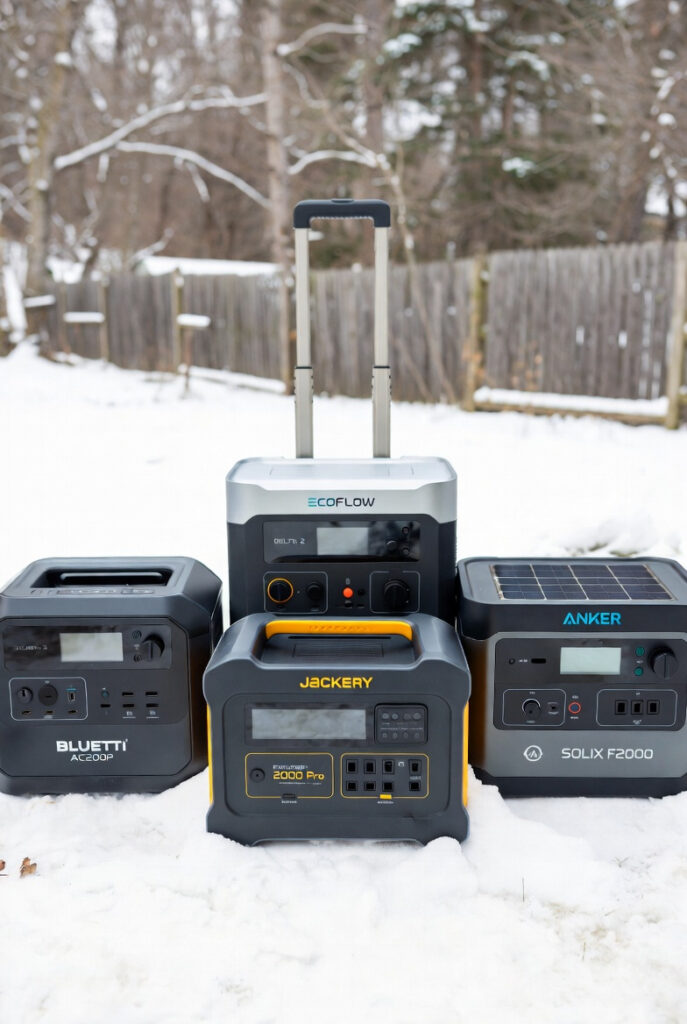
The best solar generator for home backup 2026 is not a magic box. Every technician has a service cart with a battery charger, a jump pack, a multimeter, and a power supply on wheels. A solar generator is that same idea applied to your home. Battery, inverter, and charger in one chassis. No wiring, no permits, no installation required.
The Costco unit that fails to start a well pump is not a bad solar generator. It is the wrong solar generator bought without a load calculation. That is a diagnostic problem, not a product problem. The best solar generator for home backup matches the 48-hour load calculation, not the biggest number on the box.
The market has matured significantly. LFP chemistry is now standard across all four units reviewed here, with a baseline of 4,000 cycles and UPS-speed switching. For system sizing fundamentals, see the solar sizing guide.
| Decision Point | Generic Buyer Approach | Ontario Master Tech Standard |
|---|---|---|
| Unit selection | Biggest wattage number | 48-hour load calculation first |
| Capacity check | Wh on the box | Wh minus 25% winter correction |
| Surge rating | Often ignored | Must exceed well pump startup |
| Cold weather | Not considered | Sub-zero LFP charging verified |
| Expandability | Buy the biggest unit | Start right, expand as needed |
Best Solar Generator for Home Backup: Four Units That Work
| Unit | Watt-Hours | Continuous | Surge | Price |
|---|---|---|---|---|
| Bluetti Elite 200 V2 | 2,073Wh | 2,600W | 3,900W | $1,299 |
| EcoFlow DELTA Pro 3 | 4,096Wh | 4,000W | 6,000W | $1,999 |
| Jackery HomePower 3000 | 3,072Wh | 3,600W | 7,200W | $899 to $1,299 |
| Anker SOLIX C1000 Gen 2 | 1,056Wh | 1,500W | 2,400W | $599 |
Watt-Hours vs Watts: The Fuel Tank and the Engine
The most important concept in evaluating the best solar generator for home backup is the difference between watt-hours and watts. Watt-hours determine how long the unit lasts. Watts determine how much it can power at once. Both numbers matter for Ontario backup.
An Ontario well pump draws 750 to 1,200W to run and 3,000 to 5,000W to start. You need the peak watts to start it and the watt-hours to run it for 48 hours. A unit that starts the pump but runs dry in 90 minutes is a single-event tool, not a home backup solution.
Pro Tip: Calculate your 48-hour load before you buy. Fridge at 80W plus router at 10W plus lights at 30W plus CPAP at 30W equals 150W. Over 48 hours that is 7,200Wh. The unit that looks big enough on the spec sheet may not get you through the outage.
Bluetti Elite 200 V2: Best Overall Balance
The Bluetti Elite 200 V2 offers 2,073Wh of LFP capacity, 2,600W continuous, and 3,900W surge in Hercules mode. It charges from 0 to 80 percent in 50 minutes via Turbo mode. It accepts up to 1,000W of solar input and delivers over 6,000 cycles to 80 percent capacity.
The limitation is capacity. At 2,073Wh the Bluetti covers a 150W essential load for approximately 14 hours before needing a recharge. For a 48-hour outage without solar, that means at least 3 recharge cycles. Best for homeowners who want fast charging speed and portability in a single unit.
EcoFlow DELTA Pro 3: Best for Heavy Loads
The EcoFlow DELTA Pro 3 delivers 4,096Wh of LFP capacity, 4,000W continuous, and 6,000W via X-Boost. It expands to 48kWh with additional battery modules. The 10ms UPS switchover is the fastest in this comparison. Dual voltage at 120V and 240V runs a 240V well pump natively.
The IP65-rated battery pack handles weather exposure that damages competitors. For homeowners who need to connect to a home panel during an outage, the Jackery vs EcoFlow comparison covers the full breakdown. The best solar generator for home backup when heavy loads and expandability matter most.
Jackery HomePower 3000: Best for Storage Readiness
The Jackery HomePower 3000 provides 3,072Wh of LFP capacity, 3,600W continuous, and 7,200W surge. ZeroDrain technology retains approximately 95 percent charge after 12 months in storage. A unit purchased today is ready for a December ice storm next year without a maintenance charge.
The critical limitation is non-expandability. 3,072Wh is the maximum with no add-on battery option. If the 48-hour load exceeds 3,072Wh, a second unit is the only expansion path. Best for homeowners who want long-term storage reliability and simplicity.
Anker SOLIX C1000 Gen 2: Best for Ontario Cold Weather
The Anker SOLIX C1000 Gen 2 offers 1,056Wh of LFP capacity, 1,500W continuous, and 2,400W surge. Cold-weather optimised LFP chemistry with BMS protection allows sub-zero operation that throttles most competitors below 0C. It pairs with SOLIX expansion batteries for increased runtime.
Best for Rockwood and rural Ontario homeowners who need reliable coverage for lights, router, CPAP, and small appliances during ice storms. If well pump capacity is required, step up to the DELTA Pro 3. For the detailed cold weather analysis, see the solar battery guide.
The 48-Hour Buyer Checklist for Ontario
Do not buy for the average power outage. The average Ontario outage is under four hours. Buy for the December ice storm that takes the grid down for 48 hours. The math is straightforward. Fridge at 80W, router at 10W, lights at 30W, CPAP at 30W. That is 150W continuous over 48 hours equaling 7,200Wh.
Expandability is the standard for the best solar generator for home backup. The EcoFlow DELTA Pro 3 expands to 48kWh. The Jackery HomePower 3000 does not expand at all. A unit that grows with you protects the investment. Solar input rating matters for extended outages where 1,000W enables practical daytime recharge.
Code Compliance for Portable Solar Generators in Ontario
NEC Article 445 covers portable generators used as temporary power sources. Portable solar generators are not subject to NEC 690 fixed PV requirements because they are not permanently connected. Running extension cords from a portable solar generator to appliances is code-compliant. Hardwiring to the panel without a transfer switch is not. Contact the NFPA (National Fire Protection Association) for current requirements.
CEC Section 22 governs portable generators in Ontario. Portable solar generators are exempt from permit requirements that apply to fixed solar PV under CEC Rule 64. If connected to home wiring through any outlet, the CEC requires a listed transfer device to prevent backfeed. Contact the ESA (Electrical Safety Authority) for current requirements.
- The Bluetti Elite 200 V2 is the best overall for Ontario homeowners who want fast charging, proven LFP reliability, and a portable format at 2,073Wh.
- The EcoFlow DELTA Pro 3 is the best for heavy loads, dual voltage, and expandability to 48kWh for serious 48-hour outages.
- The Jackery HomePower 3000 is the best for long-term storage readiness with 95 percent charge retention after 12 months.
- The Anker SOLIX C1000 Gen 2 is the best for Rockwood winters and rural Ontario essentials coverage with cold-weather optimised LFP.
Frequently Asked Questions
What is the best solar generator for home backup in Ontario?
The EcoFlow DELTA Pro 3 at 4,096Wh with dual 120V/240V output is the best for heavy loads and expandability. The Anker SOLIX C1000 Gen 2 is the best for cold-weather essentials coverage. The right answer depends on your 48-hour load calculation.
How long will a solar generator last during an Ontario ice storm?
A 150W essential load over 48 hours consumes 7,200Wh. The DELTA Pro 3 at 4,096Wh covers roughly 27 hours on a single charge. The Jackery HomePower 3000 at 3,072Wh covers 20 hours. For 48-hour coverage you need either expansion batteries or solar recharging.
Do I need a transfer switch for a portable solar generator?
Only if you connect it to your home electrical panel. Running extension cords to appliances is code-compliant without a transfer switch. Hardwiring to the panel requires a listed transfer switch and may require an ESA inspection.
Can a solar generator run a well pump in Ontario?
Only if the surge rating exceeds the pump startup draw of 3,000 to 5,000W. The EcoFlow DELTA Pro 3 at 6,000W X-Boost handles most well pumps. The Jackery HomePower 3000 at 7,200W surge handles them cleanly. Units under 3,000W surge will trip on the first pump cycle.
This build is engineered within the 48V DC Safety Ceiling. Diagnostic logic is based on 20+ years of technical service experience. All structural and electrical installations must be verified by a Licensed Professional and comply with your Local AHJ.
About the Author
Robert Bertrand spent 20 years as a service advisor in the automotive industry (Lexus and Nissan), where precision diagnostics, wiring integrity, and documentation standards were non-negotiable. He brings that same technical discipline to GridFree Guide, where he researches, tests, and documents off-grid solar systems for Ontario conditions. Based in Rockwood, Ontario, every article is built on verified specifications, manufacturer data, and the real-world climate constraints of Canadian off-grid living.
As an Amazon Associate I earn from qualifying purchases. This site also contains affiliate links to other products and services. GridFree Guide earns a small commission at no extra cost to you.