
This post contains affiliate links. If you purchase through our links, we may earn a small commission at no extra cost to you.
Off-grid dc lighting systems are the fastest way to reclaim 50 to 100 watts of overnight battery drain in a Fortress build. I had a client call after their first winter off-grid outside Rockwood. Battery draining overnight, lights off by 9 PM, still flat by 4 AM. Walked through the system remotely. Found it immediately: the inverter was sitting at idle, burning 85 watts all night, to power two 9-watt LED bulbs wired through the AC panel. That is like idling a semi-truck engine to charge a cell phone. The load was almost irrelevant. The overhead was the problem. 85 watts times 10 hours is 850 watt-hours. On a 200Ah 48V bank that is nearly 15% of usable capacity gone before a single light actually turns on.
Why Off-Grid DC Lighting Systems Beat the Inverter Every Time
The math of inverter idle draw vs LED load is stark. A typical 5,000W inverter running two 9W LED bulbs has an effective system efficiency of roughly 10%, because the 85W idle draw dwarfs the 9W load. By removing the inverter from the lighting circuit and using a purpose-built DC-DC converter drawing 3 to 5W of overhead, you achieve an effective efficiency above 90% for the same two bulbs. The difference is 80 watts. Over a 10-hour night that is 800Wh reclaimed from a battery that does not grow any larger in a Rockwood January. In cold climates, batteries derate under load, and every watt-hour counts. If you want the full picture on what your inverter costs you at idle, the inverter idle draw guide covers the numbers. For the broader DC architecture that makes native off-grid dc lighting systems possible, see the DC coupling standard.
12V vs 24V: Choosing the Right Voltage for Your DC Lighting Circuit
While 12V is simpler and fixtures are widely available, voltage drop over distance matters. A 10-metre run at 5A on 14AWG wire loses nearly 0.5V, which is 4% of a 12V system. The same run on a 24V DC lighting circuit loses the same 0.5V but represents only 2% of the supply voltage. For any cabin larger than roughly 600 square feet, or any lighting run longer than 7 metres, 24V is the correct choice for an off-grid dc lighting system. The Victron Orion 48V-to-24V DC-DC converter is the standard interface between the 48V Fortress bus and a 24V lighting sub-panel. For longer runs, the DC voltage drop guide covers conductor sizing in detail.
| Voltage | Run Distance | Minimum Wire Gauge |
|---|---|---|
| 12V | 5m | 14AWG |
| 12V | 7m | 12AWG |
| 12V | 10m | 10AWG |
| 24V | 5m | 16AWG |
| 24V | 7m | 14AWG |
| 24V | 10m | 12AWG |
How to Wire Off-Grid DC Lighting Systems: The Sub-Panel Standard
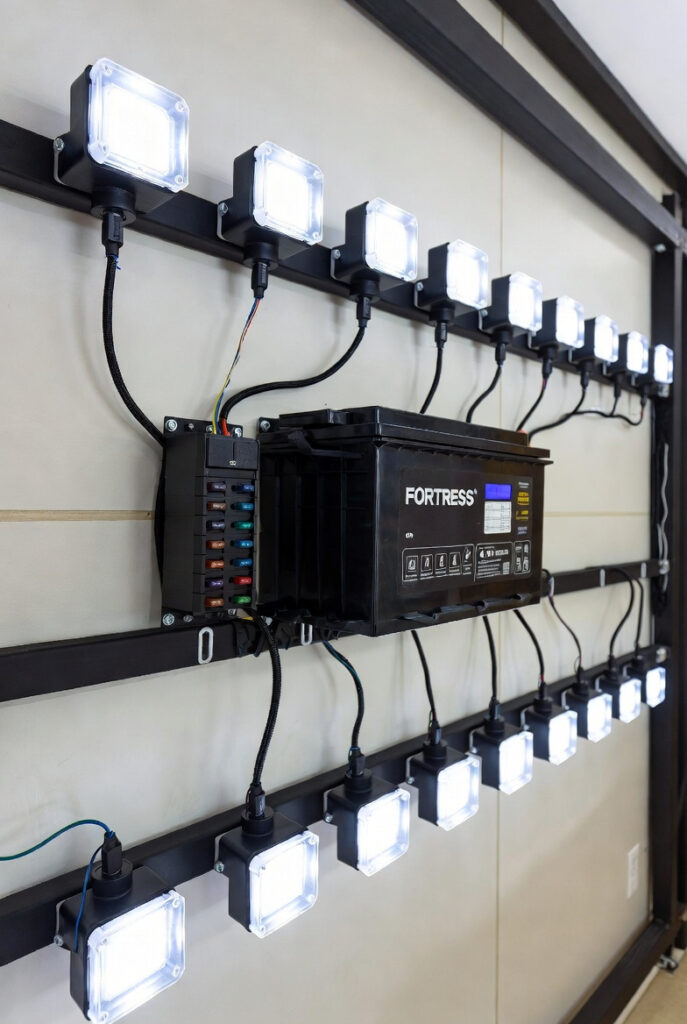
The dedicated lighting fuse block is separate from the main DC distribution panel. This means a lighting fault cannot pull down the whole system. Individual zone fuses are the standard: bedroom 5A, kitchen 5A, power room 5A, barn exterior 10A. The cable run from the DC-DC converter to the fuse block should be 10AWG rated DC cable sized for the total lighting load with a minimum 25% headroom.
Standard AC wall dimmers do not work on DC circuits. AC dimmers use a triac switching device that relies on the AC waveform crossing zero volts to extinguish the arc on each half-cycle. DC voltage does not cross zero. A triac dimmer on a DC circuit creates a sustained arc at the switching point and will burn out the dimmer or ignite insulation at the contact point. DC LED dimming requires a PWM controller rated for DC voltage and the specific LED load. This is not optional. It is a fire prevention standard.
In my own barn setup outside Rockwood I have a single 24V LED strip wired directly off the DC bus through a 10A fuse, no inverter in the circuit at all. The inverter failed on a January night at minus 22. The cooling fan seized. AC power in the barn went dark. That strip was the only reason I could see the terminals, the fuse block, and the Cerbo GX display well enough to diagnose the problem. I had the fan bypassed and the inverter back on in 40 minutes. Without that strip I would have been doing it by flashlight at minus 22 trying not to drop a metal tool across the busbar. DC emergency lighting in the power room is not a comfort feature. It is a diagnostic tool.
To terminate the fuse block connections correctly, use a ratcheting crimper for a mechanically sound lug. For terminal treatment on DC fuse block connections, the ferrule standard covers the detail.
The Emergency Light Standard: DC Redundancy in the Power Room
Every power room needs one always-on DC emergency light connected directly to the battery bank through a dedicated fuse, bypassing all switching. A 3W 24V LED strip costs less than $20. When the inverter fails in January you need to see the terminals, the fuse block, and the Cerbo display. Label the circuit with red tape: EMERGENCY DC – DO NOT REMOVE. This is the first DC circuit installed in an off-grid dc lighting system, before commissioning, before anything else.
Pro Tip: A 3W DC emergency light in your power room costs less than $20. A blind restart on a failed inverter at minus 22 costs you the whole system.
NEC and CEC: What the Electrical Codes Say About DC Lighting Circuits
NEC Article 411 covers low-voltage lighting systems, DC circuits at 30V or less, appropriate wiring methods, and overcurrent protection. NEC 690.31 extends PV wiring requirements to off-grid source circuits, and NEC 300.4 requires mechanical protection for exposed conductors. A dedicated fuse block with individually fused circuits and correctly gauged wire meets the intent of all three requirements. Improvised DC wiring: unfused runs, undersized wire, or AC components used on DC does not.
CEC Section 30 covers low-voltage systems and requires overcurrent protection for all conductors. In Ontario the ESA may require inspection for new DC wiring in a permanent structure depending on scope. A properly installed DC lighting sub-panel with correct wire gauge, listed DC fuses, and appropriate connectors is code-compliant. DC wire stapled to barn rafters without protection is not. For the full system sizing context that determines how much your off-grid dc lighting system needs to reclaim, the off-grid system sizing hub covers the load calculation.
The Verdict
Off-grid dc lighting systems are not a decorating choice. They are a battery management standard.
- Wire your lighting circuits native DC and remove the inverter from the overnight equation. 800Wh per night reclaimed in a Rockwood January is not a rounding error.
- Use 24V for any run over 7 metres. Voltage drop on 12V over distance is real and the fix is the right voltage at the start, not heavier wire after the fact.
- Install one always-on emergency DC light in the power room before commissioning. When the inverter goes down in January you need to see what you are working with.
In the shop, we do not use an adapter when a direct fit exists. In the Fortress, DC lighting is your Limp Home mode. If the inverter fails, you are not left in the dark.
Questions? Drop them below.
About the Author
Robert Bertrand spent 20 years as a service advisor in the automotive industry (Lexus and Nissan), where precision diagnostics, wiring integrity, and documentation standards were non-negotiable. He brings that same technical discipline to GridFree Guide, where he researches, tests, and documents off-grid solar systems for Ontario conditions. Based in Rockwood, Ontario, every article is built on verified specifications, manufacturer data, and the real-world climate constraints of Canadian off-grid living.
As an Amazon Associate I earn from qualifying purchases. This site also contains affiliate links to other products and services. GridFree Guide earns a small commission at no extra cost to you.