
Disclosure: This post contains affiliate links. If you purchase through our links, we may earn a small commission at no extra cost to you.
Off-grid DC coupling is the efficiency standard that eliminates unnecessary conversion losses from your always-on loads by routing them directly through a native DC sub-panel rather than through the inverter. I explain this concept on the service drive using a story about a GS450h customer who idled their car every morning for 30 minutes to maintain the 12V accessory battery. The hybrid system’s idle power consumption was 1,400W. The accessory draw being maintained was 40W. I calculated the numbers for them on a piece of paper: 1,400W consumed, 40W delivered, 1,360W wasted as heat. They stopped idling the car that week. In your off-grid Fortress, a Victron MultiPlus-II at standby draws 35-50W just to maintain its ready state. If the only load running at 2am is a Starlink dish and a router consuming 65W combined, the inverter overhead is between 35% and 43% of total system draw. Off-grid DC coupling is the direct-fit solution that removes the V8 engine from that equation. Make sure your system sizing is correct before building the DC sub-panel; the loads being moved must be identified accurately.
Why Off-Grid DC Coupling Eliminates Conversion Loss at the Source
Every AC load in an off-grid system follows a conversion path: DC from the battery bank is converted to AC by the inverter, and then most AC loads convert that AC back to DC internally to run their electronics. A phone charger, a router, a Starlink dish, and most LED drivers all run on DC internally. The AC supply is a compatibility layer, not a functional requirement.
Each conversion stage carries a loss. A quality inverter at 92-94% efficiency. An AC-DC adapter at 85-90% efficiency. An internal device converter at 90-93% efficiency. Three stages in series: 0.92 × 0.88 × 0.92 = 0.745. A three-stage conversion path delivers approximately 74-78% of the battery energy that entered the first stage. The remaining 22-26% is heat dissipated in the inverter case, the adapter body, and the device’s internal regulator.
A 48V-to-12V DC-DC converter at 98% efficiency is a single stage. It delivers 98% of the battery energy to the load. The difference between a three-stage AC path and a single-stage DC path for a 65W load running 24 hours is approximately 15-18Wh per day lost as heat in the adapter stack. Multiply that across three or four always-on loads and the DC sub-panel recovers 50-80Wh per day that the inverter path was losing silently. That energy goes back into the battery bank. In a Rockwood cloud-cover week, those recovered watt-hours matter.
The 30-day monitoring protocol builds the energy audit that identifies exactly which loads to move. The DC voltage drop guide covers the conductor sizing for DC branch circuits. This article covers the architecture and the implementation sequence.
The Off-Grid DC Coupling Sub-Panel Architecture
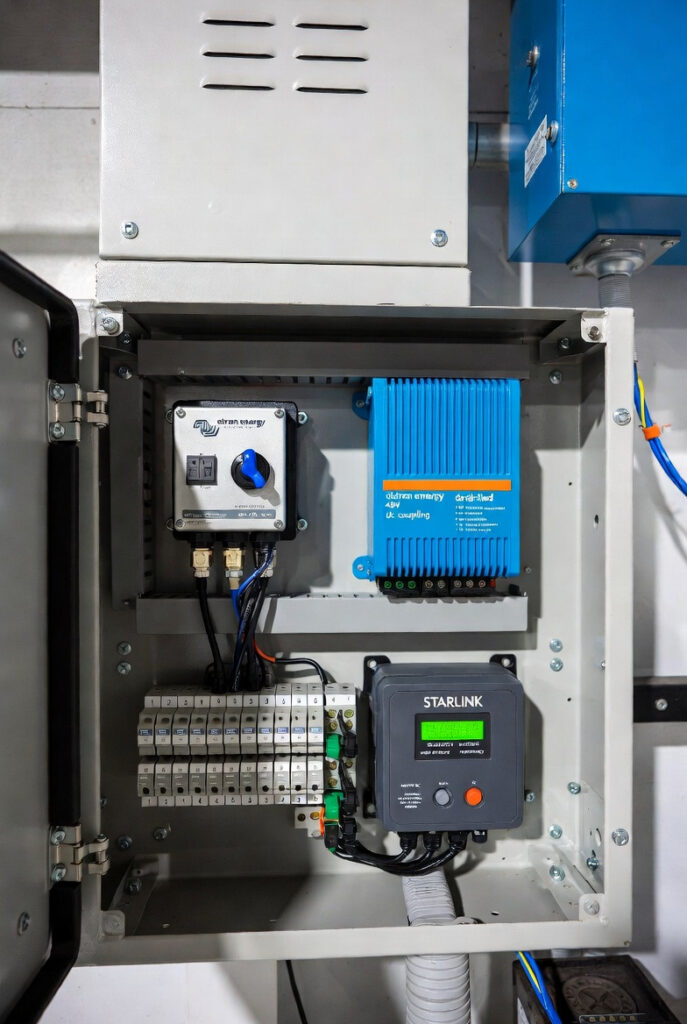
The DC sub-panel is a 48V distribution bus fed directly from the battery bank through a dedicated disconnect and overcurrent protection. It powers a 48V-to-12V DC-DC converter whose 12V output feeds all of the always-on low-voltage loads. The Victron MPPT 100/30 charge controller feeds the battery bank at 48V; the DC sub-panel draws from that same 48V bus downstream of the MPPT output.
The 48V bus feeds three circuit types. The first is the DC-DC converter input: a high-efficiency buck converter rated for 48V input and 12V output at the required current for the combined 12V load. Minimum efficiency specification is 95%; units rated at 97-98% are available and the efficiency difference is worth the cost for an always-on converter. The second circuit type is any load that accepts 48V direct input, such as some LED driver modules and industrial DC lighting. The third is a dedicated fused circuit for each branch load.
Each branch circuit leaving the 48V bus requires an individual fuse rated for the branch conductor ampacity at 48V DC interrupting capacity. As covered in the DC fusing guide, standard automotive blade fuses are rated for 32V DC and are not suitable for 48V system branch circuits. Midi fuses or Class T fuses rated for 58V DC or higher are the correct specification. Size each fuse at 125% of the maximum continuous branch current.
The Victron SmartShunt 500A installed in the DC sub-panel feed confirms the current draw from the bus in real time and provides the before-and-after measurement that quantifies the efficiency gain when each load is moved from AC to DC.
Starlink Native DC Conversion: The Highest-Return Off-Grid DC Coupling Project
A client on a 48V system was running Starlink through its factory AC power brick. Their energy audit showed Starlink plus router at 118Ah per day, higher than the manufacturer’s rated consumption. I traced the power path: 48V battery bank to MultiPlus-II inverter to 120V AC to Starlink AC power brick to Starlink internal DC converter to dish. Three conversion stages. At 7-10% loss per stage, between 18% and 27% of the energy leaving the battery was lost before reaching the dish.
After converting to a 48V-to-12V DC-DC converter feeding the Starlink dish directly through a third-party DC input cable, measured consumption dropped to 94Ah per day. Twenty-four Ah per day recovered from the same dish, doing the same work, in the same location. In a cloud-cover event where the system draws down at net 34Ah per day from the battery bank, that 24Ah saving extends the days of autonomy by 0.7 days. In a Rockwood February cloud-cover week, 0.7 days is the difference between the system recovering cleanly when the sun returns and hitting the LVC before it does.
Starlink Generation 2 and Generation 3 dishes accept 48V direct DC input through third-party passive PoE cables that replace the AC power brick entirely. No modification to the dish is required. The dish operates identically. The AC brick and its conversion losses are removed from the circuit. This is the highest-return individual off-grid DC coupling project available on a typical Victron-based system.
Inverter Sleep Mode: The Overnight Idle Saving From Off-Grid DC Coupling
With always-on loads moved to the DC sub-panel, the MultiPlus-II AC output has no continuous load overnight. This enables inverter search mode, which changes the inverter’s overnight idle behaviour from continuous standby to periodic polling.
In search mode, the MultiPlus-II activates its AC output for 2 seconds at the configured interval, checks for a load above the search sensitivity threshold (configurable from 15W to 50W), and if no load is detected, returns to a low-power wait state. Average power draw in search mode with a 6-second poll interval: approximately 6W. Continuous standby draw: 35-50W. The overnight saving from search mode alone is 29-44W continuously through the 10-12 hours per night when no AC loads are active.
Combined with the DC sub-panel conversion loss recovery, the total overnight efficiency improvement is 80-130Wh per night depending on the load profile and inverter model. Over a 30-day month that is 2,400-3,900Wh recovered from loads that were already being paid for. The battery bank experiences less depth of discharge each night. The solar array has less recovery work to do each morning. The system’s days of autonomy during cloud cover increase without adding a single panel or a single cell. The low voltage cutoff guide covers how the improved autonomy figure changes the correct LVC setting for a system running a DC sub-panel.
NEC and CEC: What the Electrical Codes Actually Say
NEC 551.10 addresses low-voltage DC systems and requires that DC branch circuits be protected by overcurrent devices rated for the system voltage. For a 48V DC sub-panel, this means all fusing and overcurrent devices must be rated for a minimum of 58V DC interrupting capacity. NEC 445.13 requires that DC conductors be sized for the maximum circuit current and protected accordingly. A DC sub-panel branch circuit supplying a 12V DC-DC converter drawing 8A at 48V must have a conductor and fuse both rated for that current at 48V DC, not at 12V AC or 32V DC ratings.
CEC Section 64-400 governs DC distribution systems in Canada and requires that DC wiring be installed in a manner that prevents shock hazard and that all live parts be protected against accidental contact. A 48V DC sub-panel with exposed bus connections must be in a listed enclosure with appropriate IP rating for the installation location. CEC Rule 26-700 requires that DC branch circuit overcurrent protection be located as close as practical to the point where the branch circuit originates from the DC bus. For the DC sub-panel, each branch fuse must be mounted at the bus connection, not at the load end of the circuit.
Quick Reference – Off-Grid DC Coupling Implementation
| Load Type | Current Path | Recommended Solution | Typical Daily Saving |
|---|---|---|---|
| Starlink Gen 2/3 | AC brick (3 conversion stages) | 48V native DC input via PoE cable | 20-25Ah per day |
| Router and network switch | AC adapter | 12V DC-DC converter output | 3-5Ah per day |
| LED lighting circuits | AC driver | 12V DC direct drive or 48V LED driver | 5-10Ah per day |
| USB charging stations | AC adapter | 12V DC USB hub | 2-4Ah per day |
| Inverter overnight standby | Continuous 35-50W | Search mode enabled when DC sub-panel active | 350-600Wh per night |
| All above combined | Multiple AC paths | DC sub-panel with 48V-to-12V converter | 30-50Ah per day total |
Before building the DC sub-panel, run a one-week audit with the Victron SmartShunt 500A monitoring total daily Ah consumption. Then move the first load to DC, wait one week, and compare. Move the second load, wait one week, compare again. This staged approach gives you a precise Ah-per-load saving figure for each circuit, which tells you whether the DC conversion project for that load is worth the hardware cost. Some loads deliver 24Ah per day in savings. Others deliver 2Ah. Know the number before buying the hardware.
The Verdict
Off-grid DC coupling is the efficiency upgrade that recovers energy that was already being paid for. The loads do not change. The work done does not change. The conversion path changes.
Before building the DC sub-panel:
- Run the one-week energy audit with the SmartShunt to identify the always-on loads by daily Ah consumption; the loads drawing more than 10Ah per day that run continuously are the priority candidates for DC conversion
- Build the DC sub-panel with a 48V bus, a 97-98% efficiency DC-DC converter for the 12V rail, individual Midi or Class T fuses at 58V DC rating for each branch, and a dedicated disconnect; the sub-panel is a safety device as well as an efficiency device and it must be built to code
- Enable inverter search mode after the always-on loads are on the DC sub-panel; the search mode saving is only available after the AC output is clear of continuous loads overnight
The direct fit is always more efficient than the adapter. Off-grid DC coupling is the direct fit for every load that does not actually need AC to do its job.
Questions? Drop them below.
About the Author
Robert Bertrand spent 20 years as a service advisor in the automotive industry (Lexus and Nissan), where precision diagnostics, wiring integrity, and documentation standards were non-negotiable. He brings that same technical discipline to GridFree Guide, where he researches, tests, and documents off-grid solar systems for Ontario conditions. Based in Rockwood, Ontario, every article is built on verified specifications, manufacturer data, and the real-world climate constraints of Canadian off-grid living.
As an Amazon Associate I earn from qualifying purchases. This site also contains affiliate links to other products and services. GridFree Guide earns a small commission at no extra cost to you.