
Disclosure: This post contains affiliate links. If you purchase through our links, we may earn a small commission at no extra cost to you.
Off-grid conduit wiring is the skeletal system of the Fortress power plant: get the selection and fill calculation right and the conductors run cool and protected for a decade; get it wrong and the fault happens inside the wall where it cannot be found without opening everything up. I learned the importance of matching protection to environment early in my career: a shop apprentice repaired an engine harness and zip-tied the repaired section to the exhaust manifold heat shield because it was tidy and convenient. The loom bracket that the original harness used was right there. The apprentice used a zip tie instead. Three weeks later the car came back with melted insulation and a P0301 misfire code. The bracket existed because the designer knew what that wire would be next to. In your off-grid Fortress the conduit selection standard exists for the same reason. The 4/0 battery cable needs to be in the right pipe for the environment it runs through. Not the smallest pipe that fits. The right pipe. Make sure your system is sized correctly before selecting conduit; the conductor sizes that drive the fill calculations come from the load calculation.
Off-Grid Conduit Wiring: Conduit Type Selection by Run Environment
There are four conduit types used in off-grid installations and each has a specific application envelope.
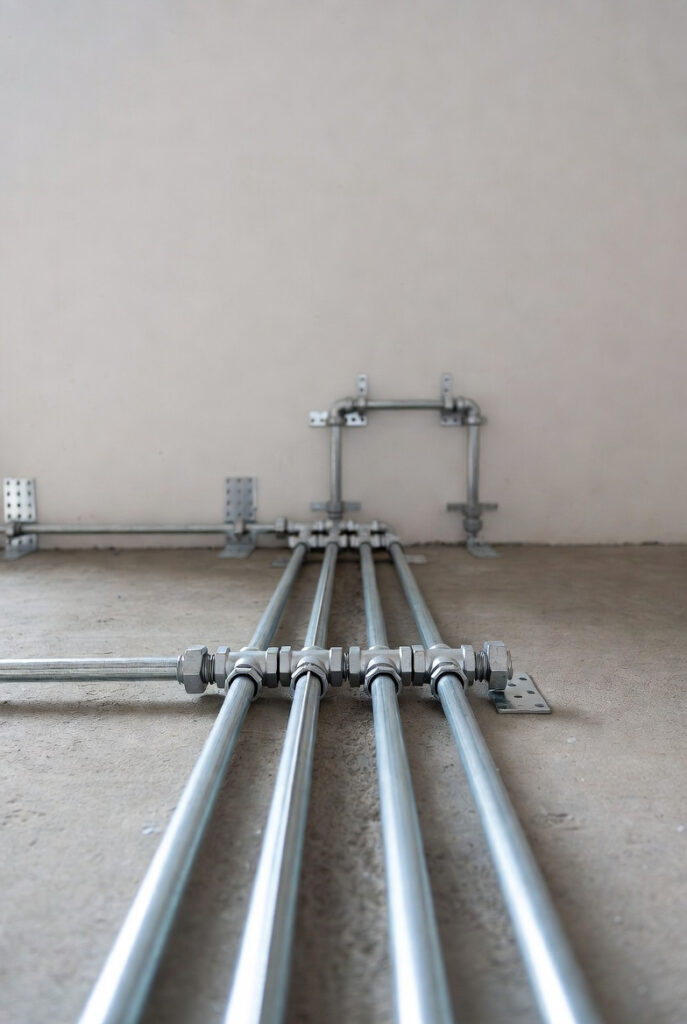
Electrical metallic tubing, commonly called EMT, is the standard for indoor equipment room runs. It is lightweight, easy to cut and bend with standard tools, and accepts compression fittings that are rated as equipment grounding conductors when properly installed. Every run along the equipment room wall from the battery bank to the inverter, from the inverter to the AC panel, and from the MPPT to the combiner box should be EMT unless the run exits the building or is subject to physical damage below 8 feet of height. EMT is not appropriate for outdoor exposed runs subject to weather, underground runs, or anywhere it might be struck by equipment.
Rigid metal conduit, or RMC, is the appropriate choice for any run that is exposed to physical damage: runs along the base of a barn wall where a battery rack or equipment dolly might contact them, runs through a workshop area, and any exterior surface-mount run below 8 feet. RMC is significantly heavier than EMT and requires threaded fittings, but it provides impact protection that EMT cannot. For a Rockwood barn installation where a loaded hay fork or a battery on a hand truck shares the space with the conduit runs, RMC is the correct specification for all vulnerable sections.
Liquid-tight flexible metallic conduit, abbreviated LFMC, is the correct choice for the final connection to any equipment that vibrates, requires periodic access for maintenance, or needs a degree of movement tolerance. Every inverter connection should terminate with a minimum 300mm (12-inch) flexible loop of LFMC rather than a rigid EMT stub going directly to the cabinet. As covered in the solar inverter ventilation guide, inverters require clearance and access for maintenance. The LFMC loop provides the movement tolerance that prevents vibration-induced loosening at the inverter terminals covered in the inverter terminal torque guide.
PVC Schedule 40 is the correct conduit for underground runs between buildings. EMT and RMC are not rated for direct earth burial without additional protection. A buried conduit run from the main building to an outbuilding combiner box should be PVC Schedule 40 at a minimum depth of 600mm (24 inches) per CEC Section 12-012 for general wiring or 450mm (18 inches) for conduit in concrete. Seal the conduit ends with duct seal compound at both terminations to prevent moisture migration and, as a secondary benefit, conduit entry by rodents.
The Off-Grid Conduit Wiring Fill Calculation: Why the 40% Rule Exists
NEC Chapter 9 Table 1 requires that three or more conductors occupy no more than 40% of a conduit’s cross-sectional area. The reason is thermal: conductors carrying current generate heat, and that heat must dissipate through the conduit wall and into the surrounding air. When conductors are packed too tightly, the heat they generate accumulates inside the conduit faster than it can escape. The insulation temperature rating is exceeded. The insulation degrades. The fault happens inside the wall.
The calculation uses the cross-sectional area of each conductor from NEC Chapter 9 Table 5 and the internal area of the conduit from NEC Chapter 9 Table 4. For a typical 48V off-grid inverter DC feed with three 4/0 AWG THWN conductors, the positive, negative, and equipment ground, each 4/0 THWN cross-sectional area is 0.3237 square inches. Total for three conductors: 3 × 0.3237 = 0.9711 square inches.
Working through the conduit options: 1-inch EMT has an internal area of 0.864 square inches, giving a fill ratio of 0.9711 divided by 0.864 = 112% of the conduit area. Over the limit by a factor of nearly three. 1.5-inch EMT has an internal area of 1.610 square inches: fill ratio 60%. Still over. 2-inch EMT has an internal area of 2.013 square inches: fill ratio 48%. Still over. The correct conduit for three 4/0 THWN conductors is 2.5-inch EMT, which has an internal area of 3.356 square inches, giving a fill ratio of 29%.
Three months after commissioning a system outside Rockwood, a client noticed the 1-inch EMT run from the battery bank to the Victron MultiPlus-II was warm to the touch at the midpoint. Pulled the run. Three 4/0 THWN conductors plus two 10AWG communication cables. Total fill: 68%. The run had been operating at 170% of the allowed fill ratio since commissioning. Pulled the communication cables into a dedicated 1/2-inch EMT run, replaced the 1-inch with 1.5-inch EMT for the power conductors only. Recalculated fill with three 4/0 THWN in 1.5-inch EMT: 60%. Still over. Added a second parallel 1.5-inch EMT for the negative conductor and the EGC, leaving the positive conductor alone in the first 1.5-inch EMT at 20% fill. The warmth in the conduit disappeared within 24 hours. The DC voltage drop guide covers the conductor sizing calculation. The fill calculation determines what conduit size that conductor requires.
Communication Cable Separation: The Off-Grid Conduit Wiring Code Requirement
Running communication cables in the same conduit as power conductors is a code violation, not just a noise problem. NEC 725.136 prohibits Class 2 and Class 3 circuit conductors from being installed in the same conduit, cable tray, or raceway as power conductors unless the power conductors are in a metal-sheathed cable or individual conduit. Victron VE.Direct cables, battery temperature sensor leads, Cerbo GX communication cables, and any other signal wiring in the system are Class 2 circuits. Running them in the same EMT as the 4/0 power conductors violates NEC 725.136 regardless of whether noise interference is actually observed.
The practical solution is a dedicated 1/2-inch EMT run for all communication cables, routed parallel to the power conduit runs but at a minimum 150mm (6 inches) of separation where possible. Label both conduits clearly at each end: one label for power, one for communications. The separation solves the code compliance issue and the interference issue simultaneously. Use 10AWG solar cable for any DC power runs in the communication conduit that carry monitoring current rather than load current; keeping the conductor gauge consistent with the rest of the installation simplifies future modifications.
NEC and CEC: What the Electrical Codes Actually Say
NEC 300.17 requires that the number and size of conductors in any conduit not exceed that permitted by the percentage fill specified in Chapter 9 Table 1. This is the foundational fill requirement that applies to every conduit run in the off-grid installation regardless of voltage level or circuit type. NEC 690.31 specifies that PV source and output circuit conductors be installed using wiring methods suitable for the location and environment, which means EMT for indoor protected runs, RMC for exposed runs subject to physical damage, LFMC for equipment connections, and direct-burial PVC for underground runs. The conduit type selection is a code requirement derived from the installation environment, not a preference.
CEC Section 12-900 governs conduit fill requirements in Canada and applies the same 40% fill limit for three or more conductors as the NEC Chapter 9 standard. CEC Section 12-100 specifies the wiring methods permitted for each installation environment; the applicable subsections for PV and energy storage system wiring in Ontario require that conductors be protected by conduit appropriate to the location. A barn installation where the conduit run is exposed to physical contact from equipment requires RMC or equivalent protection as specified by CEC Section 12-100 for exposed wiring in agricultural locations. The off-grid system grounding guide covers the bonding requirements for metallic conduit; an EMT run that serves as a supplementary equipment grounding conductor must be bonded at both ends with listed fittings to satisfy both the grounding requirement and the conduit installation standard.
Quick Reference – Off-Grid Conduit Wiring Selection Standard
| Conduit Type | Application | Not Appropriate For | Key Requirement |
|---|---|---|---|
| EMT | Indoor equipment room runs, wall-mounted in protected locations | Outdoor exposed, underground, impact zones below 8 ft | Listed compression fittings; bond at both ends for grounding path |
| RMC | Exposed runs subject to physical damage, exterior surface-mount below 8 ft | Underground without additional protection | Threaded fittings; heavier and requires threading tools |
| LFMC | Final equipment connection with 300mm flex loop minimum | Long runs, underground | Rated for the location; provides vibration tolerance |
| PVC Schedule 40 | Underground runs between buildings | Indoor runs requiring equipment grounding path | 600mm minimum burial depth per CEC; seal ends with duct seal |
| Dedicated communication conduit | VE.Direct, temperature sensor, Cerbo GX cables | Power conductors (NEC 725.136 separation required) | 1/2-inch EMT minimum; 150mm separation from power conduit |
| Fill calculation | All conduit types with 3+ conductors | N/A | 40% maximum fill per NEC Chapter 9 Table 1 / CEC Section 12-900 |
Run the fill calculation before purchasing conduit, not after cutting it. The common mistake is buying conduit based on the largest single conductor diameter, cutting the run, and then discovering the fill ratio is over 40% when all conductors are added. Look up the cross-sectional area for every conductor in the run from NEC Chapter 9 Table 5, add them, divide by the conduit internal area from Table 4, and confirm the result is under 40% before the conduit goes in the cart. The calculation takes three minutes. Pulling and replacing an installed conduit run takes three hours.
The Verdict
Off-grid conduit wiring is a code-specified standard, not a collection of preferences. The conduit type is determined by the run environment. The conduit size is determined by the fill calculation.
Before routing any conductor in the Fortress:
- Select the conduit type based on the run environment: EMT for indoor protected runs, RMC for exposed runs subject to physical damage, LFMC for equipment connections, and PVC Schedule 40 for underground runs between buildings
- Calculate the fill ratio before purchasing conduit: sum the cross-sectional areas of all conductors in the run, divide by the conduit internal area, and confirm the result is under 40% for runs with three or more conductors
- Route communication cables in a dedicated separate conduit at least 150mm from power conduit runs; the separation is required by NEC 725.136 and it eliminates the interference source simultaneously
The bracket existed because the designer knew what that wire would be next to. Select the conduit the same way.
Questions? Drop them below.
About the Author
Robert Bertrand spent 20 years as a service advisor in the automotive industry (Lexus and Nissan), where precision diagnostics, wiring integrity, and documentation standards were non-negotiable. He brings that same technical discipline to GridFree Guide, where he researches, tests, and documents off-grid solar systems for Ontario conditions. Based in Rockwood, Ontario, every article is built on verified specifications, manufacturer data, and the real-world climate constraints of Canadian off-grid living.
As an Amazon Associate I earn from qualifying purchases. This site also contains affiliate links to other products and services. GridFree Guide earns a small commission at no extra cost to you.