
Disclosure: This post contains affiliate links. If you purchase through our links, we may earn a small commission at no extra cost to you.
Off-grid system insurance is the paperwork that has to exist before the event, not because of it. I learned this on the service drive: a customer whose vehicle was involved in an accident after an aftermarket suspension lift had been installed by a reputable shop. The receipts were organised. The work was documented. The modification existed before the accident. The disclosure to the insurer did not. The adjuster used the undisclosed modification as grounds to dispute the liability portion of the claim and the settlement dragged for four months. The receipts proved the cost. They did not prove the insurer had accepted the modification as part of the covered vehicle. Your off-grid Fortress is a $25,000 to $50,000 modification to an insured property. The parallel is exact. Make sure your system is sized and valued correctly before the insurance conversation; the insurer needs to know what they are covering before a claim requires them to decide.
Why Standard Home Insurance Policies Do Not Automatically Cover Off-Grid System Insurance
A standard homeowner policy is written around a grid-connected home with conventional electrical service. The policy schedules the dwelling, the personal property inside it, and the outbuildings under standard coverage categories. A $30,000 off-grid battery bank and solar array does not fit cleanly into any of those categories as written. The battery bank may be treated as personal property but subject to a sublimit that caps electronics coverage at $5,000. The solar panels on the roof may be treated as a permanent fixture of the dwelling but valued at actual cash value rather than replacement cost. The combiner box, charge controller, and inverter in the outbuilding may not be covered at all because they are not in the primary dwelling.
The first step in off-grid system insurance is a direct conversation with your current broker: describe the system completely, specify whether equipment is in the primary dwelling or a detached structure, provide the total replacement cost of all components, and ask specifically whether each category of equipment is covered and at what value. Most people discover that their system is partially covered but significantly undervalued. The fix is a scheduled endorsement, not a new policy.
The commissioning checklist documents the system as built and verified. The maintenance log documents the system as maintained. Both of these documents are what an adjuster needs to evaluate a claim. Both need to exist before a claim requires them.
The Two Policy Tools for Off-Grid System Insurance
A PV Rider is an endorsement added to a standard homeowner policy that schedules the solar array and all associated equipment as personal property with a specific replacement cost value. It covers the equipment as part of the home. The rider adds a named item to the policy with a stated value: 6 panels at $280 each, one Victron MPPT charge controller at $420, one Victron MultiPlus-II at $3,200, one LiFePO4 battery bank at $6,800, and so on through the full component list. Ask your broker whether the rider is written on a Replacement Cost Value basis or an Actual Cash Value basis. The difference matters: Actual Cash Value subtracts depreciation, and a three-year-old Victron inverter depreciated at standard electronics rates may settle at 55-60% of replacement cost. Replacement Cost Value pays what it costs to buy the equivalent equipment today.
An Inland Marine policy is a standalone policy that covers equipment regardless of location. It is the correct tool for equipment installed in outbuildings or barns that may not be considered part of the primary dwelling under the standard homeowner policy. A Fortress installed in a barn on the same property as the insured home may require an Inland Marine endorsement for the barn equipment even if the house has a PV Rider for the roof panels. Ask your broker specifically which policy form covers equipment in each location where your off-grid system equipment is installed.
The ESA Certificate: The Insurance Evidence Document in Ontario
The Electrical Safety Authority certificate documents that a qualified person inspected the off-grid installation and found it compliant with the Ontario Electrical Safety Code. For a standard home insurance claim involving an electrical system, the adjuster’s first question after a fire or fault event is whether the installation was professionally completed and code-compliant. Without an ESA certificate, an adjuster investigating a cause of loss has grounds to question whether the installation contributed to the event and whether non-compliant work voids the relevant policy coverage.
The ESA certificate costs $200-$400 for a residential off-grid inspection in Ontario. It removes the compliance question from the claims process entirely. It is the document that turns a DIY installation into a verified installation in the eyes of an adjuster. The off-grid system grounding guide covers the grounding standard that the ESA inspector will check first. The inverter terminal torque guide covers the connection standard that governs whether the installation meets the workmanlike requirement of the Ontario Electrical Safety Code. Both of these standards need to be in place before the ESA inspection, not after it.
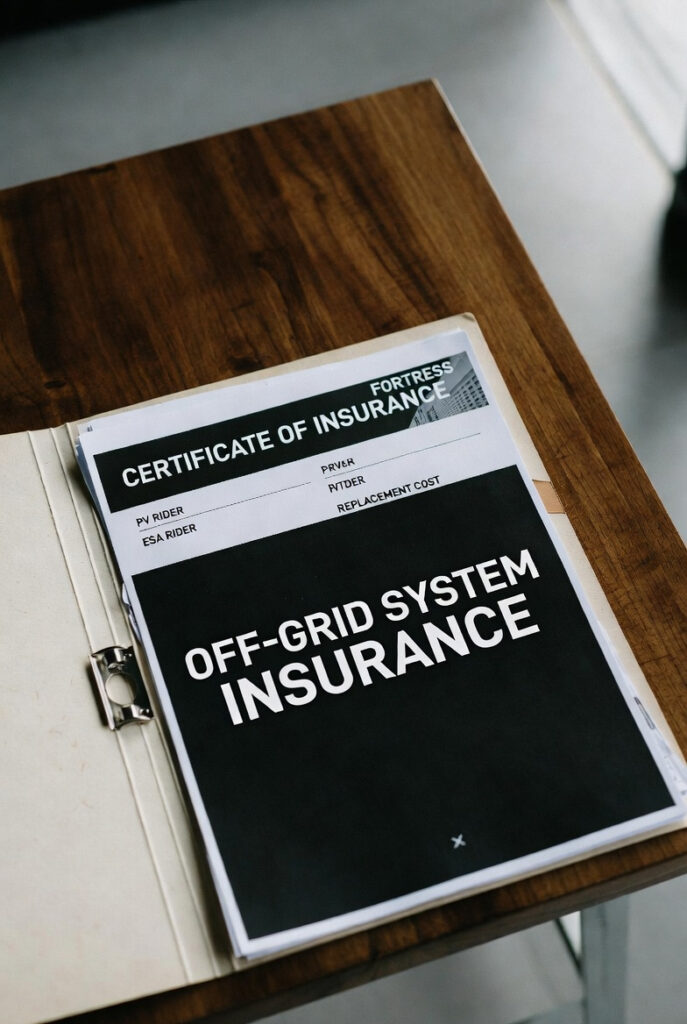
The Documentation Folder: Building the Off-Grid System Insurance Evidence Package
A client called me after a spring storm took out two 400W panels and damaged their combiner box. The standard home policy covered the roof repair without question. The adjuster had no replacement cost figure for Victron and Midnite Solar equipment and no basis for valuation beyond the client’s memory of what they paid two years earlier. The claim for the panels and combiner box sat in limbo for six weeks. The client had no commissioning checklist, no organised receipts, no replacement cost audit, and no photographs of the completed installation from before the storm. The claim settled at 62% of actual replacement cost. Two replacement panels at current cost: $380. Midnite Solar MNPV6 combiner box: $340. Labour to reinstall: $600. Total actual replacement cost: $1,320. Settlement received: $818. The documentation folder would have cost 45 minutes to assemble at commissioning.
The documentation folder contains five categories of information. The first is a complete component list with purchase receipts and current replacement cost for each item. The second is a copy of the completed commissioning checklist from Article 147, signed and dated, demonstrating that the system was verified as correctly built. The third is a copy of the ESA inspection certificate if obtained. The fourth is a set of dated photographs of the completed installation taken at commissioning, showing the full equipment room, the panel array, and the external disconnect location. The fifth is the current replacement cost audit, which is the total cost to replace all components and labour to reinstall at today’s rates, not the original purchase price. The Victron Cerbo GX data logs showing the system’s operating history are an optional but useful addition: they demonstrate continuous normal operation up to the date of the loss event.
Update the replacement cost audit annually. Equipment prices change. A system whose components were purchased three years ago may have a different current replacement cost than the original purchase price. File the documentation folder with your insurance policy documents and provide a copy to your broker when the off-grid system insurance rider or endorsement is added.
NEC and CEC: What the Electrical Codes Actually Say
NEC 690.4 requires that PV systems be installed by qualified persons in accordance with the applicable requirements of the code. From an insurance perspective, the NEC 690.4 requirement establishes the professional installation standard that an adjuster will reference when evaluating whether a loss event was caused or contributed to by a non-compliant installation. A system that was built to the standards documented throughout this series, commissioned per Article 147, and maintained per Article 149 satisfies the NEC 690.4 qualified installation standard in its documentation even for a self-installed system.
CEC Section 64 governs photovoltaic systems in Canada and establishes the installation standards that the Electrical Safety Authority inspects against in Ontario. A system that receives an ESA inspection certificate has been verified as compliant with CEC Section 64 by a qualified inspector. This verification is the insurance evidence that transforms a self-installed off-grid system from an undisclosed modification into a documented, compliant, inspected installation. The difference between these two descriptions is not technical; the installation may be identical. The difference is in what an adjuster can use to question the claim.
Quick Reference – Off-Grid System Insurance Documentation Checklist
| Document | Purpose | When to Prepare |
|---|---|---|
| Complete component list with receipts | Establishes replacement cost of each item | At purchase and updated annually |
| Commissioning checklist (Article 147) | Proves system was correctly built and verified | At commissioning |
| ESA inspection certificate (Ontario) | Removes compliance question from claims process | Before or shortly after commissioning |
| Dated installation photographs | Visual baseline for pre-loss condition | At commissioning |
| Annual replacement cost audit | Current cost to rebuild at today’s prices | Updated at each spring maintenance visit |
| Cerbo GX operating history log | Demonstrates normal operation before loss event | Ongoing; export before any claim |
When you call your broker to add the off-grid system insurance rider or endorsement, ask two specific questions. First: is this written on a Replacement Cost Value basis or Actual Cash Value basis? Second: does the coverage extend to equipment in detached structures on the same property? The answers to these two questions determine whether your policy will actually rebuild your Fortress after a total loss or pay you a depreciated fraction of what it costs to do so. If your broker cannot answer both questions confidently, ask them to get the answers in writing from the underwriter before you sign the endorsement.
The Verdict
Off-grid system insurance is not the paperwork you assemble after a claim. It is the paperwork you build alongside the Fortress and update alongside the maintenance log.
Before the first storm season after commissioning:
- Call your broker, describe the complete system including all equipment locations, and ask specifically whether a PV Rider or Inland Marine endorsement is required to cover the full replacement cost value of every component in every location
- Obtain the ESA inspection certificate if your installation is in Ontario; it is the $200-$400 investment that removes the compliance question from any future claim and transforms a self-installed system into a verified installation in the adjuster’s file
- Assemble the documentation folder with the component list, commissioning checklist, installation photographs, ESA certificate, and replacement cost audit, and update it at every annual spring maintenance visit
The adjuster who arrives after a loss event will work with what exists in the file. Build the file before the event. The Fortress that was documented is the Fortress that gets rebuilt.
Questions? Drop them below.
About the Author
Robert Bertrand spent 20 years as a service advisor in the automotive industry (Lexus and Nissan), where precision diagnostics, wiring integrity, and documentation standards were non-negotiable. He brings that same technical discipline to GridFree Guide, where he researches, tests, and documents off-grid solar systems for Ontario conditions. Based in Rockwood, Ontario, every article is built on verified specifications, manufacturer data, and the real-world climate constraints of Canadian off-grid living.
As an Amazon Associate I earn from qualifying purchases. This site also contains affiliate links to other products and services. GridFree Guide earns a small commission at no extra cost to you.