
A solar rapid shutdown system is the protection that your master kill switch cannot provide. I learned this distinction in the service bay: when a hybrid or EV arrives after a collision, the shop follows a mandatory high-voltage isolation procedure before anyone picks up a tool. The orange cables run at 300V to 400V DC regardless of ignition state. The manual service disconnect must be pulled and verified dead before cutting begins. This is not optional. It is the procedure that keeps the technician alive. In your off-grid Fortress, the solar array is the orange cables. The sun does not have an ignition switch. When the panels are in sunlight they are generating voltage, and that voltage is present in every inch of wire between the roof and the combiner box regardless of whether the inverter is running, the master kill switch is open, or every breaker in the building is tripped. A solar rapid shutdown system is the procedure that makes the roof safe. Without it, the wires in your attic are live DC at array voltage and the first responder at the end of your driveway knows it. Before sizing any part of this system, make sure you understand how much solar power your system actually needs; the string voltage that rapid shutdown must reduce is determined by your array configuration.
Why a Solar Rapid Shutdown System Is Not the Same as a Master Kill Switch
The emergency stop master kill switch disconnects the battery bank from the inverter. It kills the load. It stops the inverter from operating. It does none of these things to the source circuit wiring between the solar array and the combiner box. That wiring is a direct connection from the panels to the first overcurrent protection point in the system. As long as the panels are illuminated, that wiring carries the array open-circuit voltage regardless of every switch downstream.
For a 2-panel series string using standard 400W panels with a 40V VOC, the open-circuit voltage in the source circuit wiring is 80V DC. For a 4-panel series string it is 160V DC. For a 6-panel series string it is 240V DC. These are DC voltages with no zero-crossing. A DC arc at 240V does not self-extinguish the way a 240V AC arc does. A firefighter’s axe through a conduit carrying 240V DC in a burning attic is a fatal event. The master kill switch did not change this condition. The inverter shutdown did not change this condition. Only a solar rapid shutdown system that actively reduces the array source circuit voltage to touch-safe levels changes this condition.
The series vs parallel wiring guide covers the voltage arithmetic that determines what is present in the source circuit wiring. The rapid shutdown system is what reduces that voltage to the level at which first responders can work safely.
The NEC 690.12 Solar Rapid Shutdown System Standard: Two Boundaries, Two Thresholds
NEC 690.12 establishes the rapid shutdown requirement through two distinct boundaries with separate voltage thresholds, both of which must be met within 30 seconds of initiator activation.
The array boundary is the area within 1 foot of the array itself. Within this boundary, the voltage must drop to under 80V within 30 seconds. This covers the wiring at the panel level and the short runs between panels in a string. Module-level power electronics installed at each panel can reduce panel output voltage to near zero within the 30-second window, satisfying this requirement at the source.
Outside the array boundary covers all conductors running from the roof into and through the building: attic wiring, conduit through walls, runs to the combiner box, and any source circuit wiring inside the structure. All of this wiring must drop to under 30V within 30 seconds of initiator activation. 30V DC is the internationally recognised touch-safe threshold; below this level, contact with an energised conductor is not considered lethal for a first responder in standard protective equipment. Satisfying this threshold requires active voltage reduction in the source circuit wiring, not simply isolation. An isolated string that is disconnected at the combiner box still holds its open-circuit voltage in the wiring between the panels and the disconnect point until that energy is actively dissipated.
The initiator is the device that triggers the rapid shutdown sequence. It is typically mounted at the Midnite Solar MNPV6 combiner box at the building entry point, the same location where the lightning arrestor mounts. When the initiator is activated by a manual button, a signal from a fire alarm panel, or loss of utility power in a grid-tied system, it sends the shutdown command to the array-level devices that begin the voltage reduction sequence.
Module-Level Power Electronics vs String-Level Rapid Shutdown Devices
There are two approaches to meeting NEC 690.12, and the correct choice depends on the installation type and existing equipment.
Module-level power electronics, commonly called MLPE, install at each individual panel. DC optimisers or microinverters with shutdown capability reduce each panel’s output voltage to near zero on receipt of the shutdown signal. This approach satisfies both the within-boundary and outside-boundary thresholds simultaneously because the voltage source is eliminated at the panel level. MLPE also provides panel-level monitoring and shade mitigation. The cost is higher per watt than a standard string inverter installation.
String-level rapid shutdown devices install at the array boundary, typically at the MC4 branch connectors where strings combine, and actively dissipate the source circuit voltage when the initiator activates. These devices are less expensive than MLPE for a full array but must be verified to meet the 30V outside-boundary threshold within 30 seconds for the specific string configuration and cable length of the installation. For a standard Ontario barn installation with a moderate cable run from roof to equipment room, string-level devices are typically adequate and represent the more cost-effective solution. The solar combiner box guide covers the combiner box installation that houses the initiator and string terminations for this configuration.
Simply disconnecting the string at the combiner box with a manual switch does not satisfy NEC 690.12. Disconnection removes the string from the load but does not reduce the open-circuit voltage held in the isolated source circuit conductors. Active dissipation is required.
The First Responder Label: What NEC 690.56 and CEC Section 64-054 Require
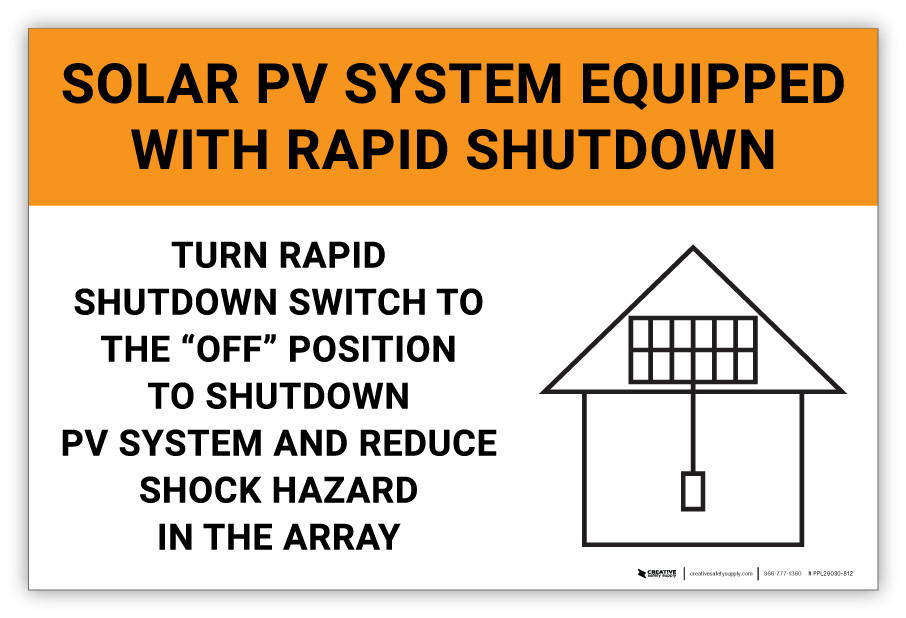
The rapid shutdown system is only useful to a first responder who knows it exists and knows where the initiator is. NEC 690.56 requires a permanent, reflective label at the service entrance or main electrical panel that states the system is equipped with rapid shutdown and identifies the initiator location. CEC Section 64-054 requires equivalent labeling for Canadian PV installations on buildings.
The label must be visible without opening any enclosure. A label inside the combiner box satisfies nothing. A label on the inverter panel that requires opening a door satisfies nothing. The firefighter at the service entrance needs to see the label, read the initiator location, and know that activating it will make the roof safe to work on, all before entering the building. This is the specific function the label serves and nothing else substitutes for it.
I had a direct conversation with a fire chief in the Rockwood township area about a neighbour’s property with a roof-mounted solar installation and no rapid shutdown labels at the service entrance. The system itself was well-built: quality inverter, clean wiring, properly installed combiner box. None of it was visible from the service entrance. The chief’s position was simple and non-negotiable: no rapid shutdown label means the structure is treated as having live conductors throughout during a fire event. The crew works the perimeter. They do not enter. The label is not a bureaucratic formality. It is the information that allows the people coming to save your home to actually enter it.
NEC and CEC: What the Electrical Codes Actually Say
NEC 690.12 requires that all PV systems installed on or in buildings be equipped with a rapid shutdown function that reduces conductors inside the array boundary to under 80V and conductors outside the array boundary to under 30V within 30 seconds of initiator activation. The requirement applies to roof-mounted and building-integrated PV systems; ground-mounted arrays with no conductors passing through inhabited structures have different requirements under NEC 690.12(B). The initiator must be located at a readily accessible location outside the building, and the system must include the required labeling at the service entrance under NEC 690.56.
CEC Section 64-054 establishes the Canadian rapid shutdown requirements for PV systems on buildings, with voltage and timing requirements equivalent to NEC 690.12. In Ontario, a building-mounted PV installation without a compliant rapid shutdown system and service entrance labeling does not pass inspection under CEC Section 64-054 regardless of the quality of every other aspect of the installation. The rapid shutdown requirement is not a condition that can be deferred to a future upgrade; it is a commissioning requirement that must be satisfied before the system is energised on a building.
Quick Reference – Solar Rapid Shutdown System Standard
| Requirement | Location | Threshold | Timing |
|---|---|---|---|
| Array boundary voltage | Within 1 foot of array | Under 80V DC | Within 30 seconds of initiator activation |
| Outside boundary voltage | All conductors inside building | Under 30V DC | Within 30 seconds of initiator activation |
| Initiator location | Outside building, readily accessible | Manual activation minimum | Must activate the full shutdown sequence |
| Service entrance label | At electrical meter or main panel | Permanent, reflective, visible without opening enclosure | Installed before system energisation |
| Ground-mount exception | No conductors through inhabited structures | Different requirements under NEC 690.12(B) | Verify with AHJ for specific installation |
| CEC equivalent | CEC Section 64-054 | Same thresholds as NEC 690.12 | Required before Ontario inspection approval |
Walk a family member or a trusted neighbour to the initiator location before the system is commissioned and again every year. Show them the label. Show them the button. Tell them: if the roof makes a noise, if there is smoke, if something looks wrong, hit this button before calling the fire department. The rapid shutdown system protects the firefighters. The person who knows where the button is protects the firefighters before the truck arrives. A Fortress is only as safe as the people living in it know how to operate it. The label tells the professionals. The walk-through tells the people who were there first.
The Verdict
A solar rapid shutdown system is not an upgrade for roof-mounted arrays. It is a code-required first responder safety standard that must be in place before the system is energised on a building.
Before commissioning any roof-mounted PV installation:
- Install a compliant rapid shutdown solution, either module-level power electronics at the panel level or a string-level rapid shutdown device at the array boundary, verified to meet the 30V outside-boundary threshold within 30 seconds for the specific installation
- Mount the initiator at a readily accessible location outside the building, connected to the combiner box at the building entry point, with a clear activation path that does not require opening any enclosure
- Install the permanent reflective service entrance label per NEC 690.56 and CEC Section 64-054 before the system is energised; the label is the signal that tells first responders the roof is safe to work on
The orange cables in the service bay get respected because everyone in the shop knows what they carry. Give the wires in your attic the same respect. Install the system that makes them safe. Put the label where it can be read.
The Rapid Shutdown Standard: Solar Rapid Shutdown System for Your Off-Grid Fortress
Disclosure: This post contains affiliate links. If you purchase through our links, we may earn a small commission at no extra cost to you.
About the Author
Robert Bertrand spent 20 years as a service advisor in the automotive industry (Lexus and Nissan), where precision diagnostics, wiring integrity, and documentation standards were non-negotiable. He brings that same technical discipline to GridFree Guide, where he researches, tests, and documents off-grid solar systems for Ontario conditions. Based in Rockwood, Ontario, every article is built on verified specifications, manufacturer data, and the real-world climate constraints of Canadian off-grid living.
As an Amazon Associate I earn from qualifying purchases. This site also contains affiliate links to other products and services. GridFree Guide earns a small commission at no extra cost to you.