
Off-grid system grounding is the difference between a Fortress and a floating electrical hazard waiting for a human to complete its circuit. I have seen the vehicle version of this failure more times than I can count on the service drive: a customer brings in a car with flickering headlights, radio static that comes and goes, and an ECU throwing ghost codes that have no logical pattern. The engine block ground strap is so corroded it is conducting at a fraction of its rated capacity. Every sensor in the system is returning subtly wrong data because the zero-volt reference is not zero. Replaced a $12 braided strap. Cleared every code. Problem solved permanently. In your off-grid Fortress the stakes are not a diagnostic readout. They are a tingle that becomes a shock that becomes something you do not walk away from. Off-grid system grounding is not the last item on the commissioning checklist. It is the first protection the rest of the system depends on. Before any of this becomes relevant, make sure you understand how much solar power your system actually needs; the grounding electrode system must be sized for the maximum fault current the system can generate.
Why Off-Grid System Grounding Protects Against the Fault You Cannot See
When a fault energises a metal enclosure in an ungrounded system, the enclosure rises to the fault voltage. In a 120V AC off-grid system a wire loose inside the inverter that contacts the chassis puts 120V on every metal surface connected to that chassis. The current does not flow because there is no return path to the source. The breaker does not trip. The GFCI does not respond. Nothing announces that the enclosure is energised. The moment a person touches that enclosure while standing on earth, they become the return path. At that point the current flows, the breaker may trip if it is fast enough, and the person is the fuse.
GFCI protection requires a ground reference to detect the imbalance between line and neutral current that signals a fault to ground. An ungrounded system has no ground reference. GFCI protection does not function in an ungrounded system regardless of how many GFCI outlets are installed. The protection architecture depends entirely on the ground path existing before the fault occurs.
The grounding vs bonding guide covers the conceptual distinction between equipment grounding and system bonding. This article covers the practical standard for installing the electrode system that makes both work. The chassis ground vs earth ground guide explains why connecting equipment to a chassis is not the same as connecting it to earth. Off-grid system grounding requires both: equipment grounded to a central ground busbar, and that busbar connected to a grounding electrode driven into the earth outside the building.
The Off-Grid System Grounding Electrode System: Three Required Components
The grounding electrode system has three components that must all be present and connected for the system to function as designed.
The first component is the equipment grounding conductor. Every metal enclosure in the system, including the inverter chassis, the charge controller housing, the combiner box, and the main disconnect enclosure, must be connected to a central equipment ground busbar with a dedicated grounding conductor. The Victron MultiPlus-II has a dedicated chassis ground lug for this purpose. The conductor must be sized to carry the maximum fault current the circuit can produce without failing before the overcurrent device clears the fault. For most 48V off-grid systems with a 200A main fuse, a 6 AWG copper equipment grounding conductor is the minimum. Use oxygen-free copper grounding cable throughout; the same corrosion resistance standard that protects DC power cables applies to the ground conductor that must perform reliably in a fault condition.
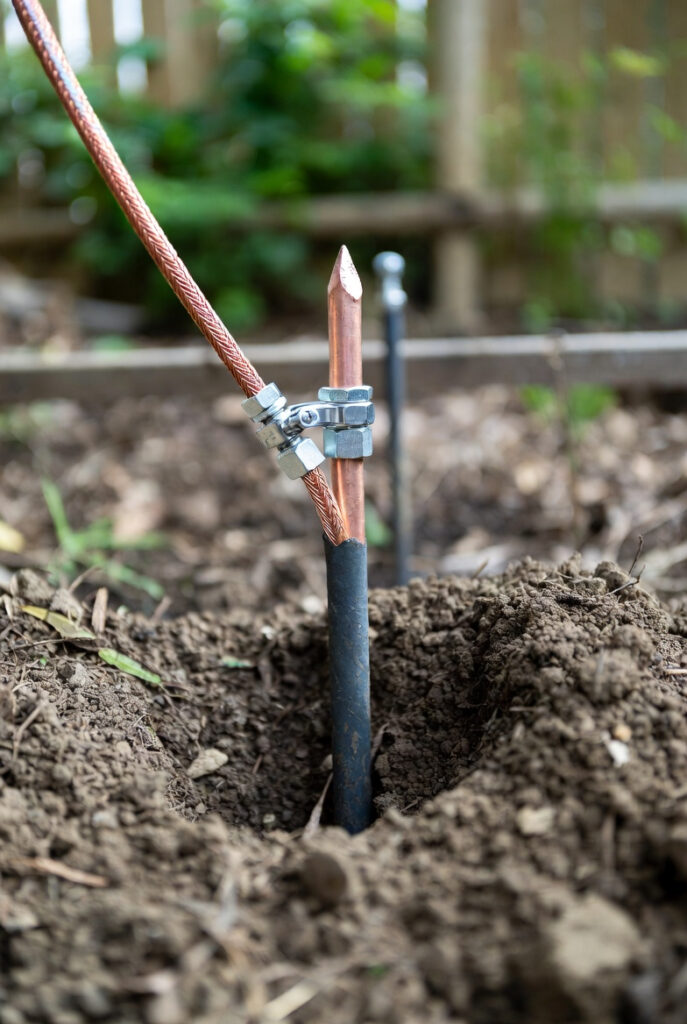
The second component is the grounding electrode and its conductor. A 10-foot copper-clad ground rod driven vertically into the earth outside the building, with a 6 AWG bare copper conductor running from the central equipment ground busbar to the top of the rod via a listed ground rod clamp, is the standard installation. The rod must be driven to full depth. A rod that is only partially driven because it hit rock provides a fraction of the soil contact area and a fraction of the fault dissipation capacity.
The third component is the main bonding jumper. The neutral conductor and the equipment grounding conductor must be bonded at exactly one location in the system, at the main panel or the inverter’s AC output panel. This bond is what allows the overcurrent device to see a ground fault as a short circuit and trip. Without this bond, fault current has no return path to the source and the breaker cannot detect the fault. With this bond in the wrong place or in more than one location, neutral current flows on the grounding conductor and energises every metal enclosure in the system. As covered in the generator bonding guide, the dual-bond hazard is one of the most dangerous and least visible wiring errors in an off-grid installation.
I arrived at a client’s barn outside Rockwood after they reported a tingle when touching the MultiPlus-II casing while standing on damp concrete. No GFCI trip. No breaker. No alarm. The equipment grounding conductor on the inverter was connected to the inverter chassis but the chassis had no path to a grounding electrode. The neutral-ground bond was absent at the main panel. The inverter casing was floating at approximately 40V relative to true earth, not enough to trip anything, more than enough to be lethal under different conditions. We installed a 10-foot copper ground rod, ran the equipment grounding conductor from the central ground busbar to the rod via a listed clamp, and installed the main bonding jumper at the inverter output panel. The tingle was gone before we left the site. The lightning arrestor depends on this same ground path to dissipate surge energy into the earth rather than through the equipment.
Ground Resistance Testing: Why “It Looks Good” Is Not a Measurement
A ground rod that is properly installed and visually clean may still have a resistance to earth that exceeds the code limit if the surrounding soil is dry, rocky, or both. NEC 250.56 requires a single ground rod to achieve 25 ohms or less resistance to earth. Rural Ontario soil, particularly the rocky Precambrian Shield terrain around Rockwood, commonly measures 50 to 100 ohms on a single 10-foot rod in dry summer conditions. A single rod that cannot achieve 25 ohms requires a second rod driven at least 6 feet from the first. Two rods in parallel reduce the total resistance approximately in half. Rockwood installations should treat the dual-rod configuration as the standard, not the exception.
Ground resistance measurement requires a dedicated instrument. A standard multimeter cannot measure ground resistance accurately. A clamp-style ground resistance tester, available for $150 to $400, is the correct tool. The measurement is taken with the system energised and the ground conductor intact; the clamp method measures the resistance of the ground electrode path without disconnecting any conductors. If the measured resistance exceeds 25 ohms on a single rod, drive a second rod and retest. Log the measured resistance value, the date, and the soil conditions as part of the commissioning record. Retest annually; ground resistance changes with soil moisture and seasonal conditions.
NEC and CEC: What the Electrical Codes Actually Say
NEC 690.43 requires that all exposed non-current-carrying metal parts of photovoltaic system equipment be grounded in accordance with NEC Article 250. For off-grid inverters, charge controllers, and combiner boxes, this means a dedicated equipment grounding conductor from each enclosure to the equipment ground busbar. NEC 690.47 requires a grounding electrode system for PV installations that meets the NEC Article 250 requirements for grounding electrodes, including the ground rod specification and the 25-ohm resistance requirement of NEC 250.56. NEC 250.56 specifically requires that if a single ground rod cannot achieve 25 ohms, a second electrode must be installed. The code does not allow a high-resistance ground installation as long as a rod is present; the resistance must be measured and verified.
CEC Section 10-700 governs grounding electrodes for electrical installations in Canada and requires that ground electrodes achieve a resistance to earth that provides effective fault current dissipation. CEC Section 64-400 extends these requirements to photovoltaic system installations, requiring that the grounding electrode system for a PV installation meet the general grounding electrode requirements of Section 10. In Ontario, Rule 10-106 requires that ground electrode resistance be verified by measurement and that additional electrodes be installed if the required resistance cannot be achieved with a single rod. A Rockwood installation that has not been tested with a ground resistance instrument has not been verified to meet CEC Section 64-400 regardless of how well the rod was driven.
Quick Reference – Off-Grid System Grounding Electrode Standard
| Component | Specification | Minimum Requirement | Ontario Notes |
|---|---|---|---|
| Ground rod | 10-foot copper-clad steel | NEC 250.52 / CEC 10-700 listed electrode | Drive to full depth; partial drives do not qualify |
| Equipment grounding conductor | 6 AWG bare copper minimum | Sized for maximum fault current | OFC copper for corrosion resistance |
| Ground rod clamp | Listed for direct soil burial | NEC 250.70 listed clamp | Must be rated for the conductor size |
| Ground resistance, single rod | 25 ohms or less | NEC 250.56 / CEC Rule 10-106 | Rockwood soil commonly 50-100 ohms; test first |
| Ground resistance, dual rod | Drive second rod 6 ft from first | Required if single rod exceeds 25 ohms | Parallel resistance approximately halves single-rod value |
| Main bonding jumper | At main panel or inverter output panel | One location only in the system | Second bond creates neutral-on-ground fault |
Test your ground resistance in late summer when the soil is at its driest. This is the worst-case condition for ground resistance in Ontario, and it is the condition your grounding electrode must perform under during peak cooling load season when fault risk is highest. A rod that tests at 18 ohms in April after spring thaw may test at 47 ohms in August after six weeks without rain. If the summer measurement exceeds 25 ohms, drive the second rod before the next high-demand season begins. Log both measurements. The spring reading tells you where you are. The summer reading tells you whether your ground is actually reliable when you need it most.
The Verdict
Off-grid system grounding is not a checkbox at the end of the commissioning list. It is the safety architecture that every other protection in the system depends on.
Before energising any off-grid installation:
- Install the equipment grounding conductor from every metal enclosure to the central ground busbar, and run the grounding electrode conductor from the busbar to a listed 10-foot copper ground rod driven to full depth outside the building
- Install the main bonding jumper at exactly one location, at the main panel or inverter output panel, and verify with the grounding vs bonding guide that no second bond exists anywhere in the system
- Measure the ground resistance with a clamp-style ground resistance tester and drive a second rod 6 feet from the first if the single-rod measurement exceeds 25 ohms; log the measurement, the date, and the soil conditions as part of the permanent commissioning record
The drain pipe works because it has a clear, low-resistance path to somewhere the water can go. Your ground works the same way. Verify the path before you trust the protection.
Disclosure: This post contains affiliate links. If you purchase through our links, we may earn a small commission at no extra cost to you.
Questions? Drop them below.
About the Author
Robert Bertrand spent 20 years as a service advisor in the automotive industry (Lexus and Nissan), where precision diagnostics, wiring integrity, and documentation standards were non-negotiable. He brings that same technical discipline to GridFree Guide, where he researches, tests, and documents off-grid solar systems for Ontario conditions. Based in Rockwood, Ontario, every article is built on verified specifications, manufacturer data, and the real-world climate constraints of Canadian off-grid living.
As an Amazon Associate I earn from qualifying purchases. This site also contains affiliate links to other products and services. GridFree Guide earns a small commission at no extra cost to you.