
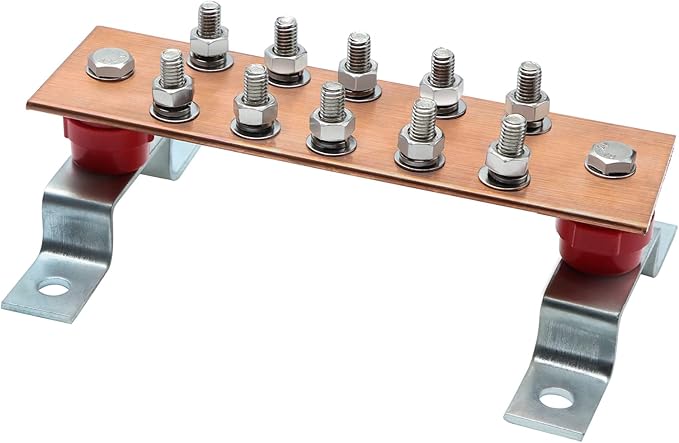
Battery bank busbar wiring is the topology decision that determines whether your $5,000 LiFePO4 bank ages evenly or burns through one battery at a time. I’ve seen the civilian version of this failure on the service drive: a customer brings in a car with electrical gremlins, headlights flickering when the AC kicks in and the radio cutting out under acceleration. You open the hood and find five aftermarket wires T-tapped onto a single battery positive post with no distribution block and no fusing. Every accessory is fighting for voltage through the same corroded terminal junction. The diagnosis takes thirty seconds. The headlights aren’t failing. The battery isn’t failing. The topology is failing. In your off-grid Fortress the same failure at higher current destroys batteries instead of flickering lights. A daisy-chained battery bank does not fail all at once. It fails Battery 1 first, slowly and invisibly, one discharge cycle at a time, while Battery 3 sits at nearly full capacity wondering why it keeps getting dragged offline. Before sizing your busbar, make sure you understand how much solar power your system actually needs; the total system current determines the busbar rating.
Why Battery Bank Busbar Wiring Eliminates the Daisy-Chain Current Imbalance
Current follows the path of least resistance. This is not a guideline; it is physics. In a 3-battery daisy-chain with the load connected to Battery 1 positive and Battery 3 negative, current must travel through inter-battery connections to reach Batteries 2 and 3. Each 12-inch inter-battery connection in 4/0 AWG adds 0.000612Ω to the resistance path for each downstream battery. Battery 1’s path to the load has the lowest total resistance. Battery 1 supplies the most current. At 100A total draw, Battery 1 contributes approximately 45A, Battery 2 approximately 35A, and Battery 3 approximately 20A. Same capacity. Same state of charge. Same BMS. Wildly different current contribution. The BMS cannot correct this imbalance because it sees a balanced parallel voltage across all three batteries. The problem is invisible to every monitor in the system except a thermal camera or a per-battery current clamp.
A common-point battery bank busbar wiring configuration connects every battery to the same busbar with its own dedicated lead. Every battery sees the same connection point. Every battery’s resistance path to the load is the lead resistance plus the busbar resistance, identical for all batteries when the leads are equal length. The current distributes evenly. Every battery ages at the same rate. The bank fails as a unit after a full service life rather than sequentially, starting with Battery 1.
A client came back to me 18 months after I had documented their daisy-chain installation and recommended a busbar rewire they had deferred. Capacity test: Battery 1 at 71Ah from a rated 100Ah, a 29% degradation. Battery 2 at 88Ah. Battery 3 at 94Ah. Same manufacturer, same purchase date, same charge profile. Battery 1 had been supplying approximately 45A every discharge cycle for 18 months while Battery 3 was supplying approximately 20A. We installed a Blue Sea Systems 600A busbar with equal 18-inch 4/0 AWG leads to all three batteries. After three full charge-discharge cycles the current contribution balanced to within 4% across all three batteries. The daisy-chain had not failed the bank. It had failed Battery 1 first. Batteries 2 and 3 were next.
The DC voltage drop guide covers the voltage loss at every resistance point in the system. A daisy-chain is not just a capacity imbalance problem; it is a voltage drop problem. The inter-battery connections add series resistance that produces measurable voltage drop at the load under high current. A busbar eliminates that series resistance entirely.
The Battery Bank Busbar Wiring Equal-Length Lead Standard
With a common busbar, equal-length leads are not a preference. They are the requirement that makes the common point work as designed.
The mathematics: 4/0 AWG copper has a resistance of 0.000051Ω per inch. A 12-inch lead has a resistance of 0.000612Ω. An 18-inch lead has a resistance of 0.000918Ω. The difference is 0.000306Ω. At 100A that difference produces 0.0306V at the battery terminal, small in absolute terms but consistent across every charge and discharge cycle. Over 200 cycles per year the battery with the shorter lead delivers marginally more current every cycle and ages marginally faster. This is a slow imbalance, far less severe than a daisy-chain, but it compounds over the battery bank’s service life.
The standard is simple: every battery lead is the same gauge, the same length, the same lug type, torqued to the same specification. If the physical layout requires that some batteries are closer to the busbar than others, cut all leads to the length required by the most distant battery. Do not shorten the leads to the closer batteries to save copper. The copper is cheap. The capacity balance is not recoverable once lost.
The busbar itself must be rated for at least 125% of the main fuse or breaker rating, not the inverter’s continuous draw. A 3000W inverter on a 48V system draws 62.5A continuously. The main battery fuse is typically 150A to 200A to handle surge current at startup and fault conditions. The busbar must be rated for at least 188A to 250A. A busbar sized to the inverter’s 62.5A continuous draw is undersized for the fault current the fuse allows. The busbar layout standard covers the physical arrangement of busbars in the equipment room. The sizing standard covered here determines which busbar belongs in that arrangement.
The Reference Solutions: Blue Sea 600A and the Victron Lynx Distributor
The Blue Sea Systems 600A busbar is the reference solution for most Ontario off-grid installations with 3 to 5 batteries at up to 600A continuous. Tinned copper construction, dual-row terminal layout, rated for both positive and negative bus. It does not include integrated fusing; the main fuse or breaker lives upstream on the battery positive cable, and the busbar is the common distribution point for everything downstream. Clean, simple, correctly rated. For installations where stacking lugs on a single terminal has been a temptation, the busbar stacking standard explains exactly why that approach fails and why the dedicated busbar position for each lug is the only acceptable configuration.
The Victron Lynx Distributor is the premium solution for larger systems or installations requiring integrated fusing at the distribution point. Each output position accepts a MEGA fuse rated individually for that circuit; the battery feeds, the inverter feed, and any charge sources each get their own fuse at the distribution bar. The Lynx integrates with the Victron ecosystem and can be combined with the Lynx Power-In for multi-battery configurations. It costs significantly more than a standalone busbar and is the correct solution for systems above 600A or installations where integrated per-circuit fusing at the distribution point is the design requirement. For a standard 3-battery 48V Fortress build, the Blue Sea 600A delivers the same common-point benefit at lower cost and lower complexity.
The inverter terminal torque guide applies directly to every busbar terminal connection. Every lug on every busbar position must be torqued to specification and witness-marked. The busbar is the highest-current junction in the system and the highest-stakes connection for thermal runaway if a lug backs off under load.
NEC and CEC: What the Electrical Codes Actually Say
NEC 690.71 requires that battery systems for photovoltaic installations be installed in accordance with the manufacturer’s specifications and that conductors be sized for the maximum current the circuit will carry. A daisy-chain battery bank wiring configuration that produces uneven current distribution between batteries in the same parallel bank does not meet the NEC 690.71 requirement that the installation operate within the batteries’ specified parameters. The battery manufacturer’s specification assumes balanced current distribution across parallel cells. NEC 690.8 requires that conductors be sized for maximum current including surge and fault conditions; the busbar sizing standard of 125% of the main fuse rating satisfies this requirement for the distribution point.
CEC Section 64-500 requires that storage battery installations meet manufacturer specifications for installation and operation. Every LiFePO4 manufacturer specifies that parallel batteries be connected to a common bus with equal-length leads to ensure balanced current distribution. A daisy-chain topology does not satisfy this specification, and the resulting accelerated degradation of the first battery in the chain is a foreseeable consequence of a non-compliant installation. CEC Section 8-102 requires that voltage drop in conductors not exceed code limits; the inter-battery series resistance in a daisy-chain configuration adds voltage drop at the load that a common busbar eliminates entirely.
Quick Reference – Battery Bank Busbar Wiring Standard
| Configuration | Current Distribution | Battery Aging | Recommended For |
|---|---|---|---|
| Daisy-chain, 3 batteries | 45% / 35% / 20% | Battery 1 fails 18-24 months early | Never — no acceptable use case |
| T-tap to single post | Uneven, proximity-dependent | Accelerated aging on closest battery | Never — high resistance and fire risk |
| Common busbar, equal leads | Within 4% across all batteries | Even aging, full rated service life | All parallel battery bank configurations |
| Common busbar, unequal leads | 5-15% imbalance by length difference | Mild accelerated aging on shorter-lead battery | Acceptable only if length difference under 3 inches |
| Victron Lynx Distributor | Within 2%, integrated fusing per circuit | Even aging with per-circuit overcurrent protection | Systems above 600A or requiring integrated fusing |
After rewiring to a common busbar with equal-length leads, verify the balance with a DC clamp meter on each battery lead under full load. Each lead should read within 5% of the others. If one battery is contributing significantly more current than its neighbours after the rewire, the cause is almost always a connection issue: a cold-weld crimp on that battery’s lug, a partially-tightened terminal, or a corroded battery post. The clamp meter test takes three minutes and confirms that the busbar is doing its job. Run it at commissioning and again at the first annual thermal audit. A balanced bank is a long-lived bank.
The Verdict
Battery bank busbar wiring is the topology decision that determines whether your battery bank delivers its rated service life or burns through Battery 1 and then Battery 2 while Battery 3 waits its turn.
Before commissioning any parallel battery bank:
- Install a tinned copper busbar rated for 125% of the main fuse rating, not the inverter’s continuous draw, as the single common connection point for all battery leads, all load feeds, and all charge sources
- Run equal-length leads from every battery to the busbar, same gauge, same length, same lug, same torque, and verify the balance with a DC clamp meter under full load before calling the installation complete
- Never daisy-chain batteries and never T-tap multiple loads onto a single battery terminal; the imbalance is invisible to every monitor in the system until Battery 1 is 30% degraded and the bank is already failing
A fuel rail does not favour one injector over the others. Neither should your busbar.
Disclosure: This post contains affiliate links. If you purchase through our links, we may earn a small commission at no extra cost to you
Questions? Drop them below.
About the Author
Robert Bertrand spent 20 years as a service advisor in the automotive industry (Lexus and Nissan), where precision diagnostics, wiring integrity, and documentation standards were non-negotiable. He brings that same technical discipline to GridFree Guide, where he researches, tests, and documents off-grid solar systems for Ontario conditions. Based in Rockwood, Ontario, every article is built on verified specifications, manufacturer data, and the real-world climate constraints of Canadian off-grid living.
As an Amazon Associate I earn from qualifying purchases. This site also contains affiliate links to other products and services. GridFree Guide earns a small commission at no extra cost to you.