
A solar combiner box off-grid is the difference between an array you can diagnose in five minutes and a bird’s nest you cannot touch without shutting everything down. I’ve seen the vehicle equivalent: a customer brings in a car with an intermittent no-start, and when you open the hood you find a tangle of aftermarket wiring lights, winch, stereo all tapped directly to the battery terminal with no fusing and no distribution point. Diagnosing that wiring is nearly impossible because every circuit shares the same failure point. The no-start turned out to be voltage drop from a corroded aftermarket connection pulling the terminal low during crank. In your off-grid Fortress the parallel is exact four or six solar strings all terminating at the MPPT charge controller terminal block with no individual fusing creates the same diagnostic problem and adds a fire risk the vehicle wiring job never had. Without a solar combiner box off-grid, one faulted string can pull current from every other string into the fault on the roof, in PV wire, while the system is energised. Before sizing your combiner box, make sure you understand how much solar power your system actually needs the total string count determines the combiner specification.
Why a Solar Combiner Box Off-Grid Is Not Optional for Multi-String Arrays
When two or more solar strings are connected in parallel positive to positive, negative to negative — they form a combined array with additive current and shared voltage. This is how multi-string arrays achieve higher wattage than a single string allows. It is also how a fault in one string becomes a fire risk for the entire array.
The backfeed problem: when one string in a parallel connection faults a shorted cell, a reversed connection, a ground fault every other string in the parallel array becomes a current source driving into the fault point. For a 6-string array, the faulted string can receive up to five times the short circuit current of a single string. PV wire is rated for 1.56 times the single-string short circuit current the NEC 690.9 overcurrent protection requirement reflects exactly this rating. At five times the single-string current the wire is carrying more than three times its rated capacity. The result is a sustained arc or fire at the fault point. On a roof. While the system is energised and producing. Individual string fuses in a solar combiner box eliminate this by isolating the faulted string before the backfeed current builds to dangerous levels.
The series vs parallel wiring guide covers the configuration standard for multi-string arrays. The solar combiner box off-grid is what makes that configuration safe at the point where the strings merge. As covered in the inverter terminal torque guide, loose connections are the primary failure mode at every high-current junction a combiner box with properly torqued, individually fused string terminations is the standard for that junction.
The Solar Combiner Box Off-Grid Standard: What the MNPV6 Provides
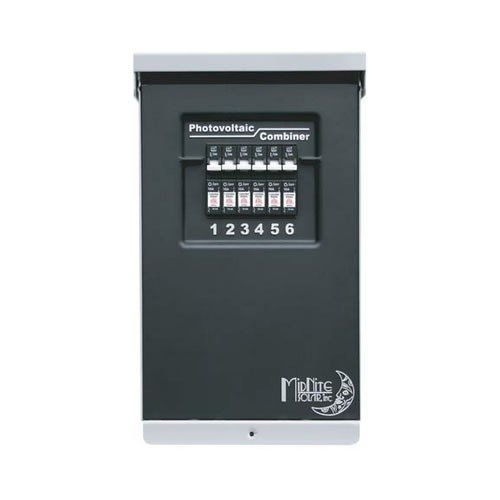
The Midnite Solar MNPV6 is the reference combiner box for most Ontario off-grid installations handling up to six strings. It provides six fused string inputs, a main disconnect, a lightning arrestor mounting position, and a single fused output feed to the MPPT charge controller. Each string input accepts a DIN-rail mounted fuse sized to the string’s short circuit current typically 15A for standard 400W panels with a 10-12A short circuit current.
I arrived at a client’s barn outside Rockwood to find a 2400W array six strings of two panels each with all six positive leads crammed into the MPPT charge controller terminal block using wire nuts over the MC4 pigtails. Two of the six strings had reversed polarity from the original installation the four correctly-wired strings were backfeeding current into the two reversed strings through the parallel connection. The reversed strings were absorbing power rather than producing it. The system was producing approximately 1,400W from a 2,400W array with clear skies. We installed the Midnite Solar MNPV6 combiner box with individual 15A fuses on each string input. With each string individually fused and labelled, identifying the two reversed strings took four minutes pull the fuse, check the open circuit voltage polarity with a multimeter, confirm the reversal. Corrected the polarity at the MC4 connectors on the roof. Array output after the fix: 1,880W a 34% increase. The combiner box did not add that output. It made it diagnosable.
The lightning arrestor mounts at the combiner box not at the MPPT and not at the battery bank. A transient voltage surge from a nearby lightning strike travels through the array wiring toward the equipment room. The arrestor must be at the point where the array wiring enters the building to clamp the surge before it reaches the charge controller and inverter. As covered in the lightning arrestor guide, the arrestor location is as critical as the arrestor specification. The combiner box at the building entry point is the correct mounting location.
When a Combiner Box Is Required and When Inline Fusing Is Adequate
A solar combiner box off-grid is the standard for three or more strings, any installation with a long roof-to-equipment-room cable run, and any installation where the lightning arrestor needs to mount at the building entry point.
For a simple 2-string array on a 48V system with a short run from roof to MPPT under 10 feet inline MC4 fusing at the string level with MC4 branch connectors is adequate if the MPPT terminal block can accept both string conductors cleanly with individual terminations. The MC4 inline fuse holders are the string-level overcurrent protection the combiner box function is performed at the MPPT terminals. This is acceptable for 2-string arrays. It is not acceptable for 3 or more strings. The MPPT terminal block is not designed to be a combiner box and using it as one for more than 2 strings creates exactly the bird’s nest fault condition that makes the array undiagnosable and the backfeed risk unmitigated.
For the MC4 connector crimping standard that governs the string terminations feeding into the combiner box, the crimping guide covers the lug integrity requirement at every MC4 connection in the string run. Every joint in the path from panel to combiner box to MPPT must meet the same standard.
NEC and CEC: What the Electrical Codes Actually Say
NEC 690.9 requires overcurrent protection for each PV source circuit each solar string sized at no more than 1.56 times the string’s short circuit current. For a standard 400W panel with a 10A short circuit current, the maximum string fuse size under NEC 690.9 is 15.6A a 15A fuse is the correct selection. This requirement applies whether the overcurrent protection is provided by a combiner box fuse or an inline MC4 fuse holder the protection requirement does not change with the hardware used to implement it. NEC 690.15 requires a disconnecting means for the PV array that allows the array to be isolated from the charge controller and inverter the combiner box master disconnect satisfies this requirement for the entire array in a single accessible location.
CEC Section 64-218 requires overcurrent protection for PV source circuits in Canada using the same 1.56 times short circuit current multiplier as the NEC a 15A fuse is the correct selection for standard 400W panels in Ontario installations. CEC Section 64-112 requires a disconnecting means for the PV array that is accessible and lockable the combiner box master disconnect satisfies this requirement. In a Rockwood barn installation where the array is on the roof and the equipment room is in the barn, the combiner box at the building entry point is the correct location for both the overcurrent protection and the disconnecting means accessible from inside the building, serviceable without going on the roof, and positioned to protect the full length of the interior wiring run.
Quick Reference – Solar Combiner Box Off-Grid Specification
| Number of Strings | Recommended Solution | String Fuse Size (400W panels) | Lightning Arrestor Location |
|---|---|---|---|
| 1 string | No combiner required – direct MPPT connection | 15A inline MC4 fuse | At MPPT input if run exceeds 10 ft |
| 2 strings | Inline MC4 fusing + MC4 branch connector | 15A per string | At building entry point if run exceeds 10 ft |
| 3-6 strings | Combiner box MNPV6 or equivalent | 15A per string input | Combiner box at building entry – mandatory |
| 6+ strings | Combiner box with expansion or dual combiner | 15A per string input | Combiner box at building entry – mandatory |
| Any string count long run | Combiner box regardless of string count | 15A per string input | Combiner box at building entry – mandatory |
Label every string fuse position in the combiner box before you energise the array. A strip of labelling tape on the DIN rail beneath each fuse String 1 NW panel, String 2 NE panel, String 3 South left, and so on takes five minutes at installation and saves hours during every future diagnostic. When one string underperforms on the VRM data, you pull the labelled fuse, walk to the roof, and you know exactly which string you are testing. Without labels you pull a fuse and then spend 20 minutes figuring out which panels went dark. Label the box when you build it. You will use those labels every time you troubleshoot.
The Verdict
A solar combiner box off-grid is not an optional upgrade for multi-string arrays it is the code-required overcurrent protection and disconnect point that makes the array safe to operate and possible to diagnose.
Before commissioning any array with three or more strings:
- Specify the combiner box for the string count the MNPV6 handles up to six strings with individual 15A fuses and a master disconnect in a single enclosure
- Mount the combiner box at the building entry point this is where the lightning arrestor mounts and where the array disconnecting means must be accessible without going on the roof
- Label every string fuse position before energising the labels are the diagnostic tool you will use every time the system underperforms
The manifold is not a luxury. It is what makes the fuel system serviceable.
Disclosure: This post contains affiliate links. If you purchase through our links, we may earn a small commission at no extra cost to you.
Questions? Drop them below.
About the Author
Robert Bertrand spent 20 years as a service advisor in the automotive industry (Lexus and Nissan), where precision diagnostics, wiring integrity, and documentation standards were non-negotiable. He brings that same technical discipline to GridFree Guide, where he researches, tests, and documents off-grid solar systems for Ontario conditions. Based in Rockwood, Ontario, every article is built on verified specifications, manufacturer data, and the real-world climate constraints of Canadian off-grid living.
As an Amazon Associate I earn from qualifying purchases. This site also contains affiliate links to other products and services. GridFree Guide earns a small commission at no extra cost to you.