
Inverter dust protection off-grid is the maintenance standard that most barn and shop builders skip entirely until the heatsinks are coated and the throttling starts. I’ve seen the vehicle equivalent on the service drive: a car with a stutter under load, an air filter so clogged it is collapsing into the intake under vacuum, or a cooling fan seized by grit from a dirt road commute. The engine is starving for clean air not fuel, not spark, air. In your off-grid Fortress the inverter is doing the same thing your engine does: pulling air at high velocity across internal components to manage heat. The difference is your engine has a filter you replace every 15,000 kilometres. Your inverter has nothing unless you install it yourself. And in a Rockwood barn with hay dust, sawdust, or metal shavings in the air, that unfiltered intake is depositing a layer of insulating debris on the heatsinks with every hour of operation. Before specifying the protection standard, make sure you understand how much solar power your system actually needs the inverter size determines the intake volume and the dust load it accumulates per hour.
Why Inverter Dust Protection Off-Grid Requires Understanding Two Failure Modes
Not all dust fails inverters the same way. There are two distinct failure modes and both are present in a typical Ontario barn environment.
The first is thermal failure from insulating dust. Sawdust, hay dust, and drywall dust are poor thermal conductors. When they coat the aluminium heatsinks inside the inverter they act as insulation the heatsink cannot transfer heat to the airstream efficiently. The inverter runs hotter than its design temperature. The capacitor lifespan rule applies here directly: every 10°C above rated operating temperature cuts capacitor life in half. A heatsink coated in 3mm of sawdust can raise the effective operating temperature by 15-20°C reducing the service life of internal capacitors to a fraction of rated. This is a slow failure. It accumulates over months. The thermal imaging guide will show you exactly what dust-coated heatsinks look like in infrared before they reach failure temperature.
The second is conductive failure from bridging dust. Metal shavings from a grinder or drill press, carbon dust from brushed motors, and damp wood dust with mineral content are partially conductive. The circuit boards inside an inverter have trace gaps measured in fractions of a millimetre. Conductive dust that settles into those gaps can bridge the traces and create a dead short on the control board. This failure is not slow. It is instantaneous. A single bridging event can destroy a $3,000 inverter with no warning and no recoverable condition. This is why inverter dust protection off-grid in a metal fabrication or grinding environment is not a maintenance item it is a commissioning requirement.
The Inverter Dust Protection Off-Grid Standard: Three Layers of Defence
The dust protection standard is scaled to the environment. Assess the actual dust sources before specifying the solution.
Layer 1 – The magnetic PC dust filter:
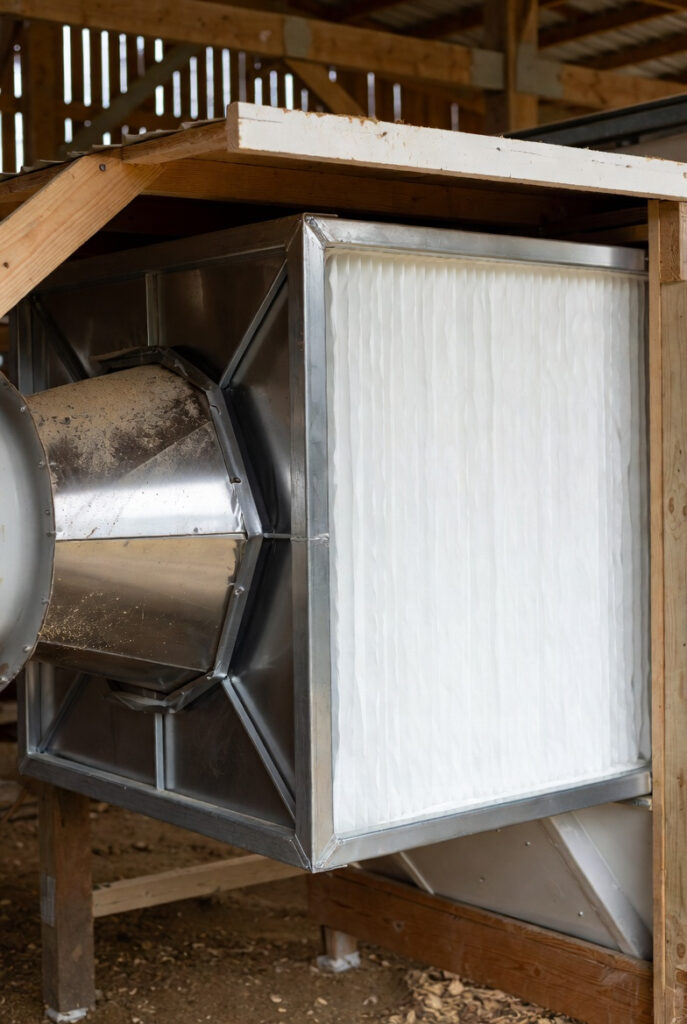
A magnetic dust filter sized to the inverter’s primary intake vent is the minimum standard for any barn or shop installation. These filters use a fine mesh fabric on a magnetic frame they snap onto any ferrous surface, cover the intake opening, and catch particulate before it enters the fan. They cost approximately $10-$20. They require monthly cleaning remove tap clean, reinstall. A Victron MultiPlus-II intake is approximately 180mm × 80mm a standard PC case filter covers this with trimming. This is a $15 insurance policy for a $3,000 machine.
Layer 2 – The monthly compressed air blowout:
Even with an intake filter in place, fine particulate will accumulate on internal heatsinks over time. The monthly maintenance protocol is a compressed air blowout: remove power from the inverter, allow it to cool fully, remove the intake filter, and blow compressed air through the heatsink fins from the exhaust side pushing debris back out the intake. Do not blow from the intake side this pushes debris deeper into the unit. Ten seconds of compressed air through the heatsink fins once a month is the maintenance standard for any dusty environment installation.
I found a client’s barn outside Rockwood with a table saw, planer, and router table running in the same open space as the off-grid equipment. The Victron MultiPlus-II heatsinks had accumulated a 3mm layer of fine sawdust after six months of operation visible through the intake grille without disassembly. The inverter was thermal throttling every afternoon during active woodworking. We cleaned the heatsinks with compressed air, installed a magnetic PC filter over the primary intake, and built a partial dividing wall between the work area and the equipment corner with a MERV-13 filtered intake fan on the equipment side. Zero thermal throttling events in the six months following. The solar inverter ventilation clearances were correct from the start the air volume was sufficient. The air quality was the problem.
Layer 3 – Positive pressure room ventilation:
For active woodshop and agricultural environments, a small intake fan pushing MERV-13 filtered air into the equipment room creates positive air pressure inside the room. Dust does not infiltrate through gaps, door cracks, or cable penetrations against a positive pressure differential the air flows out through every gap rather than contaminated air flowing in. This is the same principle used in cleanrooms. Set the intake fan to deliver slightly more airflow than the exhaust the room pressure differential does the rest.
Monitor inverter temperature in real time via the Victron Cerbo GX the dashboard displays inverter temperature and alert thresholds are configurable. If the inverter temperature is climbing on days with active woodworking but not on quiet days, the dust load is the cause. The busbar layout and equipment room standard addresses heat source separation in the equipment room the same spatial logic that separates heat sources applies to dust sources. And the inverter terminal torque standard is what ensures that even if the terminals accumulate surface contamination over time, the mechanical connection integrity is not compromised by it.
IP Ratings: What Your Inverter Is Actually Rated For
Every inverter carries an IP (Ingress Protection) rating that defines the level of protection against solid particles and liquids. Most residential off-grid inverters including the Victron MultiPlus-II are rated IP21 protected against solid objects larger than 12.5mm and vertically dripping water. IP21 is not a dusty barn rating. A grain of fine sawdust is measured in microns orders of magnitude smaller than 12.5mm. The IP21 rating means the inverter is designed for a clean indoor environment, not an agricultural or woodworking space.
Installing an IP21-rated inverter in a barn with active dust sources without additional protection is operating the equipment outside its rated environmental specification. The manufacturer’s warranty reflects this damage from contamination in an environment the equipment was not rated for is not a warranty claim. The additional protection layers magnetic filter, positive pressure ventilation, monthly blowout are what extend the IP21 equipment rating to cover the actual installation environment.
NEC and CEC: What the Electrical Codes Actually Say
NEC 110.13 requires that electrical equipment be suitable for the environment in which it is installed equipment must be listed and approved for the conditions present at the installation location. A standard IP21 residential inverter is not listed for use in a dusty agricultural environment without supplemental protection. NEC 110.3(b) requires that equipment be installed in accordance with its listing and labeling an inverter installed in a woodshop environment that exceeds its IP rating without supplemental filtration is not compliant with NEC 110.3(b) regardless of how clean the wiring is.
CEC Section 2-024 requires that electrical equipment be protected from mechanical injury and from the action of the elements. In Canadian electrical practice the elements include airborne contaminants present in the installation environment sawdust, metal shavings, and agricultural dust are foreseeable elements in a barn installation and the code expects the installation design to address foreseeable conditions. A barn installation that places an IP21 inverter in an active woodworking space without dust filtration does not satisfy the CEC Section 2-024 protection requirement. The same section that governs rodent protection governs dust protection here foreseeable means preventable, and preventable means required.
Quick Reference – Inverter Dust Protection Off-Grid by Environment
| Environment | Dust Risk | Minimum Protection | Full Standard |
|---|---|---|---|
| Finished basement or utility room | Low — no active dust sources | Monthly compressed air blowout | Magnetic intake filter as precaution |
| Unfinished barn — no power tools | Medium — hay dust, general particulate | Magnetic intake filter + monthly blowout | Positive pressure if near livestock |
| Active woodshop — same room | High — fine sawdust, conductive risk | Magnetic filter + monthly blowout + separation | Positive pressure with MERV-13 filtered intake |
| Metal fabrication or grinding | Critical — conductive metal shavings | Move inverter to separate room immediately | Positive pressure room — no exceptions |
| Agricultural barn — active use | High — hay, grain, damp organic dust | Magnetic filter + monthly blowout | Positive pressure with humidity monitoring |
The monthly compressed air blowout is the single highest-return maintenance task in a dusty installation it takes three minutes and it is the difference between an inverter that runs for ten years and one that fails in three. The sequence matters: power off, cool down completely, remove the magnetic filter, blow compressed air through the heatsink fins from the exhaust side pushing debris out the intake, reinstall the filter, power on. Never blow from the intake side. Never blow while the inverter is warm. And never skip the cool-down compressed air on hot aluminium heatsinks causes thermal shock. Three minutes once a month. That is the standard.
The Verdict
Inverter dust protection off-grid is not a barn-specific concern it is an environment assessment that every installation requires before commissioning.
Before placing an inverter in any barn, shop, or utility space:
- Assess the dust sources identify whether the risk is insulating dust, conductive dust, or both, and scale the protection layers to the actual environment
- Install a magnetic PC dust filter over the primary intake vent as the minimum standard for any installation outside a finished interior space
- Establish the monthly compressed air blowout as a scheduled maintenance item – log the date and note any unusual dust accumulation as an early warning of changing environmental conditions
A clean engine breathes clean air. Build the intake to match the environment.
Disclosure: This post contains affiliate links. If you purchase through our links, we may earn a small commission at no extra cost to you.
Questions? Drop them below.
About the Author
Robert Bertrand spent 20 years as a service advisor in the automotive industry (Lexus and Nissan), where precision diagnostics, wiring integrity, and documentation standards were non-negotiable. He brings that same technical discipline to GridFree Guide, where he researches, tests, and documents off-grid solar systems for Ontario conditions. Based in Rockwood, Ontario, every article is built on verified specifications, manufacturer data, and the real-world climate constraints of Canadian off-grid living.
As an Amazon Associate I earn from qualifying purchases. This site also contains affiliate links to other products and services. GridFree Guide earns a small commission at no extra cost to you.