
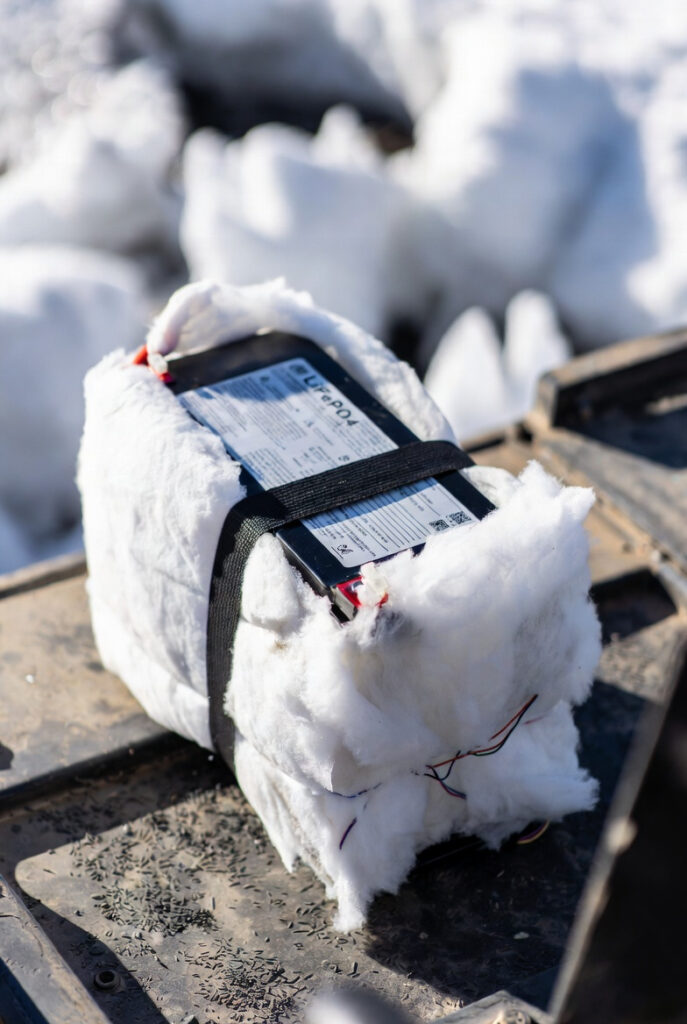
LiFePO4 cold weather charging is not a preference it is a chemistry constraint that does not negotiate with your solar schedule. I’ve seen the civilian version of this failure mode on the service drive in Guelph: a hybrid owner on a January morning, furious that the battery won’t charge to full and the range has dropped by 40%. The battery thermal management system has done exactly what it was designed to do reduced charge acceptance to protect the cells from lithium plating at low temperature. The customer thinks the battery is dying. It is working correctly. In your off-grid Fortress there is no thermal management system unless you build one. Your LiFePO4 bank hits 0°C and the BMS cuts charging. Your solar panels are producing. Your batteries are not accepting. You are sitting in the dark waiting for the sun to warm a battery box that has no insulation and no heater. That is the Rockwood winter reality for every off-grid builder who skipped this step. Before any of this becomes relevant, make sure you understand how much solar power your system actually needs cold weather affects total system capacity in ways that compound fast.
Why LiFePO4 Cold Weather Charging Causes Permanent Damage
Lithium-iron phosphate batteries operate through the intercalation of lithium ions into a graphite anode during charging. At temperatures above 0°C this process works as designed lithium ions move cleanly into the graphite lattice and the cell charges normally. Below 0°C the ionic conductivity of the electrolyte drops sharply. The lithium ions can no longer intercalate into the graphite fast enough to keep up with the charging current. They deposit instead as metallic lithium on the anode surface. This is lithium plating.
Lithium plating is irreversible. The metallic lithium deposited on the anode surface cannot be removed by discharging. It permanently reduces the cell’s capacity and creates internal short circuit risk as the metallic deposits grow into dendrites that can penetrate the separator. One LiFePO4 cold weather charging event one morning of solar current pushing into a battery bank below 0°C can permanently reduce the capacity of a $5,000 bank by 10-20%. Repeated events accelerate the degradation. Every major battery manufacturer states this explicitly: charging below 0°C voids the warranty. The chemistry is the reason. The warranty clause is the consequence.
The BMS low-temperature cutoff is the last line of defense not the strategy. The BMS disconnects the charge circuit when battery temperature drops below the programmed threshold, typically 0°C to 5°C. This protects the cells. It also means your system produces zero charging current from the solar array for the entire morning until the battery warms above threshold. The low voltage cutoff protects the battery from over-discharge the BMS low-temp cutoff protects it from charging damage but neither one is a substitute for keeping the battery warm enough to charge from first light. As covered in the shunt vs BMS guide, the BMS is a protection device, not a management strategy.
The LiFePO4 Cold Weather Charging Solution: The Pre-Conditioning Standard
The block heater analogy is exact. A Rockwood winter morning at -15°C requires a block heater on a diesel engine not because the engine cannot eventually start cold but because cold starting without pre-conditioning causes accelerated wear on every cycle. Your LiFePO4 bank requires the same approach. Pre-condition the battery before the solar array starts pushing current. Keep the battery above the minimum charge temperature at all times. Do not rely on the sun to warm it.
The three-component heating system:
Component 1 -The silicone heating pad: A 40W to 120W silicone heating pad installed on the base plate of the battery box provides direct conductive heat to the cells. 120V pads are preferred for barn and utility room installations where AC power is available they draw from the grid or generator, not from the battery bank being protected. 12V pads are the option for remote installations without AC. Size the pad to the battery box volume a 280Ah bank in a standard battery box requires approximately 60-80W of heating capacity in a Rockwood installation.
Component 2 – The thermostat controller: A digital temperature controller set to activate at 5°C and deactivate at 10°C provides automatic temperature management without manual intervention. The 5°C activation threshold gives the heater time to bring the battery above the 0°C minimum charge threshold before the solar array begins producing significant current at dawn. The 10°C deactivation threshold prevents the heater from running unnecessarily once the battery is warm.
Component 3 – The insulation wrap: R-10 rigid foam on all six faces of the battery box is what makes the heater practical. I diagnosed a client’s 280Ah LiFePO4 bank outside Rockwood that was triggering BMS low-temperature disconnect every morning below -5°C. They were convinced the BMS was faulty. The battery surface temperature at 7am was -8°C 8 degrees below the minimum charge threshold. The battery box had no insulation and no heater. We installed R-10 rigid foam on all six faces and a 120V silicone heating pad on the base plate with an Inkbird temperature controller set to 5°C on, 10°C off. The first winter after the fix produced zero low-temperature disconnects. The heater ran 8-12 minutes per hour to maintain temperature rather than continuously. The insulation is not optional it is what makes the heater efficient.
Place the Victron Smart Battery Sense inside the battery enclosure to monitor temperature wirelessly and feed that data to the MPPT charge controller. The Smart Battery Sense allows the MPPT to halt charging automatically if battery temperature drops below the configured minimum a hardware-level backstop that works independently of the BMS. The Victron SmartShunt 500A confirms that charging current is flowing normally after the heating system brings the battery above threshold if the shunt shows zero charge current on a clear morning above 5°C, the heater circuit or thermostat requires diagnosis. For the full picture of what your battery bank is doing in cold weather, see the thermal imaging guide and the current shunt calibration guide.
Self-Heating Batteries: The Alternative for Remote Installations
Self-heating LiFePO4 batteries integrate heating elements directly into the cell assembly. When the battery management system detects a temperature below the minimum charge threshold it activates the internal heater drawing a small current from the battery itself to warm the cells before accepting a charge. No external heater circuit, no thermostat controller, no insulation wrap required.
Self-heating batteries cost more upfront typically 20-30% premium over standard LiFePO4 packs of equivalent capacity. They carry a slight efficiency penalty from the self-heating draw. They are the correct choice for remote installations where running a 120V heater circuit from a panel is not practical off-grid cabins without a secondary power source, trailer installations, mobile systems. For barn and utility room installations with AC power available, an external heating system with R-10 insulation delivers better efficiency and lower total cost. Know your installation environment before choosing.
NEC and CEC: What the Electrical Codes Actually Say
NEC 690.71 governs battery system requirements for photovoltaic systems and includes provisions for battery operating conditions. The code requires that battery systems be installed and operated within the manufacturer’s specified temperature ranges a LiFePO4 bank being charged below the manufacturer’s minimum charge temperature is not compliant with NEC 690.71 regardless of whether the BMS eventually disconnects to prevent it. The protection obligation falls on the system design, not on the BMS as a last resort.
CEC Section 64-500 governs storage battery requirements for renewable energy systems in Canada. It requires that battery installations meet manufacturer specifications for operating conditions including temperature. In Ontario, every LiFePO4 manufacturer explicitly specifies a minimum charge temperature of 0°C. A barn installation without active thermal management in a climate that regularly reaches -20°C does not meet the operating condition requirements of CEC Section 64-500. The warranty void clause is the manufacturer’s acknowledgment of the same requirement charging below 0°C is outside the specified operating envelope and the installation design is responsible for preventing it.
Quick Reference – LiFePO4 Cold Weather Charging Protection
| Component | Specification | Setting | Notes |
|---|---|---|---|
| Silicone heating pad | 60-120W, 120V AC preferred | N/A — controlled by thermostat | Size to battery box volume |
| Thermostat controller | Digital, NTC probe | On: 5°C / Off: 10°C | Probe inside battery enclosure, not on box exterior |
| Insulation wrap | R-10 rigid foam | All six faces of battery box | Reduces heater run time from continuous to 8-12 min/hr |
| Victron Smart Battery Sense | Wireless temperature monitor | Min charge temp: 5°C | Feeds temperature data to MPPT — halts charging if too cold |
| Self-heating battery | Integrated BMS heater | Factory configured | Best for remote installs without AC power |
The thermostat probe goes inside the battery enclosure not on the exterior of the box and not on the heating pad itself. If the probe is on the exterior wall of the box it is measuring the temperature of the foam, not the battery. If it is on the heating pad it cycles on ambient pad temperature rather than battery temperature. One NTC probe, secured to the side of the battery cell nearest the centre of the bank, gives you an accurate reading of the temperature the cells are actually experiencing. That is the number the thermostat acts on.
The Verdict
LiFePO4 cold weather charging protection is not a winter accessory it is a year-round infrastructure decision that must be made before the first October frost in Rockwood.
Before your first winter with a LiFePO4 bank:
- Install R-10 rigid foam insulation on all six faces of the battery box this is the foundation, not the finish
- Install a silicone heating pad on the base plate with a digital thermostat controller set to 5°C on and 10°C off keep the battery above the minimum charge threshold before dawn
- Install the Victron Smart Battery Sense inside the enclosure give your MPPT the temperature data it needs to protect the bank at the hardware level
A cold engine needs a block heater. A cold lithium battery needs the same respect. Build the heating system before October. Do not wait for the first BMS disconnect to tell you it was necessary.
Disclosure: This post contains affiliate links. If you purchase through our links, we may earn a small commission at no extra cost to you.
Questions? Drop them below.
About the Author
Robert Bertrand spent 20 years as a service advisor in the automotive industry (Lexus and Nissan), where precision diagnostics, wiring integrity, and documentation standards were non-negotiable. He brings that same technical discipline to GridFree Guide, where he researches, tests, and documents off-grid solar systems for Ontario conditions. Based in Rockwood, Ontario, every article is built on verified specifications, manufacturer data, and the real-world climate constraints of Canadian off-grid living.
As an Amazon Associate I earn from qualifying purchases. This site also contains affiliate links to other products and services. GridFree Guide earns a small commission at no extra cost to you.