
Disclosure: This post contains affiliate links. If you purchase through our links, we may earn a small commission at no extra cost to you.
Why Solar Inverter Ventilation Fails in Most Off-Grid Builds
Solar inverter ventilation is the most overlooked variable in an off-grid build and I’ve diagnosed this exact failure mode before, just with a different machine. A customer brings in a car that stalls only on hot days or loses power under load. Nine times out of ten it’s a clogged radiator or a failing cooling fan, not the engine. A $40 thermostat, not a $4,000 rebuild. The customer’s face when you tell them that is something you never forget. In your off-grid Fortress, the inverter is the engine. The ventilation is the cooling system. Get it wrong and you’re not looking at a $40 fix.
The instinct to hide inverters in cabinets for aesthetics is the single most common ventilation mistake in off-grid builds. Heat is the primary killer of power electronics specifically electrolytic capacitors. The capacitor lifespan rule is unforgiving: every 10°C above rated operating temperature cuts capacitor lifespan in half. A 20°C overage means your $3,000 inverter ages at four times the normal rate, effectively delivering the service life of a $750 machine.
Thermal throttling makes this worse because it is silent. Most inverters reduce output without triggering an alarm or warning light. You will not know it is happening without active monitoring. In Ontario, summer ambient temperatures in a barn or utility room routinely hit 35-40°C before the inverter adds its own heat load. This is not a theoretical problem. It is a real-world failure mode that will cripple your off-grid system sizing before you see it coming.
The Solar Inverter Ventilation Standard: Clearance, Airflow, and Active Exchange
Clearance – manufacturer spec first, then the GridFree Guide standard:
Victron specifies a minimum of 10cm (approximately 4 inches) clearance on all sides for the Victron MultiPlus-II series. In a Rockwood barn installation where summer ambient temps regularly exceed 35°C, we treat that as the absolute floor. The GridFree Guide standard is 30cm (12 inches) on all sides triple the manufacturer minimum for any enclosed or partially enclosed installation. Open wall mount in a ventilated room: manufacturer spec is acceptable. Cabinet or closet install: 30cm minimum, no exceptions.
The chimney effect:
Heat rises. An intake vent at floor level and an exhaust opening at ceiling height creates passive airflow without a fan. This costs nothing. Every enclosed installation should have this as a baseline regardless of whether active ventilation is added. It is the foundation, not the finish.
Active exchange – the thermostat-controlled fan:
A thermostat-controlled exhaust fan set to activate at 30°C (86°F) provides active air exchange when passive flow alone is insufficient. This is the standard for any enclosed or partially enclosed installation. The fan draws 15-30W – factor that into your load calculations the same way you factor in every other parasitic draw. For a full picture of what those parasitic draws add up to, see the guide on ghost loads and battery drain.
I walked into a client’s off-grid room outside Guelph last summer and smelled it before I saw it that sharp smell of hot electronics baking in an enclosed space. They had installed a brand-new Victron MultiPlus-II in a finished cabinet with roughly two inches of clearance on each side. Beautiful cabinetry. Completely choked inverter. It was thermal throttling to about 60% of rated output every afternoon when the load peaked. We moved it to an open wall mount that same week. The throttling stopped immediately.
How to Detect Thermal Throttling Before It Kills Your Inverter
Thermal throttling is the inverter protecting itself by reducing outpu silent, no alarm, no warning light. By the time you notice reduced performance, the capacitor damage is already accumulating.
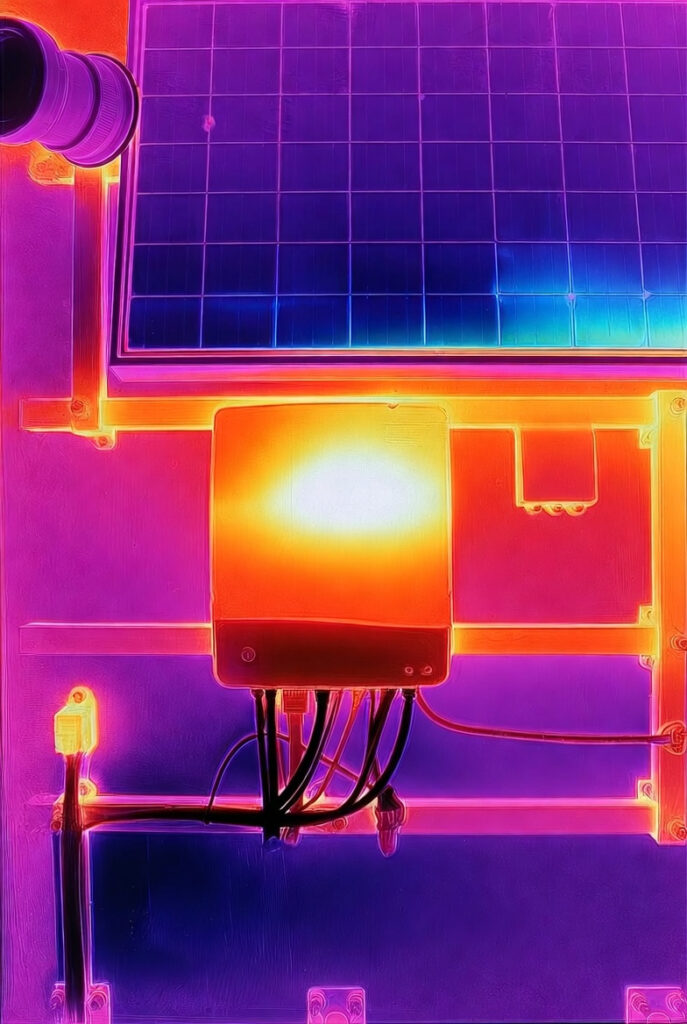
The most direct detection method is real-time temperature monitoring via the Victron Cerbo GX. Inverter temperature displays on the dashboard and alert thresholds are fully configurable. If you are not watching that number on hot afternoons, you are flying blind. The second method is a clamp meter on the AC output if your inverter is rated for 3,000W and you are pulling 1,800W under a known 2,500W load, the math tells you the machine is throttling. The third method requires no equipment at all: if you smell hot electronics when you walk into your solar room, treat it exactly like smoke. Something is already running too hot. The same thermal imaging inspection protocol you use on your battery bank applies here a thermal camera will show you exactly where the heat is concentrating before it becomes a failure.
The busbar layout and heat dissipation standard matters here too. A poorly laid out equipment room concentrates heat sources in the same space inverter, busbars, charge controller and the ambient temperature climbs faster than any single device would produce on its own. Spread the heat sources. Give each one room to breathe.
NEC and CEC: What the Electrical Codes Actually Say
NEC 110.13 requires that electrical equipment be mounted in a manner that does not block ventilation openings or impair cooling. NEC 110.26 specifies working clearances around electrical equipment while these clearances are primarily for access and safety, they establish the principle that equipment must be accessible and unobstructed. For inverters specifically, the equipment’s own installation manual defines the ventilation requirement, and NEC 110.3(b) requires that equipment be installed in accordance with its listing and labeling instructions. Installing a listed inverter in a configuration that violates its ventilation specifications is a code violation under NEC 110.3(b) regardless of whether the installation otherwise looks clean.
CEC Section 2-300 governs working space around electrical equipment, requiring sufficient space for safe operation and maintenance. CEC Rule 2-308 addresses ventilation of enclosures containing electrical equipment, requiring that heat-producing equipment be provided with ventilation adequate to prevent temperatures from exceeding equipment ratings. In Ontario, a barn or utility room installation that places an inverter in a sealed cabinet without active ventilation is not compliant with Rule 2-308 if the resulting operating temperature exceeds the inverter’s rated thermal limits. And in a Rockwood summer, it will. The low voltage cutoff is your last line of defense when the system shuts down under thermal load but the ventilation standard is what keeps you from needing it.
The Verdict: Three Rules for a Fortress That Stays Cool
- Never install an inverter in a cabinet or closet without first calculating ambient temperature, clearance, and airflow aesthetics is not a reason to choke a $3,000 machine.
- Use the chimney effect as your baseline intake low, exhaust high then add a thermostat-controlled fan for any enclosed space.
- Monitor inverter temperature actively with the Cerbo GX thermal throttling is silent, and damage accumulates before you see symptoms.
In the shop we don’t let the engine overheat. We build the cooling to match the horsepower. Your inverter deserves the same respect.
Questions? Drop them below.
Quick Reference
| Scenario | Clearance Standard | Ventilation Method |
|---|---|---|
| Open wall mount, ventilated room | Manufacturer spec — 10cm (4 in) | Passive chimney effect |
| Cabinet or closet install | GridFree Guide standard — 30cm (12 in) | Thermostat-controlled fan + chimney effect |
| Barn install, high summer ambient | GridFree Guide standard — 30cm (12 in) | Thermostat-controlled fan + chimney effect |
| Multiple inverters, utility room | GridFree Guide standard — 30cm (12 in) each | Multiple fans + chimney effect |
| Detected hot electronics smell | Immediate inspection required | De-energize, measure clearance, add active ventilation |
“If you can smell hot electronics when you walk into your solar room, you are already failing the ventilation test. A cool inverter is an efficient inverter.”
About the Author
Robert Bertrand spent 20 years as a service advisor in the automotive industry (Lexus and Nissan), where precision diagnostics, wiring integrity, and documentation standards were non-negotiable. He brings that same technical discipline to GridFree Guide, where he researches, tests, and documents off-grid solar systems for Ontario conditions. Based in Rockwood, Ontario, every article is built on verified specifications, manufacturer data, and the real-world climate constraints of Canadian off-grid living.
As an Amazon Associate I earn from qualifying purchases. This site also contains affiliate links to other products and services. GridFree Guide earns a small commission at no extra cost to you.