
Disclosure: This post contains affiliate links. If you purchase through our links, we may earn a small commission at no extra cost to you.
[H2] Why Rodent Proof Solar Wiring Starts With the Insulation
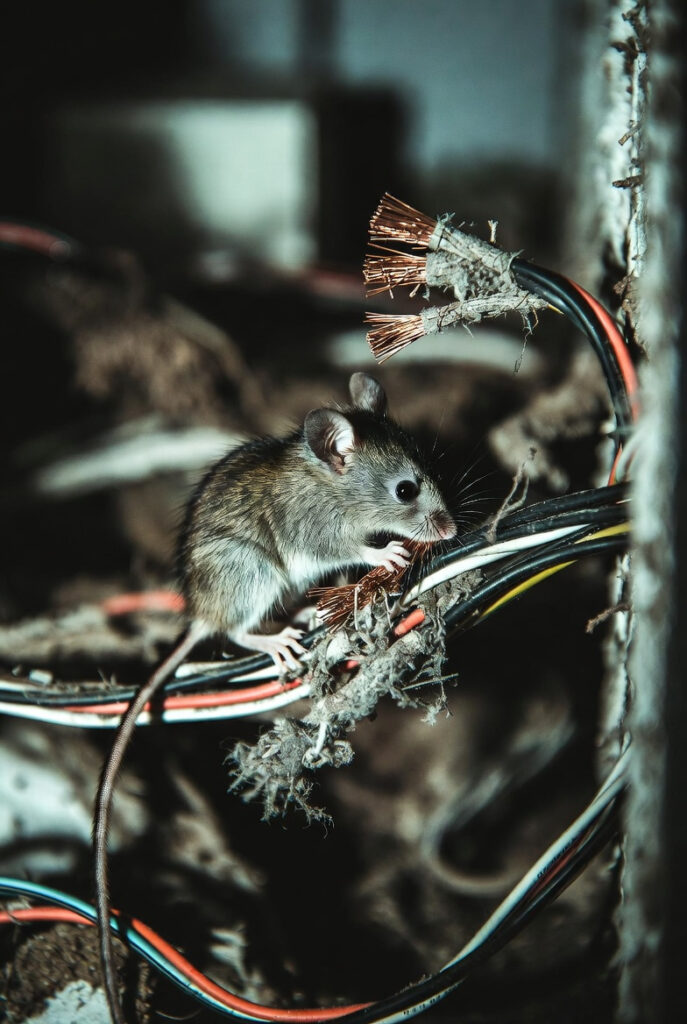
I’ve seen what a $2 squirrel does to a $70,000 Nissan Armada. It gets towed in on a flatbed because a rodent chewed through the wiring harness. The owner is standing in the service drive looking at a $1,500 repair bill and asking how this is even possible. I tell them: the insulation smelled like food. In your off-grid Fortress, the stakes are higher. There’s no Check Engine light. There’s just a DC arc and a fire.
Modern wire insulation, especially eco-formulated cable, often uses soy-based plastics as a plasticizer. Rodents aren’t chewing randomly they are responding to a real food scent. The result is exposed copper. In a 48V DC system, exposed copper means arc potential. Unlike AC faults, which self-extinguish at zero-crossing, DC arcs do not. A sustained DC arc in a dry barn wall does not trip a breaker and walk away. This is the physics detail most guides omit entirely.
In Ontario, red squirrels, field mice, and chipmunks are active even in winter. Barn installations are vulnerable year-round. This is not a seasonal problem. It is an ongoing threat to your off-grid system sizing and if you haven’t calculated how much your system can actually handle, start there first.
The Three-Layer Armor System
Layer 1: Stainless Steel Braided Sleeving
Stainless steel braided sleeving is the first line of defense for all exposed runs under solar arrays, along barn walls, anywhere cable runs without conduit protection. It is flexible enough to route around corners and impervious to rodent incisors. A mouse cannot bite through stainless braid. Full stop.
Layer 2: Capsaicin-Treated Electrical Tape
Apply capsaicin-treated electrical tape at entry points, conduit transitions, and cabinet penetrations. One test bite delivers a capsaicin hit a behavioral deterrent, not a physical barrier. It works. It must be reapplied annually because the active compound degrades over time, especially in freeze-thaw cycles.
Layer 3: Metal Liquid-Tight Conduit and Brass Entry Glands
For all wall penetrations, use metal liquid-tight conduit and brass or stainless entry glands. The dime rule applies here without exception: if a gap is the size of a dime 18mm across a mouse can fit its head through, and the body follows. Seal every penetration. No exceptions.
If rodent damage has already occurred and you need to re-run a section, use properly rated 10AWG solar cable for the replacement run. Once the new cable is in place, re-terminate the ends with a ratcheting crimper never a hammer and a prayer. The same standard that applied to your original build applies to every repair. For a full refresher on why that matters, see the crimping standard.
[H2] How to Rodent Proof Your Solar Wiring: The Inspection Habit
The walk-around is not optional. It is maintenance.
What you are looking for: insulation dust on the floor near cable runs, wood shavings under lugs or busbars, droppings near any cabinet entry, discolouration on cable jackets. Any one of those signs means something is already working on your wiring.
Last winter I was doing my walk-around of my own system in the barn outside Rockwood. I spotted fine wood shavings and what looked like insulation dust on the floor directly under a 4/0 copper lug. A red squirrel had started working on the cable jacket — maybe 20 minutes of chewing from bare copper. I armored that entire run with stainless braided sleeving the same afternoon. That $18 sleeve may have saved the whole system.
If you find evidence, stop. De-energize the affected run. Inspect the full cable length. If the jacket is breached at any point, re-terminate. The same care you put into your original heat shrink sealing applies to every repaired section.
Monthly visual inspections. Full hands-on checks every six months. That is the schedule.
[H2] NEC and CEC: What the Electrical Codes Actually Say
NEC Article 300.4 requires that conductors be protected from physical damage wherever they pass through framing, are exposed to contact, or run through spaces where mechanical injury is possible. NEC 690.31 extends this requirement to PV source and output circuits, requiring appropriate wiring methods for the installation environment. A barn installation with known rodent activity is not a controlled environment. Protection is not optional it is code-required.
CEC Section 2-024 requires that electrical equipment and conductors be protected from mechanical injury and from the action of the elements. In rural Ontario, “the elements” includes the wildlife. A red squirrel is not a force majeure event in an agricultural installation. It is a foreseeable condition, and the code expects you to address foreseeable conditions in your wiring method selection. The same principle that governs your drip loop at every conduit entry governs your rodent proofing. Foreseeable means preventable. Preventable means required.
The Verdict: Three Rules for a Critter-Proof Fortress
- Armor every exposed run with stainless braided sleeving before you commission not after you find damage.
- Seal every entry point with metal conduit and brass glands the dime rule applies to every gap.
- Walk the system monthly shavings on the floor are cheaper to find than an arc fault in the barn wall.
A $20 roll of capsaicin tape is cheaper than a $2,000 service call. Nature doesn’t care about your ROI. Armor your wires, seal your entries, and keep the Rockwood wildlife out of your engine room. And while you’re hardening the system against physical threats, make sure your array feed has a lightning arrestor on it too because the threats from above are just as real as the ones gnawing from below.
Questions? Drop them below.
| Threat | Armor Method | Where to Apply |
|---|---|---|
| Rodent chewing on cable jacket | Stainless steel braided sleeving | Under arrays, along barn walls, any unprotected run |
| Entry point access | Capsaicin-treated electrical tape | Conduit transitions, cabinet penetrations, entry glands |
| Wall penetration gaps | Metal liquid-tight conduit + brass glands | Every wall entry dime rule applies |
| Damaged cable requiring replacement | 10AWG solar cable | Any run with breached jacket |
| Re-termination after damage | Ratcheting crimper | All new lug terminations after repair |
“If you find insulation dust on your barn floor, treat it like smoke. Something is already burning you just haven’t seen the flame yet.”
About the Author
Robert Bertrand spent 20 years as a service advisor in the automotive industry (Lexus and Nissan), where precision diagnostics, wiring integrity, and documentation standards were non-negotiable. He brings that same technical discipline to GridFree Guide, where he researches, tests, and documents off-grid solar systems for Ontario conditions. Based in Rockwood, Ontario, every article is built on verified specifications, manufacturer data, and the real-world climate constraints of Canadian off-grid living.
As an Amazon Associate I earn from qualifying purchases. This site also contains affiliate links to other products and services. GridFree Guide earns a small commission at no extra cost to you.